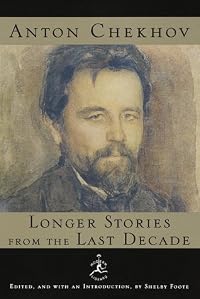
Longer Stories from the Last Decade (Modern Library)
by Anton Chekhov
On This Page
Description
"The short stories of Chekhov are an inexhaustible treasure of humanity and wisdom," wrote Elizabeth Hardwick. "The whole of Russian life lies within them." Some six hundred tales bear Chekhov's name, not a few of which are the famous "long short stories" written during roughly the last decade of his brief life. This volume gives us eleven of these, in eminent translations by Constance Garnett and chosen by Shelby Foote. Perhaps the most autobiographical is "Three Years," which offers a show more portrayal of mercantile greed and exploitation that was new to Russian literature. "The Duel" is the story of Ivan Layevsky, a self-styled "St. Petersburg Hamlet," who, filled with Tolstoyan ideas of a noble life of toil on the land, escapes (with another man's wife) to the Caucasus. The ensuing philosophical confrontations among the major characters clearly resemble those inUncle Vanya. And in the masterly "Ward No. 6," a doctor, disgusted by the stupidity and misery of the world of normal men, forms such a close relationship with an interesting lunatic that society declares the doctor a lunatic too and incarcerates him. The story is devastatingly symbolic of the corruption and hopelessness in Russia toward the end of the autocracy. Also included are "The Black Monk," "An Anonymous Story," "A Woman's Kingdom," "The Wife," "In the Ravine," "Peasants," "The Murder," and "My Life." "Chekhov is not only a great writer but, even rarer, a liberating one," said Susan Sontag. Shelby Foote has provided an Introduction for this edition. show lessTags
Recommendations



Member Reviews
Every line of dialog spoken by a character somehow explains the character's motivation, advances the plot and is not about either.
Absolutely brilliant. Highly recommended. In my opinion, he is the greatest short story writer of all time.
Ratings
Members
- Recently Added By
Author Information

2,638+ Works 44,748 Members
Anton Pavlovich Chekhov was born in the provincial town of Taganrog, Ukraine, in 1860. In the mid-1880s, Chekhov became a physician, and shortly thereafter he began to write short stories. Chekhov started writing plays a few years later, mainly short comic sketches he called vaudvilles. The first collection of his humorous writings, Motley show more Stories, appeared in 1886, and his first play, Ivanov, was produced in Moscow the next year. In 1896, the Alexandrinsky Theater in St. Petersburg performed his first full- length drama, The Seagull. Some of Chekhov's most successful plays include The Cherry Orchard, Uncle Vanya, and Three Sisters. Chekhov brought believable but complex personalizations to his characters, while exploring the conflict between the landed gentry and the oppressed peasant classes. Chekhov voiced a need for serious, even revolutionary, action, and the social stresses he described prefigured the Communist Revolution in Russia by twenty years. He is considered one of Russia's greatest playwrights. Chekhov contracted tuberculosis in 1884, and was certain he would die an early death. In 1901, he married Olga Knipper, an actress who had played leading roles in several of his plays. Chekhov died in 1904, spending his final years in Yalta. (Bowker Author Biography) show less
All Editions
Common Knowledge
- Original language
- Russian
Classifications
- Genres
- Fiction and Literature, General Fiction
- DDC/MDS
- 891.733 — Literature & rhetoric Asian Literature East Indo-European and Celtic literatures Russian and East Slavic languages Russian fiction 1800–1917
- LCC
- PG3556 .A15 .G3 — Language and Literature Slavic languages and literatures. Baltic languages. Albanian language Slavic. Baltic. Albanian Russian literature
- BISAC
Statistics
- Members
- 96
- Popularity
- 334,357
- Reviews
- 2
- Rating
- (4.65)
- Languages
- English
- Media
- Paper
- ISBNs
- 2