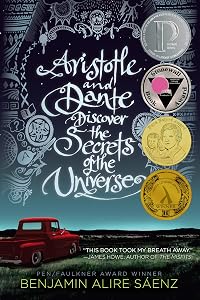
Aristotle and Dante Discover the Secrets of the Universe
by Benjamin Alire Sáenz
Aristotle and Dante (1)
On This Page
Description
Fifteen-year-old Ari Mendoza is an angry loner with a brother in prison, but when he meets Dante and they become friends, Ari starts to ask questions about himself, his parents, and his family that he has never asked before.Tags
Recommendations



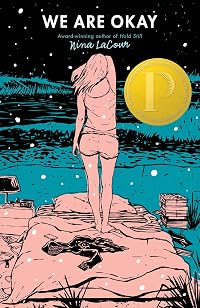
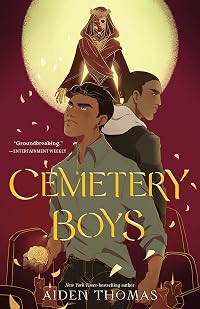
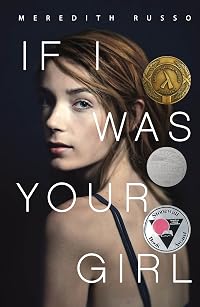
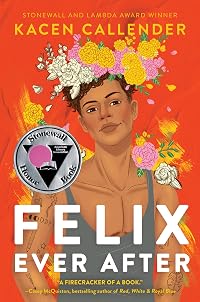









Member Recommendations






Member Reviews
Rating: 4.5* of five
The Publisher Says: A lyrical novel about family and friendship from critically acclaimed author Benjamin Alire Sáenz.
Aristotle is an angry teen with a brother in prison. Dante is a know-it-all who has an unusual way of looking at the world. When the two meet at the swimming pool, they seem to have nothing in common.
But as the loners start spending time together, they discover that they share a special friendship—the kind that changes lives and lasts a lifetime. And it is through this friendship that Ari and Dante will learn the most important truths about themselves and the kind of people they want to be.
I RECEIVED THIS BOOK AS A GIFT. THANKS!
My Review: First love, with another boy, when you're fifteen and angsty show more and from a Mexican-American family.
Wow, that's a lot. Like, a real, real lot.
Which, as adults, we sometimes do not take into account when dealing with teens. The thing we lose sight of most often is that teens have adult-strength emotions triggered by the same things we get triggered by but without our decades of perspective to temper our responses with. Ari's right...his Dad is suffering. His Dad is right...Ari can't understand this suffering. In fact, no one really can. Adults don't think this is as weird and awful as Ari, not yet used to the helplessness of loving others, does. All Ari knows is that his Dad's refusal to talk about his feelings feels like rejection. So Ari clams up...and doesn't see the irony of this. Perspective: missing.
Dante, being brash and bold, just...does stuff. Ari feels envious, astonished, drawn to this bigness and forcefulness. This feels so intoxicating, so overwhelmingly right, that he and Dante meet each other all the time, talk, think, and in that gloriously uniquely young man way, fall in love. They're on different pages here, too, stunningly. Dante doesn't see this love as weird or ugly...it's the 1980s! Stonewall was in the 1960s! Ari thinks it's another way he's weird. He does think Dante's weird, too, and if Dante...big, bright, beautiful Dante with his strong ideas about Chicanismo...is weird, weird must be okay. Somehow that must be true, but how?
Thus is first love born. That was my absolute favorite thing about the story. It wasn't about the zeal of the organs for each other, in Joseph Campbell's memorable and accurate formulation of sexual desire's essence; it was instead about the addictive rush of communion with the Other, the joy of discovering the Other is not only Other but gloriously beautifully Other. These boys discover, slowly and organically, that Love is the best, the only addictive drug that makes things better.
Or it can. And it does in this story. It does this, you should note, S L O W L Y. And Ari, angry teen with a huge rock on top of his mouth, needs help figuring out what it is about Dante that he is, well, Noticing. Here is where I felt the true beauty of the story comes to the fore. It is Ari's parents, these complicatedly wounded souls who are sources of difficulty for him (as all parents must be) who rip off the bandage and show him that he is in love with Dante.
And they do it, in 1980s El Paso, Texas, with kindness and acceptance. This is how we know it's fiction.
Everything about this read was a pleasure to me. It's been over a decade since the story burst on the scene. There are sequels (I haven't read those yet). This story keeps reverberating through our louding voices of hatred. I hope you and I, readers with mileage and perspective unavailable to its target audience, can help that audience find this wonderful story of honest love and acceptance offered and accepted. show less
The Publisher Says: A lyrical novel about family and friendship from critically acclaimed author Benjamin Alire Sáenz.
Aristotle is an angry teen with a brother in prison. Dante is a know-it-all who has an unusual way of looking at the world. When the two meet at the swimming pool, they seem to have nothing in common.
But as the loners start spending time together, they discover that they share a special friendship—the kind that changes lives and lasts a lifetime. And it is through this friendship that Ari and Dante will learn the most important truths about themselves and the kind of people they want to be.
I RECEIVED THIS BOOK AS A GIFT. THANKS!
My Review: First love, with another boy, when you're fifteen and angsty show more and from a Mexican-American family.
Wow, that's a lot. Like, a real, real lot.
Which, as adults, we sometimes do not take into account when dealing with teens. The thing we lose sight of most often is that teens have adult-strength emotions triggered by the same things we get triggered by but without our decades of perspective to temper our responses with. Ari's right...his Dad is suffering. His Dad is right...Ari can't understand this suffering. In fact, no one really can. Adults don't think this is as weird and awful as Ari, not yet used to the helplessness of loving others, does. All Ari knows is that his Dad's refusal to talk about his feelings feels like rejection. So Ari clams up...and doesn't see the irony of this. Perspective: missing.
Dante, being brash and bold, just...does stuff. Ari feels envious, astonished, drawn to this bigness and forcefulness. This feels so intoxicating, so overwhelmingly right, that he and Dante meet each other all the time, talk, think, and in that gloriously uniquely young man way, fall in love. They're on different pages here, too, stunningly. Dante doesn't see this love as weird or ugly...it's the 1980s! Stonewall was in the 1960s! Ari thinks it's another way he's weird. He does think Dante's weird, too, and if Dante...big, bright, beautiful Dante with his strong ideas about Chicanismo...is weird, weird must be okay. Somehow that must be true, but how?
Thus is first love born. That was my absolute favorite thing about the story. It wasn't about the zeal of the organs for each other, in Joseph Campbell's memorable and accurate formulation of sexual desire's essence; it was instead about the addictive rush of communion with the Other, the joy of discovering the Other is not only Other but gloriously beautifully Other. These boys discover, slowly and organically, that Love is the best, the only addictive drug that makes things better.
Or it can. And it does in this story. It does this, you should note, S L O W L Y. And Ari, angry teen with a huge rock on top of his mouth, needs help figuring out what it is about Dante that he is, well, Noticing. Here is where I felt the true beauty of the story comes to the fore. It is Ari's parents, these complicatedly wounded souls who are sources of difficulty for him (as all parents must be) who rip off the bandage and show him that he is in love with Dante.
And they do it, in 1980s El Paso, Texas, with kindness and acceptance. This is how we know it's fiction.
Everything about this read was a pleasure to me. It's been over a decade since the story burst on the scene. There are sequels (I haven't read those yet). This story keeps reverberating through our louding voices of hatred. I hope you and I, readers with mileage and perspective unavailable to its target audience, can help that audience find this wonderful story of honest love and acceptance offered and accepted. show less
Aristotle and Dante was one of those books which made me regret some of the 5 star ratings I had given other books. This one, for me, sets a new standard for YA, for LGBT YA and for YA M-M Romance.
The author, Benjamin Sáenz, takes on very difficult challenges: Portraying the challenges and difficulties faced by second and third generation Mexicans who and neither wholly Mexican and wholly Americanized, the challenge of portraying teenage thinking feelings of general angst and behavior; and, third, the awakening and confused sexuality of adolescent teenage boys. In this case, they have the added challenge of being gay in a very non-accepting culture.
Sáenz meets each of these challenges full on and comes out the winner. To me, the usual show more flaw in books and movies portraying children is that the kids speak lines and make observations worthy of the most wise and learned adults. Sáenz does not fall into that trap and instead, crafts a totally believable novel. show less
The author, Benjamin Sáenz, takes on very difficult challenges: Portraying the challenges and difficulties faced by second and third generation Mexicans who and neither wholly Mexican and wholly Americanized, the challenge of portraying teenage thinking feelings of general angst and behavior; and, third, the awakening and confused sexuality of adolescent teenage boys. In this case, they have the added challenge of being gay in a very non-accepting culture.
Sáenz meets each of these challenges full on and comes out the winner. To me, the usual show more flaw in books and movies portraying children is that the kids speak lines and make observations worthy of the most wise and learned adults. Sáenz does not fall into that trap and instead, crafts a totally believable novel. show less
It took me a little bit to adjust to this book when I started, because it definitely takes place in a hyperreal teenage world.... Ari has life-changing things happen to him that don't matter later at all, and he thinks & writes in cliches, and does stupid things, and has weird relationships and weird dreams and stilted conversations, and all of those things are perfect because that's exactly how being a teenager feels.
The book's written in an easygoing, free-flowing style that's eminently readable. There's no plot, really. It's just about Ari and Dante and what they're feeling and doing and how they grow up. It's not flashy. It's simple and good.
About the end: To those who think that Ari coming out was supposed to be a big plot twist, show more or that he didn't know he was gay until his parents told him, I can see how you could read the ending in that way and be disappointed by that suddenness. But the way I saw it, Ari was thinking and feeling things that go unrecorded through the whole book, things that are revealed only through his actions and confusions... Sáenz's style, with many long stretches of dialogue uninterrupted by interpretation, feels very true to the way in which teenagers, and really all of us, must often decipher each other through our words alone. It's easier to figure out how Dante is feeling-- in most ways he's an open book. Ari, even though we experience the entire story through his perspective, is much less readable, even (or especially) to himself. Anyway, those are just my thoughts. show less
The book's written in an easygoing, free-flowing style that's eminently readable. There's no plot, really. It's just about Ari and Dante and what they're feeling and doing and how they grow up. It's not flashy. It's simple and good.
About the end:
https://iwriteinbooks.wordpress.com/2018/01/27/aristotle-and-dante-discover-the-...
I have this list of books that I put off for the right time.
It’s not that I wouldn’t enjoy them on any given day; it’s just that some books are meant for moments of reflection and calm. Some are meant for traveling and adventures. Some are meant for great days and some for wallowing days.
For whatever reason, I put of Aristotle and Dante until this random moment and it turns out, it was the perfect book for a reflective, rainy weekend.
The book, itself, has a myriad of awards but I’ve found that I am not always swayed by such things. Although, a Stonewall award usually means I need to read it, I’m always slightly skeptical of the things others show more gush about.
Don’t fear, though. The critics (and everyone else) were right about this one.
Aristotle and Dante, two high-schoolers who meet by chance, are these adorably flawed and, yet, still somehow perfect teenagers with flawed but perfect parents. As the title implies, the story is far less about action and adventure (though there is some of that) and far more about coming of age, coming to grips, and, yes, at some point, someone comes out.
The beauty in the book is that it pulls no punches (sometimes literally). The idea that boys either have to be emotionless bots or the rare, empathic saints is done away with, creating a wide range of emotions for males, both teen and adults. The intricate emotional tapestry of both generations involved in the story was the thing that stole my heart, painting young adult parents as humans with lives, as opposed to overlords.
I highly recommend this book and not just because it is going to be displayed prominently on my shelf as a therapist. show less
I have this list of books that I put off for the right time.
It’s not that I wouldn’t enjoy them on any given day; it’s just that some books are meant for moments of reflection and calm. Some are meant for traveling and adventures. Some are meant for great days and some for wallowing days.
For whatever reason, I put of Aristotle and Dante until this random moment and it turns out, it was the perfect book for a reflective, rainy weekend.
The book, itself, has a myriad of awards but I’ve found that I am not always swayed by such things. Although, a Stonewall award usually means I need to read it, I’m always slightly skeptical of the things others show more gush about.
Don’t fear, though. The critics (and everyone else) were right about this one.
Aristotle and Dante, two high-schoolers who meet by chance, are these adorably flawed and, yet, still somehow perfect teenagers with flawed but perfect parents. As the title implies, the story is far less about action and adventure (though there is some of that) and far more about coming of age, coming to grips, and, yes, at some point, someone comes out.
The beauty in the book is that it pulls no punches (sometimes literally). The idea that boys either have to be emotionless bots or the rare, empathic saints is done away with, creating a wide range of emotions for males, both teen and adults. The intricate emotional tapestry of both generations involved in the story was the thing that stole my heart, painting young adult parents as humans with lives, as opposed to overlords.
I highly recommend this book and not just because it is going to be displayed prominently on my shelf as a therapist. show less
Although I’d heard fantastic things about this book, I was nervous about whether I’d be able to relate to a book about two teenage boys. I was so silly. The characters in this book are real, so much so that knowing nothing about being a teenage boy, I’m still convinced the author captured them perfectly. In fact, I’d say the reason I cried when I finished this book was because it was so raw and real and sad but also so beautifully happy all at the same time. I never thought I’d find myself saying this, since I generally avoid emotional books, but I loved it because it gave me all of the feels. Forget whether or not you get teenage boys (and really, does anyone get teenage boys?). This is a book about two people who are brought show more to life more vividly than any other characters I’ve ever read about. It’s also by far the most invested I’ve ever been in a fictional relationship.
Everyone knows this book as a book about LGBT issues, but the boys in this book also deal with everything from choices about sex and drugs to being part of a minority. These weighty topics were covered in a way that was profoundly moving and thoughtful without ever being preachy. Seriously, I don’t usually even notice quotes in this book and every few pages, the author was saying something that captured a truth so perfectly, I had to go write it down. The writing was fantastic in other ways as well. As you might guess from my raving about the feels, the author does a great job capturing emotion. For instance, when Ari and Dante meet, the author has a description of how it feels when you meet someone and just know you’re going to be friends. He described the feeling in a way that really resonated with me – hey, I’ve been there! And his pacing was spot on. I liked the short vignettes of Ari’s life which let me get to know him bit by bit. And the staccato sentences of conversation popping back and forth between good friends was part of what brought the characters so much to life.
In short, I think the author tackles incredibly difficult issues in a moving and thought-provoking way. I think he makes great points about acceptance and responsible choices without explicitly saying anything to that effect. He perfectly describes the turmoil of being a teenager and the challenges of being human. So go hand this to a teenager. Then get a copy for yourself.
This review first published on Doing Dewey. show less
Everyone knows this book as a book about LGBT issues, but the boys in this book also deal with everything from choices about sex and drugs to being part of a minority. These weighty topics were covered in a way that was profoundly moving and thoughtful without ever being preachy. Seriously, I don’t usually even notice quotes in this book and every few pages, the author was saying something that captured a truth so perfectly, I had to go write it down. The writing was fantastic in other ways as well. As you might guess from my raving about the feels, the author does a great job capturing emotion. For instance, when Ari and Dante meet, the author has a description of how it feels when you meet someone and just know you’re going to be friends. He described the feeling in a way that really resonated with me – hey, I’ve been there! And his pacing was spot on. I liked the short vignettes of Ari’s life which let me get to know him bit by bit. And the staccato sentences of conversation popping back and forth between good friends was part of what brought the characters so much to life.
In short, I think the author tackles incredibly difficult issues in a moving and thought-provoking way. I think he makes great points about acceptance and responsible choices without explicitly saying anything to that effect. He perfectly describes the turmoil of being a teenager and the challenges of being human. So go hand this to a teenager. Then get a copy for yourself.
This review first published on Doing Dewey. show less
When 15-year-old Aristotle (Ari) Mendoza first meets Dante Quintana in the summer of 1987, Ari is bored, miserable, and feeling sorry for himself. Certainly, he has a few good reasons: a distant father who can’t let Vietnam go, an imprisoned brother everyone acts like doesn’t exist, and a constant feeling of shame for reasons he can’t explain. However, his relationship with the charming and effusive Dante shakes up the introverted, emotionally-stunted Ari and forces him to reexamine all the things he (thinks) he knows about himself.
This is a rare young adult book that tackles many issues that the genre lacks: Ari and Dante’s identities as Mexican-Americans, Dante’s homosexuality, and Ari’s dysfunctional (yet loving) family. show more Sáenz, however, deftly balances all of these elements to craft a story about finding yourself in a world that isn’t always so kind. Despite all of these threads, the beautiful relationship between Dante and Ari is the heart of the book, and whether they’re overcoming a brutal beating or simply having a silly conversation about the existence of birds, readers will be deeply moved by these two boys and their relationship.
“Words were different when they lived inside of you,” Ari explains at the beginning. And maybe that’s what is so important about this story: the words of two teenaged boys discovering who they are--together and apart—will live inside of you long after you finish it. Highly recommended. Grades 7 and up. show less
This is a rare young adult book that tackles many issues that the genre lacks: Ari and Dante’s identities as Mexican-Americans, Dante’s homosexuality, and Ari’s dysfunctional (yet loving) family. show more Sáenz, however, deftly balances all of these elements to craft a story about finding yourself in a world that isn’t always so kind. Despite all of these threads, the beautiful relationship between Dante and Ari is the heart of the book, and whether they’re overcoming a brutal beating or simply having a silly conversation about the existence of birds, readers will be deeply moved by these two boys and their relationship.
“Words were different when they lived inside of you,” Ari explains at the beginning. And maybe that’s what is so important about this story: the words of two teenaged boys discovering who they are--together and apart—will live inside of you long after you finish it. Highly recommended. Grades 7 and up. show less
Aristotle and Dante are teen Mexican-American boys living in El Paso in the summer of 1987. They have challenges. Aristotle can’t swim. Dante can’t abide wearing shoes. Aristotle is as silent as his father. Dante is as talkative and friendly as his father. Neither of them have ever kissed a girl or a boy. And worst of all, they are burdened by parents that love them. It’s hard to figure out who you are or what you want to be at the best of times. Fortunately best friends help cut through all the distractions.
Both a coming of age story and a coming out story, the novel is presented from the point of view of Aristotle. He is a late child in the marriage of his parents. He has much older adult sisters and a brother in prison of whom show more no one speaks. His father, a Vietnam vet, has his own demons and nightmares about which he cannot speak. And Aristotle is very like his father. By contrast, Dante knows himself better but not always how to tell his parents about himself. He is brave in his way and extremely loyal. When bad things happen to both boys, it’s almost impossible not to root for them to overcome the obstacles in the way of their happiness.
I especially like the treatment of both sets of parents in this novel. Everyone is a complex individual and their relationships are equally complex. Of course there is melodrama, but it won’t seem excessive if you too were ever an angst-ridden teen.
Recommended. show less
Both a coming of age story and a coming out story, the novel is presented from the point of view of Aristotle. He is a late child in the marriage of his parents. He has much older adult sisters and a brother in prison of whom show more no one speaks. His father, a Vietnam vet, has his own demons and nightmares about which he cannot speak. And Aristotle is very like his father. By contrast, Dante knows himself better but not always how to tell his parents about himself. He is brave in his way and extremely loyal. When bad things happen to both boys, it’s almost impossible not to root for them to overcome the obstacles in the way of their happiness.
I especially like the treatment of both sets of parents in this novel. Everyone is a complex individual and their relationships are equally complex. Of course there is melodrama, but it won’t seem excessive if you too were ever an angst-ridden teen.
Recommended. show less
Members
- Recently Added By
Published Reviews
Lists

Top-Rated Books on LibraryThing
272 works; 117 members

Best Young Adult
399 works; 101 members

Best LGBT Fiction
144 works; 25 members
Favorite Coming of Age Novels.
164 works; 51 members

Recommend the 20 best books you've read in the last five years
2,168 works; 602 members

Best Beach Reads
99 works; 61 members

Comfort Reads
221 works; 41 members

SLJ's 100 Must-Have YA books
36 works; 2 members

FAB 2021
14 works; 1 member

Red Dot 2014-2015 - Mature Readers - Longlist
36 works; 5 members

Sad Queer Stories
18 works; 1 member

Good LGBT fiction for LGBT folk and friends
545 works; 54 members

BookTok Teen
123 works; 2 members

Bildungsromans
26 works; 1 member

Main Character is aged 10-19
361 works; 6 members

Books Read in 2015
3,299 works; 129 members

Florida's Book Bans and Challenges
311 works; 4 members

Books Read in 2022
5,166 works; 112 members

Books recommended by Calgary Public Library staff
1,588 works; 4 members

Bullies
44 works; 2 members

Best 21st Century Books (So Far)
670 works; 86 members

Vlogbrothers Book Recommendations
307 works; 4 members

Gay YA
15 works; 1 member

Books Read in 2014
2,343 works; 86 members

READ IN 2021
239 works; 4 members

Top Five Books of 2021
604 works; 181 members

Carole's List
445 works; 13 members

Fiction with Men's Given Names in the Title
302 works; 11 members

Books Read in 2021
5,361 works; 114 members

Books Read in 2020
4,379 works; 124 members

Must-Read Books About the Southwest
98 works; 2 members

Banging Book Club
36 works; 1 member

Books Read in 2018
4,360 works; 110 members

Books Read in 2017
4,249 works; 129 members

Top Five Books of 2016
795 works; 228 members
Favourite Books
1,819 works; 316 members
Five star books
1,755 works; 107 members
Books Read in 2016
4,666 works; 197 members

GLBTQ Library Books
8 works; 1 member

Books Read in 2013
1,630 works; 51 members

Books Read in 2025
4,091 works; 97 members
Author Information

28+ Works 12,399 Members
Benjamin Alire Saenz was born in 1954 in his grandmother's house in Old Picacho, a small farming village in the outskirts of Las Cruces, New Mexico. He was the fourth of seven children and was raised on a small farm near Mesilla Park. Later, when the family lost the farm, his father went back to his former occupation -- being a cement finisher. show more His mother worked as a cleaning woman and a factory worker. During his youth, he worked at various jobs -- painting apartments, roofing houses, picking onions, and cleaning for a janitorial service. He graduated from high school in 1972 and went on to college. He studied philosophy and theology in Europe for four years and spent a summer in Tanzania. He eventually became a writer and professor and moved back to the border -- the only place where he feels he truly belongs. show less
Some Editions
Awards and Honors
Awards
Distinctions
Notable Lists
Series

Work Relationships
Is contained in
Has the adaptation
Has as a teacher's guide
Common Knowledge
- Canonical title*
- Aristoteles & Dante ontdekken de geheimen van het universum
- Original title
- Aristotle and Dante Discover the Secrets of the Universe
- Original publication date
- 2012-02-21
- People/Characters
- Aristotle "Ari" Mendoza; Dante Quintana
- Important places
- El Paso, Texas, USA
- Related movies
- Aristotle and Dante Discover the Secrets of the Universe (2022 | IMDb)
- Epigraph
- Why do we smile? Why do we laugh? Why do we feel alone? Why are we sad and confused? Why do we read poetry? Why do we cry when we see a painting? Why is there a riot in the heart when we love? Why do we feel shame? What is th... (show all)at thing in the pit of your stomach called desire?
- Dedication
- To all the boys who've had to learn to play by different rules
- First words
- One summer night I fell asleep, hoping the world would be different when I woke. In the morning, when I opened my eyes, the world was the same.
- Quotations
- I got to thinking that poems were like people. Some people you got right off the bat. Some people you just didn't get - and never would get. (p. 29)
The whole world seemed to be quiet and calm and I wanted to be the world and feel like that. (p. 105)
My mother and father held hands. I wondered what that was like, to hold someone's hand. I bet you could sometimes find all of the mysteries of the universe in someone's hand. (p. 140) - Last words
- (Click to show. Warning: May contain spoilers.)How could I have ever been ashamed of loving Dante Quintana?
- Publisher's editor
- Gale, David
- Original language
- English
- Canonical DDC/MDS
- 813.6
*Some information comes from Common Knowledge in other languages. Click "Edit" for more information.
Classifications
Statistics
- Members
- 7,906
- Popularity
- 1,423
- Reviews
- 385
- Rating
- (4.26)
- Languages
- 14 — Catalan, Czech, Danish, Dutch, English, French, German, Hungarian, Italian, Polish, Portuguese, Spanish, Swedish, Turkish
- Media
- Paper, Audiobook, Ebook
- ISBNs
- 57
- UPCs
- 1
- ASINs
- 23