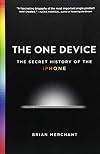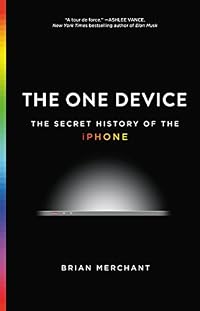
The One Device: The Secret History of the iPhone
by Brian Merchant
On This Page
Description
Describes how the inception of the iPhone has transformed society and skyrocketed Apple to the most valuable company in the world, detailing how the most current technological advances have become inseparable to everyday life.Tags
Recommendations



Member Reviews
Merchant's task here was to tell as much as he could about the way that the i-phone was developed, and give some background into how the i-phone was developed, created and marketed. To be honest, there are a lot of gaps here due to Apple's and Steve Job's obsession with secrecy. Most of the information comes from interviews with the few people who had worked for/with Apple and were willing to talk to Merchant.
Frankly, Apple and Jobs sound awful. The intensity of the work on the i-phone destroyed marriages. Different parts of the team weren't allowed to fully talk to each other, so the i-phone was put together in pieces. Job's took credit for the idea and execution, which wasn't at all true -- he was against working on the i-phone when show more it was first presented to him. I-phones are made in factories in China where the workers are treated awfully.
However, the i-phone WAS and is a genius product, that really revolutionized the way we live today. It was interested to find out more about this; from the use of touch screen technology to the development of Siri. The interesting thing is that this really isn't a one person product; its the result of a team of people within Apple; plus adjuncts from within and without Apple, who worked night and day to create a new product, which they could not even imagine at the start of the process.
Merchant tells the story in a lay-person, journalistic sort of way, which fits in well with the material. There were times I wanted more, and other times I wanted less. But overall, it works. show less
Frankly, Apple and Jobs sound awful. The intensity of the work on the i-phone destroyed marriages. Different parts of the team weren't allowed to fully talk to each other, so the i-phone was put together in pieces. Job's took credit for the idea and execution, which wasn't at all true -- he was against working on the i-phone when show more it was first presented to him. I-phones are made in factories in China where the workers are treated awfully.
However, the i-phone WAS and is a genius product, that really revolutionized the way we live today. It was interested to find out more about this; from the use of touch screen technology to the development of Siri. The interesting thing is that this really isn't a one person product; its the result of a team of people within Apple; plus adjuncts from within and without Apple, who worked night and day to create a new product, which they could not even imagine at the start of the process.
Merchant tells the story in a lay-person, journalistic sort of way, which fits in well with the material. There were times I wanted more, and other times I wanted less. But overall, it works. show less
Actually, I’ve written this review based just on the Blinkist summary of it. So it’s not really a fair review. Though I’ve been able to compare some Blinkist summaries with the full book and have been surprised at how much the authors have been able to capture of the original. I liked this book and here are a few snippets that particularly caught my attention:
The iPhone is a colossal success and has sold one billion units. When Wall Street analysts took stock of the most profitable products in the world, the iPhone was one of the top items on their list as well. Most people attribute its success to Steve Jobs,
However, the history of the iPhone truly begins in the early 2000s with a small group of Apple employees who were secretly show more experimenting with human-computer interfaces. The group collectively believed that the traditional keyboard and mouse were outmoded. So they set out to enable more direct interaction with computers and explored motion sensors and multitouch technology in particular. They produced the first, very low-tech prototype of what would eventually become the iPhone. However, they certainly weren’t the first to delve into such technology.
The first mobile phone was made in 1910 by the Swedish inventor Lars Magnus Ericsson, who later founded the tech giant Ericsson. To be fair, this mobile device was a car phone and to function it actually had to be directly connected to telephone lines using a wire. But it led to the invention of an even more mobile device in 1917. This second iteration was made by a Finnish inventor named Eric Tigerstedt and it was truly wireless....But it wasn’t until the 1990s that the first “smartphone” was produced. That’s right, decades before the iPhone, Frank Canova Jr., then an engineer at IBM, produced the Simon Personal Communicator, or the Simon for short. It was the first mobile phone that featured a computer.....And therein lay the actual innovation of the product: it boasted a touchscreen and applications, the features that made it “smart.”.....In fact, Canova’s initial goal was to add all manner of apps, like GPS and a stock ticker. He even developed some of them, but in the end the hard drive of the device couldn’t support them all. With the few apps and games the phone came with, it was already as big as a brick.
One of the most remarkable things about the iPhone is its battery capacity.
Today, the lithium battery in the iPhone is rechargeable, and we have researchers like Whittingham and the brilliant physicist John Goodenough, to thank for it.....John Goodenough solved the problem of the iphones catching fire.. Unlike Whittingham, who used titanium in his lithium battery, Goodenough used cobalt oxide. This chemical combination resulted in a more stable battery that’s still widely used to this day in all manner of electronics, the iPhone included. In 2015, the lithium-ion battery market was worth $30 billion,
When Apple began considering incorporating a camera, the company didn’t consider it an essential feature. Today, the camera is almost as essential as the phone itself; it’s also seriously complex. The camera module that goes into an iPhone today has over 200 parts and is considered indispensable. It has a sensor, an image-stabilization module and an image-signal processor that sharpens the image....Apple has a separate camera division with some 800 employees, all of whom are working to improve the iPhone camera.
Back in 1839, Robert Cornelius took his own picture. Technically, it wasn’t a photograph but an earlier form of image-making known as a daguerreotype. Then, in 1914, a teenage Russian duchess named Anastasia Nikolaevna took her own photo in a mirror. She later shared the image with her friends and it became one of the first well-known selfies. The selfie camera was added to the iPhone in 2010. This simple addition made it much easier to take your own photo, and it transformed the culture in the process.
Siri can answer all sorts of questions. In 2015, this artificial intelligence gave out one billion answers a week. In 2016, that number doubled. Siri is parts artificial intelligence, speech-recognition software and language-user interface. Together, they transform human speech into digital language before sending it to an Apple server where another software understands the speech and translates it into written text. From there, the natural-language user interface analyzes it. When she attempts to answer your questions or fulfill your requests, Siri looks to your phone internally. If no solution can be found, she connects to the internet......An early inspiration for Siri was Hearsay II, a kind of Siri prototype. This technology was developed by a young Indian researcher at Stanford named Dabbala Rajagopal Reddy. In the 1960s, Reddy and his team designed a system that allowed a computer to understand words. This computer was the largest device of its type at the time, and it understood around 560 words with 92-percent accuracy...Then, during the 1970s, while at Carnegie Mellon University, Reddy continued to work on this system and eventually turned it into a speech interface called Hearsay, which was proceeded by its successor, and Hearsay II. The latter system could understand a thousand English words
The list of materials in the iphone is pretty long, with at least 30 materials, including aluminum, iron, copper and even a bit of tin. That tin most likely comes from the mines of Cerro Rico, right outside the Bolivian city of Potosí....This tin from Cerro Rico comes with costs. For instance, since mining began there in the mid-sixteenth century, between four and eight million people have died there from starvation, freezing temperatures and cave ins.
To this day, around 15,000 people work there, several thousand children among them, and fatality rates are still out of control. In fact, in a recent incident, two kids died while working in a mine.
More than half of the tin smelters used by Apple reside on Bangka Island in Indonesia, another site of deadly mines. On this island, the mining overseers randomly, and often illegally, dig pits with tractors, leaving behind unstable walls. These precarious walls often crash down, killing miners. [This whole story about tin imports by FoxConn just doesn’t ring true. China is the world’s largest importer of both refined tin and tin ores and concentrates. The latter are, presumably, smelted into refined tin inside China. And the largest sources of tin ore are; Australia, Nigeria, Brazil, Russia and Laos. Bolivia does not even register. And it would, indeed, be surprising if Foxconn exclusively imported tin from one source in Bolivia. But China is also the largest importer of refined tin with Indonesia supplying the majority. Again, Bolivia does not register as a major supplier. So I start to suspect the overall narrative when the stories of mining deaths in Potosi are mentioned. There is also the small matter of the Potosi mine being a silver mine. Certainly the majority of the slaves who died over the last 500 years in the mines were mining silver not tin per se (although tin ore.... casserite ...and silver are often found together). So the author seems to have his story wrong here and one wonders about the other parts if this is so poorly researched].
In China, just outside of Shenzhen, there sits a massive Foxconn factory that manufactures and assembles the iPhone. Foxconn is the largest employer in mainland China; it employs some 1.3 million people globally, a number only topped by McDonald’s and Walmart. The company’s Longhua plant in Shenzhen is roughly 1.4 square miles in size and at one point it housed some 450,000 workers. Today, while fewer people work in the plant, it’s still one of the largest in the world. Perhaps unsurprisingly, the working conditions in this factory are abhorrent. In 2010 alone, 14 workers took their own lives by jumping off the tall factory buildings. Each suicide attempt is known to have been motivated by the insufferable conditions of the work, which includes long hours, repressive managers and a common system of unjustified and humiliating fines. Rather than improve working conditions, Gou had nets erected around the building to block the free fall of workers. Meanwhile, Steve Jobs was entirely dismissive, citing statistics about comparable suicide rates at your average university....[Suicide rate at Foxconn then was 14 per 450,000 or 0.3/100,000 which compares with 12.3/100,000 in Australia in 2022 so it seems to me that the author is exaggerating the issue]. When the author visited the Apple suppliers in Shanghai, he found them highly secured. He wasn’t allowed inside the facility and was even prohibited from taking pictures of it from the outside. While the company claims that such measures are to protect intellectual property, it’s clear that this high security also insulates the company from the bad press that the factory working conditions would doubtless generate.
The key message in this book: While the iPhone may embody the pinnacle of modern technology, it’s actually based on centuries of experimentation and innovation. Though this technological wonder has revolutionized modern life, its production has a number of negative effects on the people who assemble the iPhone as well as the workers who mine the metals from which it’s made.
My take on the book. It’s passingly interesting that the iphone did not emerge from nothing but followed on the back of earlier versions and the work of many people in developing different functions of the iphone. I was disappointed in the author’s poor research on tin asnd errors concerning the Potosi mines in Bolivia. Also in the rather breathless and unsophisticated repetition of stories of suicides at the Foxconn plant in China. By my research, the death rates from suicides at Foxconn were far less than we experience nationally in Australia. (And I haven’t looked at other countries). That’s not saying that working conditions at Foxconn are great but I’d expect a bit of objectivity here and it seems to be missing.
Overall, Not impressed with the book. One star from me. show less
The iPhone is a colossal success and has sold one billion units. When Wall Street analysts took stock of the most profitable products in the world, the iPhone was one of the top items on their list as well. Most people attribute its success to Steve Jobs,
However, the history of the iPhone truly begins in the early 2000s with a small group of Apple employees who were secretly show more experimenting with human-computer interfaces. The group collectively believed that the traditional keyboard and mouse were outmoded. So they set out to enable more direct interaction with computers and explored motion sensors and multitouch technology in particular. They produced the first, very low-tech prototype of what would eventually become the iPhone. However, they certainly weren’t the first to delve into such technology.
The first mobile phone was made in 1910 by the Swedish inventor Lars Magnus Ericsson, who later founded the tech giant Ericsson. To be fair, this mobile device was a car phone and to function it actually had to be directly connected to telephone lines using a wire. But it led to the invention of an even more mobile device in 1917. This second iteration was made by a Finnish inventor named Eric Tigerstedt and it was truly wireless....But it wasn’t until the 1990s that the first “smartphone” was produced. That’s right, decades before the iPhone, Frank Canova Jr., then an engineer at IBM, produced the Simon Personal Communicator, or the Simon for short. It was the first mobile phone that featured a computer.....And therein lay the actual innovation of the product: it boasted a touchscreen and applications, the features that made it “smart.”.....In fact, Canova’s initial goal was to add all manner of apps, like GPS and a stock ticker. He even developed some of them, but in the end the hard drive of the device couldn’t support them all. With the few apps and games the phone came with, it was already as big as a brick.
One of the most remarkable things about the iPhone is its battery capacity.
Today, the lithium battery in the iPhone is rechargeable, and we have researchers like Whittingham and the brilliant physicist John Goodenough, to thank for it.....John Goodenough solved the problem of the iphones catching fire.. Unlike Whittingham, who used titanium in his lithium battery, Goodenough used cobalt oxide. This chemical combination resulted in a more stable battery that’s still widely used to this day in all manner of electronics, the iPhone included. In 2015, the lithium-ion battery market was worth $30 billion,
When Apple began considering incorporating a camera, the company didn’t consider it an essential feature. Today, the camera is almost as essential as the phone itself; it’s also seriously complex. The camera module that goes into an iPhone today has over 200 parts and is considered indispensable. It has a sensor, an image-stabilization module and an image-signal processor that sharpens the image....Apple has a separate camera division with some 800 employees, all of whom are working to improve the iPhone camera.
Back in 1839, Robert Cornelius took his own picture. Technically, it wasn’t a photograph but an earlier form of image-making known as a daguerreotype. Then, in 1914, a teenage Russian duchess named Anastasia Nikolaevna took her own photo in a mirror. She later shared the image with her friends and it became one of the first well-known selfies. The selfie camera was added to the iPhone in 2010. This simple addition made it much easier to take your own photo, and it transformed the culture in the process.
Siri can answer all sorts of questions. In 2015, this artificial intelligence gave out one billion answers a week. In 2016, that number doubled. Siri is parts artificial intelligence, speech-recognition software and language-user interface. Together, they transform human speech into digital language before sending it to an Apple server where another software understands the speech and translates it into written text. From there, the natural-language user interface analyzes it. When she attempts to answer your questions or fulfill your requests, Siri looks to your phone internally. If no solution can be found, she connects to the internet......An early inspiration for Siri was Hearsay II, a kind of Siri prototype. This technology was developed by a young Indian researcher at Stanford named Dabbala Rajagopal Reddy. In the 1960s, Reddy and his team designed a system that allowed a computer to understand words. This computer was the largest device of its type at the time, and it understood around 560 words with 92-percent accuracy...Then, during the 1970s, while at Carnegie Mellon University, Reddy continued to work on this system and eventually turned it into a speech interface called Hearsay, which was proceeded by its successor, and Hearsay II. The latter system could understand a thousand English words
The list of materials in the iphone is pretty long, with at least 30 materials, including aluminum, iron, copper and even a bit of tin. That tin most likely comes from the mines of Cerro Rico, right outside the Bolivian city of Potosí....This tin from Cerro Rico comes with costs. For instance, since mining began there in the mid-sixteenth century, between four and eight million people have died there from starvation, freezing temperatures and cave ins.
To this day, around 15,000 people work there, several thousand children among them, and fatality rates are still out of control. In fact, in a recent incident, two kids died while working in a mine.
More than half of the tin smelters used by Apple reside on Bangka Island in Indonesia, another site of deadly mines. On this island, the mining overseers randomly, and often illegally, dig pits with tractors, leaving behind unstable walls. These precarious walls often crash down, killing miners. [This whole story about tin imports by FoxConn just doesn’t ring true. China is the world’s largest importer of both refined tin and tin ores and concentrates. The latter are, presumably, smelted into refined tin inside China. And the largest sources of tin ore are; Australia, Nigeria, Brazil, Russia and Laos. Bolivia does not even register. And it would, indeed, be surprising if Foxconn exclusively imported tin from one source in Bolivia. But China is also the largest importer of refined tin with Indonesia supplying the majority. Again, Bolivia does not register as a major supplier. So I start to suspect the overall narrative when the stories of mining deaths in Potosi are mentioned. There is also the small matter of the Potosi mine being a silver mine. Certainly the majority of the slaves who died over the last 500 years in the mines were mining silver not tin per se (although tin ore.... casserite ...and silver are often found together). So the author seems to have his story wrong here and one wonders about the other parts if this is so poorly researched].
In China, just outside of Shenzhen, there sits a massive Foxconn factory that manufactures and assembles the iPhone. Foxconn is the largest employer in mainland China; it employs some 1.3 million people globally, a number only topped by McDonald’s and Walmart. The company’s Longhua plant in Shenzhen is roughly 1.4 square miles in size and at one point it housed some 450,000 workers. Today, while fewer people work in the plant, it’s still one of the largest in the world. Perhaps unsurprisingly, the working conditions in this factory are abhorrent. In 2010 alone, 14 workers took their own lives by jumping off the tall factory buildings. Each suicide attempt is known to have been motivated by the insufferable conditions of the work, which includes long hours, repressive managers and a common system of unjustified and humiliating fines. Rather than improve working conditions, Gou had nets erected around the building to block the free fall of workers. Meanwhile, Steve Jobs was entirely dismissive, citing statistics about comparable suicide rates at your average university....[Suicide rate at Foxconn then was 14 per 450,000 or 0.3/100,000 which compares with 12.3/100,000 in Australia in 2022 so it seems to me that the author is exaggerating the issue]. When the author visited the Apple suppliers in Shanghai, he found them highly secured. He wasn’t allowed inside the facility and was even prohibited from taking pictures of it from the outside. While the company claims that such measures are to protect intellectual property, it’s clear that this high security also insulates the company from the bad press that the factory working conditions would doubtless generate.
The key message in this book: While the iPhone may embody the pinnacle of modern technology, it’s actually based on centuries of experimentation and innovation. Though this technological wonder has revolutionized modern life, its production has a number of negative effects on the people who assemble the iPhone as well as the workers who mine the metals from which it’s made.
My take on the book. It’s passingly interesting that the iphone did not emerge from nothing but followed on the back of earlier versions and the work of many people in developing different functions of the iphone. I was disappointed in the author’s poor research on tin asnd errors concerning the Potosi mines in Bolivia. Also in the rather breathless and unsophisticated repetition of stories of suicides at the Foxconn plant in China. By my research, the death rates from suicides at Foxconn were far less than we experience nationally in Australia. (And I haven’t looked at other countries). That’s not saying that working conditions at Foxconn are great but I’d expect a bit of objectivity here and it seems to be missing.
Overall, Not impressed with the book. One star from me. show less
Decent enough overview of the iPhone (materials, design, factories, team dynamics, precursor technologies, key technologies) but nothing new and nothing really insightful in the analysis. Good for people unfamiliar with the industry. 3 star for techies.
I had expected a more captivating book. The focus on prior at goes back so far as to file is impact. For instance I was left without a clear understanding of how multichannel works.
Perhaps the continuing development of iOS and the iPhone have somehow left the book behind.
I didn't get the feeling the author was truly enthusiastic about the iPhone. It seems more like a kiss and tell.
Perhaps the continuing development of iOS and the iPhone have somehow left the book behind.
I didn't get the feeling the author was truly enthusiastic about the iPhone. It seems more like a kiss and tell.
Ratings
Members
- Recently Added By
Published Reviews
ThingScore 50
“Let’s open the iPhone up, to discover its beginnings and evaluate its impact,” Merchant says, but goes on to do rather more. He provides pocket-sized histories of shatterproof glass, of popular photography, electronic music, apps that make farting noises, material on Apple Store employees’ productivity, and much else, all sprinkled with pointless facts. The amount of lithium used in show more iPhones is so tiny that Chile’s annual exports of the metal would be enough for 43 billion of them. More people work for Taiwanese iPhone assembler Foxconn than live in Estonia.
The camera wasn’t originally a priority, but Merchant can’t mention that without also talking about the history of selfies, about time spent in Paris with a professional iPhone-using photographer, and about the invention of image stabilisation.
He arranges for an iPhone to be atomised for the purpose of analysis, and lists the quantities and costs of each constituent element discovered. Doing the same to his book would reveal a high proportion of kitchen sink.
Despite much globe-trotting – from Bolivian tin mines via the atom-smashing facility at CERN to a cruise ship off Papua New Guinea – and much musing on the phone’s global impact, Merchant makes this a story of American enterprise, told in slangy magazine-style techno-argot, addressing an American mindset.
But the book is never dull. Considerable effort has gone into researching the phone from every possible angle and turning material on subjects as varied as office politics, software development and chemistry into a fast-paced and easily digestible read. show less
The camera wasn’t originally a priority, but Merchant can’t mention that without also talking about the history of selfies, about time spent in Paris with a professional iPhone-using photographer, and about the invention of image stabilisation.
He arranges for an iPhone to be atomised for the purpose of analysis, and lists the quantities and costs of each constituent element discovered. Doing the same to his book would reveal a high proportion of kitchen sink.
Despite much globe-trotting – from Bolivian tin mines via the atom-smashing facility at CERN to a cruise ship off Papua New Guinea – and much musing on the phone’s global impact, Merchant makes this a story of American enterprise, told in slangy magazine-style techno-argot, addressing an American mindset.
But the book is never dull. Considerable effort has gone into researching the phone from every possible angle and turning material on subjects as varied as office politics, software development and chemistry into a fast-paced and easily digestible read. show less
added by peternh
Author Information

4 Works 569 Members
Brian Merchant is an editor at Mother - board, VICE's science and technology outlet, and the founder of Terraform, its online fiction outlet.
Awards and Honors
Classifications
- Genres
- Technology, Nonfiction, Business, History, General Nonfiction, Science & Nature, Art & Design
- DDC/MDS
- 004.1675 — Computer science, information & general works Computer science, knowledge & systems Computer science General works on specific types of computers Personal Computers Mobile computing devices By Specific Type
- LCC
- QA76.8 .I64 .M47 — Science Mathematics Mathematics Instruments and machines Calculating machines Electronic computers. Computer science
- BISAC
Statistics
- Members
- 192
- Popularity
- 167,325
- Reviews
- 4
- Rating
- (3.68)
- Languages
- English
- Media
- Paper, Audiobook, Ebook
- ISBNs
- 13
- ASINs
- 3