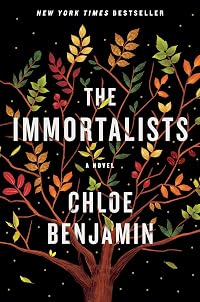
The Immortalists
by Chloe Benjamin
On This Page
Description
It's 1969 in New York City's Lower East Side, and word has spread of the arrival of a mystical woman, a traveling psychic who claims to be able to tell anyone the day they will die. The Gold children -- four adolescents on the cusp of self-awareness -- sneak out to hear their fortunes. Their prophecies inform their next five decades. Golden-boy Simon escapes to the West Coast, searching for love in '80s San Francisco. Dreamy Klara becomes a Las Vegas magician, obsessed with blurring reality show more and fantasy. Eldest son Daniel seeks security as an army doctor post-9/11, hoping to control fate. Bookish Varya throws herself into longevity research, where she tests the boundary between science and immortality. The Immortalists probes the line between destiny and choice, reality and illusion, this world and the next. It is a deeply moving testament to the power of story, the nature of belief, and the unrelenting pull of familial bonds. show lessTags
Recommendations




Member Reviews
It all begins when the four Gold siblings make an unexpected trip to see a fortune teller who is rumoured to be able to foretell the date of your death… Seemingly a typical horror or fantasy type story for a beginning, but Benjamin quickly steers us back into the realm of reality and grounds the narrative by telling the story from the perspective of each sibling in turn. We begin with Simon, the youngest sibling, and also the first fated to die. Alongside his sister Klara, who feels stifled in the expected role her parents have planned for her (college, a steady job, etc), he travels to San Francisco - the golden city on the opposite coast where he can reinvent himself and not be confined by the expected role of the straight man. show more Simon’s zest for life and his wholehearted embrasure of the west coast lifestyle is absolutely enthralling, which makes the conclusion of his part of the story even more heartbreaking as he contracts AIDS and dies on the date predicted for him. Whether this is just the timing of the rise of AIDS in the population and his carefree (and rather hedonistic at times) lifestyle or if it really is the prediction coming true, we aren’t quite sure yet. Klara’s story continues where Simon’s leaves off: she is still living in San Francisco, distanced from the rest of the family and struggling to create a magic show that brings back the old world charm to the profession. Klara’s life on stage seems whimsical and otherworldly, but the death of her brother and her inability to accept the norms of reality leave her haunted and looking for answers in other realms - mostly those inside her head. After her untimely death we transition to Daniel, the older brother who has made a successful career for himself as a military doctor and who has no time for the nonsense of childhood fortune-telling. At least until he nears his own predicted date. Daniel is such a staunch believer in reality that it seems to be his inflexibility and need for proof that the fortune teller is a liar that eventually leads to his own accidental death. As we enter the fourth and final section of the book we are left feeling almost jaded. We have seen three of the Gold siblings die, and we are seemingly coming up to the fourth with Varya. Varya has also entered a medical profession, but this time focusing on clinical genetics and chemistry, as she and her team conduct experiments in an attempt to lengthen lifespan. Varya is so wrapped up in her work that she has become almost disassociative from the real world (a messy and unpredictable place), which is almost more frightening for the reader to watch as we can almost see her mental breakdown coming. When the climax comes, Varya breaks the pattern of deaths, even though it seems like she’s testing the fate that the fortune teller has set in store for her. With this finale, it seems like everything has come full circle and the reality of destiny has been laid clear for us (with a heavy moral theme of: live your life, be damned the consequences), but ultimately I was left feeling a little dissatisfied. Did I expect the story to actually have a magical realism ending, or is the tragedy just too much? Definitely food for thought. show less
4-1/2 stars
I had to round up to 5 stars because I enjoyed it immensely, much more than I’d expected. I thought that it was brilliant all the way through, and I loved how it ended as it did. I was swept away as I read it. Despite a lot of telling vs. showing, I I enjoyed the writing style. It’s unusual, quotable, and great storytelling. Most importantly, I felt as though I truly knew all of these people.
I loved all four children, though they don’t stay children for long. By page 19 they are no longer children. (The book cover says they’re adolescents during a crucial point in time but they are not: they are a girl of 13 (barely) named Varya and a boy of 11 named Daniel, a girl of 9 named Klara, and a boy of only 7 named Simon. show more Children.)
The funny thing is that as adults I didn’t like them all that much, but even so I thoroughly enjoyed spending time with them, and I could often empathize with them and like certain things about them. It’s not typical that I enjoy spending time with mostly unlikable characters but here I did. I also appreciated that the many, many minor characters were for the most part fleshed out and I felt as though I knew and understood them too.
I thought that I wouldn’t be interested in the two younger children’s stories but I was riveted and all of the stories had me interested as I read, much to my surprise. I was especially flabbergasted that I liked reading the story of the second to youngest sibling, but I did. I liked each of their sections. This is a great family and siblings story, though an unusual one.
I am not a fan of magic acts, don’t believe in magic, etc.
I see that this is on many readers’ fantasy or similar shelves so at the beginning I had put it on my speculative fiction shelf. I might change my mind but for now I’ve taken it off that shelf because I don’t think that in fact it is a speculative fiction book. It’s more of a psychological fiction book. That’s my interpretation of events anyway. (I might put it back on at some point.) I also could consider putting it on my animal rights shelf but likely won’t, but might. So many shelves could fit this book; it’s hard to categorize. I don’t believe in the magic of the fortuneteller but I did understand and appreciate Klara’s magic, and Ruby’s, and I thought it was beautiful.
San Francisco of the late 70s-early 80s for a particular subculture was depicted perfectly, and I think that New York was done well too. San Francisco and NYC and my only two place shelves and being able to use both in one book was fun for me.
I’m a person who at any point during my entire life would have loved to learn the exact date of my death, even now. I realize that many people wouldn’t want to know or would think they did but then not like knowing. I would have and would like knowing.
This is a book about living, not about dying. I can’t stress that enough.
I almost rounded down to 4 stars vs. rounding up to 5. Even though everything nicely came together, I wasn’t wild about the inclusion of two of the male characters, particularly one of them. But the more I think about it, the more I think the whole story worked, so 5 stars it is.
The book deeply touched me. show less
I had to round up to 5 stars because I enjoyed it immensely, much more than I’d expected. I thought that it was brilliant all the way through, and I loved how it ended as it did. I was swept away as I read it. Despite a lot of telling vs. showing, I I enjoyed the writing style. It’s unusual, quotable, and great storytelling. Most importantly, I felt as though I truly knew all of these people.
I loved all four children, though they don’t stay children for long. By page 19 they are no longer children. (The book cover says they’re adolescents during a crucial point in time but they are not: they are a girl of 13 (barely) named Varya and a boy of 11 named Daniel, a girl of 9 named Klara, and a boy of only 7 named Simon. show more Children.)
The funny thing is that as adults I didn’t like them all that much, but even so I thoroughly enjoyed spending time with them, and I could often empathize with them and like certain things about them. It’s not typical that I enjoy spending time with mostly unlikable characters but here I did. I also appreciated that the many, many minor characters were for the most part fleshed out and I felt as though I knew and understood them too.
I thought that I wouldn’t be interested in the two younger children’s stories but I was riveted and all of the stories had me interested as I read, much to my surprise. I was especially flabbergasted that I liked reading the story of the second to youngest sibling, but I did. I liked each of their sections. This is a great family and siblings story, though an unusual one.
I am not a fan of magic acts, don’t believe in magic, etc.
I see that this is on many readers’ fantasy or similar shelves so at the beginning I had put it on my speculative fiction shelf. I might change my mind but for now I’ve taken it off that shelf because I don’t think that in fact it is a speculative fiction book. It’s more of a psychological fiction book. That’s my interpretation of events anyway. (I might put it back on at some point.) I also could consider putting it on my animal rights shelf but likely won’t, but might. So many shelves could fit this book; it’s hard to categorize. I don’t believe in the magic of the fortuneteller but I did understand and appreciate Klara’s magic, and Ruby’s, and I thought it was beautiful.
San Francisco of the late 70s-early 80s for a particular subculture was depicted perfectly, and I think that New York was done well too. San Francisco and NYC and my only two place shelves and being able to use both in one book was fun for me.
I’m a person who at any point during my entire life would have loved to learn the exact date of my death, even now. I realize that many people wouldn’t want to know or would think they did but then not like knowing. I would have and would like knowing.
This is a book about living, not about dying. I can’t stress that enough.
I almost rounded down to 4 stars vs. rounding up to 5. Even though everything nicely came together, I wasn’t wild about the inclusion of two of the male characters, particularly one of them. But the more I think about it, the more I think the whole story worked, so 5 stars it is.
The book deeply touched me. show less
“She’d tell herself that what she really wanted was not to live forever, but to stop worrying.”
This book begins with a visit to a fortune teller in 1969 New York City, where four siblings are told the exact dates of their deaths. The novel then unfolds in four interconnected sections, each focusing on one sibling’s life and how their prophesied end shapes their choices, relationships, and sense of identity. It’s a thought-provoking exploration of fate, free will, and the power of belief.
Chloe Benjamin is a relatively young author whose first novel, The Anatomy of Dreams, was also well-received. She has mentioned in interviews that her writing often explores the intersection of science and spirituality, which is clearly show more evident in The Immortalists.
In a way, this novel felt like four short stories connected by the thread of the siblings’ shared encounter with the fortune teller. Normally, I find short stories a bit exhausting, as they require reconnecting with new characters repeatedly. But, in this book, the shared experience of the fortune teller grounded the story and made the transitions between sections more cohesive.
One of the most fascinating aspects of this book was its psychological depth. It made me constantly question how much of the siblings’ fates were shaped by the fortune teller’s predictions versus their own belief in them. Was it self-fulfilling prophecy or true destiny? This lingering question keeps you thinking long after the last page.
Although the character development was pretty strong, I found it hard to deeply bond with any of the siblings. I suspect this is largely due to the segmented “short story” structure, which didn’t leave as much room to fully immerse in their lives. Still, each sibling’s story felt real and layered, even if the emotional connection wasn’t as deep as I might have hoped.
I highly recommend this book to readers who enjoy pondering the human condition. It’s not predictable or kitschy, and it kept me engaged from start to finish. While the characters didn’t completely steal my heart, the story left me with plenty to reflect on, which is a mark of a worthwhile read in my book. If you’re looking for something thought-provoking and uniquely structured, give it a try! show less
This book begins with a visit to a fortune teller in 1969 New York City, where four siblings are told the exact dates of their deaths. The novel then unfolds in four interconnected sections, each focusing on one sibling’s life and how their prophesied end shapes their choices, relationships, and sense of identity. It’s a thought-provoking exploration of fate, free will, and the power of belief.
Chloe Benjamin is a relatively young author whose first novel, The Anatomy of Dreams, was also well-received. She has mentioned in interviews that her writing often explores the intersection of science and spirituality, which is clearly show more evident in The Immortalists.
In a way, this novel felt like four short stories connected by the thread of the siblings’ shared encounter with the fortune teller. Normally, I find short stories a bit exhausting, as they require reconnecting with new characters repeatedly. But, in this book, the shared experience of the fortune teller grounded the story and made the transitions between sections more cohesive.
One of the most fascinating aspects of this book was its psychological depth. It made me constantly question how much of the siblings’ fates were shaped by the fortune teller’s predictions versus their own belief in them. Was it self-fulfilling prophecy or true destiny? This lingering question keeps you thinking long after the last page.
Although the character development was pretty strong, I found it hard to deeply bond with any of the siblings. I suspect this is largely due to the segmented “short story” structure, which didn’t leave as much room to fully immerse in their lives. Still, each sibling’s story felt real and layered, even if the emotional connection wasn’t as deep as I might have hoped.
I highly recommend this book to readers who enjoy pondering the human condition. It’s not predictable or kitschy, and it kept me engaged from start to finish. While the characters didn’t completely steal my heart, the story left me with plenty to reflect on, which is a mark of a worthwhile read in my book. If you’re looking for something thought-provoking and uniquely structured, give it a try! show less
Another 'Not what I was expecting' novel, but in a good way. New York, 1969: four siblings visit a fortune teller who predicts the exact dates of their deaths. Simon, who knows he will die young, leaves home for San Francisco, where he makes fearless but fateful choices. Klara takes up magic but can't escape reality. Daniel struggles to deal with the predictions and takes his anger out on the fortune teller. And Varya treats her life like a scientific experiment, afraid to reach out even though she has been given the longest span of years. Each character claims a quarter of the book, telling their story, and some are more engaging than others - I loved reading about Simon, throwing himself into the San Francisco gay scene before meeting show more calm, grounded Robert, and discovering the unnamed disease which finally claims him, and Gertie, the Gold family matriarch, who loses her husband and three of her children, but gains a bright and talented granddaughter, Ruby.
I was anticipating more of a fantasy story, to be honest, but really enjoyed reading about these four otherwise ordinary brothers and sisters whose lives are ruled by the expectation of death. If you thought you knew when you were supposed to die, would you live life to the full, reject the everyday, fight the inevitable, feel free from uncertainty, or fear tempting fate? Would you be a fatalist or a hedonist? A very thoughtful novel, with sympathetic characters. show less
I was anticipating more of a fantasy story, to be honest, but really enjoyed reading about these four otherwise ordinary brothers and sisters whose lives are ruled by the expectation of death. If you thought you knew when you were supposed to die, would you live life to the full, reject the everyday, fight the inevitable, feel free from uncertainty, or fear tempting fate? Would you be a fatalist or a hedonist? A very thoughtful novel, with sympathetic characters. show less
I really liked this one. There's so much to unpack -- what it means to live, how much we control our fate, how much our fate controls us, what love is, and what it isn't, what we owe to our families and to ourselves.
I'm still looping around on who lived -- really lived -- of the Gold siblings. Life can be measured in years, or in experiences, or in love. And they don't always go together.
I'm still looping around on who lived -- really lived -- of the Gold siblings. Life can be measured in years, or in experiences, or in love. And they don't always go together.
This book examines the question: “How would you live your life if you knew the date of your death?” Would it cause you to live life to the fullest or live in fear? Four siblings visit a fortune teller and are each individually told their “death date.” The author focuses on one sibling at a time, and follows each through a portion of his or her life. Since they are siblings, each is influenced to some degree by the actions of the others, and lots of family dynamics are at play.
The storyline is creative and the characters are extremely well-developed. I almost felt as though I knew each of them personally, and could picture the psychological burdens they carried. The stories are interesting, touching on topics ranging from gay show more life in San Francisco in the 1980’s to performance magic to military medicine to scientific research on longevity. It brings up questions on the meaning of life, and does so in an entertaining manner. It shows how a single event can have far-reaching psychological repercussions. It explores how much of what one believes to be true leads to a self-fulfilling prophesy. Themes include science vs. religion, the power of words, dealing with uncertainty, the impact of knowledge (both good and detrimental). There was a bit of graphic sex in one of the parts, and another was a bit of a stretch on the suspension of disbelief, but overall, I found it almost spell-binding and particularly enjoyed the author’s elegant writing style.
Highly recommended to readers of thought-provoking literature. It would be an excellent pick for a book club. I received an advance copy of this e-book from the publisher via NetGalley in return for a candid review. This book will be released in January 2018. show less
The storyline is creative and the characters are extremely well-developed. I almost felt as though I knew each of them personally, and could picture the psychological burdens they carried. The stories are interesting, touching on topics ranging from gay show more life in San Francisco in the 1980’s to performance magic to military medicine to scientific research on longevity. It brings up questions on the meaning of life, and does so in an entertaining manner. It shows how a single event can have far-reaching psychological repercussions. It explores how much of what one believes to be true leads to a self-fulfilling prophesy. Themes include science vs. religion, the power of words, dealing with uncertainty, the impact of knowledge (both good and detrimental). There was a bit of graphic sex in one of the parts, and another was a bit of a stretch on the suspension of disbelief, but overall, I found it almost spell-binding and particularly enjoyed the author’s elegant writing style.
Highly recommended to readers of thought-provoking literature. It would be an excellent pick for a book club. I received an advance copy of this e-book from the publisher via NetGalley in return for a candid review. This book will be released in January 2018. show less
In many ways, The Immortalists is an adult version of They Both Die at the End. Both explore the idea of fate versus choice. Both deal with the idea of living your life knowing when your last day is. Unfortunately, as good as Chloe Benjamin‘s novel is, I do think Adam Silvera did it better.
The thing is, The Immortalists is a well-written novel. The Gold children each deal with the knowledge of their death date in different ways, with a wide variety of success and tragedy. Simon’s story is particularly poignant and inspiring. No matter how you react to each of the siblings, however, Ms. Benjamin gets you to react. You care enough to feel for these four children and the lives they lead. Their deaths, while not unexpected, are still show more tragic in the fact that they happen if not how. You want the psychic to be wrong and hope the kids can beat back any demons that haunt them. It is an emotional novel that questions the idea of fate versus choice.
In spite of all that emotional goodness, I am left feeling rather unsatisfied. One could debate for days whether each of the siblings would have acted in the same way had they never learned about their death date and therefore knowing this information contributed to their demise. It makes for a fascinating but ultimately unsatisfactory discussion because there are no definitive answers to either point. Regardless if there was, this is not the point of the story. The story is about family and about living a genuine life. The thing is that no one really learns these lessons. The siblings part ways early on in the novel and remain apart from one another if not completely estranged in some form. As for living a genuine life, well, that too may be up for debate. This all makes me question whether the learning lessons are more for readers rather than the characters, which I find somewhat disappointing. The Immortalists then becomes a 352-page lecture, albeit a well-told one.
I suspect my feelings about The Immortalists would be different had I not read Adam Silver’s latest masterpiece a few short months ago. In his story, the focus is two characters and one day, allowing readers a greater opportunity to get to know them and to experience their last day alongside them. Ms. Benjamin has us as silent witnesses versus silent participants. Not only that but by keeping the focus to one day, we see the difference it makes when one truly lives their life without fear and without worry. Ms. Benjamin’s version, by occurring over five decades, makes this more nebulous, and we don’t necessarily see the Gold siblings living without fear or worry. We see them, for the most part, as adults worried about the same things as every other adult.
For me, The Immortalists is good but it cannot be as good as Adam Silvera’s novel. This is not only because I read it first but also because I remain more impressed with how he told his story, with his characterization, and the method by which he laid out his theme. Ms. Benjamin’s novel suffers from uneven characters, a theme which makes no sense in the context of the story, and from the feeling of repetitiveness that comes with having recently read a more impressive and memorable similar story. show less
The thing is, The Immortalists is a well-written novel. The Gold children each deal with the knowledge of their death date in different ways, with a wide variety of success and tragedy. Simon’s story is particularly poignant and inspiring. No matter how you react to each of the siblings, however, Ms. Benjamin gets you to react. You care enough to feel for these four children and the lives they lead. Their deaths, while not unexpected, are still show more tragic in the fact that they happen if not how. You want the psychic to be wrong and hope the kids can beat back any demons that haunt them. It is an emotional novel that questions the idea of fate versus choice.
In spite of all that emotional goodness, I am left feeling rather unsatisfied. One could debate for days whether each of the siblings would have acted in the same way had they never learned about their death date and therefore knowing this information contributed to their demise. It makes for a fascinating but ultimately unsatisfactory discussion because there are no definitive answers to either point. Regardless if there was, this is not the point of the story. The story is about family and about living a genuine life. The thing is that no one really learns these lessons. The siblings part ways early on in the novel and remain apart from one another if not completely estranged in some form. As for living a genuine life, well, that too may be up for debate. This all makes me question whether the learning lessons are more for readers rather than the characters, which I find somewhat disappointing. The Immortalists then becomes a 352-page lecture, albeit a well-told one.
I suspect my feelings about The Immortalists would be different had I not read Adam Silver’s latest masterpiece a few short months ago. In his story, the focus is two characters and one day, allowing readers a greater opportunity to get to know them and to experience their last day alongside them. Ms. Benjamin has us as silent witnesses versus silent participants. Not only that but by keeping the focus to one day, we see the difference it makes when one truly lives their life without fear and without worry. Ms. Benjamin’s version, by occurring over five decades, makes this more nebulous, and we don’t necessarily see the Gold siblings living without fear or worry. We see them, for the most part, as adults worried about the same things as every other adult.
For me, The Immortalists is good but it cannot be as good as Adam Silvera’s novel. This is not only because I read it first but also because I remain more impressed with how he told his story, with his characterization, and the method by which he laid out his theme. Ms. Benjamin’s novel suffers from uneven characters, a theme which makes no sense in the context of the story, and from the feeling of repetitiveness that comes with having recently read a more impressive and memorable similar story. show less
Members
- Recently Added By
Published Reviews
Chloe Benjamin pulls this novel off almost as a series of four set-pieces, enriched by period detail from each era.
added by rodneyvc
Lists

Magic Realism
371 works; 52 members

Top Five Books of 2018
802 works; 265 members

Litsy Awards 2018
248 works; 9 members
Amazon best fictional genre picks monthly for 2018
418 works; 9 members

Vine Reads
60 works; 1 member

Fate vs. Free Will
63 works; 8 members

Books Read in 2020
4,379 works; 124 members

Book Club Suggestions for 2020
27 works; 2 members

Publishers Weekly Best Books of the Week / Starred Reviews 2018
78 works; 2 members

Library TBR
64 works; 1 member

Books Read in 2018
4,360 works; 110 members

KayStJ's to-read list
1,616 works; 11 members

Books Read in 2019
4,052 works; 108 members

At the Library
217 works; 1 member

Indie Next Picks
196 works; 4 members
Author Information

3+ Works 4,552 Members
Chloe Benjamin is an American author, born in San Francisco, California. She is a graduate of Vassar College and received her MFA in Fiction at the University of Wisconsin. In addition to writing, she teaches workshops on the business of publishing. Her first novel, The Anatomy of Dreams, received the Edna Ferber Fiction Book Award. The show more Immortalist is her second novel and was published in January 2018. (Bowker Author Biography) show less
Some Editions
Awards and Honors
Awards
Common Knowledge
- Original publication date
- 2018-01-09
- People/Characters
- Varya Gold; Daniel Gold; Klara Gold; Simon Gold; Gertie Gold; Saul Gold (show all 14); Robert; Rajanikant "Raj" Chapal; Rubina "Ruby" Chapal; Mira Gold; Eddie O'Donoghue; Bruna Costello; Luke Van Gelder (Solomon); Annie Kim
- Important places
- New York, New York, USA; San Francisco, California, USA; Las Vegas, Nevada, USA; Albany, New York, USA; Kingston, New York, USA; West Milton, Ohio, USA (show all 7); The Drake Institute for Research on Aging
- Important events
- AIDS epidemic
- Dedication
- For my grandmother, Lee Krug
- First words
- Varya is thirteen. New to her are three more inches of height and the dark patch of fur between her legs.
- Quotations
- She's always thought of home as a physical destination, but perhaps Raj and Ruby are home enough. Perhaps home, like the moon, will follow wherever she goes.
Our language is our strength. Thoughts have wings.
The cost of loneliness is high, she knows, but the cost of loss is higher. - Last words
- (Click to show. Warning: May contain spoilers.)"I love you all," she whispered. "I love you all, I love you all." Then she stepped through the curtain to join them.
- Blurbers
- Russo, Richard; Hill, Nathan; Fowler, Karen Joy; Mitchell, Judith Claire
- Original language
- English
- Canonical DDC/MDS
- 813.6
Classifications
Statistics
- Members
- 4,294
- Popularity
- 3,517
- Reviews
- 220
- Rating
- (3.70)
- Languages
- 10 — Danish, Dutch, English, French, German, Italian, Romanian, Spanish, Swedish, Portuguese (Portugal)
- Media
- Paper, Audiobook, Ebook
- ISBNs
- 43
- ASINs
- 11