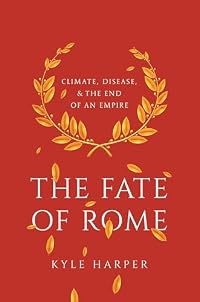
The Fate of Rome: Climate, Disease, and the End of an Empire
by Kyle Harper
On This Page
Description
A sweeping new history of how climate change and disease helped bring down the Roman Empire. Here is the monumental retelling of one of the most consequential chapters of human history: the fall of the Roman Empire. The Fate of Rome is the first book to examine the catastrophic role that climate change and infectious diseases played in the collapse of Rome's power--a story of nature's triumph over human ambition. Interweaving a grand historical narrative with cutting-edge climate science and show more genetic discoveries, Kyle Harper traces how the fate of Rome was decided not just by emperors, soldiers, and barbarians but also by volcanic eruptions, solar cycles, climate instability, and devastating viruses and bacteria. He takes readers from Rome's pinnacle in the second century, when the empire seemed an invincible superpower, to its unraveling by the seventh century, when Rome was politically fragmented and materially depleted. Harper describes how the Romans were resilient in the face of enormous environmental stress, until the besieged empire could no longer withstand the combined challenges of a "little ice age" and recurrent outbreaks of bubonic plague. A poignant reflection on humanity's intimate relationship with the environment, The Fate of Rome provides a sweeping account of how one of history's greatest civilizations encountered, endured, yet ultimately succumbed to the cumulative burden of nature's violence. The example of Rome is a timely reminder that climate change and germ evolution have shaped the world we inhabit--in ways that are surprising and profound. - Publisher. show lessTags
Recommendations







Member Recommendations
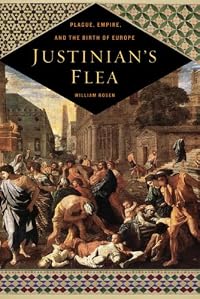
M_Clark Justinian's Flea focuses mostly on Justinian and the plague that arose during his rule.
Member Reviews
https://nwhyte.livejournal.com/3145827.html
A very thought-provoking study of the natural causes behind the collapse of the Roman Empire, which he describes as the biggest economic reverse suffered by any region of the world in human history (though surely the destruction of the pre-colonisation Americas must come pretty close).
Harper goes in detail into the two big factors to which he attributes the fall of Rome: climate change and pandemic. The initial growth of the Roman Empire took place at a moment when the Mediterranean was unusually warm and wet by the standards of the last few thousand years. When the climate started shifting - not for anthropogenic reasons, just from the natural shift of orbits and sunspots - crops optimised for show more the previous situation did not do as well, and also shifting populations (both of humans and of animals) meant that new diseases had new populations to devastate.
He identifies three big pandemics which devastated the Roman Empire - the Antonine plague of 165, the plague of Cyprian in 249, and Justinian’s plague in 541. The first of these was probably related to smallpox, the second is uncertain and the third was definitely bubonic plague in its first major European manifestation. Unhealthy Roman urbanisation made it all worse. So did a major volcanic eruption in 536, the “year without a summer” - the volcano in question has not been identified, but the effects are clear. The 6th century plague was proportionally at least as bad as the Black Death of the 14th century. He pulls in lots of contemporary observations, notably from Galen and Procopius.
It’s a good read, though slightly oddly organised in places, and marked down for poor monochrome maps which don’t always illustrate the points being made and also for GRRRRRRR endnotes. In particular, though Harper doesn’t put it in these terms, it’s an important corrective to Gibbon, who very much wanted to find a human political cause of the Decline and Fall. The human factor is not absent from Harper’s account, but the key point is that the most developed society is still vulnerable to the vicissitudes of climate change and disease - a lesson for us all. show less
A very thought-provoking study of the natural causes behind the collapse of the Roman Empire, which he describes as the biggest economic reverse suffered by any region of the world in human history (though surely the destruction of the pre-colonisation Americas must come pretty close).
Harper goes in detail into the two big factors to which he attributes the fall of Rome: climate change and pandemic. The initial growth of the Roman Empire took place at a moment when the Mediterranean was unusually warm and wet by the standards of the last few thousand years. When the climate started shifting - not for anthropogenic reasons, just from the natural shift of orbits and sunspots - crops optimised for show more the previous situation did not do as well, and also shifting populations (both of humans and of animals) meant that new diseases had new populations to devastate.
He identifies three big pandemics which devastated the Roman Empire - the Antonine plague of 165, the plague of Cyprian in 249, and Justinian’s plague in 541. The first of these was probably related to smallpox, the second is uncertain and the third was definitely bubonic plague in its first major European manifestation. Unhealthy Roman urbanisation made it all worse. So did a major volcanic eruption in 536, the “year without a summer” - the volcano in question has not been identified, but the effects are clear. The 6th century plague was proportionally at least as bad as the Black Death of the 14th century. He pulls in lots of contemporary observations, notably from Galen and Procopius.
It’s a good read, though slightly oddly organised in places, and marked down for poor monochrome maps which don’t always illustrate the points being made and also for GRRRRRRR endnotes. In particular, though Harper doesn’t put it in these terms, it’s an important corrective to Gibbon, who very much wanted to find a human political cause of the Decline and Fall. The human factor is not absent from Harper’s account, but the key point is that the most developed society is still vulnerable to the vicissitudes of climate change and disease - a lesson for us all. show less
This book has an interesting topic -- I'm particularly interested in the Antonine Plague -- and it has some useful things to say, but I had a lot of trouble with the writing style. There are so, so many bland, introductory-type or sweeping statements that it started to drive me crazy. Just get to the meat of the information please and leave the grand pronouncements on the cutting room floor. I bet this book could have been a lot shorter and yet a lot better.
The other thing is that the reader for this audio book seemed to mispronounce virtually every Latin name and term. He didn't stop at Latin either. Inundate is a common enough word, right? It's pronounced /ˈinənˌdāt/. See, that second syllable is a schwa and so it's unaccented. show more But he would repeatedly somehow find the word "nun" in the middle of that word and accent it for all it was worth. There were other long words where this happened as well. I'm reminded of the question, does everyone have to do everything? If one doesn't know or want to know how to pronounce words properly, why become a reader? I started to think he was upset about something and deliberately trying to sabotage the audiobook.
Anyway, while I did find it very interesting to learn about how the heights of Romans changed, how the plague progressed and similar such topics, I think a rewrite might be in order, and a re-recording. It might also be good to split the nebulous topic into two books, one about disease, the other about climate so that the book could focus more instead of meandering about. show less
The other thing is that the reader for this audio book seemed to mispronounce virtually every Latin name and term. He didn't stop at Latin either. Inundate is a common enough word, right? It's pronounced /ˈinənˌdāt/. See, that second syllable is a schwa and so it's unaccented. show more But he would repeatedly somehow find the word "nun" in the middle of that word and accent it for all it was worth. There were other long words where this happened as well. I'm reminded of the question, does everyone have to do everything? If one doesn't know or want to know how to pronounce words properly, why become a reader? I started to think he was upset about something and deliberately trying to sabotage the audiobook.
Anyway, while I did find it very interesting to learn about how the heights of Romans changed, how the plague progressed and similar such topics, I think a rewrite might be in order, and a re-recording. It might also be good to split the nebulous topic into two books, one about disease, the other about climate so that the book could focus more instead of meandering about. show less
A thorough and chilling exploration into the fall of Rome.
In 150 CE, a Roman would have lived in what he or she imagined was an enduring, robust civilization, having reached a pinnacle of development and growth which the world had never yet seen, manifesting stability which they would easily imagine would continue indefinitely.
By 600, the world had completely changed for the Romans, and they knew their great age had passed. Civilization would not reach the same extent of strength, quality of life, etc. until the 19th century.
The author explores the traditional understanding of the fall of Rome based on Gibbon and historians after him. He then provides his major critique of that posture: it treated the environment as a constant and a show more given. This whole work is the author's exploration into what archaeology and climatology have taught us regarding what allowed for the rise of Rome and why it so thoroughly collapsed.
The bulk of the work tells the story of the Roman Climate Optimum and the growth and expansion of the Roman Empire and the Roman population. The author addresses the continual sources of sickness and death throughout the Roman Empire throughout its heyday - the pervasive gastrointestinal parasites and diseases that rendered Romans shorter than those who came before and after them and led to persistently high death rates - diarrhea as the primary cause of death in the Roman world.
He speaks in detail on the Antonine plague which he identifies as smallpox and does well at tracing its likely origins from sub-Saharan Africa and the wide Indian Ocean trading route use which facilitated the spread of smallpox from Egypt outward. He would also speak of the Cyprianic plague and make the argument it was a virus related to Ebola. The author associated the rise of Christianity with the Christian treatment of plague victims and the disruption caused by the plague.
The author addressed the climate variations - the Roman Climate Optimum (RCO) of 200 BCE to 150 CE, and then the intermediate period between it and the Late Antique Ice Age of 450 to 750. He explained how the Mediterranean climate was truly warmer and more humid and not at all consistent with the idea of the "Mediterranean climate" today during the RCO. He associated the end of the RCO with a lot of data regarding difficulties throughout the Empire in the disruptions of the 3rd century and afterward.
He also addresses the history - the terrible times of 240-270 and how it could have ended the Empire, the impressive nature of the resurgence of Empire in the fourth century, and all to set up the ultimate disasters which would end the Roman Empire as a going concern in the fifth century and onward.
The end of the book focuses on the disaster of the middle of the sixth century: the combination of less solar energy and intense volcanism that led to the coldest two decades of the past few thousand years from 540 to 560, and how those conditions facilitated the spread of bubonic plague in the days of Justinian and afterward. In great depth he explains how powerful the Justinian Plague was, how it also likely led to the death of half of Europe just as the Black Death of the 14th century would, and how the bubonic plague would persist and flare up throughout Europe and Western Asia from 540 until 750. He explained the truly apocalyptic situation this engendered, how it led to fervent eschatological expectations, and how that shaped Judaism, Christianity, and even the development of Islam. We see how the world of 520, even with Germanic invasions and incursions in the west, in many respects remained recognizably Roman; because of the inauguration of the Late Antique Ice Age and the coming of the plague, we see the almost complete collapse of Western civilization, and why it would not reach the heights it enjoyed in Roman times until the 19th century.
In light of climate change and COVID-19 this is a thoroughly terrifying book. It reminds us that our world which we take for granted as "normal" has only been so for 200 or so years at maximum. We can see the disruption to Roman life caused by changes in climate which prove minute compared to what we have done in saturating the atmosphere in carbon dioxide and can only wonder what will happen to us soon. Likewise, COVID-19 is almost nothing compared to smallpox, the Ebola-like virus, and the bubonic plague's impact on Roman society, and yet look how disruptive COVID-19 has proven. Our civilization is not as stable or as normal as we would like to imagine.
In its own way this book testifies to the satisfaction of all the plagues prophesied in the book of Revelation against the beast, false prophet, and whore known as Rome and its Empire and religion...and yet there's plenty to challenge Christian theology here, since the Empire experienced its great death knell at the height of its Christendom in the sixth century. As a result, many "Christianized" lands would be Islamicized as they have been until this day.
Nevertheless, an indispensable work for understanding the fall of the Roman Empire, and all kinds of lessons for modern man to consider. show less
In 150 CE, a Roman would have lived in what he or she imagined was an enduring, robust civilization, having reached a pinnacle of development and growth which the world had never yet seen, manifesting stability which they would easily imagine would continue indefinitely.
By 600, the world had completely changed for the Romans, and they knew their great age had passed. Civilization would not reach the same extent of strength, quality of life, etc. until the 19th century.
The author explores the traditional understanding of the fall of Rome based on Gibbon and historians after him. He then provides his major critique of that posture: it treated the environment as a constant and a show more given. This whole work is the author's exploration into what archaeology and climatology have taught us regarding what allowed for the rise of Rome and why it so thoroughly collapsed.
The bulk of the work tells the story of the Roman Climate Optimum and the growth and expansion of the Roman Empire and the Roman population. The author addresses the continual sources of sickness and death throughout the Roman Empire throughout its heyday - the pervasive gastrointestinal parasites and diseases that rendered Romans shorter than those who came before and after them and led to persistently high death rates - diarrhea as the primary cause of death in the Roman world.
He speaks in detail on the Antonine plague which he identifies as smallpox and does well at tracing its likely origins from sub-Saharan Africa and the wide Indian Ocean trading route use which facilitated the spread of smallpox from Egypt outward. He would also speak of the Cyprianic plague and make the argument it was a virus related to Ebola. The author associated the rise of Christianity with the Christian treatment of plague victims and the disruption caused by the plague.
The author addressed the climate variations - the Roman Climate Optimum (RCO) of 200 BCE to 150 CE, and then the intermediate period between it and the Late Antique Ice Age of 450 to 750. He explained how the Mediterranean climate was truly warmer and more humid and not at all consistent with the idea of the "Mediterranean climate" today during the RCO. He associated the end of the RCO with a lot of data regarding difficulties throughout the Empire in the disruptions of the 3rd century and afterward.
He also addresses the history - the terrible times of 240-270 and how it could have ended the Empire, the impressive nature of the resurgence of Empire in the fourth century, and all to set up the ultimate disasters which would end the Roman Empire as a going concern in the fifth century and onward.
The end of the book focuses on the disaster of the middle of the sixth century: the combination of less solar energy and intense volcanism that led to the coldest two decades of the past few thousand years from 540 to 560, and how those conditions facilitated the spread of bubonic plague in the days of Justinian and afterward. In great depth he explains how powerful the Justinian Plague was, how it also likely led to the death of half of Europe just as the Black Death of the 14th century would, and how the bubonic plague would persist and flare up throughout Europe and Western Asia from 540 until 750. He explained the truly apocalyptic situation this engendered, how it led to fervent eschatological expectations, and how that shaped Judaism, Christianity, and even the development of Islam. We see how the world of 520, even with Germanic invasions and incursions in the west, in many respects remained recognizably Roman; because of the inauguration of the Late Antique Ice Age and the coming of the plague, we see the almost complete collapse of Western civilization, and why it would not reach the heights it enjoyed in Roman times until the 19th century.
In light of climate change and COVID-19 this is a thoroughly terrifying book. It reminds us that our world which we take for granted as "normal" has only been so for 200 or so years at maximum. We can see the disruption to Roman life caused by changes in climate which prove minute compared to what we have done in saturating the atmosphere in carbon dioxide and can only wonder what will happen to us soon. Likewise, COVID-19 is almost nothing compared to smallpox, the Ebola-like virus, and the bubonic plague's impact on Roman society, and yet look how disruptive COVID-19 has proven. Our civilization is not as stable or as normal as we would like to imagine.
In its own way this book testifies to the satisfaction of all the plagues prophesied in the book of Revelation against the beast, false prophet, and whore known as Rome and its Empire and religion...and yet there's plenty to challenge Christian theology here, since the Empire experienced its great death knell at the height of its Christendom in the sixth century. As a result, many "Christianized" lands would be Islamicized as they have been until this day.
Nevertheless, an indispensable work for understanding the fall of the Roman Empire, and all kinds of lessons for modern man to consider. show less
One of the best one-volume history books I've ever read. Harper covers the familiar story of the fall of the Roman Empire with an emphasis on environmental factors, such as the spread of disease pandemics (smallpox, then later bubonic plague), and a changing climate that greatly impacted the empire's ability to feed itself as temperatures rose and fell and rain patterns changed drastically. But he also doesn't ignore the traditional literary sources, drawing on them with a practiced hand to match ice core analysis and DNA sequencing of ancient bacterial genomes. This is not a book that argues that humans are mere pawns to structural factors — Harper notes, echoing Gibbon, how impressive it was that the Roman Empire endured and even show more prospered for as long as it did after the friendly climate and pandemic-free ecosystem that had enabled the Romans' rise disappeared. Human decisions matter, on the macro and micro levels — it's just that nature is not a mere passive background, but an ever-changing actor itself. The book is also highly readable (moreso than Peter Heather's [b:Empires and Barbarians: The Fall of Rome and the Birth of Europe|8577980|Empires and Barbarians The Fall of Rome and the Birth of Europe|Peter Heather|https://i.gr-assets.com/images/S/compressed.photo.goodreads.com/books/1280328660l/8577980._SY75_.jpg|6903116], which I also loved — but it could be ponderous at times in a way that Harper's book never is). Recommended to anyone with an interest in history, or how climate and disease can impact even sophisticated human civilizations. show less
The Fate of Rome (2017) is an innovative history of the fall of the Roman Empire (defined here as from the 3rd into the 7th centuries). Harper emphasizes a perspective often neglected, namely the role of nature in shaping Roman history through pandemics, natural climate variability and volcanoes. It's in the tradition of Peter Brown's classic The World of Late Antiquity, AD 150-750 and Big History. Harper says history is like the deck of a ship, a human-made artifact solid to stand on but ceaselessly roiled by external forces of nature. Those big-scale hidden forces act upon history - they don't determine it - but can push it. The book is on the cutting edge of research, for example there is significant discussion of the Late Antique show more Little Ice Age which was only proposed as a theory as recently as 2015. And Harper's own research into the Plague of Cyprian, normally overlooked and even ignored by historians, Harper makes a compelling case this was a key moment from which the Empire barely recovered. Despite the academic rigor the book is very readable, indeed exciting with a constant stream of new perspectives. show less
This book looks at Roman history in relation to two key variables -- disease and climate change. The author attributes the much of the ability of Roman civilization to reach its second century heights to a period of a warm, moist and relatively stable climate. As to the fall of Rome (a process that took several centuries, it should be remembered) he attributes this to a negative change in the climate, and to massive disease outbreaks with mortality that may have approached 50%. I find his arguments compelling, particularly when a third horseman of the apocalypse joins climate change and epidemic -- warfare. This is not coincidental: as climate and disease stress increased, populations began to move, triggering conflict. As to the show more writing, the author's style is more literary than most such works. At first this bothered me, but I settled nicely into his humanistic approach, and found the book an enjoyable read as well as a most enlightening one. show less
Back in the day I was part of a circle of friends who enjoyed table-top gaming and one of our "go to" games was "Republic of Rome" where, essentially, you sought to be come the first emperor; unless you were defeated by cardboard and dice and the Republic collapsed on top of you. What one has with this book is a close examination of the real-life version of the process, and how pandemic disease and climate extremes brought about the collapse of the Roman Empire. Which, if nothing else, allowed for the rise of the Caliphate. While this is not exactly news, we now have more access to what the author calls "natural archives," which allows for a fuller picture of the process of dissolution and all but the most well-informed student of the show more classical world will take away something of value from this book. show less
Members
- Recently Added By
Published Reviews
The Fate of Rome is the first book of its kind. No other monograph has so infused Late Antiquity with state-of-the-art paleoscience or highlighted the place of climate and disease in the story of Rome’s fall. It is Harper’s third book in seven years and despite being his first environmental history and a synthesis it is ambitious and bold.
Harper seeks to revise our understanding of show more Rome’s slow death. In 293 pages packed with 42 figures, 26 maps, 15 tables and one ‘box’, he covers five hundred years—from the ‘halcyon days’ of the second century to about 650 by which point the empire was ‘reduced to a Byzantine rump state’—and the entirety of the empire. Other matters, from smallpox contact rates in Pakistan to ‘jagged’ Pleistocene climate oscillations, are touched upon as well. A short timeline opens the book and an 18-page Justinianic Plague appendix closes it out. show less
Harper seeks to revise our understanding of show more Rome’s slow death. In 293 pages packed with 42 figures, 26 maps, 15 tables and one ‘box’, he covers five hundred years—from the ‘halcyon days’ of the second century to about 650 by which point the empire was ‘reduced to a Byzantine rump state’—and the entirety of the empire. Other matters, from smallpox contact rates in Pakistan to ‘jagged’ Pleistocene climate oscillations, are touched upon as well. A short timeline opens the book and an 18-page Justinianic Plague appendix closes it out. show less
added by cinaedus
Lists

Non Fiction
4 works; 1 member

In Our Time books
4,934 works; 2 members
Author Information

Kyle Harper is professor of classics and letters and senior vice president and provost at the University of Oklahoma. His books include Slavery in the Late Roman World, AD 275-425.
Some Editions
Awards and Honors
Awards
Series
Belongs to Publisher Series
Common Knowledge
- Canonical title
- The Fate of Rome: Climate, Disease, and the End of an Empire
- Original title
- The Fate of Rome: Climate, Disease, and the End of an Empire
- Original publication date
- 2017-10-02 (1st US publishing, Princeton university Press) (1st US publishing, Princeton university Press); 2019-01-03 (1e traduction et édition française, La Découverte) (1e traduction et édition française, La Découverte)
- Important places
- Roman Empire
- Important events
- Fall of the Roman Empire
- Epigraph*
- En mon commencement est ma fin.
Successivement
Les maisons s'élèvent et croulent,
sont agrandies,
Déplacées, détruites, restaurées,
ou bien à leur place
S'étend un champ ou une usine ou une autoroute... (show all).
La vieille pierre se mue en bâtiments neufs, le vieux bois en feux nouveaux,
Les vieux feux en cendres, et les cendres en terre
Laquelle est déjà chair, fourrure et fèces,
Ossements d'hommes et de bêtes, tuyaux de céréales et feuilles.
T. S. ELIOT, East Coker (traduction Pierre Leyris) - Dedication*
- Pour Sylvie, August et Blaise
- First words*
- Préface
Une autre histoire
(Benoît Rossignol)
Une autre histoire. C'est au sens strict une autre histoire de la fin de l'Empire romain qui nous est proposée ici. Aux deux sens du terme. [.... (show all)..]
Prologue
Le triomphe de la nature
Tout au début de l'année 400, l'empereur et son consul débarquèrent à Rome. Personne ne se souvenait du temps où les empereurs vivaient encore dans la vieille ca... (show all)pitale. [...]
Chapitre 1
L'environnement et l'Empire
Morphologie de l'Empire romain
L'histoire de l'essor de Rome reste un sujet de stupéfaction, en premier lieu sans doute parce que les Romains so... (show all)nt arrivés assez tard sur la scène politique méditerranéenne. [...] - Blurbers
- Brown, Peter
- Original language*
- Anglais (Etats-Unis) (Etats-Unis)
- Canonical DDC/MDS
- 937.06
- Canonical LCC
- DG312
*Some information comes from Common Knowledge in other languages. Click "Edit" for more information.
Classifications
- Genres
- History, Nonfiction, Science & Nature, General Nonfiction
- DDC/MDS
- 937.06 — History & geography History of ancient world (to ca. 499) Italian Peninsula to 476 and adjacent territories to 476 Empire 31 B.C.-476 A.D.
- LCC
- DG312 — History of Europe, Asia, Africa and Oceania City History of Italy Ancient Italy. Rome to 476 History By period Empire, 27 B.C. - 476 A.D. 284-476. Decline and fall
- BISAC
Statistics
- Members
- 515
- Popularity
- 57,957
- Reviews
- 14
- Rating
- (4.26)
- Languages
- 6 — English, French, German, Italian, Spanish, Swedish
- Media
- Paper, Audiobook, Ebook
- ISBNs
- 21
- ASINs
- 7