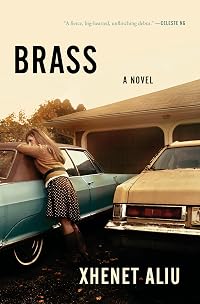
Brass
by Xhenet Aliu
On This Page
Description
“A fierce, big-hearted, unflinching debut”* novel about mothers and daughters, haves and have-nots, and the stark realities behind the American Dream*Celeste Ng, author of Little Fires Everywhere
WINNER OF THE GEORGIA AUTHOR OF THE YEAR AWARD FOR FIRST NOVEL • NAMED ONE OF THE BEST BOOKS OF THE YEAR BY SAN FRANCISCO CHRONICLE AND REAL SIMPLE
A waitress at the Betsy Ross Diner, Elsie hopes her nickel-and-dime tips will add up to a new life. Then she meets Bashkim, who is at once both show more worldly and naïve, a married man who left Albania to chase his dreams—and wound up working as a line cook in Waterbury, Connecticut. Back when the brass mills were still open, this bustling factory town drew one wave of immigrants after another. Now it’s the place they can’t seem to leave. Elsie, herself the granddaughter of Lithuanian immigrants, falls in love quickly, but when she learns that she’s pregnant, Elsie can’t help wondering where Bashkim’s heart really lies, and what he’ll do about the wife he left behind.
Seventeen years later, headstrong and independent Luljeta receives a rejection letter from NYU and her first-ever suspension from school on the same day. Instead of striking out on her own in Manhattan, she’s stuck in Connecticut with her mother, Elsie—a fate she refuses to accept. Wondering if the key to her future is unlocking the secrets of the past, Lulu decides to find out what exactly her mother has been hiding about the father she never knew. As she soon discovers, the truth is closer than she ever imagined.
Told in equally gripping parallel narratives with biting wit and grace, Brass announces a fearless new voice with a timely, tender, and quintessentially American story.
Praise for Brass
“Lustrous . . . a tale alive with humor and gumption, of the knotty, needy bond between a mother and daughter . . . [Brass] marks the arrival of a writer whose work will stand the test of time.”—O: The Oprah Magazine
“An exceptional debut novel, one that plumbs the notion of the American Dream while escaping the clichés that pursuit almost always brings with it . . . [Xhenet] Aliu delivers a living, breathing portrait of places left behind.”—The Boston Globe
“The writing blazes on the page. . . . So much about the book is also extraordinarily timely, especially when it focuses on class and culture, and what they really mean.”—San Francisco Chronicle
“Aliu is witty and unsparing in her depiction of the town and its inhabitants, illustrating the granular realities of the struggle for class mobility.”—The New Yorker. show less
Tags
Recommendations














Member Recommendations

Member Reviews
In the decaying factory town of Waterbury, Connecticut, a young Lithuanian American girl gets a job as a waitress at the Betsy Ross diner. Her mother's an alcoholic, her younger sister has the brains and grades to get out of Waterbury, and Elsie's just hoping for a better life. Instead, she meets Bashkim, newly emigrated from Albania, where he left his wife behind in the hopes of a better life in the US.
A generation later, Elsie's daughter, Luljeta, also hopes for a better life somewhere else, but a rejection letter from the university she'd pinned her hopes on have her scrambling to find a reason to believe that she can make a better life for herself than the low income grind she has with her mother. Lulu goes in search of the father show more her mother won't talk about.
This may be a debut novel, but it's self-assured and well-written. Xhenet Aliu has managed something even seasoned authors struggle with; her two narrators sound different, but subtly so. She also writes with a dry humor and keen eye for detail. The characters inhabit a vivid, if run-down world and there's a lot of detail as to the cultural and social structures of the immigrant communities Lulu and Elsie live in, as well as the realities of always having to scramble to make the rent payment. I was impressed by this novel, loved that it shed light on people and places not usually given attention.
The addition of your mother's boyfriend, the postanarchist Professor Robbie, brings the total number of guests gathered for Christmas dinner to five, one more than the quartet of you, your mother, Mamie, and Greta, which had gathered for Thanksgiving and all other previous holidays you've sat through your entire life. Even with the addition of a Y chromosome, your Noel looks mostly like a nativity scene staged by a militant women's separatist group. show less
A generation later, Elsie's daughter, Luljeta, also hopes for a better life somewhere else, but a rejection letter from the university she'd pinned her hopes on have her scrambling to find a reason to believe that she can make a better life for herself than the low income grind she has with her mother. Lulu goes in search of the father show more her mother won't talk about.
This may be a debut novel, but it's self-assured and well-written. Xhenet Aliu has managed something even seasoned authors struggle with; her two narrators sound different, but subtly so. She also writes with a dry humor and keen eye for detail. The characters inhabit a vivid, if run-down world and there's a lot of detail as to the cultural and social structures of the immigrant communities Lulu and Elsie live in, as well as the realities of always having to scramble to make the rent payment. I was impressed by this novel, loved that it shed light on people and places not usually given attention.
The addition of your mother's boyfriend, the postanarchist Professor Robbie, brings the total number of guests gathered for Christmas dinner to five, one more than the quartet of you, your mother, Mamie, and Greta, which had gathered for Thanksgiving and all other previous holidays you've sat through your entire life. Even with the addition of a Y chromosome, your Noel looks mostly like a nativity scene staged by a militant women's separatist group. show less
Chip Off the Old Block
Xhenet Aliu portrays the lives of two women, a mother and her daughter, a small American city, Waterbury, CT, crushed dreams, and an Albanian immigrant community in transition from homeland customs to rough and ready U.S. capitalism, though that can’t compare to the financial snookering perpetrated by Albanians on Albanians in the 1990s, half the timeframe of the novel. Doubtless the circumstances of mother Elsie and daughter Luljeta are often desperate, but also in the end inspirational, at least in that given determination, there seems always to be a way out.
Aliu sets the story in Waterbury, in the 1990s for Elsie, in current times for Luljeta. She has both women tell their stories, Elsie’s about how she came show more to have Luljeta and raise her as a single mother, Luljeta’s concerning her feelings of being a misfit and inadequate and yearning to know about her father. Elsie tells her story in the first-person. Luljeta tells her in the second-person, which in the skillful hands of Aliu proves a very effective device helping us understand how Luljeta feels about herself, removed from the world, incomplete, and cynical about the whole thing.
Waterbury, once a prosperous city trilling on the several brass works in the city, has fallen unto hard times by the 1990s. Many without marketable knowledge-work skills find themselves casting around for anything to put bread on the table, exactly the plight of Elsie. She works in a small family run Albanian restaurant operated by husband and wife Gjonni and Yllka. There, she takes up with the fry cook, Bashkim. He’s fairly fresh from Albania and a man with big dreams and a wife back home. Bashkim, as do many of his fellow countrymen, talk constantly about getting rich on mysterious investments, mysterious because whenever Elsie questions him about them he blows her off. (These investments, numbering at least 25, were really a rash of pyramid schemes that eventually tore Albania apart and led to the Albanian Civil War in 1997.) Eventually, Elsie becomes pregnant with Luljeta and Bashkim deserts her for reasons left for readers to discover on their own.
Luljeta’s 17, always the odd girl out in school to the point where she’s subject to constant abuse, keeps herself moving forward with her big plans, a trait not unlike he father’s. Then she receives bad news that sends her into a tailspin; her aspirational college NYU rejects her. Like many teens, she’s at odds on the outside and as much in conflict within her home with mom Elsie. Eventually, she concocts a plan to find her father, especially after she learns his name and a smidge of Elsie’s and his life together from Yllka. In a parallel to her mother’s life with Bashkim, she accepts the help of a well off Albanian-American college boy Ahmet, whose entrepreneurial ambition is owning a couple of Panera Bread franchises. With him, she begins a quest to find her father and gain an understanding of herself. All, as they say, doesn’t quite turn out as planned.
If Luljeta had the benefit Aliu provides us readers, she would realize that in the most important ways, she is very much her mother’s daughter, conveyed by Aliu in the attitude and dialogue she conjures for each in their alternating stories. Beautifully written, capturing both adaptive immigrant life and desperate times, Aliu tells the tales with edge and humor. It’s a novel not to be missed. show less
Xhenet Aliu portrays the lives of two women, a mother and her daughter, a small American city, Waterbury, CT, crushed dreams, and an Albanian immigrant community in transition from homeland customs to rough and ready U.S. capitalism, though that can’t compare to the financial snookering perpetrated by Albanians on Albanians in the 1990s, half the timeframe of the novel. Doubtless the circumstances of mother Elsie and daughter Luljeta are often desperate, but also in the end inspirational, at least in that given determination, there seems always to be a way out.
Aliu sets the story in Waterbury, in the 1990s for Elsie, in current times for Luljeta. She has both women tell their stories, Elsie’s about how she came show more to have Luljeta and raise her as a single mother, Luljeta’s concerning her feelings of being a misfit and inadequate and yearning to know about her father. Elsie tells her story in the first-person. Luljeta tells her in the second-person, which in the skillful hands of Aliu proves a very effective device helping us understand how Luljeta feels about herself, removed from the world, incomplete, and cynical about the whole thing.
Waterbury, once a prosperous city trilling on the several brass works in the city, has fallen unto hard times by the 1990s. Many without marketable knowledge-work skills find themselves casting around for anything to put bread on the table, exactly the plight of Elsie. She works in a small family run Albanian restaurant operated by husband and wife Gjonni and Yllka. There, she takes up with the fry cook, Bashkim. He’s fairly fresh from Albania and a man with big dreams and a wife back home. Bashkim, as do many of his fellow countrymen, talk constantly about getting rich on mysterious investments, mysterious because whenever Elsie questions him about them he blows her off. (These investments, numbering at least 25, were really a rash of pyramid schemes that eventually tore Albania apart and led to the Albanian Civil War in 1997.) Eventually, Elsie becomes pregnant with Luljeta and Bashkim deserts her for reasons left for readers to discover on their own.
Luljeta’s 17, always the odd girl out in school to the point where she’s subject to constant abuse, keeps herself moving forward with her big plans, a trait not unlike he father’s. Then she receives bad news that sends her into a tailspin; her aspirational college NYU rejects her. Like many teens, she’s at odds on the outside and as much in conflict within her home with mom Elsie. Eventually, she concocts a plan to find her father, especially after she learns his name and a smidge of Elsie’s and his life together from Yllka. In a parallel to her mother’s life with Bashkim, she accepts the help of a well off Albanian-American college boy Ahmet, whose entrepreneurial ambition is owning a couple of Panera Bread franchises. With him, she begins a quest to find her father and gain an understanding of herself. All, as they say, doesn’t quite turn out as planned.
If Luljeta had the benefit Aliu provides us readers, she would realize that in the most important ways, she is very much her mother’s daughter, conveyed by Aliu in the attitude and dialogue she conjures for each in their alternating stories. Beautifully written, capturing both adaptive immigrant life and desperate times, Aliu tells the tales with edge and humor. It’s a novel not to be missed. show less
Chip Off the Old Block
Xhenet Aliu portrays the lives of two women, a mother and her daughter, a small American city, Waterbury, CT, crushed dreams, and an Albanian immigrant community in transition from homeland customs to rough and ready U.S. capitalism, though that can’t compare to the financial snookering perpetrated by Albanians on Albanians in the 1990s, half the timeframe of the novel. Doubtless the circumstances of mother Elsie and daughter Luljeta are often desperate, but also in the end inspirational, at least in that given determination, there seems always to be a way out.
Aliu sets the story in Waterbury, in the 1990s for Elsie, in current times for Luljeta. She has both women tell their stories, Elsie’s about how she came show more to have Luljeta and raise her as a single mother, Luljeta’s concerning her feelings of being a misfit and inadequate and yearning to know about her father. Elsie tells her story in the first-person. Luljeta tells her in the second-person, which in the skillful hands of Aliu proves a very effective device helping us understand how Luljeta feels about herself, removed from the world, incomplete, and cynical about the whole thing.
Waterbury, once a prosperous city trilling on the several brass works in the city, has fallen unto hard times by the 1990s. Many without marketable knowledge-work skills find themselves casting around for anything to put bread on the table, exactly the plight of Elsie. She works in a small family run Albanian restaurant operated by husband and wife Gjonni and Yllka. There, she takes up with the fry cook, Bashkim. He’s fairly fresh from Albania and a man with big dreams and a wife back home. Bashkim, as do many of his fellow countrymen, talk constantly about getting rich on mysterious investments, mysterious because whenever Elsie questions him about them he blows her off. (These investments, numbering at least 25, were really a rash of pyramid schemes that eventually tore Albania apart and led to the Albanian Civil War in 1997.) Eventually, Elsie becomes pregnant with Luljeta and Bashkim deserts her for reasons left for readers to discover on their own.
Luljeta’s 17, always the odd girl out in school to the point where she’s subject to constant abuse, keeps herself moving forward with her big plans, a trait not unlike he father’s. Then she receives bad news that sends her into a tailspin; her aspirational college NYU rejects her. Like many teens, she’s at odds on the outside and as much in conflict within her home with mom Elsie. Eventually, she concocts a plan to find her father, especially after she learns his name and a smidge of Elsie’s and his life together from Yllka. In a parallel to her mother’s life with Bashkim, she accepts the help of a well off Albanian-American college boy Ahmet, whose entrepreneurial ambition is owning a couple of Panera Bread franchises. With him, she begins a quest to find her father and gain an understanding of herself. All, as they say, doesn’t quite turn out as planned.
If Luljeta had the benefit Aliu provides us readers, she would realize that in the most important ways, she is very much her mother’s daughter, conveyed by Aliu in the attitude and dialogue she conjures for each in their alternating stories. Beautifully written, capturing both adaptive immigrant life and desperate times, Aliu tells the tales with edge and humor. It’s a novel not to be missed. show less
Xhenet Aliu portrays the lives of two women, a mother and her daughter, a small American city, Waterbury, CT, crushed dreams, and an Albanian immigrant community in transition from homeland customs to rough and ready U.S. capitalism, though that can’t compare to the financial snookering perpetrated by Albanians on Albanians in the 1990s, half the timeframe of the novel. Doubtless the circumstances of mother Elsie and daughter Luljeta are often desperate, but also in the end inspirational, at least in that given determination, there seems always to be a way out.
Aliu sets the story in Waterbury, in the 1990s for Elsie, in current times for Luljeta. She has both women tell their stories, Elsie’s about how she came show more to have Luljeta and raise her as a single mother, Luljeta’s concerning her feelings of being a misfit and inadequate and yearning to know about her father. Elsie tells her story in the first-person. Luljeta tells her in the second-person, which in the skillful hands of Aliu proves a very effective device helping us understand how Luljeta feels about herself, removed from the world, incomplete, and cynical about the whole thing.
Waterbury, once a prosperous city trilling on the several brass works in the city, has fallen unto hard times by the 1990s. Many without marketable knowledge-work skills find themselves casting around for anything to put bread on the table, exactly the plight of Elsie. She works in a small family run Albanian restaurant operated by husband and wife Gjonni and Yllka. There, she takes up with the fry cook, Bashkim. He’s fairly fresh from Albania and a man with big dreams and a wife back home. Bashkim, as do many of his fellow countrymen, talk constantly about getting rich on mysterious investments, mysterious because whenever Elsie questions him about them he blows her off. (These investments, numbering at least 25, were really a rash of pyramid schemes that eventually tore Albania apart and led to the Albanian Civil War in 1997.) Eventually, Elsie becomes pregnant with Luljeta and Bashkim deserts her for reasons left for readers to discover on their own.
Luljeta’s 17, always the odd girl out in school to the point where she’s subject to constant abuse, keeps herself moving forward with her big plans, a trait not unlike he father’s. Then she receives bad news that sends her into a tailspin; her aspirational college NYU rejects her. Like many teens, she’s at odds on the outside and as much in conflict within her home with mom Elsie. Eventually, she concocts a plan to find her father, especially after she learns his name and a smidge of Elsie’s and his life together from Yllka. In a parallel to her mother’s life with Bashkim, she accepts the help of a well off Albanian-American college boy Ahmet, whose entrepreneurial ambition is owning a couple of Panera Bread franchises. With him, she begins a quest to find her father and gain an understanding of herself. All, as they say, doesn’t quite turn out as planned.
If Luljeta had the benefit Aliu provides us readers, she would realize that in the most important ways, she is very much her mother’s daughter, conveyed by Aliu in the attitude and dialogue she conjures for each in their alternating stories. Beautifully written, capturing both adaptive immigrant life and desperate times, Aliu tells the tales with edge and humor. It’s a novel not to be missed. show less
There's a strong possibility you haven't heard of Xhenet Aliu... yet. She published a little known collection four years ago, Domesticated Wild Things and Other Stories. Personally, I think it is one of the best, most well-rounded collections I've had the pleasure of reading. Her stories were dark, yet hopeful, poetic, still simple, specific and universal—so much of what I love. So I was excited when I learned Aliu would soon publish her first novel, Brass.
Naturally, I was a little concerned if Aliu's style—so incredibly effective in short form—could be stretched out over three hundred pages. It does and it doesn't. There's a punch to Aliu's shorter stories that I looked forward to in Brass, but it never came. That's okay. show more Honestly, there aren't too many novels that have packed that punch, nor need to. Novels are a much more subtle form of writing and it takes an extremely dedicated and talented novelist to surprise a reader and to adequately manipulate their emotions over the length of a novel (Kazuo Ishiguro, I'm talking to you). In every other way, Brass is every bit as powerful as the stories in Aliu's collection. First and foremost, the language is simple, yet always somehow evokes higher emotions—excitement, dread, sympathy:
For anyone who has read my reviews long enough, you know voice and character development are what matter most to me, as a reader. This is perhaps what I love most about Aliu's writing. She is adept at crafting a wonderful, memorable voice and in providing characters who are extremely realistic, yet never boring. The characters in Aliu's story are incredibly real. I felt as though I were prying into their private lives. Brass uses alternating viewpoints. The first is Elsie's. Hers is written in the first person and takes place during the 1980s. The second is Luljeta's, Elsie's daughter. Her story occurs in recent years and is written in the second person. I, like many readers, am not a big fan of second person narratives, but in this case it's done well and is only occasionally noticeable. What purpose does the second-person narration serve? I'm not sure. In a story where both mother and daughter live similar lives in like environments, it's difficult at time to keep their stories straight and these perspective do perhaps aid in differentiating the two. Also, I think what it does initially is to help the reader feel closer to Luljeta. Although her mother's story begins the novel and is vitally important, Brass is really Luljeta's story. As Elsie's story builds and becomes more interesting than Luljeta's in middle chapters, the reader has already grown close to Luljeta, so her mother's story does not surpass her own.
Brass possesses so much honesty—it's incredibly believable but that doesn't keep it from being interesting and beautiful. Aliu is a master of taking the everyday world and finding a story in its darkest most-well-lit places. She doesn't need to reshape or glamorize what she finds, she merely looks at it from a different perspective and is able to put it into words with great skill. Aliu is such a terrific writer and Brass is just the story that will introduce many new readers to her work. show less
Naturally, I was a little concerned if Aliu's style—so incredibly effective in short form—could be stretched out over three hundred pages. It does and it doesn't. There's a punch to Aliu's shorter stories that I looked forward to in Brass, but it never came. That's okay. show more Honestly, there aren't too many novels that have packed that punch, nor need to. Novels are a much more subtle form of writing and it takes an extremely dedicated and talented novelist to surprise a reader and to adequately manipulate their emotions over the length of a novel (Kazuo Ishiguro, I'm talking to you). In every other way, Brass is every bit as powerful as the stories in Aliu's collection. First and foremost, the language is simple, yet always somehow evokes higher emotions—excitement, dread, sympathy:
”... Isn't that what you want?”
I couldn't make my head move up and down in agreement, so I just rested it against his chest, listening to his heart in case it was giving anything away. It sounded like it was beating uh-oh, uh-oh, uh-oh, the droning pulse of a dirge, and that made me feel a little better. That dread was the same kind I felt the first time I saw Bashkim, the same kind I felt when I listened to the best minor-key ballads, and that inspired the kind of love that was easier to nurture than kudzu. It didn't even need light to grow.
For anyone who has read my reviews long enough, you know voice and character development are what matter most to me, as a reader. This is perhaps what I love most about Aliu's writing. She is adept at crafting a wonderful, memorable voice and in providing characters who are extremely realistic, yet never boring. The characters in Aliu's story are incredibly real. I felt as though I were prying into their private lives. Brass uses alternating viewpoints. The first is Elsie's. Hers is written in the first person and takes place during the 1980s. The second is Luljeta's, Elsie's daughter. Her story occurs in recent years and is written in the second person. I, like many readers, am not a big fan of second person narratives, but in this case it's done well and is only occasionally noticeable. What purpose does the second-person narration serve? I'm not sure. In a story where both mother and daughter live similar lives in like environments, it's difficult at time to keep their stories straight and these perspective do perhaps aid in differentiating the two. Also, I think what it does initially is to help the reader feel closer to Luljeta. Although her mother's story begins the novel and is vitally important, Brass is really Luljeta's story. As Elsie's story builds and becomes more interesting than Luljeta's in middle chapters, the reader has already grown close to Luljeta, so her mother's story does not surpass her own.
Brass possesses so much honesty—it's incredibly believable but that doesn't keep it from being interesting and beautiful. Aliu is a master of taking the everyday world and finding a story in its darkest most-well-lit places. She doesn't need to reshape or glamorize what she finds, she merely looks at it from a different perspective and is able to put it into words with great skill. Aliu is such a terrific writer and Brass is just the story that will introduce many new readers to her work. show less
I really liked this—kind of exactly what I needed to read right now. As an essentially kind person who sometimes walks around with a chip on my shoulder because the world is a difficult place, I find reading about essentially kind people who sometimes walk around with chips on their shoulders because the world is a difficult place to be really... comforting. At least if the writing is good and the story has a good compassionate heart, and this is definitely one of those. Super sweet without being at all saccharine.
Elsie is a young waitress at the Betsy Ross Diner. She hopes her nickel and dime tips will take her away from her small town of Waterbury, Connecticut. Instead, she becomes pregnant to Bashkim - a married man from Albania who works at the Diner as a line cook. Elsie doesn't quite know what's going to happen once the baby comes. Will Bashkim stay or will he go back to his wife? Fast forward seventeen years and we have headstrong, independent Luljeta who has just received a rejection letter from NYU and her first ever suspension from school both on the same day. She desperately wanted a new life in New York but she's stuck in Connecticut with her mother. Now she's determined to uncover the truth about the father she never knew.
The show more chapters alternate between Elsie when she was younger, and her daughter, Luljeta, when she's almost the same age. I really enjoyed the writing. The author has the ability to transform a mundane sentence into something mesmerizing. Sadly, at a little over halfway, the lack of anything really happening made me bored and the ending didn't make up for that fact. What a disappointing ending.
Thank you to Netgalley and Random House for an ARC. show less
The show more chapters alternate between Elsie when she was younger, and her daughter, Luljeta, when she's almost the same age. I really enjoyed the writing. The author has the ability to transform a mundane sentence into something mesmerizing. Sadly, at a little over halfway, the lack of anything really happening made me bored and the ending didn't make up for that fact. What a disappointing ending.
Thank you to Netgalley and Random House for an ARC. show less
Brass by Xhenet Aliu explores the relationship of a mother and daughter who both dream of escaping their economically depressed town.
In 1996, Elsie Kuzavinas is working as a waitress at a diner owned by Alabanian immigrants. She has big dreams of earning enough money to purchase a car and leave behind both her dead-end job and hometown. Entering into an affair with Bashkim, whose wife, Agnes did not accompany him to America, an unplanned pregnancy threatens to derail her plans. With promises to help raise their baby, Bashkim convinces her to continue the pregnancy but he leaves before she gives birth. Now following in the path of her own mother (but hopefully minus the drinking problem), Elsie barely ekes out a living for herself and show more her daughter Luljeta "Lulu".
Fast forward seventeen years and Lulu also dreams of leaving Waterbury for New York where she plans to attend college. A bit of a social outcast, she is a painfully shy young woman who always follows the rules. When she receives a college rejection letter, she ends up suspended from school following an altercation with the school bully. Lulu decides it is time to learn the truth about the father she has never met.
The storyline weaves back and forth in time so readers get to see both mother and daughter at the same age as they each attempt to reach the same goal: leave their bleak hometown with hopes of a brighter future. Elsie and Bashkim are both a little naive about finances but once Elsie gets pregnant, reality strikes rather quickly. Life with Bashkim is not easy and she is planning a way out when he betrays her. Lulu wants to avoid the same fate as her mother and she has worked hard to ensure she makes it into college, but the rejection letter hits her hard and she becomes a little cynical.
Brass is an unflinchingly honest portrayal of life in a financially depressed town. Xhenet Aliu paints a rather hopeless and depressing future for both Elsie and Lulu as they fail to realize their dreams of escaping the same fate as the previous generations. While the storyline is interesting, the pacing of the story is rather slow. Elsie's chapters are much easier to read than Lulu's which are written in second person. The novel comes to a bit of an unexpected conclusion that is a little heartrending. show less
In 1996, Elsie Kuzavinas is working as a waitress at a diner owned by Alabanian immigrants. She has big dreams of earning enough money to purchase a car and leave behind both her dead-end job and hometown. Entering into an affair with Bashkim, whose wife, Agnes did not accompany him to America, an unplanned pregnancy threatens to derail her plans. With promises to help raise their baby, Bashkim convinces her to continue the pregnancy but he leaves before she gives birth. Now following in the path of her own mother (but hopefully minus the drinking problem), Elsie barely ekes out a living for herself and show more her daughter Luljeta "Lulu".
Fast forward seventeen years and Lulu also dreams of leaving Waterbury for New York where she plans to attend college. A bit of a social outcast, she is a painfully shy young woman who always follows the rules. When she receives a college rejection letter, she ends up suspended from school following an altercation with the school bully. Lulu decides it is time to learn the truth about the father she has never met.
The storyline weaves back and forth in time so readers get to see both mother and daughter at the same age as they each attempt to reach the same goal: leave their bleak hometown with hopes of a brighter future. Elsie and Bashkim are both a little naive about finances but once Elsie gets pregnant, reality strikes rather quickly. Life with Bashkim is not easy and she is planning a way out when he betrays her. Lulu wants to avoid the same fate as her mother and she has worked hard to ensure she makes it into college, but the rejection letter hits her hard and she becomes a little cynical.
Brass is an unflinchingly honest portrayal of life in a financially depressed town. Xhenet Aliu paints a rather hopeless and depressing future for both Elsie and Lulu as they fail to realize their dreams of escaping the same fate as the previous generations. While the storyline is interesting, the pacing of the story is rather slow. Elsie's chapters are much easier to read than Lulu's which are written in second person. The novel comes to a bit of an unexpected conclusion that is a little heartrending. show less
Members
- Recently Added By
Lists

Kirkus Starred Fiction Reviews of Books Published in 2018
330 works; 3 members

Books You Couldn't Finish
202 works; 32 members
Author Information

4 Works 274 Members
Awards and Honors
Common Knowledge
- Canonical title
- Brass
- Original title
- Brass
- Original publication date
- 2018-01-23
- People/Characters
- Elsie Kuzavinas; Luljeta "Lulu" Hasani; Bashkim Hasani
- Important places
- Waterbury, Connecticut, USA
- Dedication
- To my mother, this book is for you, not about you, I promise.
- First words
- When the last of the brass mills locked up their doors and hauled ass out of town once and for all, it seemed all they left behind were blocks of abandoned factories that poked out from behind high stone gates like caskets fl... (show all)oated to the surface after the great flood of '55.
- Blurbers
- Ng, Celeste; Henriquez, Cristina; Greenidge, Kaitlyn; van der Berg, Laura; Engel, Patricia
- Original language
- English
Classifications
Statistics
- Members
- 227
- Popularity
- 143,852
- Reviews
- 14
- Rating
- (3.86)
- Languages
- English
- Media
- Paper, Audiobook, Ebook
- ISBNs
- 8
- ASINs
- 2