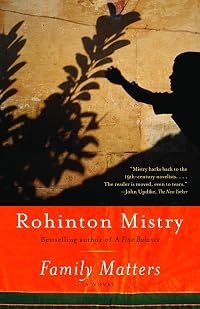
Family Matters
by Rohinton Mistry
On This Page
Description
From the author of the highly acclaimed A fine balance comes Rohinton Mistry's eagerly anticipated new novel is set in Bombay in the mid-1990s. Nariman, an ailing, elderly Parsi widower, lives with his middle-aged stepchildren and dreams of the past. When he breaks an ankle and can no longer partake of his one pleasure, a daily walk through the neighborhood, his bitter stepdaughter schemes to move him to her sister's home and relieve herself of the burden of caring for him. The move is show more accomplished, but living in a new household with Roxana, her husband and two young boys sets into motion a series of events that lead to the unraveling of the family's secrets and surprising revelations from the past. Family matters is a brilliantly evocative novel that confirms Mistry's a reputation as one of the finest writers of our time. show lessTags
Recommendations







































Member Recommendations


Member Reviews
This is a beautifully written story that focuses on a Parsi family living in Bombay (Mumbai) in the 1990s. They live in a small flat. The mother’s step siblings deposit her injured and aging father, who is also battling Parkinson’s disease, on her doorstep when they are unable or unwilling to care for him. It is about ordinary lives that are transformed by bad luck, and how they respond to these challenges. It is filled with moral dilemmas, especially for the family’s patriarch, Yesad. The relationship between the youngest child and the grandfather is portrayed with such tenderness. The child wants to help and even finds a way of making money and secretly slipping it into the family’s funds. It poignantly depicts family show more dynamics, the big changes taking place in the city, Parsi beliefs and concerns, and Hindu-Muslim tensions of the time period. Themes include elder care, family bonds, corruption, sense of belonging, religion, and the generation gap. It is a bittersweet and intimate story told in Mistry’s elegant style. It is slow in developing, but the payoff is well worth it. It is a book to become immersed in. Truly a gem. show less
This is a beautifully written story that focuses on a Parsi family living in Bombay (Mumbai) in the 1990s. They live in a small flat. The mother’s step siblings deposit her injured and aging father, who is also battling Parkinson’s disease, on her doorstep when they are unable or unwilling to care for him. It is about ordinary lives that are transformed by bad luck, and how they respond to these challenges. It is filled with moral dilemmas, especially for the family’s patriarch, Yesad. The relationship between the youngest child and the grandfather is portrayed with such tenderness. The child wants to help and even finds a way of making money and secretly slipping it into the family’s funds. It poignantly depicts family show more dynamics, the big changes taking place in the city, Parsi beliefs and concerns, and Hindu-Muslim tensions of the time period. Themes include elder care, family bonds, corruption, sense of belonging, religion, and the generation gap. It is a bittersweet and intimate story told in Mistry’s elegant style. It is slow in developing, but the payoff is well worth it. It is a book to become immersed in. Truly a gem. show less
They continued to cope, poorly, with the excretions and secretions of their stepfather's body, moving from revulsion to pity to anger, and back to revulsion. They were bewildered, and indignant, that a human creature of blood and bone, so efficient in good health, could suddenly become so messy. Neither Nariman's age nor his previous illnesses had served to warn them. Sometimes they took it personally, as though their stepfather had reduced himself to this state to harass them. And by nightfall, the air was again fraught with tension, thick with reproaches spoken and silent. (p 68)
Nariman Vakeel is an elderly, retired English professor suffering from Parkinson's Disease. He lives in the family home -- ironically named Chateau Felicity show more -- with his middle-aged step-children, Jal and Coomy. Nariman married their mother Yasmin when Jal and Coomy were children, after his family forbid him to marry his true love, Lucy. He raised them along with a younger half-sister, Roxana. Coomy is filled with resentment; everyone else walks on eggshells to avoid her bitterness. Jal feigns obliviousness, tinkering with his hearing aid when tempers flare.
When Nariman falls while out on a walk, Jal and Coomy are quickly overwhelmed by the responsibility of caring for him. Coomy wastes no time tricking Roxana into taking him in. Roxana and her family live in a smaller flat and struggle to make ends meet, but they are blessed with a more positive outlook on life. Even Roxana's young sons take things in stride:
The balcony door framed the scene: nine-year-old happily feeding seventy-nine.
And then it struck her like a revelation -- of what, she could not say. Hidden by the screen of damp clothes, she watched, clutching Yezad's shirt in her hands. She felt she was witnessing something almost sacred, and her eyes refused to relinquish the previous moment, for she knew instinctively that it would become a memory to cherish, to recall in difficult times when she needed strength. (p. 98)
But as weeks pass, the strain takes its toll on everyone. Coomy takes dramatic steps to keep up the illusion she is unable to care for Nariman. Jal is silently complicit. Roxana tries, in vain, to stretch Yezad's salary to cover the cost of Nariman's medication. And Yezad responds to the financial strain through a series of progressively destructive acts aimed at improving their financial situation. Eventually they hit rock bottom in ways both inevitable and shocking, and are then faced with the challenge of rebuilding what they hold most dear.
I put off reading this book for some time, thinking it might strike too close to home. My father has Parkinson's, and last year a medical incident set in motion a series of events culminating in my parents' long-overdue move to a continuous care retirement community. Family Matters was indeed painful to read, although I could distance myself from it because the Vakeel family's situation was very different from mine. And yet there are valuable messages in this book about the importance of family, and living for today, that are still with me days after finishing the book. show less
Nariman Vakeel is an elderly, retired English professor suffering from Parkinson's Disease. He lives in the family home -- ironically named Chateau Felicity show more -- with his middle-aged step-children, Jal and Coomy. Nariman married their mother Yasmin when Jal and Coomy were children, after his family forbid him to marry his true love, Lucy. He raised them along with a younger half-sister, Roxana. Coomy is filled with resentment; everyone else walks on eggshells to avoid her bitterness. Jal feigns obliviousness, tinkering with his hearing aid when tempers flare.
When Nariman falls while out on a walk, Jal and Coomy are quickly overwhelmed by the responsibility of caring for him. Coomy wastes no time tricking Roxana into taking him in. Roxana and her family live in a smaller flat and struggle to make ends meet, but they are blessed with a more positive outlook on life. Even Roxana's young sons take things in stride:
The balcony door framed the scene: nine-year-old happily feeding seventy-nine.
And then it struck her like a revelation -- of what, she could not say. Hidden by the screen of damp clothes, she watched, clutching Yezad's shirt in her hands. She felt she was witnessing something almost sacred, and her eyes refused to relinquish the previous moment, for she knew instinctively that it would become a memory to cherish, to recall in difficult times when she needed strength. (p. 98)
But as weeks pass, the strain takes its toll on everyone. Coomy takes dramatic steps to keep up the illusion she is unable to care for Nariman. Jal is silently complicit. Roxana tries, in vain, to stretch Yezad's salary to cover the cost of Nariman's medication. And Yezad responds to the financial strain through a series of progressively destructive acts aimed at improving their financial situation. Eventually they hit rock bottom in ways both inevitable and shocking, and are then faced with the challenge of rebuilding what they hold most dear.
I put off reading this book for some time, thinking it might strike too close to home. My father has Parkinson's, and last year a medical incident set in motion a series of events culminating in my parents' long-overdue move to a continuous care retirement community. Family Matters was indeed painful to read, although I could distance myself from it because the Vakeel family's situation was very different from mine. And yet there are valuable messages in this book about the importance of family, and living for today, that are still with me days after finishing the book. show less
"The heart has its reasons which reason knows nothing of."
Rohinton Mistry’s novel 'Family Matters' is smaller in scope than his earlier 'A Fine Balance', it deals with fateful choices by three generations of the men of a Parsi family in modern day India, the difficulties of caring for elder family members, and the role of tradition and religion in an ethnic minority that's in decline.
Nariman Vakeel is a 79 year old widower with Parkinson’s who lives with his two middle-aged step-children in an increasingly dilapidated apartment in Mumbai. Old age has brought him considerable health problems, yet Nariman is largely jovial and optimistic until an accident leaves him bed-ridden. Decisions about his on-going care needs have tragic show more consequences for all of the family as do decisions made decades previously.
You may be forgiven for thinking that its Nariman’s life story that dominates this novel but it covers three generations of Parsi men. The novel touches on many of the issues of modern day India, poor housing and wages, few employee rights, corruption, religious and ethnic divisions, healthcare problems to name but a few but this a familial and intimate story that befits the tile. However, it does share some common ground with the author's previous novels.
"If you ignore little things, they become big problems."
There were a couple of things that niggled me about the novel and both of them centred around Nariman's son-in-law, Yezad. When his father-in-law is placed in his family’s care the effect on their finances is considerable, he lashes out at his wife and sons and engages in dangerous ventures which puts all of his family at risk yet there seems to be little remorse shown. Similarly his full-blown return to his faith just seemed to be so out of keeping with what had gone before that it was hard to believe.
All three of Mistry’s novels were shortlisted for the Booker Prize which is an impressive achievement in itself and he can perhaps count himself unlucky not to have one of them. I thoroughly enjoy Mistry's character development. All of them in this novel are well drawn and it was difficult to dislike any of them despite not agreeing with some of their decisions, eccentric minor characters only added considerable colour and humour. The central theme of the care for elders and the burden that it can place on a struggling families, the difficult moral choices made in desperate circumstances is relatable and universal making this a poignant and thoughtful piece of writing. show less
Rohinton Mistry’s novel 'Family Matters' is smaller in scope than his earlier 'A Fine Balance', it deals with fateful choices by three generations of the men of a Parsi family in modern day India, the difficulties of caring for elder family members, and the role of tradition and religion in an ethnic minority that's in decline.
Nariman Vakeel is a 79 year old widower with Parkinson’s who lives with his two middle-aged step-children in an increasingly dilapidated apartment in Mumbai. Old age has brought him considerable health problems, yet Nariman is largely jovial and optimistic until an accident leaves him bed-ridden. Decisions about his on-going care needs have tragic show more consequences for all of the family as do decisions made decades previously.
You may be forgiven for thinking that its Nariman’s life story that dominates this novel but it covers three generations of Parsi men. The novel touches on many of the issues of modern day India, poor housing and wages, few employee rights, corruption, religious and ethnic divisions, healthcare problems to name but a few but this a familial and intimate story that befits the tile. However, it does share some common ground with the author's previous novels.
"If you ignore little things, they become big problems."
There were a couple of things that niggled me about the novel and both of them centred around Nariman's son-in-law, Yezad. When his father-in-law is placed in his family’s care the effect on their finances is considerable, he lashes out at his wife and sons and engages in dangerous ventures which puts all of his family at risk yet there seems to be little remorse shown. Similarly his full-blown return to his faith just seemed to be so out of keeping with what had gone before that it was hard to believe.
All three of Mistry’s novels were shortlisted for the Booker Prize which is an impressive achievement in itself and he can perhaps count himself unlucky not to have one of them. I thoroughly enjoy Mistry's character development. All of them in this novel are well drawn and it was difficult to dislike any of them despite not agreeing with some of their decisions, eccentric minor characters only added considerable colour and humour. The central theme of the care for elders and the burden that it can place on a struggling families, the difficult moral choices made in desperate circumstances is relatable and universal making this a poignant and thoughtful piece of writing. show less
Yezad, who works at the Bombay sports Emporium, has a boss, Mr kapur, whose hobby it is to find and buy old photos of Bombay in its early days. Then he finds photos of even earlier times and then a bit later time, and compare them to the actual scene. He shows yezad three photos of the area around the Bombay Sports Emporium, and what they looked like in earlier times:
"yezad's eyes moved from the print to the junction where six roads converged, and back to the print, willing the cinema to disappear with the picture's aid.
'What are those low structures in the photo?'
'I went to the Asiatic society library and did some research. This plot of land was acquired by the metro goldwin corporation in 1936, on a lease for 99 years, at one rupee show more per year. What you see in the photo are the stables of the royal air force.'
'why would the Air Force need stables?'
'for their horses.'
'Very funny. Okay, so why would they need horses?'
'to wheel the planes out of the hangers, to haul heavy machinery - mix of high-tech and low. Like it still is - last week, the phone company was laying state of the art fiber optic cable near my house, but the ditch was being dug with pickaxes and spades, the rubble carried away in baskets on women's heads.' "
Nariman, who is yezaad's father-in-law, Lives with his step-children Coomy and jal. When he breaks his ankle, and is immobilized in his bed with a cast from his ankle to his thigh, it's very hard for them to take care of him. They have to bring his bedpan whenever he has to do his bathroom, they need to give him Sponge baths, they have to bring his food and take it away.
Coomy doesn't like it, so instead of a bedpan she brings him a commode, to put next to his bed. But now they have to maneuver Nariman in and out of bed and set him on the commode; moreover, they have to empty it. It hurts nariman to get up and down out of bed and to rest his ankle on the floor while he uses the commode.
Coomy hates taking care of him, even refusing to give him sponge baths. She devises a plan to make Roxana, their younger sister, and nariman's daughter, take care of him, in their little flat.
When he is supposed to come back after 10 weeks to his own flat he shares with Coomy and Jal, she thinks of an even more chaotic plan: to pretend that water wrecked their roof, and that it would be dangerous for Nariman to return to his room.
" 'Hold the stool tight!' He stood, and steadied himself, checking if he could touch the ceiling. Yes. He rested the fingertips of his left hand against the smooth surface, and immediately felt more stable.
'Go on, begin.'
Sighing, he swung the hammer. It landed with a half-hearted thud, raining bits of plaster upon the bed and in Coomy's hair. 'I just thought of something - what if someone hears the noise?'
'who, the crows? Only the roof is above us.'
He continued, creating holes and cracks in the ceiling. Some sections crumbled readily, others resisted. He paused to give his shoulders a rest, and moved to places that were less damaged, following her directions.
'isn't that enough?'
'keep going. Dr Tarapore removed more plaster from Pappa's leg.'
Finally she asked him to come down and give his opinion. 'Does it look genuine?'
From below, the ceiling appeared worse than when his face had been close to it. He felt sick as he surveyed the wreck, and nodded.
'good, we can work on the other side.' "
In Roxana and yezad's flat, nariman has to sleep on the settee, which I think is like a couch. Roxana has to bring the bed pan for him, and the urinal, and give him his sponge bath, all right there in the front room, with the dining table right next to it. She keeps the bedpan and the urinal underneath the settee. All of this disgusts yezad.
"The boys were alone in the back room when he got home. He asked them where their mother was.
'She went out, daddy.'
'I can see that. I asked where.'
'she didn't tell us.'
he went to the kitchen and put the kettle on for himself. Nariman's voice, requesting his bottle, drifted softly in from the front room. Jehangir came hurrying to the kitchen. 'I think Grandpa wants to do soo-soo.'
Though his son's concern touched him, he was firm. 'We went through this last week, didn't we?'
'yes, daddy, but I think he wants to do it very badly.'
'listen, jehangla, I promised myself when your grandfather was thrust into our lives -- I will never touch the bottle or the bed pan. And neither will you.'
Jehangir looked puzzled while his father was saying all this. There was sadness in his father's voice. He tried again, explaining that the bed might get wet.
'That's not your concern. Do your homework.'
His shoulders drooped as he went back exhaling heavily. He heard his grandfather call out again, 'please, it cannot wait. Ultimately... It will issue forth...' before lapsing into a whimper.
Yezad finished making his tea, stirring his grievances into it. After a sip from the saucer he gulped the rest down and made a face. Not as good as roxana's.
He returned his empty cup and saucer to the kitchen, peeked in the back room where the boys were doing homework, and went to the balcony to lean over the railing. Was he becoming one of those pathetic men who are models of geneality everywhere except in their own homes, where they were bullies? [My ex-husband, the SOB]
No, he refused to believe it. His very life, the one he'd been leading till a few months ago, had been kidnapped. Roxana's family had stolen his peace and contentment. Until he could regain it, he would have to face the squalor within these four walls, in this place that used to be his sanctuary from the brutal city."
As Nariman's time with roxana's family drags on, yezad's attitude softens towards his father-in-law. He sees the suffering he goes through with his Parkinson's disease, his hands and feet tossing helplessly beneath the sheet. It causes him to ruminate on the end of life
"nariman groaned in his sleep, and yezad broke off his rumination to go to the settee. 'It's okay, chief,' He touched his shoulder. 'I'm sitting right here.'
He returned to his teacup, not sure if Nariman had heard him. Strange trip, this journey towards death. No way of knowing how much longer for the chief ... a year, two years? But Roxana was right, helping your elders through it - that was the only way to learn about it. And the trick was to remember it when your own time came..
would he, he wondered? What folly made young people, even those in Middle age, think they were immortal? How much better, their lives, if they could remember the end. Carrying your death with you every day would make it hard to waste time on unkindness and anger and bitterness, on anything petty. that was the secret: remembering your dying time, in order to keep the stupid and the ugly out of your living time.
He pushed back his chair quietly and took his cup and saucer to the kitchen. He rinsed them, wiped his hands, and returned to watch nariman. Curious, he thought, how, if you knew a person long enough, he could elicit every kind of emotion from you, every possible reaction, envy, admiration, pity, irritation, fury, fondness, jealousy, love, disgust. But in the end all human beings became candidates for compassion, all of us, without exception ... and if we could recognize this from the beginning, what a saving in pain and grief and misery..."
This book was deeply moving. It's not only the author's gift for language and complete observation of human emotions and family Dynamics. It's how it made me remember the time that I was my father's caretaker. He had become too sick to stay in their house, and my mother had died years before. He kept falling, and would lay there for hours.
All of us, his children, discussed what should be done about him. Several of them said that he should go to a nursing home, but he was broke and on medicare, which does not pay for a nursing home. Living with my ex-husband, I asked him if i could take care of him here. He agreed, and I arranged to bring him here. I also had to take care of emptying his house.
Though I am the one of my brothers and sisters who makes the least money, I was the only one who wanted to take care of him. I couldn't face the thought of my father being with strangers in his last days. But I was woefully inefficient at the job. I had no training whatsoever as a caretaker, being a tutor at a university. Moreover, at the time I was an alcoholic. Though I did take good care of my father, bathing him, cooking for him, taking care that he took all of his medications, making and taking him to doctor's appointments, making sure he had the controllers to watch his shows on netflix, taking care of his dog and seeing that she was next to him, I didn't do as much as I should have for him. And when he was in the nursing home and the hospital, I didn't spend enough time with him. My job interfered; my drinking interfered.
My father died alone, after we had all gone home from a visit in his hospital room.
To this day I cry (as I cried at Nariman's last day), to think of how I could have done so much more for him, and how much I miss him to this day. show less
"yezad's eyes moved from the print to the junction where six roads converged, and back to the print, willing the cinema to disappear with the picture's aid.
'What are those low structures in the photo?'
'I went to the Asiatic society library and did some research. This plot of land was acquired by the metro goldwin corporation in 1936, on a lease for 99 years, at one rupee show more per year. What you see in the photo are the stables of the royal air force.'
'why would the Air Force need stables?'
'for their horses.'
'Very funny. Okay, so why would they need horses?'
'to wheel the planes out of the hangers, to haul heavy machinery - mix of high-tech and low. Like it still is - last week, the phone company was laying state of the art fiber optic cable near my house, but the ditch was being dug with pickaxes and spades, the rubble carried away in baskets on women's heads.' "
Nariman, who is yezaad's father-in-law, Lives with his step-children Coomy and jal. When he breaks his ankle, and is immobilized in his bed with a cast from his ankle to his thigh, it's very hard for them to take care of him. They have to bring his bedpan whenever he has to do his bathroom, they need to give him Sponge baths, they have to bring his food and take it away.
Coomy doesn't like it, so instead of a bedpan she brings him a commode, to put next to his bed. But now they have to maneuver Nariman in and out of bed and set him on the commode; moreover, they have to empty it. It hurts nariman to get up and down out of bed and to rest his ankle on the floor while he uses the commode.
Coomy hates taking care of him, even refusing to give him sponge baths. She devises a plan to make Roxana, their younger sister, and nariman's daughter, take care of him, in their little flat.
When he is supposed to come back after 10 weeks to his own flat he shares with Coomy and Jal, she thinks of an even more chaotic plan: to pretend that water wrecked their roof, and that it would be dangerous for Nariman to return to his room.
" 'Hold the stool tight!' He stood, and steadied himself, checking if he could touch the ceiling. Yes. He rested the fingertips of his left hand against the smooth surface, and immediately felt more stable.
'Go on, begin.'
Sighing, he swung the hammer. It landed with a half-hearted thud, raining bits of plaster upon the bed and in Coomy's hair. 'I just thought of something - what if someone hears the noise?'
'who, the crows? Only the roof is above us.'
He continued, creating holes and cracks in the ceiling. Some sections crumbled readily, others resisted. He paused to give his shoulders a rest, and moved to places that were less damaged, following her directions.
'isn't that enough?'
'keep going. Dr Tarapore removed more plaster from Pappa's leg.'
Finally she asked him to come down and give his opinion. 'Does it look genuine?'
From below, the ceiling appeared worse than when his face had been close to it. He felt sick as he surveyed the wreck, and nodded.
'good, we can work on the other side.' "
In Roxana and yezad's flat, nariman has to sleep on the settee, which I think is like a couch. Roxana has to bring the bed pan for him, and the urinal, and give him his sponge bath, all right there in the front room, with the dining table right next to it. She keeps the bedpan and the urinal underneath the settee. All of this disgusts yezad.
"The boys were alone in the back room when he got home. He asked them where their mother was.
'She went out, daddy.'
'I can see that. I asked where.'
'she didn't tell us.'
he went to the kitchen and put the kettle on for himself. Nariman's voice, requesting his bottle, drifted softly in from the front room. Jehangir came hurrying to the kitchen. 'I think Grandpa wants to do soo-soo.'
Though his son's concern touched him, he was firm. 'We went through this last week, didn't we?'
'yes, daddy, but I think he wants to do it very badly.'
'listen, jehangla, I promised myself when your grandfather was thrust into our lives -- I will never touch the bottle or the bed pan. And neither will you.'
Jehangir looked puzzled while his father was saying all this. There was sadness in his father's voice. He tried again, explaining that the bed might get wet.
'That's not your concern. Do your homework.'
His shoulders drooped as he went back exhaling heavily. He heard his grandfather call out again, 'please, it cannot wait. Ultimately... It will issue forth...' before lapsing into a whimper.
Yezad finished making his tea, stirring his grievances into it. After a sip from the saucer he gulped the rest down and made a face. Not as good as roxana's.
He returned his empty cup and saucer to the kitchen, peeked in the back room where the boys were doing homework, and went to the balcony to lean over the railing. Was he becoming one of those pathetic men who are models of geneality everywhere except in their own homes, where they were bullies? [My ex-husband, the SOB]
No, he refused to believe it. His very life, the one he'd been leading till a few months ago, had been kidnapped. Roxana's family had stolen his peace and contentment. Until he could regain it, he would have to face the squalor within these four walls, in this place that used to be his sanctuary from the brutal city."
As Nariman's time with roxana's family drags on, yezad's attitude softens towards his father-in-law. He sees the suffering he goes through with his Parkinson's disease, his hands and feet tossing helplessly beneath the sheet. It causes him to ruminate on the end of life
"nariman groaned in his sleep, and yezad broke off his rumination to go to the settee. 'It's okay, chief,' He touched his shoulder. 'I'm sitting right here.'
He returned to his teacup, not sure if Nariman had heard him. Strange trip, this journey towards death. No way of knowing how much longer for the chief ... a year, two years? But Roxana was right, helping your elders through it - that was the only way to learn about it. And the trick was to remember it when your own time came..
would he, he wondered? What folly made young people, even those in Middle age, think they were immortal? How much better, their lives, if they could remember the end. Carrying your death with you every day would make it hard to waste time on unkindness and anger and bitterness, on anything petty. that was the secret: remembering your dying time, in order to keep the stupid and the ugly out of your living time.
He pushed back his chair quietly and took his cup and saucer to the kitchen. He rinsed them, wiped his hands, and returned to watch nariman. Curious, he thought, how, if you knew a person long enough, he could elicit every kind of emotion from you, every possible reaction, envy, admiration, pity, irritation, fury, fondness, jealousy, love, disgust. But in the end all human beings became candidates for compassion, all of us, without exception ... and if we could recognize this from the beginning, what a saving in pain and grief and misery..."
This book was deeply moving. It's not only the author's gift for language and complete observation of human emotions and family Dynamics. It's how it made me remember the time that I was my father's caretaker. He had become too sick to stay in their house, and my mother had died years before. He kept falling, and would lay there for hours.
All of us, his children, discussed what should be done about him. Several of them said that he should go to a nursing home, but he was broke and on medicare, which does not pay for a nursing home. Living with my ex-husband, I asked him if i could take care of him here. He agreed, and I arranged to bring him here. I also had to take care of emptying his house.
Though I am the one of my brothers and sisters who makes the least money, I was the only one who wanted to take care of him. I couldn't face the thought of my father being with strangers in his last days. But I was woefully inefficient at the job. I had no training whatsoever as a caretaker, being a tutor at a university. Moreover, at the time I was an alcoholic. Though I did take good care of my father, bathing him, cooking for him, taking care that he took all of his medications, making and taking him to doctor's appointments, making sure he had the controllers to watch his shows on netflix, taking care of his dog and seeing that she was next to him, I didn't do as much as I should have for him. And when he was in the nursing home and the hospital, I didn't spend enough time with him. My job interfered; my drinking interfered.
My father died alone, after we had all gone home from a visit in his hospital room.
To this day I cry (as I cried at Nariman's last day), to think of how I could have done so much more for him, and how much I miss him to this day. show less
As Nariman counts his last breaths amid the serene violin rendition of Brahms Lullaby, played by Daisy, my mind races through a gloomy apartment where the stale odor of eau de cologne amalgamates in the air of misery thriving among the bustling of outside traffic and noisy vendors trying to earn their daily wage unaware of Nariman’s existence. The acridity of my parched throat makes me think about my death. Will I die as a happy soul or will death be a gift that I would crave in the course of vulnerable seclusion? This is how Mistry’s words affect me, as I breathe and feel every emotion that flows through the ink. It is not because of my familiarity with the physical surroundings or the Parsi community, but the fact that Mistry show more writes a simple story of nameless ordinary faces with astonishing lives.
Old age and Parkinson’s disease has not only bed-ridden Nariman but made him a burden on his financially challenged children. Coomy and Jal, his step-children, both heading their prime and plagued by their own ailments coax Nariman’s biological daughter Roxanna into providing healthcare to her ailing father. A middle-class housewife with two young kids and a budgeted monthly survival faces a monstrous task by burning the candle at both ends. The woes of middle-classes ripened by bigotry and communalism are highlighted with sheer accuracy throughout the manuscript. The preposterous stubbornness of arranged marriages, the segregation of religious identities, stigmatism of step-parental aspects and the eternal financial instabilities mesh into a burdensome desperation of graphic cunningness. In Asian cultures, looking after elderly parents is viewed not only dutiful but the most obedient thing to do. The concept of old-aged homes is highly condemned in the Indian society (also, many other Asian cultures). Old age can be cruel and if plagued by incurable diseases it becomes a metal cage. A man who once was free to walk in the by lanes of his vicinity and enjoy a wonderful German orchestra at the nearby concert hall; Nariman was reduced to a mere caged mortal who longed for freedom to breathe fresh air, feel the splatter of rainwater as he walked through the puddles and for once make his own choices without being reprimanded for his doings. I empathize more towards Nariman than any other character in the book. Nariman could never marry his true love Lucy, for she was a Catholic, he could not bring his step-daughter (Coomy) to accept him as her father and now he was the sole reason for the rifts between his children. I wonder if my grandparents could have had found happiness if they were not arranged to be married? What would the circumstances be if my father was not financially well enough to take care of my grandfather during his last days surviving cancer? Would we have been deprived of basic amenities like butter or hot water and frantically hoped to find additional money in the budgeted envelopes of monthly payments? In a society where corruption is spelled in gold letters, and a man’s potency is derived from his monetary success, money matters; come what may.
Each sketched characters defines the ebb and flow of life and its greatness that we as children dream to achieve. Right from Nariman to Roxanna and even Yehzad (Roxanna’s husband) who once nurtured the dream of Canadian immigration, somehow end up in a vortex of familial or financial obligations of a capricious life. Mistry does not adhere either to pompous melancholic facades or epical anecdotes. He throws out the phrase of ordinary people with ordinary lives. For if, lives were ordinary, nostalgia would not be such a pain in the arse and worries would not construct topsy-turvy pathways. show less
Old age and Parkinson’s disease has not only bed-ridden Nariman but made him a burden on his financially challenged children. Coomy and Jal, his step-children, both heading their prime and plagued by their own ailments coax Nariman’s biological daughter Roxanna into providing healthcare to her ailing father. A middle-class housewife with two young kids and a budgeted monthly survival faces a monstrous task by burning the candle at both ends. The woes of middle-classes ripened by bigotry and communalism are highlighted with sheer accuracy throughout the manuscript. The preposterous stubbornness of arranged marriages, the segregation of religious identities, stigmatism of step-parental aspects and the eternal financial instabilities mesh into a burdensome desperation of graphic cunningness. In Asian cultures, looking after elderly parents is viewed not only dutiful but the most obedient thing to do. The concept of old-aged homes is highly condemned in the Indian society (also, many other Asian cultures). Old age can be cruel and if plagued by incurable diseases it becomes a metal cage. A man who once was free to walk in the by lanes of his vicinity and enjoy a wonderful German orchestra at the nearby concert hall; Nariman was reduced to a mere caged mortal who longed for freedom to breathe fresh air, feel the splatter of rainwater as he walked through the puddles and for once make his own choices without being reprimanded for his doings. I empathize more towards Nariman than any other character in the book. Nariman could never marry his true love Lucy, for she was a Catholic, he could not bring his step-daughter (Coomy) to accept him as her father and now he was the sole reason for the rifts between his children. I wonder if my grandparents could have had found happiness if they were not arranged to be married? What would the circumstances be if my father was not financially well enough to take care of my grandfather during his last days surviving cancer? Would we have been deprived of basic amenities like butter or hot water and frantically hoped to find additional money in the budgeted envelopes of monthly payments? In a society where corruption is spelled in gold letters, and a man’s potency is derived from his monetary success, money matters; come what may.
Each sketched characters defines the ebb and flow of life and its greatness that we as children dream to achieve. Right from Nariman to Roxanna and even Yehzad (Roxanna’s husband) who once nurtured the dream of Canadian immigration, somehow end up in a vortex of familial or financial obligations of a capricious life. Mistry does not adhere either to pompous melancholic facades or epical anecdotes. He throws out the phrase of ordinary people with ordinary lives. For if, lives were ordinary, nostalgia would not be such a pain in the arse and worries would not construct topsy-turvy pathways. show less
Family Matters, by Rohinton Mistry, is a book that seems to move along at a slow pace, despite the fact that there is so much going on. Professor Nariman Vakeel, the elderly patriarch who has had so much sadness in his life, is now left alone with his haunting memories as he succumbs to Parkinson's Disease. His stepson Jal and stepdaughter Coomy live and care for him in the palatial flat where they have lived since Nariman married their mother, Yasmin. Unfortunately, there is some deep resentment and bad blood, especially in Coomy's heart, for she blames Nariman for her mother's unhappiness. She also feels some jealousy toward her younger sister Roxanna, suspecting that Nariman has treated his only natural child more favorably.
So, Coomy show more finds a very deceitful way to foist the care of her elderly father onto Roxanna, her husband Yezad, and her two young sons, Murad and Jehangir. Since they live in a tiny flat, this is a great hardship for them, and money is tight. In the process of dealing with this predicament, Roxanna and her family become closer and learn from each other in ways that forever change them.
Meanwhile, Yezad is facing other challenges at work, and his actions affect others' lives in unforeseen ways. Also, Coomy's efforts to keep up a lie also have drastic and sad consequences. There's a lot of deceit going on, and it becomes a fascinating, tangled web.
The magic of this novel by Rohinton Mistry is that the characters are so multilayered. No one is all good or all bad. The sad ironies in life simply are, and I felt something for all the characters. Along the way, I cried at some places, and in the end, I felt real frustration and concern.
This story takes place in 1990s Bombay, with its religious bigotry and the corrupt government that effect everyone's lives.
Family Matters would be a great book to discuss in a group, actually. I highly recommend it for being thought-provoking and real. show less
So, Coomy show more finds a very deceitful way to foist the care of her elderly father onto Roxanna, her husband Yezad, and her two young sons, Murad and Jehangir. Since they live in a tiny flat, this is a great hardship for them, and money is tight. In the process of dealing with this predicament, Roxanna and her family become closer and learn from each other in ways that forever change them.
Meanwhile, Yezad is facing other challenges at work, and his actions affect others' lives in unforeseen ways. Also, Coomy's efforts to keep up a lie also have drastic and sad consequences. There's a lot of deceit going on, and it becomes a fascinating, tangled web.
The magic of this novel by Rohinton Mistry is that the characters are so multilayered. No one is all good or all bad. The sad ironies in life simply are, and I felt something for all the characters. Along the way, I cried at some places, and in the end, I felt real frustration and concern.
This story takes place in 1990s Bombay, with its religious bigotry and the corrupt government that effect everyone's lives.
Family Matters would be a great book to discuss in a group, actually. I highly recommend it for being thought-provoking and real. show less
Members
- Recently Added By
Lists

1001 Books You Must Read Before You Die
1,448 works; 1,133 members

The Guardian's 1000 Novels Everyone Must Read
1,005 works; 550 members

The Best of Canadian Literature
235 works; 33 members

Best 21st Century Books (So Far)
670 works; 85 members
Booker Prize
491 works; 62 members

Recommend the 20 best books you've read in the last five years
2,168 works; 601 members

Best of World Literature
432 works; 51 members

All Things India
95 works; 21 members

Best family sagas
244 works; 32 members

Most Popular Books Tagged India
36 works; 5 members
International IMPAC Dublin Literary Award
179 works; 6 members

Five star books
1,755 works; 108 members

Books featuring grandfathers
23 works; 4 members

A Novel Cure
742 works; 23 members
Books featuring grandfathers
24 works; 3 members

Man Booker Prize Longlist 2002
20 works; 2 members

Booker Prize Shortlist: Titles Not Yet Read
161 works; 4 members

Alphabetical Books
211 works; 3 members

Not the NYT list of top 100 21st century books
100 works; 6 members
Author Information

10+ Works 15,309 Members
Rohinton Mistry was born in Bombay in 1952 and immigrated to Canada in 1975. He began writing stories in 1983 while a student at the University of Toronto. His books recount everyday life in India. Titles include Tales From Firozsha Baag, a collection of short stories, and A Fine Balance, a novel. Mistry's first novel, Such a Long Journey, show more received several awards, including the Governor General's Award and the Commonwealth Writers Prize for Best Book. It was also shortlisted for the Booker Prize and for the Trillium Award. (Bowker Author Biography) show less
Awards and Honors
Awards
Distinctions
Series
Belongs to Publisher Series
Les ales esteses (146)
Common Knowledge
- Canonical title*
- Afers de família
- Original title
- Family matters
- Original publication date
- 2002
- People/Characters
- Nariman Vakeel; Roxanne
- Important places
- Bombay, India; Mumbai, Maharashtra, India; India
- Dedication
- For Freny
- First words
- A splash of light from the late-afternoon sun lingered at the foot of Nariman's bed as he ended his nap and looked towards the clock.
- Last words
- (Click to show. Warning: May contain spoilers.)"Yes, I'm happy."
*Some information comes from Common Knowledge in other languages. Click "Edit" for more information.
Classifications
Statistics
- Members
- 2,726
- Popularity
- 6,769
- Reviews
- 54
- Rating
- (3.96)
- Languages
- 13 — Catalan, Danish, Dutch, English, French, German, Italian, Norwegian (Bokmål), Norwegian, Portuguese, Russian, Spanish, Swedish
- Media
- Paper, Audiobook, Ebook
- ISBNs
- 39
- ASINs
- 9