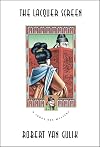
The Lacquer Screen
by Robert van Gulik
Judge Dee: Chronological order (2), Judge Dee: Publication order (9)
On This Page
Description
Early in his career, Judge Dee visits a senior magistrate who shows him a beautiful lacquer screen on which a scene of lovers has been mysteriously altered to show the man stabbing his lover. The magistrate fears he is losing his mind and will murder his own wife. Meanwhile, a banker has inexplicably killed himself, and a lovely lady has allowed Dee's lieutenant, Chiao Tai, to believe she is a courtesan. Dee and Chiao Tai go incognito among a gang of robbers to solve this mystery, and find show more the leader of the robbers is more honorable than the magistrate. "One of the most satisfyingly devious of the Judge Dee novels, with unusual historical richness in its portrayal of the China of the T'ang dynasty."--New York Times Book Review "Even Judge Dee is baffled by Robert van Gulik's new mysteries in The Lacquer Screen. Disguised as a petty crook, he spends a couple of precarious days in the headquarters of the underworld, hobnobbing with the robber king. Dee's lively thieving friends furnish some vital clues to this strange and fascinating jigsaw."--The Spectator "So scrupulously in the classic Chinese manner yet so nicely equipped with everything to satisfy the modern reader."--New York Times Robert Van Gulik (1910-67) was a Dutch diplomat and an authority on Chinese history and culture. He drew his plots from the whole body of Chinese literature, especially from the popular detective novels that first appeared in the seventeenth century. show lessTags
Recommendations
















































Member Reviews
Even on vacation, Judge Dee doesn't take a break from crime.
In Robert van Gulik's The Lacquer Screen, Judge Dee, accompanied by his faithful lieutenant Chiao Tai, decides to take a week off from his grueling duties as the magistrate in the backwater town of Peng-lai to head for rest and relaxation in Weiping. He visits the town incognito, with only Weiping's magistrate in the know; however, Judge Dee almost immediately stumbles onto the scene of a beautiful woman's murder. With the help of Chiao Tai and some unlikely characters, Judge Dee is able to solve the woman's murder, a merchant's alleged suicide, and the hidden agenda of a disfigured thief who keeps spying on Judge Dee and Chiao Tai. The mysteries are very clever, and, just when show more you deem all of the loose ends neatly tied up, van Gulik introduces a jaw-dropping surprise twist in the novel's last few pages.
Van Gulik, a Dutch diplomat to China and other Asian nations, a linguist and Asian scholar, translated an 18th century Chinese novel on the exploits of a real-life Chinese magistrate during the T'ang Dynasty named Ti Jen-chieh. Simplifying the magistrate's name to Judge Dee Jen-djieh, van Gulik first introduced the West to the real-life Judge Dee in Celebrated Cases of Judge Dee, first published in 1949 (although not translated into English until 1976). Ensuing books -- including The Lacquer Screen pluck plots from original ancient Chinese cases and 18th century Chinese detective stories.
All of the Judge Dee novels provide readers with an exotic setting -- Seventh Century China; each novel also comes with three, usually intertwining, mysteries and a great glimpse of the everyday life in the T'ang Dynasty for people at every level of society. The novels are all excellent, but I believe this is the best one I've read so far. show less
In Robert van Gulik's The Lacquer Screen, Judge Dee, accompanied by his faithful lieutenant Chiao Tai, decides to take a week off from his grueling duties as the magistrate in the backwater town of Peng-lai to head for rest and relaxation in Weiping. He visits the town incognito, with only Weiping's magistrate in the know; however, Judge Dee almost immediately stumbles onto the scene of a beautiful woman's murder. With the help of Chiao Tai and some unlikely characters, Judge Dee is able to solve the woman's murder, a merchant's alleged suicide, and the hidden agenda of a disfigured thief who keeps spying on Judge Dee and Chiao Tai. The mysteries are very clever, and, just when show more you deem all of the loose ends neatly tied up, van Gulik introduces a jaw-dropping surprise twist in the novel's last few pages.
Van Gulik, a Dutch diplomat to China and other Asian nations, a linguist and Asian scholar, translated an 18th century Chinese novel on the exploits of a real-life Chinese magistrate during the T'ang Dynasty named Ti Jen-chieh. Simplifying the magistrate's name to Judge Dee Jen-djieh, van Gulik first introduced the West to the real-life Judge Dee in Celebrated Cases of Judge Dee, first published in 1949 (although not translated into English until 1976). Ensuing books -- including The Lacquer Screen pluck plots from original ancient Chinese cases and 18th century Chinese detective stories.
All of the Judge Dee novels provide readers with an exotic setting -- Seventh Century China; each novel also comes with three, usually intertwining, mysteries and a great glimpse of the everyday life in the T'ang Dynasty for people at every level of society. The novels are all excellent, but I believe this is the best one I've read so far. show less
In general, I find van Gulik's mysteries to be well-written, and the mysteries actually explicable without relying on any sleight-of-hand tricks. This puts them above average, and this particular book is no exception. Judge Dee, in this case, goes undercover after a fashion to unravel a murder, a suicide and a fraud.
Characters, provided you make allowances for the time and cultural differences, are likable. There is some humor and a nice , twisty mystery with even a slightly gothic flavor. Satisfying ending, as in all the judge dee I have read, with the good rewarded and the bad punished
After hearing this series praised so much, I expected more. The mystery and setting were ok, but some of the motivations weren't super convincing. I enjoy tangled mysteries, but I like them to make a little more sense than a wife murdering a husband for his money and none of their friends and servants suspecting that their union was just a bit dysfunctional. And it wasn't just one crime with a strange, improbable motive, either.
I also thought the history and culture would feature more interestingly, considering that it's set in Tang dynasty China. This might have to do with starting the series on book 9, but I don't think I'll be reading more of the Judge Dee mysteries.
I also thought the history and culture would feature more interestingly, considering that it's set in Tang dynasty China. This might have to do with starting the series on book 9, but I don't think I'll be reading more of the Judge Dee mysteries.
#7 in the series finds our friends going undercover and trying to infiltrate a band of thieves. But, as usual, that's not the only action going on here.
One of Judge Dee's cronies thinks he's going crazy because he owns a lacquer screen on which the scene has changed from a serene setting with two lovers to one where the man stabs the woman. It's Judge Dee & friends on the case!
This series is amazing; and I highly recommend it, especially to people who enjoy historical mysteries or books set in China. Caveat: start with #1, please!
One of Judge Dee's cronies thinks he's going crazy because he owns a lacquer screen on which the scene has changed from a serene setting with two lovers to one where the man stabs the woman. It's Judge Dee & friends on the case!
This series is amazing; and I highly recommend it, especially to people who enjoy historical mysteries or books set in China. Caveat: start with #1, please!
Very interesting. A look at a very different way of seeing the world.
Excellent unusual storyline
Members
- Recently Added By
Lists

Best Crime Fiction
262 works; 39 members

Scandinavian Crime Fiction
224 works; 37 members

Books Read in 2017
4,249 works; 129 members

Books Read in 2025
4,128 works; 98 members
Author Information

112+ Works 10,375 Members
Robert H. Van Gulik was born in the Netherlands on August 9, 1910. He joined the Dutch Foreign Service in 1935. From 1942-1945, he was secretary for the Dutch mission to Chiang Kai-shek's Nationalist government in Chongqing, China. During this time, he translated a number of Chinese texts including Celebrated Cases of Judge Dee (Dee Goong An). He show more proceeded to write sixteen of his own Judge Dee novels. His scholarly works included Siddham: An Essay on the History of Sanskrit Studies in China and Japan, Hayagriva: Horse Cult in Asia, and Sexual Life in Ancient China. He died on September 24, 1967. (Bowker Author Biography) show less
Some Editions
Awards and Honors
Distinctions
Series


Belongs to Publisher Series
Work Relationships
Is contained in
Common Knowledge
- Canonical title
- The Lacquer Screen
- Original title
- The Lacquer Screen
- Original publication date
- 1962
- People/Characters
- Judge Dee; Chaio Tai
- Important places
- Wei-ping, China
- Important events
- Tang Dynasty (618 | 907)
- First words*
- In grosser Verwirrung blieb er vor der Tür seiner Bibliothek stehen.
- Last words*
- (Click to show. Warning: May contain spoilers.)Sie flatterten ein wenig hinter dem Pferd in der Luft; dann sanken sie langsam zu Boden mit dem aufgewirbelten Staub.
- Original language*
- Englisch
*Some information comes from Common Knowledge in other languages. Click "Edit" for more information.
Classifications
Statistics
- Members
- 530
- Popularity
- 56,600
- Reviews
- 13
- Rating
- (3.69)
- Languages
- 12 — Czech, Danish, Dutch, English, Estonian, Finnish, French, German, Hungarian, Italian, Polish, Spanish
- Media
- Paper, Audiobook, Ebook
- ISBNs
- 39
- ASINs
- 15