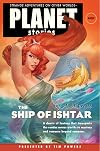
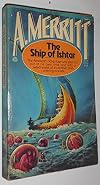
The Ship of Ishtar
by A. Merritt
On This Page
Description
The goddess of love and beauty is adrift on an enchanted ocean in a magic world. The myriad forces of satanic evil plague the vessel of the red-haired, passionate goddess. Only one man, John Kenton, the American adventurer, can try to save Ishtar's priestess from the black magic which divides her world from ours. The goddess of love and beauty is adrift on an enchanted ocean in a magic world. The myriad forces of satanic evil plague the vessel of the red-haired, passionate goddess. Only one show more man, John Kenton, the American adventurer, can try to save Ishtar's priestess from the black magic which divides her world from ours. Abraham Grace Merritt - known by his byline, A. Merritt - was an American Sunday magazine editor and a writer of fantastic fiction. The Science Fiction and Fantasy Hall of Fame inducted him in 1999. show lessTags
Recommendations












Member Reviews
This book was on the "Seven-League Shelf"--a list of the "cream" of fantasy literature in A Reader's Guide to Fantasy. Originally published in 1924, the style feels antique, and the romance beyond antiquated. That style... well, we're definitely talking about the color purple--mind you, that sometimes has its beauties. The hero, John Kenton, a veteran of the first world war, is transported to a ship divided into two warring factions each representing a Babylonian God--Ishtar, Goddess of Love, and Nergal, God of the Underworld. The device through which Kenton is transported is an ancient artifact shipped to him from an archeological dig, a model of the ship. Here's how the model is described:
It floated high on a base of curving waves cut show more from lapis lazuli and
foam-crested with milky rock crystals. Its hull was of crystal, creamy
and faintly luminous. Its prow was shaped like a slender scimitar, bent
backward. Under the incurved tip was a cabin whose seaward sides were
formed, galleon fashion, by the upward thrust of the bows. Where the
hull drew up to form this cabin, a faint flush warmed and cloudy
crystal; it deepened as the sides lifted; it gleamed at last with a
radiance that turned the cabin into a rosy jewel.
There's only one way that style above is atypical. No exclamation points. I can't recall ever reading an author more fond of them--several in each page. More on one page than almost all contemporary authors would put into an entire novel. It was an annoying tic, but not nearly annoying as the romance within the pages. Here's another quote--that makes contemporary romance aisle bodice rippers seem enlightened and restrained in comparison:
"Yea--dear lord of me--even you do not know how greatly I love you,"
whispered Sharane again, eyes worshipping, arms fettering his neck. His
lips clung to hers. Even in the sweet fire of their touch he marvelled,
blind to his own renaissance, at this changed Sharane--Love's changeling
since that time he had carried her within her bower, disdaining her as
gift, taking her by right of his two strong arms.
Swift memories shook him; of Sharane--conquered; of some unearthly
wonder that had flamed over the shrine and with fingers of pure fire had
woven his soul with hers in threads of flaming ecstasies!
Oh, gag. Sharane aka Miss Love Object I found pretty insipid, Kenton too stupid to live and a victim of testosterone poisoning. I much preferred the secondary characters--the Assyrian Gigi, the Persian Zubran and the Viking Sigurd. Yet, I admit it. By and large I enjoyed this. The colorful characters, the lushness of the mythological trappings, the swashbuckling daring do. It was a rip roaring yarn told in bright primary colors that I sped through happily turning the pages, even if the characters were paper thin. This doesn't make me want to read more of this author--for this type of adventure story I'd recommend H Rider Haggard over Merritt. But melodramatic pulp fiction it might be, it was cheesy fun. show less
It floated high on a base of curving waves cut show more from lapis lazuli and
foam-crested with milky rock crystals. Its hull was of crystal, creamy
and faintly luminous. Its prow was shaped like a slender scimitar, bent
backward. Under the incurved tip was a cabin whose seaward sides were
formed, galleon fashion, by the upward thrust of the bows. Where the
hull drew up to form this cabin, a faint flush warmed and cloudy
crystal; it deepened as the sides lifted; it gleamed at last with a
radiance that turned the cabin into a rosy jewel.
There's only one way that style above is atypical. No exclamation points. I can't recall ever reading an author more fond of them--several in each page. More on one page than almost all contemporary authors would put into an entire novel. It was an annoying tic, but not nearly annoying as the romance within the pages. Here's another quote--that makes contemporary romance aisle bodice rippers seem enlightened and restrained in comparison:
"Yea--dear lord of me--even you do not know how greatly I love you,"
whispered Sharane again, eyes worshipping, arms fettering his neck. His
lips clung to hers. Even in the sweet fire of their touch he marvelled,
blind to his own renaissance, at this changed Sharane--Love's changeling
since that time he had carried her within her bower, disdaining her as
gift, taking her by right of his two strong arms.
Swift memories shook him; of Sharane--conquered; of some unearthly
wonder that had flamed over the shrine and with fingers of pure fire had
woven his soul with hers in threads of flaming ecstasies!
Oh, gag. Sharane aka Miss Love Object I found pretty insipid, Kenton too stupid to live and a victim of testosterone poisoning. I much preferred the secondary characters--the Assyrian Gigi, the Persian Zubran and the Viking Sigurd. Yet, I admit it. By and large I enjoyed this. The colorful characters, the lushness of the mythological trappings, the swashbuckling daring do. It was a rip roaring yarn told in bright primary colors that I sped through happily turning the pages, even if the characters were paper thin. This doesn't make me want to read more of this author--for this type of adventure story I'd recommend H Rider Haggard over Merritt. But melodramatic pulp fiction it might be, it was cheesy fun. show less
High fantasy, with a mediocre plot (modern man swept into a fantasy world, it has been done before), and a rather surprising ending (I must admit, I had suspected a totally different outcome).
That being said, I rather enjoyed reading this tome, for the same reason I usually enjoy this type of books: the language. It is so elaboratly descriptive, with beautiful, nowadays underused words, it gives the whole story a bit of a mystical air (like these 2 sentences found on page 163:
Kenton, climbing, heard thunderings like the clashing of armied shields; clanging of countless cymbals, tintamarre of millions of gongs of brass. Ever louder grew the clangor as he ascended; with it mingled now the diapason of mighty winds, staccato of cataracts show more of rain.) show less
That being said, I rather enjoyed reading this tome, for the same reason I usually enjoy this type of books: the language. It is so elaboratly descriptive, with beautiful, nowadays underused words, it gives the whole story a bit of a mystical air (like these 2 sentences found on page 163:
Kenton, climbing, heard thunderings like the clashing of armied shields; clanging of countless cymbals, tintamarre of millions of gongs of brass. Ever louder grew the clangor as he ascended; with it mingled now the diapason of mighty winds, staccato of cataracts show more of rain.) show less
Fantasy book written 100 years ago. The most interesting thing is that one can observe how many things have changed and how many have stayed the same regarding the way authors (and society) sees the world. The book is an adventure taking place in a imaginary world loosely connected to our world. The characters are barely sketched and seem driven (only) by strong passions that are not very well developed. The main characters seem a bit irresponsable and uninteresting, some of the side characters are better. Relations between men and women are very "crude". The ending does not bring any particular closure, and while better than "they lived happily ever after" seems a bit rushed/uninspired.
One of the books that turned me on to heroic fantasy fiction back in the early Seventies.
I've been a fan of Merritt's for a long time. He's little known outside a narrow field these days, but he knew how to drive a plot.
Our protagonist is "sucked" into a sculpure of a boat, finding himself part of the crew and forced to man the oars in a fantasy "Arabian Nights" setting.
That's just the start of a swashbuckling adventure worthy of a Douglas Fairbanks movie. There are sultry maidens, heroic rescues, and black magic, all you'd expect in a fantasy novel of the period.
The writing style seems pulpy and dated these days, but it's a great fast read, and should be on every fantasy reader's bookshelf, just so they can understand the history of show more the genre. show less
I've been a fan of Merritt's for a long time. He's little known outside a narrow field these days, but he knew how to drive a plot.
Our protagonist is "sucked" into a sculpure of a boat, finding himself part of the crew and forced to man the oars in a fantasy "Arabian Nights" setting.
That's just the start of a swashbuckling adventure worthy of a Douglas Fairbanks movie. There are sultry maidens, heroic rescues, and black magic, all you'd expect in a fantasy novel of the period.
The writing style seems pulpy and dated these days, but it's a great fast read, and should be on every fantasy reader's bookshelf, just so they can understand the history of show more the genre. show less
Read this some years ago and wasn't very interested. It is a probably fairly typical example of a particular kind of pulp fiction: mightly hewed Vikings, beautiful compliant women, trusty sidekick of a non Caucasian extraction. People are on ships, they are different groups and the groups are backed by different gods, including Ishtar. There's fighting, and the hero is a slave part of the time. That's all I remember, but I do know I wasn't very keen and there are other books by Merritt that I far prefer to this one.
http://www.fireandsword.com/Reviews/shipishtar.html
Did you ever wonder what heroic fantasy was like before Conan and Kull? It looked like The Ship of Ishtar, big, bold, and fantastic.
Did you ever wonder what heroic fantasy was like before Conan and Kull? It looked like The Ship of Ishtar, big, bold, and fantastic.
Cuando John Kenton descubrió la pequeña nave de piedra que procedía de los lejanos tiempos de Sargón de Akkad, no podía imaginar que estaba abriendo una puerta a través del Espacio y el Tiempo que le llevaría a un mundo de magia y aventura, de amor y amistad, pero también de odio y peligro, en el que conocería y desearía a sharane, la sensual sacerdotisa de Ishtar, pero también a Klaneth, el Sacerdote Negro del terrible dios Nergal. Dos seres empeñados en una eterna lucha a muerte, que le arrastrarán a un torbellino de horror, pasión, brujería y violencia.
Nov 23, 2022Spanish
Members
- Recently Added By
Lists

Cawthorn and Moorcock's Fantasy: The 100 Best Books
110 works; 7 members

The Seven-League Shelf
57 works; 3 members

Books Read in 2020
4,379 works; 124 members
Author Information

Some Editions
Awards and Honors
Notable Lists
Series
Belongs to Publisher Series
Work Relationships
Is contained in
Common Knowledge
- Canonical title
- The Ship of Ishtar
- Original title
- The Ship of Ishtar
- Original publication date
- 1924
- People/Characters
- John Kenton; Sharane; Gigi
Classifications
Statistics
- Members
- 480
- Popularity
- 63,325
- Reviews
- 8
- Rating
- (3.23)
- Languages
- 7 — English, French, German, Hungarian, Italian, Romanian, Spanish
- Media
- Paper, Audiobook, Ebook
- ISBNs
- 44
- ASINs
- 29