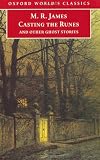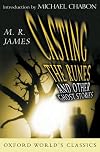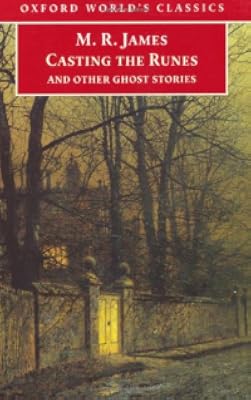
Casting the Runes and Other Ghost Stories [Oxford World Classics]
by M. R. James
On This Page
Description
This selection of twenty-one short stories by M.R. James--a first-class writer of supernatural fiction--represents his best work, including "Count Magnus," "The Rose Garden," "The Uncommon Prayer-book," "Rats," "The Malice of Inanimate Objects," and "A Vignette," as well as the title story.Tags
Recommendations





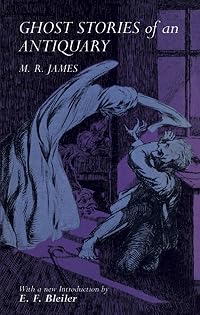









Member Recommendations

Member Reviews
M.R. James is an acknowledged master of the form of the modern ghost story, and this volume collects a sizeable number of his best. These are stories for the telling, effectively calculated to disturb their hearers, and they mix the aims of entertainment and (I hesitantly suggest) initiation after the fashion of a spookhouse event.
All of these tales are set in England, and the Englishness of them is pervasive. The narrators and most of the central characters share the well-off intellectual background of James himself, and the texts actually inhabit an impressively narrow cultural spectrum. And yet there is a fair amount of variety to the ways in which James can scare you. He never makes the error of providing too much detail, and he is show more very efficient in leaving inessential issues undefined, and even critical ones ambiguous, when that won't undermine the chilling effect.
James was an author favored by H.P. Lovecraft, and he also seems to have been read by Thelemic magician Jack Parsons, whose notion of "the Black Pilgrimage" evidently derives from the story "Count Magnus" included here. The title story "Casting the Runes" (1911) has so many points of similarity to H.R. Wakefield's "He cometh and he passeth by..." (1928), that I suspect Wakefield of using James as a model there. (Wakefield also used Aleister Crowley as a model for the villain of "He cometh..." and it is just possible that James's Karswell in "Casting the Runes" is also predicated on Crowley, although with much less supporting detail.)
The edition I read was the 2002 Oxford World's Classics reissue in hardback (checked out from my public library). It is a delightfully portable little tome, considering how much material it contains, and it boasts a new introduction by Michael Chabon, which is full of interesting observations on James's biography and the role of the ghost story in Western literature. But the edition had one drawback. Beyond the author's own occasional numbered footnotes (supplementary explanations in his narrative mode of a friendly scholar) the book is full of asterisks, usually after proper names and geographic references, suggesting that it once included a further apparatus of editorial annotation. The corresponding notes are absent from this edition, however, and the vestigial reference marks are -- considering the general mood of the writing -- a little unnerving. show less
All of these tales are set in England, and the Englishness of them is pervasive. The narrators and most of the central characters share the well-off intellectual background of James himself, and the texts actually inhabit an impressively narrow cultural spectrum. And yet there is a fair amount of variety to the ways in which James can scare you. He never makes the error of providing too much detail, and he is show more very efficient in leaving inessential issues undefined, and even critical ones ambiguous, when that won't undermine the chilling effect.
James was an author favored by H.P. Lovecraft, and he also seems to have been read by Thelemic magician Jack Parsons, whose notion of "the Black Pilgrimage" evidently derives from the story "Count Magnus" included here. The title story "Casting the Runes" (1911) has so many points of similarity to H.R. Wakefield's "He cometh and he passeth by..." (1928), that I suspect Wakefield of using James as a model there. (Wakefield also used Aleister Crowley as a model for the villain of "He cometh..." and it is just possible that James's Karswell in "Casting the Runes" is also predicated on Crowley, although with much less supporting detail.)
The edition I read was the 2002 Oxford World's Classics reissue in hardback (checked out from my public library). It is a delightfully portable little tome, considering how much material it contains, and it boasts a new introduction by Michael Chabon, which is full of interesting observations on James's biography and the role of the ghost story in Western literature. But the edition had one drawback. Beyond the author's own occasional numbered footnotes (supplementary explanations in his narrative mode of a friendly scholar) the book is full of asterisks, usually after proper names and geographic references, suggesting that it once included a further apparatus of editorial annotation. The corresponding notes are absent from this edition, however, and the vestigial reference marks are -- considering the general mood of the writing -- a little unnerving. show less
Here I review only two stories in the collection and I shall add others as I read them. The first story is one of my favourites 'Casting the Runes', first published in 1911 and later the basis for another favourite - Jacques Tourneur's 1957 horror film 'Night of the Demon'.
The film is more obviously thrilling and dramatic but this does not detract from a reading of the story which is fundamentally about a deeply malicious black magician called Karswell whose persona is not a million miles from the popular media vision of one Aleister Crowley.
Crowley, Somerset Maugham with the creation of Oliver Haddo in 'The Magician' of 1908 and James' Karswell will help create a stock figure in English literature and horror cinema made popular in a show more later generation by Dennis Wheatley's Mocata in the 1934 'The Devil Rides Out'.
Karswell in Tourneur's film and then Mocata in the Hammer production of the Wheatley novel in 1968 helped popularise further the type of the wealthy and urbane dabbler in black magic who threatens all forms of decent society. James was not the first out of the gate but he played his part.
If the Tourneur film improves on the story in any way, it is only because M R James has imaginatively provided all the tools to hand for such an improvement. The reader might be genuinely unnerved by this tale of supernatural malice.
'The Rats' is a more conventional horror from 1929 centred on a the ghost of a hanged villain and, more incidentally, on the concern of the proprietors of the inn where he 'lives' to keep the matter secret lest it harm their trade.
It is a well-wrought little tale, a touch of folk horror by the Suffolk sea side, a favourite location for James, although I can't quite see why it is called 'The Rats' since the connection between rats and ghost seems to be utterly irrelevant. James does this sometimes with titles.
James has the story framed by a younger man telling the story of a much older acquaintance which has a nice distancing effect so that one might be prepared to trust the narrator but perhaps wonder if the narrator's source was as reliable, especially as the tale was told to a child.
From this perspective, 'Casting the Runes' is more reliable since the tale is told as sets of facts experienced by very respectable people. There is a curious section in which the target of Karswell's malice has to act as surety for two working class accounts of a mysterious phenomenon.
This is a fascinating aspect of James' world - trust may or may not lie in children's memories of an older person (perhaps presumed to be trustworthy because of his caste) but it certainly is automatic within the Edwardian middle class and not automatic for the Edwardian working class.
Be all that as it may, James' stories are best read as relying wholly on the 'comfort' of a class sure of itself and with a moral opposition to telling tall tales (which he is doing) in real life. Only cads and bad boys tell lies. But James is clearly neither. Indeed, he is the epitome of respectability.
And so James builds up his authority as Oxford don and reliable member of the English upper middle class to tell stories that unravel the grounded assumptions of the middle class listener - perhaps, he implies, that of which I write is possible and true! And that is scary. show less
The film is more obviously thrilling and dramatic but this does not detract from a reading of the story which is fundamentally about a deeply malicious black magician called Karswell whose persona is not a million miles from the popular media vision of one Aleister Crowley.
Crowley, Somerset Maugham with the creation of Oliver Haddo in 'The Magician' of 1908 and James' Karswell will help create a stock figure in English literature and horror cinema made popular in a show more later generation by Dennis Wheatley's Mocata in the 1934 'The Devil Rides Out'.
Karswell in Tourneur's film and then Mocata in the Hammer production of the Wheatley novel in 1968 helped popularise further the type of the wealthy and urbane dabbler in black magic who threatens all forms of decent society. James was not the first out of the gate but he played his part.
If the Tourneur film improves on the story in any way, it is only because M R James has imaginatively provided all the tools to hand for such an improvement. The reader might be genuinely unnerved by this tale of supernatural malice.
'The Rats' is a more conventional horror from 1929 centred on a the ghost of a hanged villain and, more incidentally, on the concern of the proprietors of the inn where he 'lives' to keep the matter secret lest it harm their trade.
It is a well-wrought little tale, a touch of folk horror by the Suffolk sea side, a favourite location for James, although I can't quite see why it is called 'The Rats' since the connection between rats and ghost seems to be utterly irrelevant. James does this sometimes with titles.
James has the story framed by a younger man telling the story of a much older acquaintance which has a nice distancing effect so that one might be prepared to trust the narrator but perhaps wonder if the narrator's source was as reliable, especially as the tale was told to a child.
From this perspective, 'Casting the Runes' is more reliable since the tale is told as sets of facts experienced by very respectable people. There is a curious section in which the target of Karswell's malice has to act as surety for two working class accounts of a mysterious phenomenon.
This is a fascinating aspect of James' world - trust may or may not lie in children's memories of an older person (perhaps presumed to be trustworthy because of his caste) but it certainly is automatic within the Edwardian middle class and not automatic for the Edwardian working class.
Be all that as it may, James' stories are best read as relying wholly on the 'comfort' of a class sure of itself and with a moral opposition to telling tall tales (which he is doing) in real life. Only cads and bad boys tell lies. But James is clearly neither. Indeed, he is the epitome of respectability.
And so James builds up his authority as Oxford don and reliable member of the English upper middle class to tell stories that unravel the grounded assumptions of the middle class listener - perhaps, he implies, that of which I write is possible and true! And that is scary. show less
Discovering the classic port-and-leather-armchair ghost stories of M.R. James is like first reading "Dune" or "The Lord of the Rings." The tremendous possibilities of an entire genre suddenly open up to you, and you end up reading dozens of similar books but only rarely find that original thrill-so inevitably you come full circle, content to read (over and over) "Oh Whistle," "Number 13," and "A Warning to the Curious." And the stories never lose their magic and menace. - Adam
I suppose it could reasonably be said that James' range is narrow; however, within that range, he is devastating. Characterization is kind of pale here: most of James' characters are (like him) bookish antiquarians, and you won't find a lot of stimulating dialogue. However, be warned: herein are the nastiest, creepiest, strangest ghosts you've ever encountered. Because (as someone else pointed out - I can't take credit for it) you often touch them before you see them (if you see them at all) and they're nasty to touch. Brrrrr.
I really liked these stories, though James's prose is sometimes impenetrable. Also, his stories all have the same format: "Oh, here are some books James is interested in real life, let's have the protagonist wander around trying to find them. Oh, here's a working-class guy offended by some slight from an academic. Oh, a ghost. Oh, the end."
I first read the ghost stories of M.R. James in the 1970s while in high school. IMHO,they are the best ghost stories ever written. Very British, they follow a delightful literary course , building the tension and then wrapping up the story in a memorable fashion. Many embody the creeping evil that awaits until meddling human hands intervene.
Montague Rhodes James is one of the greatest practitioners of the classic ghost story. In his stories, members of the British leisure class of his own period -- often scholars like the professor himself -- encounter the uncanny. Many of the stories were written to be read to his college at Christmastime in the English custom.
As far as the story selection goes, this contains James' most famous works, including the eponymous story, "Count Magnus," "A Warning to the Curious," and "Oh, Whistle and I'll Come to You, My Lad." Of course, James wrote so few stories that it would be hard not to include his major ones in a compilation of this length. At the end the editor presents a group of essays and selections of essays by James on his show more conception of the ghost story. These explain some of his successes, though his theorizing isn't very deep.
The book was edited, with an introduction and notes by Michael Cox. Cox would be in the position to do edit such a volume, since he wrote a biography of James. Nevertheless, the annotations in particular aren't what I'd have liked to see. Each end note begins with the publication history and disposition of the original manuscript of the story, which is useful to the scholar but not of interest to the general reader. More than that, the foot notes often leave something to be desired. Cox's note on the Black Pilgrimage, for example, really has nothing to do with what James is describing. The title of "A Neighbour's Landmark" no doubt can be found in the Book of Common Prayer, as Cox notes, but both texts take it from Deuteronomy 19:14 and 27:17 as well as Proverbs 22:28. Cox is completely silent on liturgical cursing, which actually existed and is the basis of "The Uncommon Prayer-book."
In many ways it's unfair, though. To annotate James' stories one needs to know what James knew. In addition to being well read in literature, James was a medievalist, and published everything from manuscripts he discovered mouldering in old churches to what was for decades the most authoritative edition of the New Testament apocrypha. Cox doesn't cite secondary literature at all, perhaps because there wasn't any. I understand this has now been corrected with Patrick J. Murphy's Medieval Studies and the Ghost Stories of M.R. James. I also learned recently that, a decade after Cox's book, S. T. Joshi and Penguin Classics published a two-volume Complete Ghost Stories of M.R. James with annotations. I'll most likely read this (at least piecemeal, reading the stories I haven't read yet), though I'm sure it will tell more about the weird tales Joshi knows and not about the medieval studies he probably doesn't. show less
As far as the story selection goes, this contains James' most famous works, including the eponymous story, "Count Magnus," "A Warning to the Curious," and "Oh, Whistle and I'll Come to You, My Lad." Of course, James wrote so few stories that it would be hard not to include his major ones in a compilation of this length. At the end the editor presents a group of essays and selections of essays by James on his show more conception of the ghost story. These explain some of his successes, though his theorizing isn't very deep.
The book was edited, with an introduction and notes by Michael Cox. Cox would be in the position to do edit such a volume, since he wrote a biography of James. Nevertheless, the annotations in particular aren't what I'd have liked to see. Each end note begins with the publication history and disposition of the original manuscript of the story, which is useful to the scholar but not of interest to the general reader. More than that, the foot notes often leave something to be desired. Cox's note on the Black Pilgrimage, for example, really has nothing to do with what James is describing. The title of "A Neighbour's Landmark" no doubt can be found in the Book of Common Prayer, as Cox notes, but both texts take it from Deuteronomy 19:14 and 27:17 as well as Proverbs 22:28. Cox is completely silent on liturgical cursing, which actually existed and is the basis of "The Uncommon Prayer-book."
In many ways it's unfair, though. To annotate James' stories one needs to know what James knew. In addition to being well read in literature, James was a medievalist, and published everything from manuscripts he discovered mouldering in old churches to what was for decades the most authoritative edition of the New Testament apocrypha. Cox doesn't cite secondary literature at all, perhaps because there wasn't any. I understand this has now been corrected with Patrick J. Murphy's Medieval Studies and the Ghost Stories of M.R. James. I also learned recently that, a decade after Cox's book, S. T. Joshi and Penguin Classics published a two-volume Complete Ghost Stories of M.R. James with annotations. I'll most likely read this (at least piecemeal, reading the stories I haven't read yet), though I'm sure it will tell more about the weird tales Joshi knows and not about the medieval studies he probably doesn't. show less
Members
- Recently Added By
Lists

Best Horror Books
281 works; 85 members

Ghosts
278 works; 18 members

Ghost Stories That Thrill Us
256 works; 115 members
Author Information

250+ Works 7,894 Members
Some Editions
Series
Belongs to Publisher Series
Work Relationships
Contains
Common Knowledge
- Canonical title
- Casting the Runes and Other Ghost Stories [Oxford World Classics]
- Disambiguation notice
- Contains 21 short stories
Classifications
Statistics
- Members
- 432
- Popularity
- 71,262
- Reviews
- 10
- Rating
- (4.28)
- Languages
- English
- Media
- Paper, Ebook
- ISBNs
- 9
- ASINs
- 3