On This Page
Description
"The long years of near-utopia have come to an abrupt end. Peace and order are now figments of the past. Corruption, deception, and insurgency hum within the once steadfast leadership of the Hives, nations without fixed location. The heartbreaking truth is that for decades, even centuries, the leaders of the great Hives bought the world's stability with a trickle of secret murders, mathematically planned. So that no faction could ever dominate. So that the balance held. The Hives' façade of show more solidity is the only hope they have for maintaining a semblance of order, for preventing the public from succumbing to the savagery and bloodlust of wars past. But as the great secret becomes more and more widely known, that façade is slipping away. Just days earlier, the world was a pinnacle of human civilization. Now everyone--Hives and hiveless, Utopians and sensayers, emperors and the downtrodden, warriors and saints--scrambles to prepare for the seemingly inevitable war"-- show lessTags
Recommendations
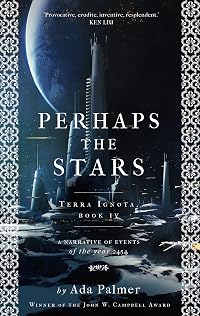







Member Reviews
There was less discontinuity between the second and third volumes of Terra Ignota than I had expected. Narrator Mycroft Canner's exposition is less polished, more raw (and unreliable) for reasons that become evident near the end of The Will to Battle. The book's title references a quote from Hobbes' Leviathan XIII which is supplied as an epigram, observing that war is in effect when that will exists, not merely when it is expressed through actual combat. As the previous volumes established that this one would be, it is concerned with the re-invention of war after multiple human generations of global peace.
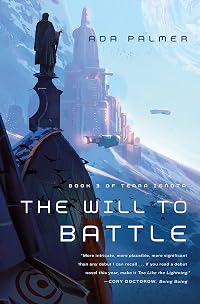
There's a blurb from Cory Doctorow on the cover of The Will to Battle that touts the plausibility of Too Like the Lightning, which I show more would not really number among Terra Ignota's virtues. But I would agree with his other adjectives: "intricate" and "significant." You can tell Palmer is a professional historian, because her 25th-century future doesn't start today: it starts in antiquity, and the characters think about the 18th century far more often than they do the 20th or 21st.
In this third book, Palmer's references to literature and history are as manifold as ever, but Leviathan and Homer's Illiad stand out for the extent to which they are presumed and explicitly referenced by the text. Each contributes an actual character into the mix. Palmer's Achilles Mojave is (in some still mysterious but actual sense) the ancient Achaean, and a spectral Thomas Hobbes joins "the reader" in the frame conversation with Mycroft that occasionally obtrudes on the narrative.
This chronicle--more "secret" than the one of the prior books--affords some more empirical precision regarding not only the dates of the events chronicled, but the dates at which Canner is supposed to have written about them, along with the in-world composition of the first two books. (Curiously, The Will to Battle begins punctually on the 550th anniversary of the reception of Liber Legis.) Palmer pulls a breathtaking stunt with narrative voice at the beginning of the final chapter that I can't help but remark yet refuse to spoil.
Because of its complexity and hectic pace, I think too long a hiatus between volumes can pose a problem for readers of Terra Ignota. I was honestly a little worried after just a few weeks when I came back to The Will to Battle. But I was happily impressed by the "Seven-Ten List for Our Changing World" in the front matter as an excellent refresher on characters and plot as they had been left at the end of Seven Surrenders. I will charge on to Perhaps the Stars before the month is over. show less
There's a blurb from Cory Doctorow on the cover of The Will to Battle that touts the plausibility of Too Like the Lightning, which I show more would not really number among Terra Ignota's virtues. But I would agree with his other adjectives: "intricate" and "significant." You can tell Palmer is a professional historian, because her 25th-century future doesn't start today: it starts in antiquity, and the characters think about the 18th century far more often than they do the 20th or 21st.
In this third book, Palmer's references to literature and history are as manifold as ever, but Leviathan and Homer's Illiad stand out for the extent to which they are presumed and explicitly referenced by the text. Each contributes an actual character into the mix. Palmer's Achilles Mojave is (in some still mysterious but actual sense) the ancient Achaean, and a spectral Thomas Hobbes joins "the reader" in the frame conversation with Mycroft that occasionally obtrudes on the narrative.
This chronicle--more "secret" than the one of the prior books--affords some more empirical precision regarding not only the dates of the events chronicled, but the dates at which Canner is supposed to have written about them, along with the in-world composition of the first two books. (Curiously, The Will to Battle begins punctually on the 550th anniversary of the reception of Liber Legis.) Palmer pulls a breathtaking stunt with narrative voice at the beginning of the final chapter that I can't help but remark yet refuse to spoil.
Because of its complexity and hectic pace, I think too long a hiatus between volumes can pose a problem for readers of Terra Ignota. I was honestly a little worried after just a few weeks when I came back to The Will to Battle. But I was happily impressed by the "Seven-Ten List for Our Changing World" in the front matter as an excellent refresher on characters and plot as they had been left at the end of Seven Surrenders. I will charge on to Perhaps the Stars before the month is over. show less
When you absolutely positively most sincerely need to have a war but you haven't had one in ages and you've been maintaining your peaceful utopia with a secret system of selected murderings rather than through the exercise of military strength and you don't even have nation states any more, you can't just go rushing in, you need your emperors and kings and psychopaths and corrupt officials and ideologues and messianic figureheads and rogue assassins and ressurected classical warriors to sort things out so we get a good clean fight. High drama indeed as the politics and philosphies and social structures cast about in some confusion over how exactly to go about kiling lots of people who disagree with you about some incredibly fundamental show more things, all told through the shiningly intelligent and certified insane mind of Mycroft Canner: murderer and torturer and cannibal and devoted worshipper of an incarnated God from another universe. show less
It’s fair to say that the Terra Ignota series continues to be demanding and rewarding. Mycroft the narrator, a convicted murderer, is writing a chronicle of events in 2454 in the style of the Enlightenment, while holding down eight jobs and suffering a psychological breakdown. The narrative is punctuated by commentary from Thomas Hobbes and a personification of the book’s readership. At times Hobbes can be tiresome, but Palmer otherwise pulls off an astonishingly complex, intellectually challenging, and original tale. ‘The Will to Battle’ is concerned with the run up to Earth’s first war in many hundreds of years. In the previous book, [b:Seven Surrenders|28220647|Seven Surrenders (Terra Ignota, #2)|Ada show more Palmer|https://images.gr-assets.com/books/1517514624s/28220647.jpg|48249332], the machinations of Madame were revealed. She takes a less significant role in this instalment, which instead considers how prior events impact upon global governance and create the conditions for violent conflict. The reader finally learns the meaning of the term Terra Ignota: it refers to the ambiguous space between legal codes, where the potential criminality of an act is uncertain and therefore subject to careful examination. An elegant concept. The Black Laws and conventions of Hobbestown are equally ingenious.
Political debates form a large part of the book and proved to be absolutely fascinating. Although I couldn’t find any unambiguous allegories for current schisms, the analysis of fundamental political questions is brilliantly done and undoubtedly sheds light on the present. Do governments have the right to kill for the collective good? Is government power better vested in a single figurehead or collectively shared? Should a monarch or emperor be entitled to choose their successor? How do populist demagogues exploit atavistic fears? Is it more destructive for society to split into two opposed sides or fragment into many? Wider philosophical queries are also addressed: are the Olympics a channel for nationalistic aggression that would otherwise turn violent? Is war justifiable because it spurs on technological progress and human ambition? What constitutes neutrality during a global war? First and foremost, the book grapples with whether there is such a thing as a just, even good, war. An important figure throughout is the reborn Achilles, acting in the capacity of War Consultant. He is definitely depicted as calmer and wiser for having died.
While I recommend the Terra Ignota series and have read nothing quite like it, I also suspect that many references (not least to Hobbes) went over my head. If you’re unfamiliar with Enlightenment thought and the Iliad, this may irk you somewhat. The mannered writing style, unreliable narrator, polylingual interjections, and multitude of names given to most characters also pose challenges. Ada Palmer writes science fiction that reads quite convincingly as if it was written hundreds of years ago. ‘The Will to Battle’ contains some spectacular scenes and magnificent dialogue, continuing the plot seamlessly where [b:Seven Surrenders|28220647|Seven Surrenders (Terra Ignota, #2)|Ada Palmer|https://images.gr-assets.com/books/1517514624s/28220647.jpg|48249332] left off. I was delighted to learn more about the Utopians, thrilled by the hunt in the penultimate chapter, and amused by the common sense of Kosala in the face of proposed global dictatorship:
As ever with series of books, I must comment on the accuracy of my predictions from the previous review. As I’d hoped, Thisbe reappears and the nature of her witchcraft becomes clearer. She doses the already unstable Mycroft with some psychoactive perfume. Madame appears seldom but does indeed appear to be a sociopath. I liked the detail that her confession in the Vatican caused the priest to try and kill her! Sniper’s plan remains relatively unknown, as they are kidnapped and thus absent for most of the book. The identity and purpose of their kidnapper remains a mystery. Bridger does not rematerialise, but nothing demonstrated unequivocally to me that he won’t. Indeed, the shocking last minute death and revival of Mycroft at the very end has Bridger written all over it. As to what is going on with Jehovah, the answer seems to be intense megalomania. Achilles does indeed have a miniature Patroclus, which pleased me. The son of Peleus does not literally fight Sniper, however they compete in the Olympics and line up on opposite sides of the war so it seems inevitable. We also learn how Mycroft balances his jobs: by abusing sleep-blocking drugs. This does not go well for him given his rampant hallucinations of Apollo, who he murdered long before [b:Too Like the Lightning|26114545|Too Like the Lightning (Terra Ignota, #1)|Ada Palmer|https://images.gr-assets.com/books/1443106959s/26114545.jpg|46061374] began.
In the next instalment, I look forward to further narration from Mycroft's successor, the 9th Anonymous. Mycroft may be alive, but I'm sure he's too busy to continue his account. His successor writes more clearly anyway. I'm intrigued to find out the extent to which Jed's absolutism alienates his allies and Sniper's kidnapping has lasting consequences. I remain convinced that Bridger will reappear as a deus ex machina. Achilles will likely die spectacularly in battle, as befits his mythic status. Sniper seems most likely to defeat him, so that would perhaps be too predictable. They must surely fight, but maybe Achilles will then fall to another? Presumably an actual battle will eventually take place, although the weapons and participants remain to be decided. And much philosophical debate is still to transpire, I'm sure.
Although it took me 600 pages of two novels to become comfortable in the world of Terra Ignota and work out who is who, I’m now wholly invested in it. I’ve never read a future history that anchors itself so firmly in the language and literature of the past, yet somehow manages to be exciting and progressive rather than conservative. Palmer has seemingly constructed a convincing utopia in order to stress-test it while playing complicated linguistic and literary games. I’m getting a great deal from series and, even if it isn’t to your taste, the audacious ambition of the endeavour definitely deserves recognition and respect. show less
Political debates form a large part of the book and proved to be absolutely fascinating. Although I couldn’t find any unambiguous allegories for current schisms, the analysis of fundamental political questions is brilliantly done and undoubtedly sheds light on the present. Do governments have the right to kill for the collective good? Is government power better vested in a single figurehead or collectively shared? Should a monarch or emperor be entitled to choose their successor? How do populist demagogues exploit atavistic fears? Is it more destructive for society to split into two opposed sides or fragment into many? Wider philosophical queries are also addressed: are the Olympics a channel for nationalistic aggression that would otherwise turn violent? Is war justifiable because it spurs on technological progress and human ambition? What constitutes neutrality during a global war? First and foremost, the book grapples with whether there is such a thing as a just, even good, war. An important figure throughout is the reborn Achilles, acting in the capacity of War Consultant. He is definitely depicted as calmer and wiser for having died.
While I recommend the Terra Ignota series and have read nothing quite like it, I also suspect that many references (not least to Hobbes) went over my head. If you’re unfamiliar with Enlightenment thought and the Iliad, this may irk you somewhat. The mannered writing style, unreliable narrator, polylingual interjections, and multitude of names given to most characters also pose challenges. Ada Palmer writes science fiction that reads quite convincingly as if it was written hundreds of years ago. ‘The Will to Battle’ contains some spectacular scenes and magnificent dialogue, continuing the plot seamlessly where [b:Seven Surrenders|28220647|Seven Surrenders (Terra Ignota, #2)|Ada Palmer|https://images.gr-assets.com/books/1517514624s/28220647.jpg|48249332] left off. I was delighted to learn more about the Utopians, thrilled by the hunt in the penultimate chapter, and amused by the common sense of Kosala in the face of proposed global dictatorship:
Kosala’s patience for fawning and French is limited. “Jed, you can’t have a war between yourself and every single other person in the world. I mean, I know you have some…” - she hesitated, surveying wretched Dominic and me - “...friends… but if you reject us all, all seven Hives, and alienate the Hiveless, which your world empire plan has definitely done, then you’re alone.”
In the next instalment, I look forward to further narration from Mycroft's successor, the 9th Anonymous. Mycroft may be alive, but I'm sure he's too busy to continue his account. His successor writes more clearly anyway. I'm intrigued to find out the extent to which Jed's absolutism alienates his allies and Sniper's kidnapping has lasting consequences. I remain convinced that Bridger will reappear as a deus ex machina. Achilles will likely die spectacularly in battle, as befits his mythic status. Sniper seems most likely to defeat him, so that would perhaps be too predictable. They must surely fight, but maybe Achilles will then fall to another? Presumably an actual battle will eventually take place, although the weapons and participants remain to be decided. And much philosophical debate is still to transpire, I'm sure.
Although it took me 600 pages of two novels to become comfortable in the world of Terra Ignota and work out who is who, I’m now wholly invested in it. I’ve never read a future history that anchors itself so firmly in the language and literature of the past, yet somehow manages to be exciting and progressive rather than conservative. Palmer has seemingly constructed a convincing utopia in order to stress-test it while playing complicated linguistic and literary games. I’m getting a great deal from series and, even if it isn’t to your taste, the audacious ambition of the endeavour definitely deserves recognition and respect. show less
Update, later the same day:
I think I'm gonna nominate this one for Hugo. It keeps getting better on reflection. :)
Original Review:
I took my time and savored this one. It deserves it. And more.
Ada Palmer has made a world worth luxuriating in, and far from resting on the Greek laurels she and her work deserve, she's delved deep into new philosophical questions while all the time fascinating us with complicated and rich characters. Never even mind the glorious world-building. The amount of thought and forethought in all of this is astounding.
The title gives the main action away. It is not Battle. But the Will to Battle. This is a philosophical conundrum. A wrenching up. A decision to kill or be killed. What's most fascinating about this is show more the fact we began these books in a de-facto utopia.
The first book throws all our perceptions and assumptions for a loop, especially when the great murderer is, in fact, a hero, but a hero for what? The second book dives deeper into the mysterious mass-assassinations and the purpose behind them, right down to the rights of kings and the greater ideological good of society. It also explores godhood as an observer and as a limited player and does it in such a way as to frame the rest of the book in a brilliant argument for and against the destruction of a whole society.
This book is both a surprising and sophisticated exploration of nobility, goodness and idealistic (broad sense) response to the calling of war and perhaps a complete destruction of humanity. I'm talking eyes-wide-open exhaustive discussion of turning their utopias (and there are essentially eleven different kinds of utopias in this world) into mass death, destruction, and eventual barbarism. Everyone's aware of the pitfalls and only the truly war-like among us (including the original, actual Achilles) has the most wisdom to impart. Prepare well. Keep lines of communication open. Stock up. Draw battlefield lines. Prepare for the absolute worst. Go about all your days, preparing to die.
What's most shocking about this book is the fact that it never feels contrived or absurd. At all. It's like being in reality, keeping a clear head, and carefully choosing to murder for the sake of your most deeply held beliefs... even while you live in heaven.
Disturbing? Hell, yeah. Understandable? Yeah. In this case, all the events, all the subjects, all the people in it are treated with respect and honor even when it's about assassination, betrayal, grief, or the realization that everything is not only going to change, but nobody will win. And yet the Will to Battle persists. Remains. It is inevitable, but heroism now consists in postponing the tragedy or mitigating the worst effects.
This is, after all, a highly advanced scientific and cultural utopia we have on Earth. Means to destroy are vast, and people's ire and mob mentalities are still very real. It's sick and fascinating.
And I'm absolutely hooked.
I should be perfectly candid about where I would place these books in my mind. These aren't simple tales full of action and pathos and they don't have clear-cut plotlines for easy public consumption. They are Considered. They are very thoughtful, very mindful, and rife with classics of both literature and philosophical thought. The latest one is a modern delving and interpretation of some of the best pre-game-theory classics. And it's also heart-wrenching, but mainly for the actual effects of these Big Ideas on all the characters I've grown to love and admire. And I mean all of them.
I would place these books in my mind in the Classics category. Classic as in "This needs to be a cult favorite that gets pulled out fifty years from now with just much love and respect as I'm giving it now" kind of book.
If there's any justice in this world, Big Ideas books that are written this well should ALWAYS have staying power. And that's what I wish for it. It needs to be known and savored. We need this discussion for all our thinking selves. Seriously and honestly.
That's how this book affects me. How all of the books have affected me. Am I putting them on a very precise pedestal? Perhaps. But any winner of the Olympics ought to be respected for all the reasons behind the competition. show less
I think I'm gonna nominate this one for Hugo. It keeps getting better on reflection. :)
Original Review:
I took my time and savored this one. It deserves it. And more.
Ada Palmer has made a world worth luxuriating in, and far from resting on the Greek laurels she and her work deserve, she's delved deep into new philosophical questions while all the time fascinating us with complicated and rich characters. Never even mind the glorious world-building. The amount of thought and forethought in all of this is astounding.
The title gives the main action away. It is not Battle. But the Will to Battle. This is a philosophical conundrum. A wrenching up. A decision to kill or be killed. What's most fascinating about this is show more the fact we began these books in a de-facto utopia.
The first book throws all our perceptions and assumptions for a loop, especially when the great murderer is, in fact, a hero, but a hero for what? The second book dives deeper into the mysterious mass-assassinations and the purpose behind them, right down to the rights of kings and the greater ideological good of society. It also explores godhood as an observer and as a limited player and does it in such a way as to frame the rest of the book in a brilliant argument for and against the destruction of a whole society.
This book is both a surprising and sophisticated exploration of nobility, goodness and idealistic (broad sense) response to the calling of war and perhaps a complete destruction of humanity. I'm talking eyes-wide-open exhaustive discussion of turning their utopias (and there are essentially eleven different kinds of utopias in this world) into mass death, destruction, and eventual barbarism. Everyone's aware of the pitfalls and only the truly war-like among us (including the original, actual Achilles) has the most wisdom to impart. Prepare well. Keep lines of communication open. Stock up. Draw battlefield lines. Prepare for the absolute worst. Go about all your days, preparing to die.
What's most shocking about this book is the fact that it never feels contrived or absurd. At all. It's like being in reality, keeping a clear head, and carefully choosing to murder for the sake of your most deeply held beliefs... even while you live in heaven.
Disturbing? Hell, yeah. Understandable? Yeah. In this case, all the events, all the subjects, all the people in it are treated with respect and honor even when it's about assassination, betrayal, grief, or the realization that everything is not only going to change, but nobody will win. And yet the Will to Battle persists. Remains. It is inevitable, but heroism now consists in postponing the tragedy or mitigating the worst effects.
This is, after all, a highly advanced scientific and cultural utopia we have on Earth. Means to destroy are vast, and people's ire and mob mentalities are still very real. It's sick and fascinating.
And I'm absolutely hooked.
I should be perfectly candid about where I would place these books in my mind. These aren't simple tales full of action and pathos and they don't have clear-cut plotlines for easy public consumption. They are Considered. They are very thoughtful, very mindful, and rife with classics of both literature and philosophical thought. The latest one is a modern delving and interpretation of some of the best pre-game-theory classics. And it's also heart-wrenching, but mainly for the actual effects of these Big Ideas on all the characters I've grown to love and admire. And I mean all of them.
I would place these books in my mind in the Classics category. Classic as in "This needs to be a cult favorite that gets pulled out fifty years from now with just much love and respect as I'm giving it now" kind of book.
If there's any justice in this world, Big Ideas books that are written this well should ALWAYS have staying power. And that's what I wish for it. It needs to be known and savored. We need this discussion for all our thinking selves. Seriously and honestly.
That's how this book affects me. How all of the books have affected me. Am I putting them on a very precise pedestal? Perhaps. But any winner of the Olympics ought to be respected for all the reasons behind the competition. show less
The Terra Ignota books are odd. Great world-building, and in the case of this one, absolutely compelling reading. But if you asked me what happened that occupied over 400 pages, I would be hard-pressed to explain. A lot of people talk to each other about things, and it often feels like minor events are given lots of coverage, and important events happen offscreen, only by implication. Like, this one is about the world preparing for war in light of the revelations at the end of book III, and I loved the scenes of the world council meeting and debating the issues, complete with lots of juicy procedural detail. And then there are the 2454 Olympics at the end, which leads into some great developments. The role of the Utopians in the war is show more fascinating and excellent, and the end of the book is tragic and leaves you waiting for the next one so much. (Which is delayed. After three installments in two years, there's a two-year gap between the third and fourth installment. Understandable reasons, though.)
But what actually happens in the middle? Lots of people talk about J. E. D. D. Mason, people talk about other things... and... uh? I don't really know, which makes me wonder if the book really had to be this long! Plus there are so many characters, and Palmer just throws you back into their world-- I had forgotten who a lot of them were in the eight months since I read Seven Surrenders. Thankfully a lot less time is spent on Madame and her brothel, which really dragged down Seven Surrenders.
Still. What a great book. Utterly unlike any science fiction I've read in a long time, and with some great moral questions at its center, and Palmer has a way with deploying unexpected developments that seem completely natural in retrospect. I'm eager to see where this story goes in book IV, and how it can possibly be pulled together. Sticking the landing on this one will certainly be an incredible feat. show less
But what actually happens in the middle? Lots of people talk about J. E. D. D. Mason, people talk about other things... and... uh? I don't really know, which makes me wonder if the book really had to be this long! Plus there are so many characters, and Palmer just throws you back into their world-- I had forgotten who a lot of them were in the eight months since I read Seven Surrenders. Thankfully a lot less time is spent on Madame and her brothel, which really dragged down Seven Surrenders.
Still. What a great book. Utterly unlike any science fiction I've read in a long time, and with some great moral questions at its center, and Palmer has a way with deploying unexpected developments that seem completely natural in retrospect. I'm eager to see where this story goes in book IV, and how it can possibly be pulled together. Sticking the landing on this one will certainly be an incredible feat. show less
**The Will to Battle** is currently the last volume of *Ada Palmer*'s brilliant **Terra Ignota** series. One volume is missing, and it's supposed to come out next year, and I bloody hope so because this one leaves me aching for more. As with the previous books, I completely get why people would not like this book, at least its style, but to me it's magical. Even three books into the series, we get an astounding amount of worldbuilding, we receive new information on the previous books (in particular their creation, it's all Very Meta), all the while the world heads straight towards the biggest and worst World War imaginable. I love these books dearly, and the world Ada Palmer shows us is filled with wonders.
The third instalment of Terra Ignota is the same as the previous books, but different. The style remains (mostly; and when the authorial voice within the book changes, so does the style); but the world is changing, sliding towards war in the manner of the boiled frog. Events take place, some major, others seemingly minor. Only at the end do you look back and realise how far down the slope to conflict we have come.
Though the pace is unchanged, there are bigger and better set-pieces; the Games of the 140th Olympiad, held in a city in Antarctica, are spectacularly described. Some of the set-pieces occur off-stage, but are none the less spectacular for all that; after all, these are novels about people as well as events, and seeing events show more through the perceptions of people who, like us, experience most of them second hand is still a human experience that we can share and understand. And along the way, more detail of the world is revealed, allowing us to fill in another corner of the bigger picture.
A fourth volume is still to come, but it has been delayed for personal reasons. The amount of effort Ada Palmer has put into writing these books on top of her Day Job and other interests cannot be under-estimated, and that it could contribute to her state of health is understandable. There are plenty of readers willing to wait for the conclusion to the series for as long as it takes. All the more time to digest the story up to now. show less
Though the pace is unchanged, there are bigger and better set-pieces; the Games of the 140th Olympiad, held in a city in Antarctica, are spectacularly described. Some of the set-pieces occur off-stage, but are none the less spectacular for all that; after all, these are novels about people as well as events, and seeing events show more through the perceptions of people who, like us, experience most of them second hand is still a human experience that we can share and understand. And along the way, more detail of the world is revealed, allowing us to fill in another corner of the bigger picture.
A fourth volume is still to come, but it has been delayed for personal reasons. The amount of effort Ada Palmer has put into writing these books on top of her Day Job and other interests cannot be under-estimated, and that it could contribute to her state of health is understandable. There are plenty of readers willing to wait for the conclusion to the series for as long as it takes. All the more time to digest the story up to now. show less
Members
- Recently Added By
Lists

2018 Hugo Eligible Novels
170 works; 16 members

Books Read in 2018
4,360 works; 110 members

Books Read in 2024
4,727 works; 128 members
Author Information

11+ Works 4,248 Members
Awards and Honors
Awards
Series

Common Knowledge
- Canonical title
- The Will to Battle
- Original title
- The Will to Battle
- Original publication date
- 2017-12-19
- People/Characters
- Mycroft Canner; Achilles Mojave; J.E.D.D. Mason
- Epigraph
- For Warre, consisteth not in Battell onely, or the act of fighting; but in a tract of time, wherein the Will to contend by Battell is sufficiently known: and therefore the notion of Time, is to be considered in the nature of... (show all) Warre; as it is in the nature of Weather.
—Thomas Hobbes, Leviathan XIII - First words
- Hubris it is, reader, to call one's self the most anything in history: the most powerful, the most mistreated, the most alone.
- Last words
- (Click to show. Warning: May contain spoilers.)That was the first day of the war.
- Publisher's editor
- Nielsen Hayden, Patrick
- Original language
- English
Classifications
Statistics
- Members
- 562
- Popularity
- 52,279
- Reviews
- 25
- Rating
- (4.16)
- Languages
- English, French, German, Polish
- Media
- Paper, Audiobook, Ebook
- ISBNs
- 16
- ASINs
- 3