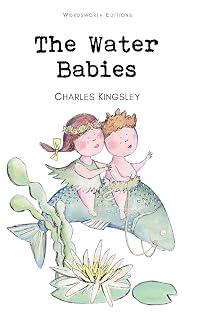
The Water-Babies
by Charles Kingsley
On This Page
Description
Readers of every age will delight in this fantastical fairy tale from Charles Kingsley. Tom, a young chimney sweep, comes to a tragically untimely end and is transformed into a mystical creature known as a water baby that resides in a magical sub-aqueous environment. Despite its nineteenth-century vintage, this engrossing fable has important lessons to teach today's readers..
Tags
Recommendations
















Member Recommendations
Member Reviews
This book was read to me when I was five years old, horrifying me then and ever since. As the story goes, chimneys were difficult to clean so they sent a small boy up inside it to do the cleaning. Why? It was his job. Why wasn't he in school? School was only for fortunate children. What did his parents do about it? No mention. Who looked after him? No one. Did the boys die up the chimney? Sometimes.
Then it goes on to describe babies in a weedy pond, the illustrations showing them peering out of their watery prison that is like a giant green goldfish bowl. I never found out why. Just how bad do you have to be to live in this world?
I have since found out the story was part of Kingley's "scientific theory" on human origins. Oh, perfect show more for a child's entertainment!
Kingsley was a priest of the Church of England and evidently believed that horror stories would keep his congregation into line. He was the worst kind of Victorian patriarch.
My grade one teacher has a lot to answer for by giving me this lifelong nightmare. show less
Then it goes on to describe babies in a weedy pond, the illustrations showing them peering out of their watery prison that is like a giant green goldfish bowl. I never found out why. Just how bad do you have to be to live in this world?
I have since found out the story was part of Kingley's "scientific theory" on human origins. Oh, perfect show more for a child's entertainment!
Kingsley was a priest of the Church of England and evidently believed that horror stories would keep his congregation into line. He was the worst kind of Victorian patriarch.
My grade one teacher has a lot to answer for by giving me this lifelong nightmare. show less
This classic was a discovery for me. It's definitely a multi-tiered read: Tom's adventures, a moral fable for hard work, atonement and forgiveness, but also a social critique of child labour and conditions. There's also the embracing of children's mortality (so many dead babies!) which spoke to a grim reality and possibly also the Victorian's obsession with death. Despite some of these more sombre themes, the story remains accessible, structured as a classical quest and explores all the emotions (Tom as angry, scared, naughty, happy) in an engaging and thoughtful way. Finally I was glad for the short introduction to set the book in its context, and the illustrations were a lovely addition.
Words cannot express the depths of my loathing for this story. The only redeeming thing about this particular volume is that it has lovely painted illustrations by Jessie Willcox Smith (but the drawings on every page rarely match the story). The fantasy/political commentary that Lewis Carroll perfected so beautifully 10 years later is a disaster of disjointed obnoxiousness in Kingsley. He is the king of the run-on sentence. His story-telling reminds me of a six year old little boy on a fast-moving train describing everything he sees without pausing for breath. For 400 miles.
Besides the fact that it's just a horribly-written piece of mind-numbing blathering, it angered me in other ways. Kingsley was a preacher but he obviously thought he show more was too smart for his Bible. The story is very pro-evolution ("water is the mother of all living things"). In fact, the story gives us a good look at how the theory of evolution caused the church to fall away. Kingsley is writing to families and at least two generations grew up influenced by this popular book until its racist bits moved it, rightfully so, to the back of the classic literature shelf. It's funny (in a sad way) how ignorant "learned" people can sound talking about science contrary to reason.
One thing, ONE, actually intrigued me: the reference to the Cheshire Cat. I thought this was a creation of Carroll's, but it's not even a creation of Kingsley's. In fact, "grinning like a Cheshire Cat" had been a popular phrase for awhile and is believed to have it's roots in an 18th century cheese brand who used a smiling cat as its logo.
To top it all off, biographical research tells me he insulted Nathaniel Hawthorne. That's an immediate dismissal from me. He and Mark Twain (who insulted Jane Austen) can go pick their arrogant noses in a corner somewhere and let the masters remain.
I suppose if there's anything positive to be said on the story it's that Kingsley takes the side of the underdog in many conversations on social injustice. Many of the Water-Babies are like Tom---neglected and orphaned children who are given a better (after)life. But why would a Christian preacher mention Heaven and the Lord? Oh no...Kingsley brings them back to the primordial soup from which they began.
At least I crossed another book off my 1001 Books to Read Before You Die list. However, I think I could have died happily not wasting my time on this drivel. show less
Besides the fact that it's just a horribly-written piece of mind-numbing blathering, it angered me in other ways. Kingsley was a preacher but he obviously thought he show more was too smart for his Bible. The story is very pro-evolution ("water is the mother of all living things"). In fact, the story gives us a good look at how the theory of evolution caused the church to fall away. Kingsley is writing to families and at least two generations grew up influenced by this popular book until its racist bits moved it, rightfully so, to the back of the classic literature shelf. It's funny (in a sad way) how ignorant "learned" people can sound talking about science contrary to reason.
One thing, ONE, actually intrigued me: the reference to the Cheshire Cat. I thought this was a creation of Carroll's, but it's not even a creation of Kingsley's. In fact, "grinning like a Cheshire Cat" had been a popular phrase for awhile and is believed to have it's roots in an 18th century cheese brand who used a smiling cat as its logo.
To top it all off, biographical research tells me he insulted Nathaniel Hawthorne. That's an immediate dismissal from me. He and Mark Twain (who insulted Jane Austen) can go pick their arrogant noses in a corner somewhere and let the masters remain.
I suppose if there's anything positive to be said on the story it's that Kingsley takes the side of the underdog in many conversations on social injustice. Many of the Water-Babies are like Tom---neglected and orphaned children who are given a better (after)life. But why would a Christian preacher mention Heaven and the Lord? Oh no...Kingsley brings them back to the primordial soup from which they began.
At least I crossed another book off my 1001 Books to Read Before You Die list. However, I think I could have died happily not wasting my time on this drivel. show less
In parts a political tract, a scientific satire, and a Christian parable as well as a children’s fantasy, Water Babies by Charles Kingsley is an uncomfortable book when read as child, and is even more unsettling when read as an adult. It emerged from a sense of social outrage, took on the big questions of belief and biology, and is eye-catching for a work by a 19th-century vicar who managed to write a moral fable, a response to the theory of evolution and a satire on Victorian attitudes toward child labor and religion.
The story follows Tom, a young chimney sweep who falls into a river and transforms into a small bug like water-baby, and then embarks on a weird educational journey. A word of warning in that even as the author takes Tom show more on a moral journey with the purpose of teaching him to be an upright Christian boy, he still manages to include some negative portrayals of Jews, Americans, and the poor. He also uses Tom’s transformation as a way of discussing some of the social problems of his day such as the brutal treatment of children and other labor issues. After Tom helps his former master repent of his sins and change his ways he is granted a return to human form by his three fairy spiritual guides.
I was thoroughly confused and rather impatient with this heavy-handed and strange story. I know it is considered a classic of Victorian literature but I think it is just too far out of date to be relatable in this day and age. Water Babies is certainly a product of it’s time, but I wouldn’t recommend it for anyone today. show less
The story follows Tom, a young chimney sweep who falls into a river and transforms into a small bug like water-baby, and then embarks on a weird educational journey. A word of warning in that even as the author takes Tom show more on a moral journey with the purpose of teaching him to be an upright Christian boy, he still manages to include some negative portrayals of Jews, Americans, and the poor. He also uses Tom’s transformation as a way of discussing some of the social problems of his day such as the brutal treatment of children and other labor issues. After Tom helps his former master repent of his sins and change his ways he is granted a return to human form by his three fairy spiritual guides.
I was thoroughly confused and rather impatient with this heavy-handed and strange story. I know it is considered a classic of Victorian literature but I think it is just too far out of date to be relatable in this day and age. Water Babies is certainly a product of it’s time, but I wouldn’t recommend it for anyone today. show less
Another childhood treasure that I hadn't read before. I'm declaring this one part of my childhood retroactively (ha!) Charming story, with social commentary as well. The version I read was illustrated by Jessie Willcox Smith, and the illustrations were beautiful. A magical, healing kind of story.
Here's the author's winding-up of the statement of the moral of his story:
"Meanwhile, do you learn your lessons, and thank God that you have plenty of cold water to wash in; and wash in it too. And then, if my story is not true, something better is; and if I am not quite right, still you will be, as long as you stick to hard work and cold water.
But remember always, as I told you at first, that this is all a fairy tale, and only fun and show more pretence: and, therefore, you are not to believe a word of it, even if it is true."
I love this book. show less
Here's the author's winding-up of the statement of the moral of his story:
"Meanwhile, do you learn your lessons, and thank God that you have plenty of cold water to wash in; and wash in it too. And then, if my story is not true, something better is; and if I am not quite right, still you will be, as long as you stick to hard work and cold water.
But remember always, as I told you at first, that this is all a fairy tale, and only fun and show more pretence: and, therefore, you are not to believe a word of it, even if it is true."
I love this book. show less
This was not for me. Yes, I understand the importance of the book at time, how it was a satire on Darwin’s classic and the fact that it predates Alice in Wonderland did impress me when I compared their publication dates. But it just got on my nerves after about chapter three and from then on right until the end where, confronted with the most ridiculous last line in the history of literature, my patience gave way entirely.
So what irritated me? Well, the awful patronising tone of Kingsley the narrator who writes as if everyone is a) male and b) white Caucasian and c) wealthy, educated, clean and morally superior. It’s patronising and prejudiced in the extreme and pulls no punches in its portrayal of the Scots, the Irish, the Jews, show more etc.
There’s this kid Tom who ends up going up one chimney and coming down the wrong one in some massive house which just happens to border some land which contains a stream where, for fear of his life, he flees and, somehow, becomes a Water Baby, some kind of waterbound fairy.
He then undertakes, for reasons not apprent to me, some epic quest to get to the Back End of Somewhere or the Bottom Side of Everywhere or somesuch meaningless location. Along the way, he meets a range of fantastic beings who are loosely based on magical interpretations of real life beings. Most are as patronisingly moralising as Kingsley himself so there’s really no let up. The story’s really not that interesting actually. You certainly don’t really care what happens to Tom. If he’d been eaten by a pike, I don’t think I would have noticed actually.
Of course, he achieves his aim, but this is by means of passing some kind of moral litmus test of doing something right even though it’s not something he wants to do. The implication is that our highest moral deeds are those which are done in the face of extreme distaste.
That’s a great shame for people like Mother Theresa whose entire life’s work count for nothing because they actually love people and want to help them. Bummer. Yep, next time I actually want to inconvenience myself for the sake of others, I’ll think twice before doing so and wait until I really, really, deep, deep down in my heart don’t want to at all. Then it will count.
But, count for what exactly? For nothing at all of course. Kingsley seems to have believed that you attain some kind of moral status by piling up good actions one after another (all without wanting to of course). What a sad fallacy for such an intelligent man to propound. No matter what we do in this life, we’re all so far short of moral perfection that we all pretty much look the same from the viewpoint of moral purity.
Anyway, all loose ends are neatly tied up and put to bed with a kiss and a warm glass of milk. Then, after having said repeatedly every other paragraph that just because someone says something is not true, that doesn’t mean it isn’t, the epilogue tells you not to bother believing a word of anything you’ve just read even if it is true. Great. Thanks.
Alice In Wonderland and Through the Looking Glass are so, so much better at giving us a satirical insight into ourselves and our lives than The Water Babies there’s hardly any comparison between them. Lewis Carrol was a genius who took Kingsley’s timebound witterings and made them into a timeless literary classic which both children and adults will treasure for hundreds of years to come, long after the last person has read that pointless last line of The Water Babies for the last time in human history. show less
So what irritated me? Well, the awful patronising tone of Kingsley the narrator who writes as if everyone is a) male and b) white Caucasian and c) wealthy, educated, clean and morally superior. It’s patronising and prejudiced in the extreme and pulls no punches in its portrayal of the Scots, the Irish, the Jews, show more etc.
There’s this kid Tom who ends up going up one chimney and coming down the wrong one in some massive house which just happens to border some land which contains a stream where, for fear of his life, he flees and, somehow, becomes a Water Baby, some kind of waterbound fairy.
He then undertakes, for reasons not apprent to me, some epic quest to get to the Back End of Somewhere or the Bottom Side of Everywhere or somesuch meaningless location. Along the way, he meets a range of fantastic beings who are loosely based on magical interpretations of real life beings. Most are as patronisingly moralising as Kingsley himself so there’s really no let up. The story’s really not that interesting actually. You certainly don’t really care what happens to Tom. If he’d been eaten by a pike, I don’t think I would have noticed actually.
Of course, he achieves his aim, but this is by means of passing some kind of moral litmus test of doing something right even though it’s not something he wants to do. The implication is that our highest moral deeds are those which are done in the face of extreme distaste.
That’s a great shame for people like Mother Theresa whose entire life’s work count for nothing because they actually love people and want to help them. Bummer. Yep, next time I actually want to inconvenience myself for the sake of others, I’ll think twice before doing so and wait until I really, really, deep, deep down in my heart don’t want to at all. Then it will count.
But, count for what exactly? For nothing at all of course. Kingsley seems to have believed that you attain some kind of moral status by piling up good actions one after another (all without wanting to of course). What a sad fallacy for such an intelligent man to propound. No matter what we do in this life, we’re all so far short of moral perfection that we all pretty much look the same from the viewpoint of moral purity.
Anyway, all loose ends are neatly tied up and put to bed with a kiss and a warm glass of milk. Then, after having said repeatedly every other paragraph that just because someone says something is not true, that doesn’t mean it isn’t, the epilogue tells you not to bother believing a word of anything you’ve just read even if it is true. Great. Thanks.
Alice In Wonderland and Through the Looking Glass are so, so much better at giving us a satirical insight into ourselves and our lives than The Water Babies there’s hardly any comparison between them. Lewis Carrol was a genius who took Kingsley’s timebound witterings and made them into a timeless literary classic which both children and adults will treasure for hundreds of years to come, long after the last person has read that pointless last line of The Water Babies for the last time in human history. show less
"The most wonderful and the strongest of things in the world, you know, are just the things which no one can see.'
First published in 1862 Reverend Charles Kingsley’s classic novel about a young chimney sweep who after falling into a river finds himself transformed in to an aquatic creature, a 'Water Baby'. The tale begins relatively realistically, and when Tom plunges into the water in becomes a mix of social and scientific satire.
This story is far more than a simple fairy tale, in parts it's a political tract. Kingsley was appalled by the plight of the young sweeps, condemned by their brutal masters to a life of misery and, often, early deaths, if not from falls then from lung disease or cancer. This book so horrified its readers, show more young and old alike, that it was instrumental in a new law reforming the working conditions of countless young boys forced to crawl up inside chimneys in order to clean them.
Initially written for Kingsley’s four-year-old son and published just three years after Darwin's ' On the Origin the Species', which shook Victorian Christian beliefs. Like Darwin, Kingsley took a keen interest in nature and science, some would even argue that this novel mirrors Darwin's theories on evolution, only in this case in the afterlife. Tom evolves due to education by his elders and experience. However, this is also a Christian parable that warns against the dangers of not being baptised in the Christian faith and the merits of treating others as you would want to be treated and the notion of eye for an eye.
This book is undoubtedly an important piece of social history but it's also an uncomfortable read. It's littered with archaic phrases and bloated sentences but most worryingly of all is the almost nonchalant use of sexist and racist (especially against the Irish) undertones throughout that simply would not be acceptable today. I personally would never recommend it being read to youngsters, hence the lowly mark. show less
First published in 1862 Reverend Charles Kingsley’s classic novel about a young chimney sweep who after falling into a river finds himself transformed in to an aquatic creature, a 'Water Baby'. The tale begins relatively realistically, and when Tom plunges into the water in becomes a mix of social and scientific satire.
This story is far more than a simple fairy tale, in parts it's a political tract. Kingsley was appalled by the plight of the young sweeps, condemned by their brutal masters to a life of misery and, often, early deaths, if not from falls then from lung disease or cancer. This book so horrified its readers, show more young and old alike, that it was instrumental in a new law reforming the working conditions of countless young boys forced to crawl up inside chimneys in order to clean them.
Initially written for Kingsley’s four-year-old son and published just three years after Darwin's ' On the Origin the Species', which shook Victorian Christian beliefs. Like Darwin, Kingsley took a keen interest in nature and science, some would even argue that this novel mirrors Darwin's theories on evolution, only in this case in the afterlife. Tom evolves due to education by his elders and experience. However, this is also a Christian parable that warns against the dangers of not being baptised in the Christian faith and the merits of treating others as you would want to be treated and the notion of eye for an eye.
This book is undoubtedly an important piece of social history but it's also an uncomfortable read. It's littered with archaic phrases and bloated sentences but most worryingly of all is the almost nonchalant use of sexist and racist (especially against the Irish) undertones throughout that simply would not be acceptable today. I personally would never recommend it being read to youngsters, hence the lowly mark. show less
Members
- Recently Added By
Published Reviews
In parts political tract, scientific satire, Christian parable as well as children’s fantasy, it is a moving and uncomfortable book when read as child, and is even more unsettling when read as an adult. It emerged from a sense of social outrage, took on the big questions of belief and biology, and is eye-catching for a work by a 19th-century vicar in that reveals a world created and ruled show more not by gods, but by goddesses. Not only did it have a huge effect on young readers, it also helped to reform legislation that relieved the suffering of innumerable young people such as Tom, who had been forced to crawl inside chimneys to keep them clean. show less
added by KayCliff
His most famous work, The Water-Babies, is an odd book which is at once a children’s classic, a moral fable, a response to the theory of evolution, and a satire on Victorian attitudes to child labour and religion.
added by KayCliff
Lists

1001 Books You Must Read Before You Die
1,448 works; 1,137 members

1001 Children's Books You Must Read Before You Grow Up
774 works; 100 members

Childhood Favorites
427 works; 24 members

1,000 Good Books of John Senior
36 works; 6 members
Honey For a Child's Heart
1,152 works; 25 members

CCE 1000 Good Books List
1,033 works; 12 members
Ambleside Books
459 works; 18 members

Out of Copyright
244 works; 14 members

The League of Extraordinary Gentlemen
87 works; 4 members

Western World's Greatest Books - Project Gutenberg
295 works; 15 members
Works Referenced in The League of Extraordinary Gentlemen
122 works; 6 members

Books Read in 2017
4,249 works; 130 members

Fiction about the Working Class
74 works; 10 members

1,001 BYMRBYD Concensus
723 works; 27 members

Books Read in 2022
5,226 works; 115 members

Ambleside Y3
36 works; 1 member

Before Austen Comes Aesop
318 works; 9 members

Ambleside Year 3
47 works; 1 member

Books We Loved As Children
610 works; 254 members

Books With Water Words in the Title
186 works; 12 members

The Playful Pioneers
166 works; 1 member
Author Information

139+ Works 7,752 Members
Charles Kingsley, a clergyman of the Church of England, who late in his life held the chair of history at Cambridge University, wrote mostly didactic historical romances. He put the historical novel to new use, not to teach history, but to illustrate some religious truth. Westward Ho! (1855), his best-known work, is a tale of the Spanish main in show more the days of Queen Elizabeth I. Hypatia: New Foes with Old Faces (1853) is the story of a pagan girl-philosopher who was torn to pieces by a Christian mob. The story is strongly anti-Roman Catholic.. Hereward the Wake, or The Watchful Hereward the Wake, or The Watchful (1866) is a tale of a Saxon outlaw. The Water-Babies (1863), written for Kingsley's youngest child, "would be a tale for children were it not for the satire directed at the parents of the period," said Andrew Lang. Alton Locke (1850) and Yeast (1851) reflect Kingsley's leadership in "muscular Christianity" and his dramatization of social issues. (Bowker Author Biography) show less
Some Editions
Awards and Honors
Notable Lists
Series
Belongs to Publisher Series
Work Relationships
Is contained in
Has the adaptation
Common Knowledge
- Canonical title
- The Water-Babies
- Original title
- The Water-Babies: A Fairy Tale for a Land-Baby
- Original publication date
- 1863; 1862-1863 (serial in Macmillan's Magazine) (serial in Macmillan's Magazine)
- People/Characters
- Tom; Mr. Grimes; Mrs. Doasyouwouldbedoneby; Ellie; Mrs. Bedonebyasyoudid; Mother Carey
- Important places
- St. Brendan's Isle; Airfowlness; Vendale
- Related movies
- The Water Babies (1978 | IMDb)
- First words
- Once upon a time there was a little chimney-sweep, and his name was Tom.
- Quotations
- No one has a right to say that no water-babies exist, till they have seen no water-babies existing.
And whither she went, thither she came.
It's so beautiful, it must be true!
If my story is not true, something better is.
Wise men know that their business is to examine what is, and not to settle what is not. - Last words
- (Click to show. Warning: May contain spoilers.)But remember always, as I told you at first, that this is all a fairy tale, and only fun and pretence: and, therefore, you are not to believe a word of it, even if it is true.
Classifications
Statistics
- Members
- 3,398
- Popularity
- 4,965
- Reviews
- 55
- Rating
- (3.29)
- Languages
- 12 — Dutch, English, Finnish, French, German, Italian, Japanese, Norwegian, Polish, Portuguese, Spanish, Swedish
- Media
- Paper, Audiobook, Ebook
- ISBNs
- 233
- UPCs
- 2
- ASINs
- 161