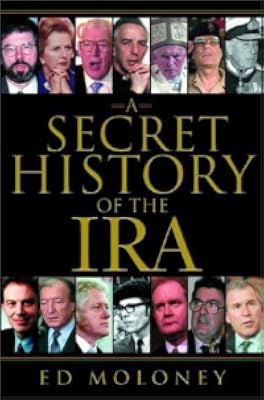
A Secret History of the IRA
by Ed Moloney
On This Page
Description
For decades, the British and Irish had 'got used to' a situation without parallel in Europe: a cold, ferocious, persistent campaign of bombing and terror of extraordinary duration and inventiveness. At the heart of that campaign lies one man: Gerry Adams. From the outbreak of the troubles to the present day, he has been an immensely influential figure. The most compelling question about the IRA is: how did a man who condoned atrocities that resulted in huge numbers of civilian deaths also show more become the guiding light behind the peace process? Moloney's book is now updated to encompass the anxious and uneasy peace that has prevailed to 2007. show lessTags
Recommendations












Member Reviews
A continuing mystery of the Northern Irish peace process is how Gerry Adams survived it. Ed Maloney’s A Secret History of the IRA, published in 2002 – only four years after the Good Friday Agreement – tells the nuanced and scrupulously researched story of Adams’ gradual abandonment of traditional Irish republican principles. One after another, Sinn Fein and the Provisional IRA compromised on abstensionism from Irish (and subsequently Northern Irish) governments, the need for a British commitment to withdrawal before ceasefire and the commencement of talks, rejection of the “unionist veto” in favour of consent in each of Ireland’s two states, the need for armed struggle, and the decommissioning of weapons and explosives. show more
Today, Sinn Fein is part of the Stormont establishment; and the Provisional IRA non-existent, its decaying corpse, lying in a lonely hedgerow, giving the occasional twitch in the form of low-level dissident terror. A recent BBC Spotlight poll showed only 17% of Northern Irish respondents in favour of Irish unity; suggesting that not even all current SF voters want reunification. While in 2011 Martin McGuinness, former Army Council lead and Adams sidekick, was profoundly rejected in the Republic of Ireland presidential election due to his murderous past.
Maloney doesn’t have the benefit of a decade and a half of post-GFA hindsight, but is silent on what exactly Adams expected to achieve. We are shown in early chapters that Adams is an intelligent man, and surrounded himself with other thinkers, and so from the mid-80s, nearly two decades into the Long War, he could see that the British could not be defeated militarily and that SF would always be stunted by its henchmen killing farmers and blowing up shopping centres. But Adams’ acceptance of the principle of consent and recognition of the institutions of Northern Ireland also suggest he knew that demographics could not be beaten; that the war was lost in 1922 when Ireland was divided.
Yet the book repeatedly hints at something more sinister: a series of high-level betrayals at key moments. We see in new light the 1986 capture of the Eksund carrying 150 tons of Libyan arms, the assassination of the finest of the rebellious East Tyrone brigade at Loughgall, and the scuppering of a series of London bombings in the period between the 1994 and 1997 ceasefires. Was Adams or his inner circle compromised by the British, or would they have gone to any lengths to deliver his vision of politically-led republicanism?
The most remarkable aspect of the book is not Adams’ path to peace but how he brought SF and the PIRA along with him. Watching blindfolded at the time, unionists wondered what he was telling his soldiers and grassroots, exactly what he had up his sleeve. But accordingly to Maloney, he told them exactly what they wanted to hear. When they said they disagreed with his approach, he denied his approach. He made promises and broke them the next day. When he faced overwhelming opposition he retrenched but ultimately returned. He moved the process forward inch by inch by lies and non-disclosure within his own community until the point the IRA was tired and rusty and incapable of doing anything but gasping for air above the tide washing over it. It’s a miracle he lived and a mercy he did.
A sequel covering the disbandment of PIRA and changes in republicanism in the years since would be another worthwhile project for Maloney. show less
Today, Sinn Fein is part of the Stormont establishment; and the Provisional IRA non-existent, its decaying corpse, lying in a lonely hedgerow, giving the occasional twitch in the form of low-level dissident terror. A recent BBC Spotlight poll showed only 17% of Northern Irish respondents in favour of Irish unity; suggesting that not even all current SF voters want reunification. While in 2011 Martin McGuinness, former Army Council lead and Adams sidekick, was profoundly rejected in the Republic of Ireland presidential election due to his murderous past.
Maloney doesn’t have the benefit of a decade and a half of post-GFA hindsight, but is silent on what exactly Adams expected to achieve. We are shown in early chapters that Adams is an intelligent man, and surrounded himself with other thinkers, and so from the mid-80s, nearly two decades into the Long War, he could see that the British could not be defeated militarily and that SF would always be stunted by its henchmen killing farmers and blowing up shopping centres. But Adams’ acceptance of the principle of consent and recognition of the institutions of Northern Ireland also suggest he knew that demographics could not be beaten; that the war was lost in 1922 when Ireland was divided.
Yet the book repeatedly hints at something more sinister: a series of high-level betrayals at key moments. We see in new light the 1986 capture of the Eksund carrying 150 tons of Libyan arms, the assassination of the finest of the rebellious East Tyrone brigade at Loughgall, and the scuppering of a series of London bombings in the period between the 1994 and 1997 ceasefires. Was Adams or his inner circle compromised by the British, or would they have gone to any lengths to deliver his vision of politically-led republicanism?
The most remarkable aspect of the book is not Adams’ path to peace but how he brought SF and the PIRA along with him. Watching blindfolded at the time, unionists wondered what he was telling his soldiers and grassroots, exactly what he had up his sleeve. But accordingly to Maloney, he told them exactly what they wanted to hear. When they said they disagreed with his approach, he denied his approach. He made promises and broke them the next day. When he faced overwhelming opposition he retrenched but ultimately returned. He moved the process forward inch by inch by lies and non-disclosure within his own community until the point the IRA was tired and rusty and incapable of doing anything but gasping for air above the tide washing over it. It’s a miracle he lived and a mercy he did.
A sequel covering the disbandment of PIRA and changes in republicanism in the years since would be another worthwhile project for Maloney. show less
this is a big book and still tells only part of the story. the war for indepence was incredibly complex and byzantine, and moloney does an admirable job bringing secrets to light. - fletcher Ó hÍr
Too textbook rather than narrative, story telling
Ratings
Members
- Recently Added By
Lists

r/History Recommended Reading List
603 works; 12 members
Author Information

3 Works 547 Members
Ed Moloney has been Northern Editor of The Irish Times and The Sunday Tribune.
Classifications
Statistics
- Members
- 396
- Popularity
- 78,948
- Reviews
- 3
- Rating
- (3.91)
- Languages
- English, Italian
- Media
- Paper, Ebook
- ISBNs
- 9
- ASINs
- 2