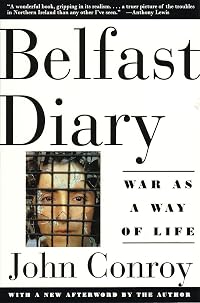
Belfast Diary: War as a Way of Life
by John Conroy
On This Page
Description
Resolution of intractable problems around the world requires understanding ordinary people as well as leaders. This street-level view of Northern Ireland provides the best explanation of the twenty-five-year conflict.Tags
Recommendations














Member Reviews
The sound of gunfire, off in the distance,
I'm getting used to it now
Lived in a brownstone, lived in a ghetto,
I've lived all over this town
--The Talking Heads - Life During Wartime
Conroy is American journalist who had a sense that The Troubles, the ongoing violence in North Ireland, was being woefully misreported. He got a grant to spend a year in Belfast, researching just one story. He wound up in a boarding house in Clonard run by Mrs. Barbour, where he experienced 1980 and 1981 from the Catholic perspective.
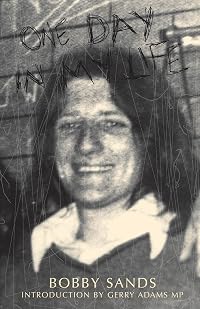
Conroy's story is one of tension and life under occupation. At this point, a decade into the Troubles and a half century into partition, violence in Belfast was ritualized, professional, but also frighteningly random. The Provos show more (Provisional IRA) took aimed shots, mostly at the British Army and the police. The counter-force of police sweeps was equally arbitrary, seizing local men on flimsy pretexts. Violence between the Catholic and Protestant communities was mostly ritualized into Marching Season and schoolyard beatings. The extreme segregation of Belfast prevented more frequent encounters, though both sides feared a common holocaust of mass violence, a repeat of the riots which had burned out Bombay street a decade prior. Low level street crime was omnipresent among youths who had no opportunities for legitimate advancement, and were mostly sealed off from the tightly compartmentalized world of IRA operations. Muggings and robberies were omnipresent. The Catholic community distrusted the Protestant police on matters of ordinary law and order, and so the IRA stepped up with rough vigilante justice, kneecapping boys who were particularly troublesome. Belfast was surprisingly livable for a city at war, except when it wasn't. Conroy was held at gunpoint by both sides, and the IRA repeatedly occupied the boarding house to use as a trigger point for a roadside bomb. Even in the drama of the hunger strike by Bobby Sands and nine other Irish martyrs, Belfast mostly gets by.
With present eyesm what is striking about Belfast in the Troubles is how well it set the pattern for the War on Terror and the militarization of domestic policing. Decades before the Patriot Act, the British had their own special laws and courts for dealing with IRA suspects. Twenty foot walls blocked neighborhoods of opposing sects in Belfast before similar barrier went up in Baghdad. And for all the bloodshed, the attitude in London was one of imperial neglect. Of course, Northern Ireland was a vital part of the United Kingdom, but god forbid Britain give civil rights to the entire population, enforce laws on the Protestants' paramilitary groups, or do anything to improve the material conditions of the people of Belfast. Instead, regiments would rotate through, the war would go on, and nothing would change. Because the only thing worse than committing to an unjust and unworkable policy is admitting that it failed.
If you weren't in one of the ghettos, Belfast could be a prosperous, successful, safe, international city. But the imperial border and the so-called 'barbarians' are right there, a few streets away rather than on the other side of the world. As Conroy puts it, the most dangerous wall is the one that runs through the heart, the wall that teaches the next generation who to hate, and who not to care about. show less
I'm getting used to it now
Lived in a brownstone, lived in a ghetto,
I've lived all over this town
--The Talking Heads - Life During Wartime
Conroy is American journalist who had a sense that The Troubles, the ongoing violence in North Ireland, was being woefully misreported. He got a grant to spend a year in Belfast, researching just one story. He wound up in a boarding house in Clonard run by Mrs. Barbour, where he experienced 1980 and 1981 from the Catholic perspective.
Conroy's story is one of tension and life under occupation. At this point, a decade into the Troubles and a half century into partition, violence in Belfast was ritualized, professional, but also frighteningly random. The Provos show more (Provisional IRA) took aimed shots, mostly at the British Army and the police. The counter-force of police sweeps was equally arbitrary, seizing local men on flimsy pretexts. Violence between the Catholic and Protestant communities was mostly ritualized into Marching Season and schoolyard beatings. The extreme segregation of Belfast prevented more frequent encounters, though both sides feared a common holocaust of mass violence, a repeat of the riots which had burned out Bombay street a decade prior. Low level street crime was omnipresent among youths who had no opportunities for legitimate advancement, and were mostly sealed off from the tightly compartmentalized world of IRA operations. Muggings and robberies were omnipresent. The Catholic community distrusted the Protestant police on matters of ordinary law and order, and so the IRA stepped up with rough vigilante justice, kneecapping boys who were particularly troublesome. Belfast was surprisingly livable for a city at war, except when it wasn't. Conroy was held at gunpoint by both sides, and the IRA repeatedly occupied the boarding house to use as a trigger point for a roadside bomb. Even in the drama of the hunger strike by Bobby Sands and nine other Irish martyrs, Belfast mostly gets by.
With present eyesm what is striking about Belfast in the Troubles is how well it set the pattern for the War on Terror and the militarization of domestic policing. Decades before the Patriot Act, the British had their own special laws and courts for dealing with IRA suspects. Twenty foot walls blocked neighborhoods of opposing sects in Belfast before similar barrier went up in Baghdad. And for all the bloodshed, the attitude in London was one of imperial neglect. Of course, Northern Ireland was a vital part of the United Kingdom, but god forbid Britain give civil rights to the entire population, enforce laws on the Protestants' paramilitary groups, or do anything to improve the material conditions of the people of Belfast. Instead, regiments would rotate through, the war would go on, and nothing would change. Because the only thing worse than committing to an unjust and unworkable policy is admitting that it failed.
If you weren't in one of the ghettos, Belfast could be a prosperous, successful, safe, international city. But the imperial border and the so-called 'barbarians' are right there, a few streets away rather than on the other side of the world. As Conroy puts it, the most dangerous wall is the one that runs through the heart, the wall that teaches the next generation who to hate, and who not to care about. show less
Absolutely loved this one. I went into it knowing very little about the Troubles, and I liked that the author didn’t seem to assume much prior knowledge from the reader. I loved that the focus of the book was on the big picture as well as the day to day nature of life in a Catholic ghetto.
John Conroy, a Chicago journalist, spent many months in Belfast covering the conflict in Northern Ireland in the early 1980s. The resulting memoir is both a political history, a moving tribute to the good people of Belfast, and a great read.
Great non-fiction read. I really got into the book when reading. He intersperses his personal narrative with others' tales and makes for an interesting book.
Ratings
Members
- Recently Added By
Author Information

2+ Works 334 Members
John Conroy is a staff writer for the Chicago Reader. He lives outside Chicago, in Oak Park, Illinois.
Awards and Honors
Awards
Common Knowledge
- Original publication date
- 1987
- People/Characters
- John Conroy [journalist]; Mrs. Barbour; Tony; Bobby Sands; Jimmy Barr; Bernadette Devlin (show all 9); Ian Paisley; Margaret Thatcher; Joe McDonnell
- Important places
- Belfast, Northern Ireland, UK; Clonard, Belfast, Northern Ireland, UK; HM Prison Maze, Belfast, Northern Ireland, UK; Divis Flats, Belfast, Northern Ireland, UK; Northern Ireland, UK; H-Blocks
- Important events
- Battle of the Bogside; Hunger Strikes
- First words
- I first went to Northern Ireland in 1972.
- Last words
- (Click to show. Warning: May contain spoilers.)I fear that my son will someday be called upon to explain the conflict to his son or daughter and that the call will be not for a history lesson, but for some explanation of current events.
Classifications
Statistics
- Members
- 212
- Popularity
- 154,770
- Reviews
- 4
- Rating
- (3.95)
- Languages
- English
- Media
- Paper, Ebook
- ISBNs
- 6
- UPCs
- 1
- ASINs
- 2