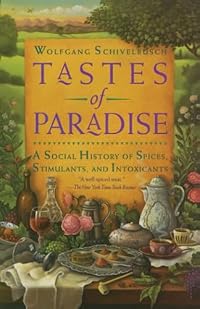
Tastes of Paradise: A Social History of Spices, Stimulants, and Intoxicants
by Wolfgang Schivelbusch
On This Page
Description
It began with pepper and other spices, like cinnamon and nutmeg, some eight hundred years ago. Then came coffee, tea, and chocolate, followed by alcohol and opium--all articles of pleasure people in the Western world craved in order to escape from their humdrum lives and heighten their daily enjoyment. How humanity transformed its history in the course of finding the rare condiments, stimulants, intoxicants, and narcotics that helped to make life more tolerable is the. Story of this rich and show more captivating book. Wolfgang Schivelbusch, in his engrossing journey through the centuries, documents with a wealth of startling information (and 125 illustrations) how our drive for the pleasure substances we can eat, drink, or inhale fueled the energies of the Old World with an explosive power that propelled mankind across the oceans and into a new age. The urge to please the palate and stimulate, benumb, or pleasure the senses arose at the dawn of. The modern age to dovetail with the needs of the rising merchant class and the capitalism it spawned. How the hunger for spices mobilized the Occident's energies with an intensity matched only by today's greed for oil; how coffee became the drink of the bourgeois age as the beverage which, unlike alcohol, promotes clear thinking and hard work; how tobacco became coffee's ally in fine-tuning the fast-paced nervous sensibilities of the modern era--here is a rich human. Array, an anecdotal history of ideas and beliefs, of fashions, fads, and rituals that orders a treasury of unknown facts in a new way to give us a fresh perspective on our own past and on our present. show lessTags
Recommendations




















Member Reviews
Translated from the German, this book talks about the evolution of delights such as chocolate, beer, and tobacco. Though the book frames itself as addressing the full phenomena, it feels very incomplete as it strongly focuses on England, Germany, France, and that immediate area of Europe; there is hardly anything on the Asiatic or New World sources and the original peoples. The topics are interesting, though, and there are many black and white photographs and illustrations that accompany the text.
A history of stimulants and intoxicants in Europe and America over the last two thousand years, with especial focus to the impacts of colonialism and the industrial revolution. Full of fascinating details (see my status updates for specifics). There is a great deal of sociological and psychological analysis for such a short book, and some of his conclusions seem more reasonable than others. (For instance, it seems probable that coffee was embraced by the middle class and chocolate by the upper class because each class treasures different values. But that drinking alcohol is considered more spiritual than eating, and this is somehow linked to the soul residing in blood, I just don't get.) My real criticism of this book, however, is that show more it features a large proportion of grey blobs which are purported to be reproductions of portraits, political cartoons, etc. Either put some money into your picture budget, or leave them out entirely; as it stands, the included reproductions are so smudgy that they were basically useless. show less
"A well written and informative book without being overwhelming. This isn't the most in depth book or look at these topics but it did give me some new perspectives on trade and goods, especially "addictive" goods than I had before."
Turns out this book, chosen by book club, was published several decades ago, and it has the unfootnoted, untested, personal-essay feel of those times. The discussion of Genussmittel that are stimulants vs sedatives was interesting. This guy spent years collecting old pictures and ads associated with getting high, many of which are reproduced in the book, but too blurrily to have much of an impression.
Facinating book. I learned a lot about the origins of some of our most common foods.
Kun olut tympein raskain höyryin
oli pimentänyt aivojemme valon,
lähetti taivas meille säälistä kai
tämän lääkitsevän pavun
Kahvi saapuu, tuo tervetullut terve juoma,
se vatsan parantaa, vilkastuttaa järjenjuoksua,
vahvistaa muistia, surullista lohduttaa
ja mielen elävöittää silti tekemättä meistä villiä.
(Tuntematon runoilija v. 1674)
oli pimentänyt aivojemme valon,
lähetti taivas meille säälistä kai
tämän lääkitsevän pavun
Kahvi saapuu, tuo tervetullut terve juoma,
se vatsan parantaa, vilkastuttaa järjenjuoksua,
vahvistaa muistia, surullista lohduttaa
ja mielen elävöittää silti tekemättä meistä villiä.
(Tuntematon runoilija v. 1674)
Jul 31, 2017Finnish
Ratings
Members
- Recently Added By
Author Information

18 Works 1,325 Members
Wolfgang Schivelbusch is a German historian and scholar of cultural studies. He has been awarded the Heinrich Mann Prize of the Academy of Arts in Berlin (1003) and the Lessing Prize of the City of Hamburg (2013).
Common Knowledge
- Canonical title*
- Storia dei generi voluttuari: spezie, caffè, cioccolato, tabacco, alcol e altre droghe
- Original title
- Das Paradies, der Geschmack und die Vernunft
- Original publication date
- 1980
- Epigraph
- Sometimes, when I had drunk a lot of coffee,
and the least little thing would startle me,
I noticed quite clearly that I jumped before
I had heard any noise.
--Lichtenberg - Dedication
- To Christina Spellman, stimulating breakfast companion
- First words
- Nothing could be more common than the salt and pepper on our tables.
Preface: This book deals not only with the history of 'Benussmittel'--the spices, stimulants, and other substances ingested or inhaled by humans to produce a pleasurable effect--but more importantly with the question: In what... (show all) way did these substances affect the history of man? - Last words
- (Click to show. Warning: May contain spoilers.)If we assume that every drug stimulates the narcissistic nature of the individual--his self-pleasure--then the fad for mineral waters in the eighties may well have been a unique chapter in the history of drugs; totally neutral in itself, indeed the very neutrality of water, now venerated as a chic drink of prestige, transported its consumer to a yet-unknown level of narcissistic well-being.
*Some information comes from Common Knowledge in other languages. Click "Edit" for more information.
Classifications
- Genres
- Nonfiction, History, Sociology, General Nonfiction, Food & Cooking
- DDC/MDS
- 394.12 — Society, Government, and Culture Customs, etiquette & folklore General customs Eating, drinking, using drugs Eating and drinking
- LCC
- GT2880 .S3613 — Geography, Anthropology and Recreation Manners and customs (General) Manners and customs (General) Customs relative to private life
- BISAC
Statistics
- Members
- 454
- Popularity
- 66,689
- Reviews
- 6
- Rating
- (3.79)
- Languages
- 10 — Danish, English, Finnish, French, German, Italian, Norwegian (Bokmål), Spanish, Swedish, Turkish
- Media
- Paper
- ISBNs
- 15
- ASINs
- 1