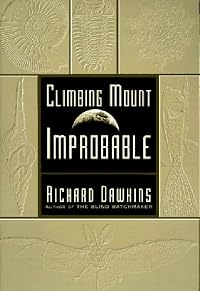
Climbing Mount Improbable
by Richard Dawkins
On This Page
Description
How do species evolve? Richard Dawkins, one of the world's most eminent zoologists, likens the process to scaling a huge, Himalaya-size peak, the Mount Improbable of his title. An alpinist does not leap from sea level to the summit; neither does a species utterly change forms overnight, but instead follows a course of "slow, cumulative, one-step-at-a-time, non-random survival of random variants"--A course that Charles Darwin, Dawkins's great hero, called natural selection. Illustrating his show more arguments with case studies from the natural world, such as the evolution of the eye and the lung, and the coevolution of certain kinds of figs and wasps, Dawkins provides a vigorous, entertaining defense of key Darwinian ideas. show lessTags
Recommendations



























Member Recommendations
BriarE Dawkins climbs the mountain again, this time to spend more time on the evidence, less on the mechanism. 426 pp. plus extras
30
Member Reviews
I don't really need Dawkins to persuade me that Darwinian evolution is an amazingly powerful idea (...or if I did, he already did the job forty years ago), but there's still a lot of pleasure in following his devastatingly clear explanations of some of the more unexpected places where it can lead us.
In this book, Dawkins looks at a selection of topics including the design of spider-webs, the possible shapes of shells, and the surprisingly complex sex-life of figs, as well as going in depth into two of the areas that are regularly held up as too complex to have "evolved by chance": vision and flight. The objections of Mrs Darwin and more recent doubters are rapidly dealt with, as Dawkins sets out the convincing evidence that both have show more developed many times, independently, in different parts of the evolutionary tree, and to many different levels of sophistication, and shows how even something as complex as the camera-eye we have nowadays could have developed through a series of quite plausible intermediate stages.
As in The blind watchmaker, there is a lot of reference to experiments with computer-simulations of evolutionary processes done by himself and other researchers, and Dawkins doesn't try to hide the limitations of such simulations, which can only assess the success of a mutation in terms of arbitrary pre-defined rules, whilst in the real world such mutations may (or, more likely, may not) turn out to overcome problems that we could only define with hindsight.
In his penultimate chapter, Dawkins tries to show us what an amazing thing life is, by setting out some of the challenges we would have to overcome to create an artificial system with the same properties. One of the pre-requisites, he tells us, would be a clearly impracticable machine he calls a "3D-printer", which would be able to create copies of actual physical components under the instructions of computer code. Not much more than twenty years later, I have such a machine on my desk...
As others have said, Dawkins is less enjoyable to read than he could be because of his constant and sometimes rather strident diatribes against the straw-men who are trying to confound him with silly, weak arguments against evolution. In the privileged environment of the printed page it's easy to start doubting that these straw-men actually exist (or, if they do, that anyone actually takes them seriously), and we often rather wish he would just get on with telling us about the science. But of course they do exist, they ignore scientific arguments, and Dawkins clearly sees it as part of his duty as a public communicator of science to warn us against them. show less
In this book, Dawkins looks at a selection of topics including the design of spider-webs, the possible shapes of shells, and the surprisingly complex sex-life of figs, as well as going in depth into two of the areas that are regularly held up as too complex to have "evolved by chance": vision and flight. The objections of Mrs Darwin and more recent doubters are rapidly dealt with, as Dawkins sets out the convincing evidence that both have show more developed many times, independently, in different parts of the evolutionary tree, and to many different levels of sophistication, and shows how even something as complex as the camera-eye we have nowadays could have developed through a series of quite plausible intermediate stages.
As in The blind watchmaker, there is a lot of reference to experiments with computer-simulations of evolutionary processes done by himself and other researchers, and Dawkins doesn't try to hide the limitations of such simulations, which can only assess the success of a mutation in terms of arbitrary pre-defined rules, whilst in the real world such mutations may (or, more likely, may not) turn out to overcome problems that we could only define with hindsight.
In his penultimate chapter, Dawkins tries to show us what an amazing thing life is, by setting out some of the challenges we would have to overcome to create an artificial system with the same properties. One of the pre-requisites, he tells us, would be a clearly impracticable machine he calls a "3D-printer", which would be able to create copies of actual physical components under the instructions of computer code. Not much more than twenty years later, I have such a machine on my desk...
As others have said, Dawkins is less enjoyable to read than he could be because of his constant and sometimes rather strident diatribes against the straw-men who are trying to confound him with silly, weak arguments against evolution. In the privileged environment of the printed page it's easy to start doubting that these straw-men actually exist (or, if they do, that anyone actually takes them seriously), and we often rather wish he would just get on with telling us about the science. But of course they do exist, they ignore scientific arguments, and Dawkins clearly sees it as part of his duty as a public communicator of science to warn us against them. show less
I may not always agree with the man, but I do enjoy the way he writes.
Once and for all: evolution is NOT about progress, a process tending towards a specific purpose and behind which, then, lies a designer. Using a metaphor (the climbing of a mountain) Dawkins insists here on the gradualism implied by evolution. Spiderwebs, the ability for some species to fly or, again, the eye are as many heights at the top of which he leads us and from where, evolution appears in all its simplicity. Besides, he defends his selfish gene hypothesis and, bounces back on the computer models developped for 'The Blind Watchmaker' in order to, not only simulate evolution through natural selection but also (and no, it's not a paradox) show what differentiate it from a guided selection.
Indeed, to be honest this is a repeat of show more 'The Blind Watchmaker', published 10 years before. The goal is the same and, he uses the same arguments -he just illustrate them by different examples.
The point is, if 'The Blind Watchmaker' was a frontal attack against the idea of an intelligent design, an in-your-face atheism, 'Climbing Mount Improbable' is more open and less radical. The conclusion remains the same (no need for a designer) but, it's not a slap in the face at each page.
A good introductory course to evolution, casting away one of the biggest misunderstanding surrounding it (a 'progress towards', hence the compatibility with a designer) this book is therefore ideal for whose who would like to know more about the topic, without being recklessly preached on atheism. show less
Indeed, to be honest this is a repeat of show more 'The Blind Watchmaker', published 10 years before. The goal is the same and, he uses the same arguments -he just illustrate them by different examples.
The point is, if 'The Blind Watchmaker' was a frontal attack against the idea of an intelligent design, an in-your-face atheism, 'Climbing Mount Improbable' is more open and less radical. The conclusion remains the same (no need for a designer) but, it's not a slap in the face at each page.
A good introductory course to evolution, casting away one of the biggest misunderstanding surrounding it (a 'progress towards', hence the compatibility with a designer) this book is therefore ideal for whose who would like to know more about the topic, without being recklessly preached on atheism. show less
I feel that this book was written solely as an attempt to refute ‘intelligent design’ theory. From the beginning to the end it provides examples of how evolution itself with no external aid could have led the species to the complexity it now possesses. The book starts and ends with a tale of the fig, and how it was a fig, and not an apple, that was offered to Adam by Eve, if Paradise had existed at all, that is.
The fig grows at the top of Mountain Improbable- the peak of evolution as we know it, and to get there we are led through the models of evolution of spider webs, gradual evolution of wings and eyes, variety of shell design and body design. For example, a seemingly infinite number of shell variations can be accounted for by show more the relationships among three variants only: flare (expansion rate), verm (how wide the shell is) and spire(how tall it is).
Mount Improbable itself is a peak, or many peaks of the development of various very complex, and seemingly too complex, elements and forms life takes to develop on its own just through the natural selection and survival pressure. Dawkins, though, takes each element he discusses: spiders and their webs, wings, etc., and shows (sometimes involving computer models into his demonstrations) how it is all possible and feasible, and not really that difficult if done step by step.
Dawkins frustrated me from time to time, even though I agree with him all along. He is such a hard core fundamentalist, that he has lost the ability to derive pleasure from seeing the world through non-Darwinian eyes. Figs and paradises exist surely to provide esthetic pleasure for us, and flowers definitely are there to make our world more beautiful :o) show less
The fig grows at the top of Mountain Improbable- the peak of evolution as we know it, and to get there we are led through the models of evolution of spider webs, gradual evolution of wings and eyes, variety of shell design and body design. For example, a seemingly infinite number of shell variations can be accounted for by show more the relationships among three variants only: flare (expansion rate), verm (how wide the shell is) and spire(how tall it is).
Mount Improbable itself is a peak, or many peaks of the development of various very complex, and seemingly too complex, elements and forms life takes to develop on its own just through the natural selection and survival pressure. Dawkins, though, takes each element he discusses: spiders and their webs, wings, etc., and shows (sometimes involving computer models into his demonstrations) how it is all possible and feasible, and not really that difficult if done step by step.
Dawkins frustrated me from time to time, even though I agree with him all along. He is such a hard core fundamentalist, that he has lost the ability to derive pleasure from seeing the world through non-Darwinian eyes. Figs and paradises exist surely to provide esthetic pleasure for us, and flowers definitely are there to make our world more beautiful :o) show less
Less 'preachy' than "The Blind Watchmaker", it contains in-depth discussions of the plausible evolution of several complex systems (wings, eyes) and of general mechanisms that could drive the co-evolution of body structures (shell morphology, embriology). A good book to put in the hands of an intelligent teen ager and a very good read for an interested adult. Still missing, I find, is a good sense of the methods of the science which Dawkins expounds on. Dawkins shows you the (likely) solution, but not the details of the methods used to obtain it. It makes you want to get into this branch of science but doesn't show you what are the steps you need to take to do so.
The Mount Improbable of the title is the probability of life evolving. Dawkin's demonstrates very eloquently exactly how life managed to climb that mountain of improbability.
I wanted to understand evolution better and this book delivered.
Members
- Recently Added By
Published Reviews
ThingScore 75
Dawkins writes in a lucid style, with never a dull moment—Dawkins throws in much informative material in real science which keeps the reader interested. And the real science in the book camouflages the many just-so speculations Dawkins resorts to.
added by jimroberts
Lists

Folio Society
831 works; 48 members

Books Cited in Blueprint by Nicholas Christakis
261 works; 1 member
Author Information

79+ Works 64,158 Members
Richard Dawkins was educated at Oxford University and taught zoology at the University of California and Oxford University, holding the position of the Charles Simonyi Professor of the Public Understanding of Science. He writes about such topics as DNA and genetic engineering, virtual reality, astronomy, and evolution. His books include The show more Selfish Gene, The Extended Phenotype, The Blind Watchmaker, River Out of Eden, Climbing Mount Improbable, The God Delusion, and An Appetite for Wonder: The Making of a Scientist. (Bowker Author Biography) show less
Some Editions
Awards and Honors
Work Relationships
Contains
Common Knowledge
- Canonical title*
- Alla conquista del monte improbabile. L'incredibile avventura dell'evoluzione
- Original title
- Climbing mount improbable
- Original publication date
- 1996
- People/Characters
- Douglas Noël Adams (meeting the meat scene from The Restaurant at the End of the Universe is paraphrased to make a point); Isaac Asimov; Henry Bennet-Clark; Patrick Callaerts; Charles Darwin [Charles Robert: 1809-1882]; Daniel Dennett (show all 64); Iain Douglas-Hamilton; Oria Douglas-Hamilton; William Eberhard; Donald Edmonds; Niles Eldredge; R. A. Fisher; Peter Fuchs; Walter Gehring; Charles Godfray; Richard Goldschmidt; Stephen Jay Gould; Alan Grafen; Radek Grzeszczuk; Haeckel, Ernst Heinrich Philipp August, 1834-1919; George Halder; W. D. Hamilton; Alister Hardy; Fred Hoyle; Barrie Juniper; Ted Kaehler; William Thomson, 1st Baron Kelvin; Bernard Kettlewell; Jonathan Kingdon; Joel Kingsolver; William Kirby; Kuno Kirschfield; Mimi Koehl; Thiemo Krink; Michael Land; Christopher Langton; Lorraine Lin; John Maynard Smith; Peter Medawar; Hans Meinhardt; Henry More; Randolph Nesse; Dan Nilsson; Christopher O'Toole; Susanne Pelger; James Pilkington; Rebecca Quiring; David Raup; Michael Robinson; Sir Charles Sherrington; Keith Thomas; D'Arcy Wentworth Thomas; William Thomson, 1st Baron Kelvin; Robert Trivers; Xiaoyuan Tu; Fritz Vollrath; Karl von Frisch; John von Neumann; Uwe Waldorf; W. Grey Walter; J. D. Watson; George Williams; Sewall Wright; Sam Zschokke
- Dedication
- For Robert Winston: a good doctor and a good man
- First words
- I have just listened to a lecture in which the topic for discussion was the fig.
- Last words
- (Click to show. Warning: May contain spoilers.)Even the most difficult problems can be solved, and even the most precipitous heights can be scaled, if only a slow, gradual, step-by-step pathway can be found. Mount Improbable cannot be assaulted. Gradually, if not always slowly, it must be climbed.
*Some information comes from Common Knowledge in other languages. Click "Edit" for more information.
Classifications
Statistics
- Members
- 2,217
- Popularity
- 9,173
- Reviews
- 8
- Rating
- (3.89)
- Languages
- 9 — Dutch, English, German, Hungarian, Italian, Polish, Portuguese, Spanish, Turkish
- Media
- Paper, Ebook
- ISBNs
- 22
- ASINs
- 15