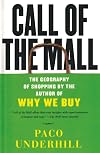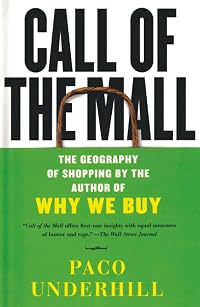
Call of the Mall: The Geography of Shopping by the Author of Why We Buy
by Paco Underhill
On This Page
Description
Profiling malls as intersections of American consumer marketing, the media, and street culture, an examination of malls as reflections of commercial and social culture considers what malls mean to ordinary people.Tags
Recommendations

















Member Reviews
For most of us, the mall has been around for as long as we can remember. But we hardly think about it that much; we just take it for granted. But Paco Underhill, on the other hand, founder of Envirosell, thinks about them all the time. His job is to meet with store executives and help run their stores better, by actually sending in his team of observers and watching how shoppers interact with the sales staff, the fixtures, and the products.
Underhill explores almost all aspects of mall sociology and economics. Underhill spends a lot of time with shoppers, listening to their advice, as well as with other consultants to gain a better understanding of the retail environment. He explores the parking lot with executives to help them show more understand it from the patrons’ point-of-view. He checks out the stores, the food court, the random kiosks, and even the bathrooms. He travels to malls all around the United States. Each chapter of Call of the Mall is devoted to a different part of the mall. Here are just some of his observations:
• Stores should sponsor the restrooms and make samples of their products available there (as well as where the patron can go to buy them).
• The store directories should be tabletop rather than a monolith that blocks the view of the newcomer.
• Food courts should be set up more like roadside bistros to facilitate the people-watching that naturally occurs there.
• There should be slightly more areas for men to congregate to keep them from nagging the people who dragged them there.
While there were some genuinely novel insights, most of his conclusions were rather uninspired. Although, they are the same gripes everybody has when going to the mall. Executives and mall owners seem only to want to simply squeeze money out of already existing business rather than spend a bit to encourage more spending.
He does see hope for the mall shopping landscape, however. New malls are incorporating innovative designs to appeal to a different breed of shoppers. They’re becoming more open-air, more ecologically friendly, and more integrated into the communities they support. While I’m still conflicted about the society that reveres the commercial good over the social good, it appears that we can have a balance of both and this book shows how we can get a little closer to that reality. A decent, quick read. show less
Underhill explores almost all aspects of mall sociology and economics. Underhill spends a lot of time with shoppers, listening to their advice, as well as with other consultants to gain a better understanding of the retail environment. He explores the parking lot with executives to help them show more understand it from the patrons’ point-of-view. He checks out the stores, the food court, the random kiosks, and even the bathrooms. He travels to malls all around the United States. Each chapter of Call of the Mall is devoted to a different part of the mall. Here are just some of his observations:
• Stores should sponsor the restrooms and make samples of their products available there (as well as where the patron can go to buy them).
• The store directories should be tabletop rather than a monolith that blocks the view of the newcomer.
• Food courts should be set up more like roadside bistros to facilitate the people-watching that naturally occurs there.
• There should be slightly more areas for men to congregate to keep them from nagging the people who dragged them there.
While there were some genuinely novel insights, most of his conclusions were rather uninspired. Although, they are the same gripes everybody has when going to the mall. Executives and mall owners seem only to want to simply squeeze money out of already existing business rather than spend a bit to encourage more spending.
He does see hope for the mall shopping landscape, however. New malls are incorporating innovative designs to appeal to a different breed of shoppers. They’re becoming more open-air, more ecologically friendly, and more integrated into the communities they support. While I’m still conflicted about the society that reveres the commercial good over the social good, it appears that we can have a balance of both and this book shows how we can get a little closer to that reality. A decent, quick read. show less
This is a fun book. Paco Underhill takes us on a little trip down the road and around and into a typical mall. He's chatty and light-hearted, but makes many trenchant observations about human behavior, and how malls both succeed and fail (sometimes miserably) in dealing with it.
The book starts off extremely well, but does tail off a bit in later chapters. Nevertheless, recommended.
The book starts off extremely well, but does tail off a bit in later chapters. Nevertheless, recommended.
An interesting look at the mechanics of the mall that drive why we shop, when and how. Think of this as an insider's walking tour of a mall and its secrets. It starts and ends, as do all our trips to the mall, in the parking lot. Now where did I park my car?
Reading this for my library management class.
As a former corporate employee of Victoria's Secret, I am skeptical after reading the chapter on marketing suggestions for VS.
As a former corporate employee of Victoria's Secret, I am skeptical after reading the chapter on marketing suggestions for VS.
ereader ebook
Ratings
Members
- Recently Added By
Author Information

4+ Works 2,122 Members
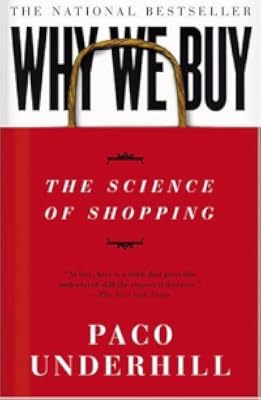
Paco Underhill is an environmental psychologist and founder of a market research and consulting company called Envirosell. His books include Why We Buy : The Science of Shopping, Call of the Mall: The Geography of Shopping, and What Women Want. (Bowker Author Biography)
Awards and Honors
Distinctions
Common Knowledge
- Blurbers
- Peters, Tom; Weisberger, Lauren
Classifications
- Genres
- Nonfiction, Business, Sociology, General Nonfiction
- DDC/MDS
- 306.30973 — Society, government, & culture Social sciences, sociology & anthropology Social Behavior - Dating, Marriage, Divorce Economic institutions Biography And History North America
- LCC
- HF5430.3 .U53 — Social sciences Commerce Commerce Business
- BISAC
Statistics
- Members
- 387
- Popularity
- 81,278
- Reviews
- 6
- Rating
- (3.57)
- Languages
- English, Italian, Portuguese
- Media
- Paper, Ebook
- ISBNs
- 7
- ASINs
- 2