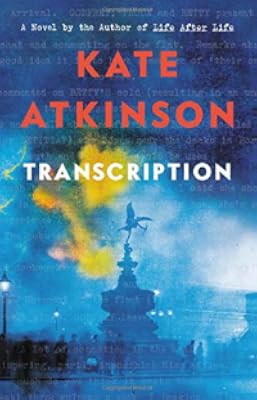
Transcription
by Kate Atkinson
On This Page
Description
In 1940, eighteen-year old Juliet Armstrong is reluctantly recruited into the world of espionage. Sent to an obscure department of MI5 tasked with monitoring the comings and goings of British Fascist sympathizers, she discovers the work to be by turns both tedious and terrifying. But after the war has ended, she presumes the events of those years have been relegated to the past forever. Ten years later, now a radio producer at the BBC, Juliet is unexpectedly confronted by figures from her show more past. A different war is being fought now, on a different battleground, but Juliet finds herself once more under threat. A bill of reckoning is due, and she finally begins to realize that there is no action without consequence. show lessTags
Recommendations

















Member Recommendations
Member Reviews
Historical fiction about MI5-related agents and double agents during WWII but actually more about the ability to deceive. Protagonist Juliet Armstrong is an orphaned teen recruited by the British Secret Service to help monitor fascist sympathizers. She is a transcriptionist, typing up recorded conversations among an agent posing as a Gestapo spy, Godfrey Toby, and a group of Nazi supporters living in England. Juliet is recognized by her superiors as someone that could effectively lie and assume a separate identity (she perhaps was a pathological liar?) and assigns her a more active spying role. It is a dual timeline story, one set in early WWII in England and the other in 1950, when Juliet is working for the BBC, engaged in creating show more programs to educate children. Her past catches up with her and she feels threatened. Someone appears out to get her, and the list of possible candidates is lengthy.
Based on declassified documents of MI5, Kate Atkinson has extrapolated upon and fictionalized events while keeping with the spirit of the time. This is a thinking person’s novel. It is unclear which people are agents and which are double-agents. We get a sense of the paranoia of the period, ripe with propaganda and wondering whom to trust. Is Godfrey Toby a double agent or does he just excel at his job? Filled with layers and complexities, the reader participates with Juliet in attempting to figure out who is threatening her. The writing is intelligent and intricate, containing depth and subtle humor. It is more than a spy novel. It is a book that inspires thoughtful reflection about deception and a person’s ability to hide behind masks. It successfully illustrates that truth often lies in that which is left unsaid.
I felt most engaged in the WWII part of the story, though I believe the 1950’s timeline was necessary to show her past catching up with her, and that once a spy, distrust lingers. To enjoy it to its fullest, I think the reader must be comfortable with an abundance of ambiguity.
Content warnings include language (not extensive), animal cruelty (one scene offstage), and violence (including murder). Recommended to those that enjoy layered, complex novels about deception where people and things may not be what they appear on the surface. This was my first reading of a novel by Kate Atkinson and it has inspired me to explore more of her works. show less
Based on declassified documents of MI5, Kate Atkinson has extrapolated upon and fictionalized events while keeping with the spirit of the time. This is a thinking person’s novel. It is unclear which people are agents and which are double-agents. We get a sense of the paranoia of the period, ripe with propaganda and wondering whom to trust. Is Godfrey Toby a double agent or does he just excel at his job? Filled with layers and complexities, the reader participates with Juliet in attempting to figure out who is threatening her. The writing is intelligent and intricate, containing depth and subtle humor. It is more than a spy novel. It is a book that inspires thoughtful reflection about deception and a person’s ability to hide behind masks. It successfully illustrates that truth often lies in that which is left unsaid.
I felt most engaged in the WWII part of the story, though I believe the 1950’s timeline was necessary to show her past catching up with her, and that once a spy, distrust lingers. To enjoy it to its fullest, I think the reader must be comfortable with an abundance of ambiguity.
Content warnings include language (not extensive), animal cruelty (one scene offstage), and violence (including murder). Recommended to those that enjoy layered, complex novels about deception where people and things may not be what they appear on the surface. This was my first reading of a novel by Kate Atkinson and it has inspired me to explore more of her works. show less
At the tender age of19, Juliet Armstrong in 1940 joins the world of spies, hired by MI5 to transcribe another spy's meetings with a group of Fascist Londoners who think he's a German agent. What seems somewhat normal and routine at the beginning of the book turns out to be anything but by the end. Juliet is a talented liar, and easily adapts to having multiple identities and living in a world of deception. How she combines this with a naivete (particularly early on) and magnetic innocence is one of the book's attractions. We never doubt her integrity, as she ends up navigating one dangerous situation after another.
There's a good bit of humor in the book. Here are a couple of examples.
"Juliet could only imagine the havoc she would cause show more if she started brandishing her own gun on Oxford Street. And she couldn’t shoot every drab housewife—she’d be here all day."
"Why was it that the females of the species were always the ones left to tidy up? she wondered. I expect Jesus came out of the tomb, Juliet thought, and said to his mother, 'Can you tidy it up a bit back there?'"
The revelations that come in the last quarter of the book change how we view Juliet and her actions, but fit them. Atkinson is adept at jumbling chronology in her books, and it works well again here. I ended up giving this one 4 and 1/2 stars. show less
There's a good bit of humor in the book. Here are a couple of examples.
"Juliet could only imagine the havoc she would cause show more if she started brandishing her own gun on Oxford Street. And she couldn’t shoot every drab housewife—she’d be here all day."
"Why was it that the females of the species were always the ones left to tidy up? she wondered. I expect Jesus came out of the tomb, Juliet thought, and said to his mother, 'Can you tidy it up a bit back there?'"
The revelations that come in the last quarter of the book change how we view Juliet and her actions, but fit them. Atkinson is adept at jumbling chronology in her books, and it works well again here. I ended up giving this one 4 and 1/2 stars. show less
Bookended by very short sections set in 1981, the main story takes place in 1940 and 1950. In 1940, Juliet Armstrong is recruited into MI5, transcribing fifth columnists reporting to (they think) a Gestapo agent (actually Godfrey Toby). She also infiltrates the Right Club, a set of British Fascists. Once she has helped catch one of the key players, as well as an American, her part in the drama seems to be over.
A decade later, Juliet is working for the BBC, but people from her life during the war start popping up: Godfrey Toby, for one, though he refuses to recognize her, even when she calls him by his real name, John Hazeldine. She receives a threatening note at work, and is being followed around London. Deciding to be the hunter show more rather than the hunted, she goes on a fact-finding mission.
As one can now expect with a fair degree of certainty, Kate Atkinson's newest is both original and brilliant. It's an English wartime story on its face, but, like Life After Life and A God in Ruins, the narrative structure is utterly original - though in Transcription, the reveal comes much later in the story, as it turns out that the close third person narration hasn't been quite as close as the reader may have thought. As Perry Gibbons says to Juliet, "The mark of a good agent is when you have no idea which side they're on."
Quotes
There was a better life somewhere, Juliet supposed, if only she could be bothered to find it. (14)
Choice, it seemed, was one of the first casualties of war. (31)
She supposed that's what war was - one test after another. Sooner or later, she was bound to fail. (80)
There were bentwood chairs and a scattering of quite ordinary people sitting on them, none of whom looked like Fascist sympathizers, but then how could you tell what anyone was in their heart? Really? (81)
"Do not equate nationalism with patriotism," Perry warned Juliet. "Nationalism is the first step on the road to Fascism." (86)
"The mark of a good agent is when you have no idea which side they're on." (Perry to Juliet, 115)
"Human nature favors the tribal. Tribalism engenders violence." (Godfrey to Juliet, 144)
People always said they wanted the truth, but really they were perfectly content with a facsimile. (185)
Sometimes she wondered if she didn't carry a fatal flaw inside her - the crack in the golden bowl, invisible to the naked eye, but impossible to ignore once you knew about it. (212)
The war was a clumsily stitched wound and it felt as if it was being opened by something. Or someone. (217)
It was curious how you could hold two quite opposing feelings at the same time, an unsettling emotional discord. (228)
It was as if a complicated game of chess was being played, but Juliet didn't know all the rules or where anyone else was on the board. She was clearly intended to be a pawn in this game. But I am a queen, she thought. Able to move in any direction. (242)
(Yet could one really be blamed for the selfish instinct to survive at the cost to others?) (261)
Don't let your imagination run away with you, Miss Armstrong. But why would you not when the reality was so awful? (305) show less
A decade later, Juliet is working for the BBC, but people from her life during the war start popping up: Godfrey Toby, for one, though he refuses to recognize her, even when she calls him by his real name, John Hazeldine. She receives a threatening note at work, and is being followed around London. Deciding to be the hunter show more rather than the hunted, she goes on a fact-finding mission.
As one can now expect with a fair degree of certainty, Kate Atkinson's newest is both original and brilliant. It's an English wartime story on its face, but, like Life After Life and A God in Ruins, the narrative structure is utterly original - though in Transcription, the reveal comes much later in the story, as it turns out that the close third person narration hasn't been quite as close as the reader may have thought. As Perry Gibbons says to Juliet, "The mark of a good agent is when you have no idea which side they're on."
Quotes
There was a better life somewhere, Juliet supposed, if only she could be bothered to find it. (14)
Choice, it seemed, was one of the first casualties of war. (31)
She supposed that's what war was - one test after another. Sooner or later, she was bound to fail. (80)
There were bentwood chairs and a scattering of quite ordinary people sitting on them, none of whom looked like Fascist sympathizers, but then how could you tell what anyone was in their heart? Really? (81)
"Do not equate nationalism with patriotism," Perry warned Juliet. "Nationalism is the first step on the road to Fascism." (86)
"The mark of a good agent is when you have no idea which side they're on." (Perry to Juliet, 115)
"Human nature favors the tribal. Tribalism engenders violence." (Godfrey to Juliet, 144)
People always said they wanted the truth, but really they were perfectly content with a facsimile. (185)
Sometimes she wondered if she didn't carry a fatal flaw inside her - the crack in the golden bowl, invisible to the naked eye, but impossible to ignore once you knew about it. (212)
The war was a clumsily stitched wound and it felt as if it was being opened by something. Or someone. (217)
It was curious how you could hold two quite opposing feelings at the same time, an unsettling emotional discord. (228)
It was as if a complicated game of chess was being played, but Juliet didn't know all the rules or where anyone else was on the board. She was clearly intended to be a pawn in this game. But I am a queen, she thought. Able to move in any direction. (242)
(Yet could one really be blamed for the selfish instinct to survive at the cost to others?) (261)
Don't let your imagination run away with you, Miss Armstrong. But why would you not when the reality was so awful? (305) show less
I haven't read a Kate Atkinson book I didn't love, and this is no exception. Told in two, alternating periods of time (1940 and 1950) bookended by a scene playing out in 1981, the story focuses on Juliet Armstrong, the British transcriber of the title. Juliet is 18 years old when she joins an MI5 department keeping tabs on the Fifth Column, a group of Brits with fascist leanings who meet with a Gestopo agent in an ordinary apartment. Unknown to them, the Gestopo agent is actually a MI5 agent and the apartment is wired for sound. In the next apartment, Juliet transcribes the recordings of the debriefings. On one occasion, she's assigned a more active role investigating a particular Nazi sympathizer. The war ends and Juliet gets on with show more her life, working as a radio producer for the BBC, but when MI5 has need of her services, she learns that no one is ever free of the security service.
In the hands of many authors, this would be sufficient for an exciting WWII/Cold War spy adventure, but Atkinson has a bit more in mind for her readers. Juliet is an amazing creation. Even with a third person narrator, we see many of Juliet's thoughts, mostly the sardonic or ironic ones. But we're not privy to everything, not until Atkinson is ready to reveal all. The twists and turns of this historical novel and Juliet comes to realize she's never truly been in control of her decisions, and that actions have consequences. Throw in exploration of identity, loyalty, trust and suspicion, plus some philosophy, and you get a literary novel that's compelling to read. show less
In the hands of many authors, this would be sufficient for an exciting WWII/Cold War spy adventure, but Atkinson has a bit more in mind for her readers. Juliet is an amazing creation. Even with a third person narrator, we see many of Juliet's thoughts, mostly the sardonic or ironic ones. But we're not privy to everything, not until Atkinson is ready to reveal all. The twists and turns of this historical novel and Juliet comes to realize she's never truly been in control of her decisions, and that actions have consequences. Throw in exploration of identity, loyalty, trust and suspicion, plus some philosophy, and you get a literary novel that's compelling to read. show less
Kate Atkinson's "Transcription" follows the fortunes of Juliet Armstrong who, when she is eighteen, is chosen by the British Secret Service to transcribe secret recordings of German sympathizers who want to help the Nazis prevail against Allied forces. These pro-Fascist individuals meet regularly to share information with Godfrey Toby, an MI5 officer who poses as one of them. Subsequently, Juliet becomes a spy and participates in activities that will continue to haunt her.
Armstrong is an entertaining narrator--funny, smart, observant, and sarcastic. Atkinson tells her fascinating story out of sequence, a device that requires readers to play close attention to detail. Ultimately, the disparate parts of Julia's life come together in a show more surprising manner. Some chapters are set in the 1940s and others in 1950, when Juliet is a producer of children's programming for the BBC. We also catch glimpses of the heroine thirty years later, in 1981. The book's dialogue is clever and sophisticated, its characters are varied and intriguing, and the author deals with issues that remain relevant today. We watch Juliet evolve from a naive young lady to a cynical woman who does not suffer foods gladly.
"Transcription" shows that events from the past often influence the present. In addition, people may put on false fronts to hide their underlying motives and, although loyalties shift and beliefs change, human nature basically stays the same. This work of fiction is like a tapestry in which humor, poignancy, and heartbreak are interconnected— in Juliet's world, there is no clear demarcation between levity and tragedy. When she looks back at her experiences, Juliet comes to understand her acquaintance's declaration: "One is never free. It's never finished." In some ways, we are all a product of everything that has happened to us and all that we have done. Atkinson has written a thoughtful and provocative novel that demonstrates how ideology and self-interest can override common sense, morality, and decency. show less
Armstrong is an entertaining narrator--funny, smart, observant, and sarcastic. Atkinson tells her fascinating story out of sequence, a device that requires readers to play close attention to detail. Ultimately, the disparate parts of Julia's life come together in a show more surprising manner. Some chapters are set in the 1940s and others in 1950, when Juliet is a producer of children's programming for the BBC. We also catch glimpses of the heroine thirty years later, in 1981. The book's dialogue is clever and sophisticated, its characters are varied and intriguing, and the author deals with issues that remain relevant today. We watch Juliet evolve from a naive young lady to a cynical woman who does not suffer foods gladly.
"Transcription" shows that events from the past often influence the present. In addition, people may put on false fronts to hide their underlying motives and, although loyalties shift and beliefs change, human nature basically stays the same. This work of fiction is like a tapestry in which humor, poignancy, and heartbreak are interconnected— in Juliet's world, there is no clear demarcation between levity and tragedy. When she looks back at her experiences, Juliet comes to understand her acquaintance's declaration: "One is never free. It's never finished." In some ways, we are all a product of everything that has happened to us and all that we have done. Atkinson has written a thoughtful and provocative novel that demonstrates how ideology and self-interest can override common sense, morality, and decency. show less
In 1940 Juliette Armstrong is recruited into MI5, the British intelligence service, to transcribe recorded meetings between an agent, Godfrey Toby, and seemingly ordinary citizens who are believed to be working for the German government. Toby pretends to be one of them, when in reality he hopes to use information obtained from these meetings to thwart the Germans. Juliette proves herself as a transcriber, and is then asked to assume a fake identity and mingle among German sympathizers.
Fast forward to 1950, when Juliette is a producer of children’s programming for BBC radio. After a chance encounter with Godfrey Toby, she begins to realize her wartime activities are not fully behind her. The novel shifts between these two time show more periods, dropping hints and details as dots for the reader to connect. A classic spy caper ensues, where Juliette -- and the reader -- are never quite sure whether people are who they say they are, and begin to question the loyalty of key figures in the drama.
Kate Atkinson brings a unique talent to this genre. There’s plenty of mystery and intrigue, as well as a great deal of humor. Juliette becomes a savvy and effective spy, and she is also an ordinary human being who loves, hopes, and fears. Atkinson also employs a very brief prologue and epilogue, set in 1981, as bookends to Juliette’s story. I found the author’s note at the end of the book very interesting, as it described how Atkinson blended discrete factual elements into a plausible story that was great fun to read. show less
Fast forward to 1950, when Juliette is a producer of children’s programming for BBC radio. After a chance encounter with Godfrey Toby, she begins to realize her wartime activities are not fully behind her. The novel shifts between these two time show more periods, dropping hints and details as dots for the reader to connect. A classic spy caper ensues, where Juliette -- and the reader -- are never quite sure whether people are who they say they are, and begin to question the loyalty of key figures in the drama.
Kate Atkinson brings a unique talent to this genre. There’s plenty of mystery and intrigue, as well as a great deal of humor. Juliette becomes a savvy and effective spy, and she is also an ordinary human being who loves, hopes, and fears. Atkinson also employs a very brief prologue and epilogue, set in 1981, as bookends to Juliette’s story. I found the author’s note at the end of the book very interesting, as it described how Atkinson blended discrete factual elements into a plausible story that was great fun to read. show less
Marvellous! This tale of an 18 year old girls very rapid growing up at the onset of WW2 and her induction into MI5 and subsequent adventures is told in the style of the wonderful writers of postWW2 England, such as Muriel Spark and Penelope Fitzgerald. Actually, Atkinson hails Fitzgerald in the Author’s Note that concludes this wonderful book. While I have read Atkinson’s 'Life After Life' and thought it fine I likely would not have read another if ‘Transcription’ had not been recommended in the pages of Louise Erdrich’s amazing story “The Sentence” and its whacky book store characters and their favourite novels, of which “Transcription” was one… but I digress. Ms. Atkinson applies the style of post WW2 writers very show more effectively, and the narrator/heroine Juliet has an amazing voice; articulate, droll, insightful, witty, brave, and full of cheeky lies. In fact, she lied to me also, and will to you too should you read this tale. The story is based mostly in two time windows, the war and 10 years later, as Juliet’s experiences in MI5 play out, and then the follow up as the past has its consequences. I loved following her adventures and thoughts. 4.5 easy! show less
Members
- Recently Added By
Published Reviews
This idea of consequences, and of every choice exacting a price later, runs like a watermark through Transcription, as it did through its two predecessors. At times, the novel is guilty of making its historical parallels a little too emphatic:... Transcription stands alongside its immediate predecessors as a fine example of Atkinson’s mature work; an unapologetic novel of ideas, which is show more also wise, funny and paced like a spy thriller. While it may lack the emotional sucker punch of A God in Ruins, Transcription exerts a gentler pull on the emotions, offering at the end a glimmer of hope, even as it asks us to consider again our recent history and the price of our individual and collective choices. It could hardly be more timely. show less
added by KayCliff
Lists

Best Spy Fiction
153 works; 102 members

Historical Fiction
889 works; 91 members

Female Protagonist
1,056 works; 57 members

Books about World War II
241 works; 22 members

Kirkus Starred Fiction Reviews of Books Published in 2018
330 works; 3 members

Amazon best fictional genre picks monthly for 2018
418 works; 9 members

Books Read in 2018
4,360 works; 110 members

Books Read in 2019
4,052 works; 110 members

Books We Couldn't Put Down
443 works; 197 members
Author Information

36+ Works 52,741 Members
Kate Atkinson was born in York, and studied English Literature at the University of Dundee. She earned her Masters Degree from Dundee in 1974. She then went on to study for a doctorate in American Literature but she failed at the viva (oral examination) stage. After leaving the university, she took on a variety of jobs from home help to legal show more secretary and teacher. Her first novel, Behind the Scenes at the Museum, won the 1995 Whitbread Book of the Year ahead of Salman Rushdie's The Moor's Last Sigh and Roy Jenkins's biography of William Ewart Gladstone. It went on to be a Sunday Times bestseller. Since then, she has published another five novels, one play, and one collection of short stories. Her work is often celebrated for its wit, wisdom and subtle characterisation, and the surprising twists and plot turns. Her most recent work has featured the popular former detective Jackson Brodie. In 2009, she donated the short story Lucky We Live Now to Oxfam's 'Ox-Tales' project, four collections of UK stories written by 38 authors. Atkinson's story was published in the 'Earth' collection. In March 2010, Atkinson appeared at the York Literature Festival, giving a world-premier reading from an early chapter from her forthcoming novel Started Early, Took My Dog, which is set mainly in the English city of Leeds. Atkinson's bestselling novel, Life after Life, has won numerous awards, including the COSTA Novel Award for 2013. The follow-up to Life After Life is A God in Ruins and was published in 2015. This title won a Costa Book Award 2015 in the novel category. (Bowker Author Biography) show less
Some Editions
Awards and Honors
Awards
Distinctions
Notable Lists
Work Relationships
Is abridged in
Common Knowledge
- Canonical title
- Transcription
- Original title
- Transcription
- Original publication date
- 2018
- People/Characters*
- Juliet Armstrong
- Important places
- London, England, UK
- Important events
- World War II
- Epigraph
- ‘In wartime, truth is so precious that she should always be attended by a bodyguard of lies.’
Winston Churchill
This Temple of the Arts and Muses is dedicated to Almighty God by the first Governors of Broadcasting in the year 1931, Sir John Reith being Director General. It is their prayer that good seed sown may bring forth a good harv... (show all)est, that all things hostile to peace or purity may be banished from this house, and that the people, inclining their ear to whatsoever things are beautiful and honest and of good report, may tread the path of wisdom and uprightness.
Translation of Latin inscription in the foyer of British Broadcasting House
Z Stands for ‘Zero’, the hour still abed
When a new England rises and the old one is dead.
From the Right Club’s ‘War Alphabet’ - Dedication
- For Marianne Velmans
- First words
- ‘MISS ARMSTRONG? MISS Armstrong, can you hear me?’
- Quotations
- Recently she had bought a new book, by Elizabeth David - "A Book of Mediterranean Food". A hopeful purchase. The only olive oil she could find was sold in her local chemist in a small bottle. "For softening earwax?" he asked ... (show all)when she handed over her money.
- Last words
- (Click to show. Warning: May contain spoilers.)‘Miss Armstrong? Miss Armstrong?’
- Blurbers*
- Yanagihara, Hanya
- Original language*
- Engels
*Some information comes from Common Knowledge in other languages. Click "Edit" for more information.
Classifications
Statistics
- Members
- 3,036
- Popularity
- 5,869
- Reviews
- 130
- Rating
- (3.66)
- Languages
- 9 — Dutch, English, French, German, Greek, Italian, Portuguese, Spanish, Swedish
- Media
- Paper, Audiobook, Ebook
- ISBNs
- 54
- ASINs
- 9