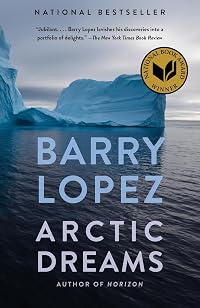
Arctic Dreams
by Barry Lopez
On This Page
Description
Winner of the National Book Award This bestselling, groundbreaking exploration of the Far North is a classic of natural history, anthropology, and travel writing. The Arctic is a perilous place. Only a few species of wild animals can survive its harsh climate. In this modern classic, Barry Lopez explores the many-faceted wonders of the Far North: its strangely stunted forests, its mesmerizing aurora borealis, its frozen seas. Musk oxen, polar bears, narwhal, and other exotic beasts of the show more region come alive through Lopez's passionate and nuanced observations. And, as he examines the history and culture of its indigenous communities, along with parallel narratives of intrepid, often underprepared and subsequently doomed polar explorers, Lopez drives to the heart of why the austere and formidable Arctic is also a constant source of breathtaking beauty, mystery, and wonder. Written in prose as pure as the land it describes, Arctic Dreams is a timeless mediation on the ability of the landscape to shape our dreams and to haunt our imaginations. show lessTags
Recommendations









Member Recommendations

Member Reviews
In his luminous Arctic Dreams, Barry Lopez travels wild country over a span of years, picking up observations, taking up with native peoples, and talking to scientists, industrialists, and others banking on finding something they seek in these polar places. He is active and curious and not shy of gestures of deeply felt appreciation: “I took to bowing on these evening walks. I would bow slightly with my hands in my pockets, toward the birds and the evidence of life in their nests.” He muses, “In a simple bow from the waist…you are able to stake your life, again, in what you dream.”
What is staked here are arctic dreams, and for Northern peoples the dreams are being interrupted. Rising temperatures are thinning and melting show more Arctic ice. Lopez’s book, published in 1986, is not one focused on these changes but I’m struck by how much the risks they bring to wildlife and to “Eskimo” culture call to mind the nightmarish “savssats” he describes: “Late in fall, while narwhals are still feeding deep in a coastal fiord, a band of ice may form in calm water across the fiord’s mouth. The ice sheet may then expand toward the head of the fiord…” The expanding ice sheet grows to exceed the distance a narwhal can travel under ice while sustained by a single breath, so the narwhals are trapped. They cannot get out. There is frenzy.
That is a threat from ice. But as the Arctic warms, leads (picture liquid “savssats,” i.e. channels of water) form and widen ever more readily, marooning polar bears on smaller, more widely separated islands of ice. Attempts to escape floes by crossing the expanding leads become especially deadly to cubs and imperil local hunters too. As Lopez observes about pack ice, “to venture out there on foot is, to put it simply, to court death.”
The rewards of Arctic Dreams are many. The account of explorers’ efforts in the region is not to be missed and by itself would justify the volume, and it is just one part (What were these men seeking? What had they imagined they’d find? What desires were inflamed or satisfied by their journeys?). Barry Lopez has given us a beautiful and inspiring and profound and worrying piece of work. show less
What is staked here are arctic dreams, and for Northern peoples the dreams are being interrupted. Rising temperatures are thinning and melting show more Arctic ice. Lopez’s book, published in 1986, is not one focused on these changes but I’m struck by how much the risks they bring to wildlife and to “Eskimo” culture call to mind the nightmarish “savssats” he describes: “Late in fall, while narwhals are still feeding deep in a coastal fiord, a band of ice may form in calm water across the fiord’s mouth. The ice sheet may then expand toward the head of the fiord…” The expanding ice sheet grows to exceed the distance a narwhal can travel under ice while sustained by a single breath, so the narwhals are trapped. They cannot get out. There is frenzy.
That is a threat from ice. But as the Arctic warms, leads (picture liquid “savssats,” i.e. channels of water) form and widen ever more readily, marooning polar bears on smaller, more widely separated islands of ice. Attempts to escape floes by crossing the expanding leads become especially deadly to cubs and imperil local hunters too. As Lopez observes about pack ice, “to venture out there on foot is, to put it simply, to court death.”
The rewards of Arctic Dreams are many. The account of explorers’ efforts in the region is not to be missed and by itself would justify the volume, and it is just one part (What were these men seeking? What had they imagined they’d find? What desires were inflamed or satisfied by their journeys?). Barry Lopez has given us a beautiful and inspiring and profound and worrying piece of work. show less
Writing a decent book isn't that difficult - there are multitudes of good writers with a facility for language who can come up with something readable merely by applying their talents to a given subject for a few months. It's a matter of mechanics more than anything else: give an established writer a topic and a deadline and you can be assured that most of the time the resulting product whether fiction or non-fiction will slide smoothly down the gullets of the reading public. To write a truly excellent book, however, you have to be truly passionate about your subject. This fire in the heart and in the fingers can't be mistaken; it's a vividness of imagery, a sharpness of perception, an outpouring of insight, and a rhythm of prose that show more makes reading the result both a pleasure and an education, which Arctic Dreams certainly is.
Arctic Dreams a nature book, and the finest books about nature are great examples of the unity between edification and entertainment that a driven author can achieve: to pick only American authors, John McPhee has made an entire career out of mining the lyrical side of the English language from the alpine majesties of the natural world, Jack London's lupine solitudes will always be peerless in their intensity and force, Rachel Carson almost singlehandedly revived the idea of the environment as a political issue worth caring about, and Henry David Thoreau is still worth rereading to understand the conflicted mindset of the modern lover of nature. Lopez borrows from each of those traditions in this work whose subtitle ("Imagination and Desire in a Northern Landscape") gives a good indication of his take on the Arctic. It talks about animals, birds, fish, whales, water, ice, the stars, the sun, Eskimos, explorers, painters, all refracted prismatically by the effect that this daunting edge of the Earth has on people like him who have lived in it for years.
It's obvious he had something of a religious experience out there in the Arctic - his lengthy digressions on the history of the narwhal or the migration of muskoxen flow in torrents that rejoin the main narrative after epic journeys of history and data, while his ruminations on the difficulty European painters had in replicating the peculiar clarity of light they saw in that alien landscape are just one of the ways he tries to get across the idea that this place can't be described in words, even if they have the fit and precision of ice blocks in an igloo. His discussions of paintings are key, and I highly recommend looking up the artwork he references while you read, because a lot of the book is devoted to the mindset you get in when surrounded by towering icebergs and endless plains. Having those depictions, as inadequate as they are, increases your appreciation for the daunting contrast he describes between the implacable earth and the ambition of man.
It's hard to read the book and come away not full of superlatives and flowery metaphors, which is a testament to the power of Lopez's prose. I haven't stopped reading so often to admire an apt phrase since I first read McPhee's Encounters With the Archdruid, and while Lopez is much more politically engaged in his subject than the scrupulously neutral McPhee, I feel like it only enhances the intensity of his ardor for the land and puts him more in Carson's realm.
I ultimately found that I had only two minor issues with the book, both related. The first issue concerns a brief discussion of the differences between Eskimo and outsider languages as they relate to the Arctic wilderness. Invoking the Sapir-Whorf hypothesis, Lopez offers the claim that due to the grammatical construction of the Hopi language, it would be easier for a Hopi child to understand quantum mechanics than an English-speaking child. Suffice it to say, this is the worst kind of layman pseudo-science (I must have missed the overwhelming dominance of Hopi speakers in theoretical physics), and it stands in stark contrast to the rest of the book. At least he didn't repeat the infamous "50 words for snow" canard.
The other issue is the general over-romanticism of the Eskimos and their way of life. While I've never been to the Arctic and have gotten all my knowledge of Eskimo culture from books, passage after passage veered dangerously close to noble savage clichés that told me more about Lopez's disdain for his own culture than anything about Eskimos. Couldn't you write that 14th century English peasants were "exquisitely adapted to the rhythms of their environment" with equal veracity, or rhapsodize about their "differing conceptions of time and space" in the same way? The commendable sympathy and insight Lopez had for the Eskimo way of life and the challenges it faces from modern society did not need the encrustations of idolatry he chose to provide. However, the book is still excellent, and is highly recommended if you like great writing about cool nature topics. show less
Arctic Dreams a nature book, and the finest books about nature are great examples of the unity between edification and entertainment that a driven author can achieve: to pick only American authors, John McPhee has made an entire career out of mining the lyrical side of the English language from the alpine majesties of the natural world, Jack London's lupine solitudes will always be peerless in their intensity and force, Rachel Carson almost singlehandedly revived the idea of the environment as a political issue worth caring about, and Henry David Thoreau is still worth rereading to understand the conflicted mindset of the modern lover of nature. Lopez borrows from each of those traditions in this work whose subtitle ("Imagination and Desire in a Northern Landscape") gives a good indication of his take on the Arctic. It talks about animals, birds, fish, whales, water, ice, the stars, the sun, Eskimos, explorers, painters, all refracted prismatically by the effect that this daunting edge of the Earth has on people like him who have lived in it for years.
It's obvious he had something of a religious experience out there in the Arctic - his lengthy digressions on the history of the narwhal or the migration of muskoxen flow in torrents that rejoin the main narrative after epic journeys of history and data, while his ruminations on the difficulty European painters had in replicating the peculiar clarity of light they saw in that alien landscape are just one of the ways he tries to get across the idea that this place can't be described in words, even if they have the fit and precision of ice blocks in an igloo. His discussions of paintings are key, and I highly recommend looking up the artwork he references while you read, because a lot of the book is devoted to the mindset you get in when surrounded by towering icebergs and endless plains. Having those depictions, as inadequate as they are, increases your appreciation for the daunting contrast he describes between the implacable earth and the ambition of man.
It's hard to read the book and come away not full of superlatives and flowery metaphors, which is a testament to the power of Lopez's prose. I haven't stopped reading so often to admire an apt phrase since I first read McPhee's Encounters With the Archdruid, and while Lopez is much more politically engaged in his subject than the scrupulously neutral McPhee, I feel like it only enhances the intensity of his ardor for the land and puts him more in Carson's realm.
I ultimately found that I had only two minor issues with the book, both related. The first issue concerns a brief discussion of the differences between Eskimo and outsider languages as they relate to the Arctic wilderness. Invoking the Sapir-Whorf hypothesis, Lopez offers the claim that due to the grammatical construction of the Hopi language, it would be easier for a Hopi child to understand quantum mechanics than an English-speaking child. Suffice it to say, this is the worst kind of layman pseudo-science (I must have missed the overwhelming dominance of Hopi speakers in theoretical physics), and it stands in stark contrast to the rest of the book. At least he didn't repeat the infamous "50 words for snow" canard.
The other issue is the general over-romanticism of the Eskimos and their way of life. While I've never been to the Arctic and have gotten all my knowledge of Eskimo culture from books, passage after passage veered dangerously close to noble savage clichés that told me more about Lopez's disdain for his own culture than anything about Eskimos. Couldn't you write that 14th century English peasants were "exquisitely adapted to the rhythms of their environment" with equal veracity, or rhapsodize about their "differing conceptions of time and space" in the same way? The commendable sympathy and insight Lopez had for the Eskimo way of life and the challenges it faces from modern society did not need the encrustations of idolatry he chose to provide. However, the book is still excellent, and is highly recommended if you like great writing about cool nature topics. show less
This Non-Fiction National Book Award Winner is not easy to categorize. It is rhapsodic writing, sometimes impressionistic and sometimes full of jaw-dropping facts: part geography (of the Arctic), part natural history, part biology (including background on muskoxen, polar bears, seals, walruses, narwhals, caribou, lemmings and numerous sea birds), part Eskimo sociology, part history of polar and Arctic exploration, and part philosophical musings on the relation of man to his environment and the relationship of human hunters to their prey.
I learned a great deal from this book. Clue to reading the book: have on hand several large, detailed maps of the region. Appendix I of the book contains the latitude and longitude of most of the key show more places mentioned. The story of the search for the Northwest Passage is greatly enhanced by being able to visualize the obstacles.
Some of the items that stood out to me:
In the search for the Northwest Passage (a sea route between the Atlantic and Pacific oceans through the Arctic Ocean), all the early explorers had to overwinter in the Arctic. An examination of a good map of the region shows how difficult it was to find a clear path through the area. While there are a number of large islands, there are only narrow bodies of water to get around them. Moreover, many of the apparent passages lead to dead ends or become blocked by large chunks of ice. Early attempts often ended in death and disaster.
Robert Peary, the self-proclaimed first explorer to reach the North Pole (his claims are in doubt), had other personality flaws besides an outsized ego and a tendency to alter facts to suit it. He notoriously mistreated the Inuit, convincing six individuals to come to America with him for “study.” He then deposited them in New York with the American Museum of Natural History as live “specimens” and abandoned them. The Inuit were kept in damp, humid conditions and within a few months, four died of tuberculosis, their remains dissected, and their bones put on display. A fifth managed to gain passage back to Greenland, and only the sixth, a boy of six or seven remained, orphaned and adrift in New York.
Peary was also cruel to his animals. He fed some of his sled dogs to the others in order to minimize the amount of food the expedition had to carry.
Lopez lived among the Eskimos while working on this book, and he discovered that few outsiders had much knowledge of the Eskimo language beyond the conversational, and even less understanding of their culture. He averred it was ''nonsense'' to consider our culture sophisticated and theirs naive.
A notion of community dominates the Eskimo worldview, as expressed by the Eskimo word “Isumataq.” It means one person cannot possibly hold all wisdom. Sharing information, respecting the opinions of others, pooling knowledge, and a respect for nature is the key to their survival.
Contrary to the popular misconception, lemmings don’t commit suicide. They migrate in large groups, and those at the front can get pushed over cliffs by the mobs following behind.
The wildlife in the Arctic is hardy. Polar bears are so well insulated they actually need to get rid of excess heat, which they do by eating snow.
In the Arctic, one often can’t discern if what is visible is a big distant thing or a close small thing. A Swedish explorer had all but completed a written description of two unusually symmetrical valley glaciers making up a a large island, when he discovered what he was looking at was a walrus.
The light in the Arctic is like a living thing, and was a constant source of awe for Lopez. Although the sun virtually disappears for the entire winter, the Northern Lights, a phenomenon caused by ionic reactions in the upper atmosphere, afford some illumination as well as putting on spectacular dynamic displays. When the sun reappears in spring, one is filled with gratitude and pleasure. Lopez noted that the reflection of the sun on the ice constantly shifts, creating scenes ranging from magnificent skyscapes to staggering cathedral-like structures made out of ice. In spite of the monochromatic landscape, nothing stays the same.
Lopez concludes about the Arctic that it is a country of the mind:
“It is easy to underestimate the power of a long-term association with the land, not just with a specific spot but with the span of it in memory and imagination, how it fills, for example, one’s dreams.”
The final line in Mr. Lopez's book, when he is standing alone on an island in the dark, silent Arctic, reads: "I was full of appreciation for all that I had seen." And readers are grateful that he shared it.
(JAB) show less
I learned a great deal from this book. Clue to reading the book: have on hand several large, detailed maps of the region. Appendix I of the book contains the latitude and longitude of most of the key show more places mentioned. The story of the search for the Northwest Passage is greatly enhanced by being able to visualize the obstacles.
Some of the items that stood out to me:
In the search for the Northwest Passage (a sea route between the Atlantic and Pacific oceans through the Arctic Ocean), all the early explorers had to overwinter in the Arctic. An examination of a good map of the region shows how difficult it was to find a clear path through the area. While there are a number of large islands, there are only narrow bodies of water to get around them. Moreover, many of the apparent passages lead to dead ends or become blocked by large chunks of ice. Early attempts often ended in death and disaster.
Robert Peary, the self-proclaimed first explorer to reach the North Pole (his claims are in doubt), had other personality flaws besides an outsized ego and a tendency to alter facts to suit it. He notoriously mistreated the Inuit, convincing six individuals to come to America with him for “study.” He then deposited them in New York with the American Museum of Natural History as live “specimens” and abandoned them. The Inuit were kept in damp, humid conditions and within a few months, four died of tuberculosis, their remains dissected, and their bones put on display. A fifth managed to gain passage back to Greenland, and only the sixth, a boy of six or seven remained, orphaned and adrift in New York.
Peary was also cruel to his animals. He fed some of his sled dogs to the others in order to minimize the amount of food the expedition had to carry.
Lopez lived among the Eskimos while working on this book, and he discovered that few outsiders had much knowledge of the Eskimo language beyond the conversational, and even less understanding of their culture. He averred it was ''nonsense'' to consider our culture sophisticated and theirs naive.
A notion of community dominates the Eskimo worldview, as expressed by the Eskimo word “Isumataq.” It means one person cannot possibly hold all wisdom. Sharing information, respecting the opinions of others, pooling knowledge, and a respect for nature is the key to their survival.
Contrary to the popular misconception, lemmings don’t commit suicide. They migrate in large groups, and those at the front can get pushed over cliffs by the mobs following behind.
The wildlife in the Arctic is hardy. Polar bears are so well insulated they actually need to get rid of excess heat, which they do by eating snow.
In the Arctic, one often can’t discern if what is visible is a big distant thing or a close small thing. A Swedish explorer had all but completed a written description of two unusually symmetrical valley glaciers making up a a large island, when he discovered what he was looking at was a walrus.
The light in the Arctic is like a living thing, and was a constant source of awe for Lopez. Although the sun virtually disappears for the entire winter, the Northern Lights, a phenomenon caused by ionic reactions in the upper atmosphere, afford some illumination as well as putting on spectacular dynamic displays. When the sun reappears in spring, one is filled with gratitude and pleasure. Lopez noted that the reflection of the sun on the ice constantly shifts, creating scenes ranging from magnificent skyscapes to staggering cathedral-like structures made out of ice. In spite of the monochromatic landscape, nothing stays the same.
Lopez concludes about the Arctic that it is a country of the mind:
“It is easy to underestimate the power of a long-term association with the land, not just with a specific spot but with the span of it in memory and imagination, how it fills, for example, one’s dreams.”
The final line in Mr. Lopez's book, when he is standing alone on an island in the dark, silent Arctic, reads: "I was full of appreciation for all that I had seen." And readers are grateful that he shared it.
(JAB) show less
"There is something of the original creation here."
Written with brilliant foresight in 1986 as a testimonial to beauty, solitude, wisdom, science, and truth, not as the eulogy which it has become, Barry Lopez asked the world for the intelligence to preserve The Arctic.
Instead, we refused or ignored his warnings. Scientists, conservation organizations, concerned citizens and government leaders did not unite, thus the world now has THE WEEK's May 2017 headline:
"Arctic warming far faster than thought..."
....well, no, only for those who refused to think, to care, to pay attention, and to have compassion for the land, its animals, birds, plants, and people...
From respectful chapters on animals, treating them with the dignity that most show more European, Canadian, and American explorers still dispatch with willful cruelty and ignorance,
he leads readers through the formation of sea ice, the plants of a tussock, oceans and tundra, contrasts of temperate, tropical, and Arctic seasons and ecosystems and on into
deep spiritual connections with the earth and universe. Introducing animal chapters with both factual information and personal experiences, he gives each animal > the muskoxen,
the polar bears, and the narwhal show less
Written with brilliant foresight in 1986 as a testimonial to beauty, solitude, wisdom, science, and truth, not as the eulogy which it has become, Barry Lopez asked the world for the intelligence to preserve The Arctic.
Instead, we refused or ignored his warnings. Scientists, conservation organizations, concerned citizens and government leaders did not unite, thus the world now has THE WEEK's May 2017 headline:
"Arctic warming far faster than thought..."
....well, no, only for those who refused to think, to care, to pay attention, and to have compassion for the land, its animals, birds, plants, and people...
From respectful chapters on animals, treating them with the dignity that most show more European, Canadian, and American explorers still dispatch with willful cruelty and ignorance,
he leads readers through the formation of sea ice, the plants of a tussock, oceans and tundra, contrasts of temperate, tropical, and Arctic seasons and ecosystems and on into
deep spiritual connections with the earth and universe. Introducing animal chapters with both factual information and personal experiences, he gives each animal > the muskoxen,
the polar bears, and the narwhal show less
What do you say about a work that attempts to fully examine the Arctic from within and without, both as a place that is real and a place upon which Westerners have imposed their dreams and delusions and greed. (The original people had few, if any, delusions about the place and its rigors). The first five chapters - each chapter is almost exactly fifty pages long - examine the natural history of the region, meticulously and readably, from migration routes to a focus on particular iconic animals from the polar bear to the narwhal, and also some of the lesser but important animals, the arctic fox and hares. He examines what is known about how each of these animals lives, what they eat, what eats them, and how they survive. In every case he show more is watching for how the animal lives in 'harmony' with the land, how they deal with disaster, with change. One feature, of the Arctic, for example is that conditions can change dramatically, populations periodically crash and recover, and some of the animals are more adaptable than others.. He also looks at the relationship each animal has to the native people, how and who hunts them. There is a little about modern hunting and whaling but for the most part Lopez spares us that. Much is still unknown and possibly unknowable about the arctic, both polar regions are beyond challenging to researchers, so that, for example, nothing is known of what narwhals get up to for large parts of the year. No one has seen a narwhal being born (if I remember correctly... it might have been some kind of walrus) or mating or anything like that. Chapter six through nine move into the deeper Lopez theme of examining how Westerners have 'seen' the Arctic - what has drawn them to such an inhospitable climate - from the monks who explored it six centuries ago, to the obsessive search for the Northwest Passage. He spends time too, examining how the attitudes of each captain or leader of expeditions determined - and frighteningly so - survival. Those who could be respectful and learn from the Eskimo were more likely to survive, those who paid attention and took precautions, who listened to their humblest sailors, who were not arrogant, well, most of them made it home. The others did not. Peary. Franklin. It's sobering. He looks at painters and oil diggers and life for the modern Eskimo, Lopez is observing everything always looking at how our dreams and ideas feed what we see and how we act. One of his most telling observations is that he begins to realize that whatever you have read about the Arctic, before you see it, will greatly influence WHAT you see when you are there. Some of the most moving and elegant writing (and all of it is elegant, believe me) is about how we forge a relationship and give meaning and depth to our lives - as in real happiness and contentment - by respecting and knowing all about the landscape around us. We are one organism surrounded and embraced by countless living organisms - even in a place as seemingly bleak as the Arctic: life, movement change prevail. Breathtakingly well expressed. Someone mentioned, when I said I was reading Arctic Dreams that their partner keeps a copy of it by the bedside, and I can fully understand why. Above all it is Lopez the writer who staggers - he can write about scientific minutia, say, how ice is formed, or about our moral and ethical responsibilities to the earth with equal clarity. This review does not do the book justice, not even close. ***** show less
Extremely readable and beautifully written nonfiction covering almost every aspect of the arctic. This book contains elements of biology, zoology, botany, archeology, anthropology, ecology, ornithology, geography, oceanography, meteorology, geology, cartography, and more. It includes segments on muskoxen, polar bears, beluga and bowhead whales, narwhals, seals, walruses, migration patterns, where its people originated and how they live, hunting, ice and snow, the aurora borealis, history of its exploration, and scientific expeditions. It exudes a sense of place, and the author’s love for this land is almost palpable.
Lopez goes beyond technical explanations, offering insight on the human responses to this stark and stunning show more environment. He covers topics not typically found in a science-based book, such as art, culture, emotion, imagination, spirituality, philosophy, and the capacity for astonishment. He cautions that the extremes of this terrain make it exceedingly susceptible to man-induced catastrophes, and that long-term thinking is needed to ensure we do not destroy it, as it recovers from harm more slowly than a temperate ecosystem. Lopez makes a cogent argument that deep-rooted ideas about seasons, time, space, distance, and light are not applicable to the arctic, and that different ways of thinking about these concepts are needed.
I have read numerous scientific books and I am fascinated by the ability to survive in extreme conditions. This book stands out for its ability to communicate the science involved in understanding the arctic, while simultaneously clarifying the limits of scientific thinking in gaining a true sense of the region. It marries science and sentiment extremely well, though it occasionally drifts into rather esoteric realms. Recommended to those interested in the arctic, environmentalism, nature, science, or the relationship of humans to the natural world.
Memorable passage:
“But the ethereal and timeless power of the land, that union of what is beautiful with what is terrifying, is insistent. It penetrates all cultures, archaic and modern. The land gets inside us; and we must decide one way or another what this means, what we will do about it.” show less
Lopez goes beyond technical explanations, offering insight on the human responses to this stark and stunning show more environment. He covers topics not typically found in a science-based book, such as art, culture, emotion, imagination, spirituality, philosophy, and the capacity for astonishment. He cautions that the extremes of this terrain make it exceedingly susceptible to man-induced catastrophes, and that long-term thinking is needed to ensure we do not destroy it, as it recovers from harm more slowly than a temperate ecosystem. Lopez makes a cogent argument that deep-rooted ideas about seasons, time, space, distance, and light are not applicable to the arctic, and that different ways of thinking about these concepts are needed.
I have read numerous scientific books and I am fascinated by the ability to survive in extreme conditions. This book stands out for its ability to communicate the science involved in understanding the arctic, while simultaneously clarifying the limits of scientific thinking in gaining a true sense of the region. It marries science and sentiment extremely well, though it occasionally drifts into rather esoteric realms. Recommended to those interested in the arctic, environmentalism, nature, science, or the relationship of humans to the natural world.
Memorable passage:
“But the ethereal and timeless power of the land, that union of what is beautiful with what is terrifying, is insistent. It penetrates all cultures, archaic and modern. The land gets inside us; and we must decide one way or another what this means, what we will do about it.” show less
I can't believe this was written in the 80s. Lopez talks about the deep, reciprocal knowledge and dignity of people in right relationship with the land (or, in the case of colonialists, the absence of this knowledge and dignity) in a way that feels absolutely current.
I got ice-bound in Chapter 8, which chronicles one European expedition after another, and I had to skip a lot of the chapter, but the rest of the book is mesmerizing. Muskoxen, polar bears, narwhals, light and ice, spectacular human and animal migrations, meditations on how and why Western people project our ideas onto the land rather than partaking of it, our disquiet in our lonely separation from the rest of creation. What a beautiful book.
It is a shock to read a deep show more reflection on the relationship of humans and the Arctic that doesn't mention climate change... I guess that the climate crisis just wasn't yet on the radar of even as thoughtful a naturalist as Lopez. show less
I got ice-bound in Chapter 8, which chronicles one European expedition after another, and I had to skip a lot of the chapter, but the rest of the book is mesmerizing. Muskoxen, polar bears, narwhals, light and ice, spectacular human and animal migrations, meditations on how and why Western people project our ideas onto the land rather than partaking of it, our disquiet in our lonely separation from the rest of creation. What a beautiful book.
It is a shock to read a deep show more reflection on the relationship of humans and the Arctic that doesn't mention climate change... I guess that the climate crisis just wasn't yet on the radar of even as thoughtful a naturalist as Lopez. show less
Members
- Recently Added By
Lists

Recommended Nature Writing
346 works; 180 members

Best Travel Writing - Non-Fiction
110 works; 6 members

Non-Fiction Worth Reading
1,025 works; 257 members

Polar exploration
54 works; 4 members

Books to Read in 2015
13 works; 1 member

Powell's 50 Books for 50 Years
50 works; 4 members

501 Must-Read Books
529 works; 72 members

Environmental History
46 works; 8 members

Blackwell's Five Foot Bookshelf
72 works; 4 members

Mustich's 1000 Books to Read Before You Die: A Life Changing List
1,001 works; 20 members
Books That Changed Our Perspective
423 works; 168 members
Talk Discussions
Past Discussions
Arctic Dreams: Group Read in 75 Books Challenge for 2022 (March 2023)
Author Information

43+ Works 7,635 Members
Barry Lopez, the author of 13 books, lives in western Oregon. (Bowker Author Biography)
Some Editions
Awards and Honors
Awards
Distinctions
Notable Lists
Series
Belongs to Publisher Series
Work Relationships
Is abridged in
Common Knowledge
- Alternate titles
- Arctic Dreams: Imagination and Desire in a Northern Landscape
- Original publication date
- 1986
- Important places
- Alaska, USA; Canada; Arctic
- Epigraph
- The landscape conveys an impression of absolute permanence. It is not hostile. It is simply there - untouched, silent and complete. It is very lonely, yet the absence of all human traces gives you the feeling that you unde... (show all)rstand this land and can take your place in it.
Edmund Carpenter
Once in his life a man ought to concentrate his mind upon the remembered earth. He ought to give himself up to a particular landscape in his experience; to look at it from as many angles as he can, to wonder upon it, to dwel... (show all)l upon it.
He ought to imagine that he touches it with his hands at every season and listens to the sounds that are made upon it.
He ought to imagine the creatures there and all the faintest motions of the wind. He ought to recollect the glare of the moon and the colors of the dawn and dusk.
N. Scott Momaday - Dedication
- For Sandra
- First words
- On a warm summer day in 1823, the Cumbrian, a 360-ton British whaler, sailed into the waters off Pond's Bay (now Pond Inlet), northern Baffin Island, after a short excursion to the north.
- Last words
- (Click to show. Warning: May contain spoilers.)I was full of appreciation for all that I had seen.
- Publisher's editor
- Schieffelin, Laurie
- Original language
- English
Classifications
Statistics
- Members
- 2,216
- Popularity
- 9,172
- Reviews
- 42
- Rating
- (4.11)
- Languages
- 11 — Chinese, Czech, Dutch, English, French, German, Italian, Japanese, Polish, Spanish, Swedish
- Media
- Paper, Audiobook, Ebook
- ISBNs
- 42
- UPCs
- 1
- ASINs
- 25