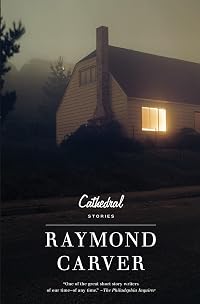
Cathedral: Stories
by Raymond Carver
On This Page
Description
This is Raymond Carver's third collection of stories, a finalist for the Pulitzer Prize, including the canonical titular story about blindness and learning to enter the very different world of another. The twelve stories in Cathedral mark a turning point in Carver's work and "overflow with the danger, excitement, mystery and possibility of life. . . .Tags
Recommendations





Member Recommendations
Member Reviews
Carver writes short stories the way you might expect a poet to write them.
The stories here are full of mood, written from deep empathy with his characters. They are not stories of unusual events, action, or grand gesture. Most are somber in tone and set in the everyday life of people who aren’t winning.
Often there is a peek of sunlight that seemingly defeated characters may or may not glimpse. The title story, Cathedral, is a good example. The principal character and narrator is cynical and dour. He dreads meeting his wife’s friend, a blind man named Robert, judging and disliking him before he even walks through the door.
But when Robert has him draw a cathedral, to show Robert with the movement of pencil on paper, how to show more communicate the shape and grandeur of a cathedral to a blind man, he comes alive. “It’s really something.”
It’s the depth of the inner lives of Carver’s characters that draws us in and along the stories. It’s the experience that fiction promises, the chance to live inside the bones of other people, to think and feel what they think and feel. Not many writers can do this at all, much less at the depth that Carver can do it.
Not a lot of laughs, but if you want to deepen your experience of life, and your ability to appreciate and participate in the lives of those around you, Carver is your guide. show less
The stories here are full of mood, written from deep empathy with his characters. They are not stories of unusual events, action, or grand gesture. Most are somber in tone and set in the everyday life of people who aren’t winning.
Often there is a peek of sunlight that seemingly defeated characters may or may not glimpse. The title story, Cathedral, is a good example. The principal character and narrator is cynical and dour. He dreads meeting his wife’s friend, a blind man named Robert, judging and disliking him before he even walks through the door.
But when Robert has him draw a cathedral, to show Robert with the movement of pencil on paper, how to show more communicate the shape and grandeur of a cathedral to a blind man, he comes alive. “It’s really something.”
It’s the depth of the inner lives of Carver’s characters that draws us in and along the stories. It’s the experience that fiction promises, the chance to live inside the bones of other people, to think and feel what they think and feel. Not many writers can do this at all, much less at the depth that Carver can do it.
Not a lot of laughs, but if you want to deepen your experience of life, and your ability to appreciate and participate in the lives of those around you, Carver is your guide. show less
In Cathedral, Raymond Carver offers the reader a powerful set of stories about people who are experiencing the worst things in their lives: divorce or abandonment, alcoholism, the death of a loved one, the loss of a job, feeling isolated and trapped in a relationship, and so on. In each of the dozen tales comprising the volume, we are dropped into the middle of a situation in which an otherwise unexceptional person faces some sort of crisis or cathartic event and struggles to deal with the situation. Whether these characters ever find their way out of their respective messes is something we never really learn, as the stories are left largely unresolved in the end. In fact, the real genius that the author brings to bear in this show more compelling collection is that he takes his protagonists as he finds them and is content to just tell a piece of their stories in a tender, if unflinching, manner. If there is a recurring theme connecting this fiction it is the slow and heartbreaking destruction that alcoholism can have on everyone connected to the one doing the drinking.
While there is not a weak story in the entire book, there were some that stood out well above the others. The title tale ‘Cathedral’ is a masterful look at both the regret that can sometimes overwhelm a marriage as well as having to confront long-held prejudices in surprising ways. ‘A Small, Good Thing’ is an ironic look at how a simple miscommunication can spiral out of control when conflated with a truly harrowing personal tragedy. ‘Where I’m Calling From’ probably comes the closest to being optimistic storytelling, despite its setting in a rehabilitation facility populated by people who have been there on multiple occasions. ‘Chef’s House’ is a very intimate portrait of the fragility involved in trying to confront one’s demons and get sober. To be sure, these are not happy stories or stories in which the characters are redeemed at the end of a long, fraught struggle. Apparently, the author himself suffered as a recovering alcoholic and, if that is true, he definitely wrote the life that he knew. That he was able to write it so very well was his lasting gift to all of us. show less
While there is not a weak story in the entire book, there were some that stood out well above the others. The title tale ‘Cathedral’ is a masterful look at both the regret that can sometimes overwhelm a marriage as well as having to confront long-held prejudices in surprising ways. ‘A Small, Good Thing’ is an ironic look at how a simple miscommunication can spiral out of control when conflated with a truly harrowing personal tragedy. ‘Where I’m Calling From’ probably comes the closest to being optimistic storytelling, despite its setting in a rehabilitation facility populated by people who have been there on multiple occasions. ‘Chef’s House’ is a very intimate portrait of the fragility involved in trying to confront one’s demons and get sober. To be sure, these are not happy stories or stories in which the characters are redeemed at the end of a long, fraught struggle. Apparently, the author himself suffered as a recovering alcoholic and, if that is true, he definitely wrote the life that he knew. That he was able to write it so very well was his lasting gift to all of us. show less
“In those olden days, when they built cathedrals, men wanted to be close to God”
This collection of twelve stories, might be my favorite of Carver's work. He writes very well about ordinary lives but favors the messiness of life. Alcohol abuse, infidelities and heartache. The opening story, "Feathers" prominently features a peacock. A homage to O' Connor, perhaps? And the title story, which wraps up the collection, is a stunning look at blindness and religion. A knockout.
This collection of twelve stories, might be my favorite of Carver's work. He writes very well about ordinary lives but favors the messiness of life. Alcohol abuse, infidelities and heartache. The opening story, "Feathers" prominently features a peacock. A homage to O' Connor, perhaps? And the title story, which wraps up the collection, is a stunning look at blindness and religion. A knockout.
The stories in Cathedral are muscular and powerful, made more so by Carver’s clean and unvarnished writing. “They were into something now, something hard.”
In some, there’s a sense that hope is over and done – nothing else good is going to happen to these characters after the story is over (Chef’s House, Preservation).
Paradoxically, other stories that ought to finish with no hope, offer a glimmer, or a glimpse of a glimmer. In the title story, a blind man opens the eyes, or mind, of a cynical man. In A Small, Good Thing, the death of a child near his birthday and an ugly episode with the baker that made his cake ends up with a moment of grace between the baker and the grieving parents.
In all, loose ends are not neatly show more wrapped, very little is resolved. Life continues. show less
In some, there’s a sense that hope is over and done – nothing else good is going to happen to these characters after the story is over (Chef’s House, Preservation).
Paradoxically, other stories that ought to finish with no hope, offer a glimmer, or a glimpse of a glimmer. In the title story, a blind man opens the eyes, or mind, of a cynical man. In A Small, Good Thing, the death of a child near his birthday and an ugly episode with the baker that made his cake ends up with a moment of grace between the baker and the grieving parents.
In all, loose ends are not neatly show more wrapped, very little is resolved. Life continues. show less
These stories are about people I don't know and don't think I would like. If someone described them to me I would think, why would I want to read that? About hairdressers and waitresses and lots of alcoholics, people down on their luck, in lousy relationships, getting divorces, growing apart. But these stories are so well written that they are completely engrossing and leave me with a feeling of having seen something amazing nearly every one. Raymond Carver works some kind of magic over ordinary people and situations that leaves an imprint on the brain, an epiphany, almost a feeling of enlightenment. I feel like reading these stories has changed me for the better. I cannot give high enough praise.
Carver's voice is unmistakable, mesmerizing, and real. I was drawn into every story through the power of this voice, even the stories that didn't touch me. But many of these did touch me. My particular favorites are "Feathers," "A Small, Good Thing," "The Train," and "Cathedral." At times the overbearing depression of the stories weighed on me, as if their repetitiveness--too much drinking, recently broken marriages--made each one more depressing than the last. Personally I most enjoyed the ones with glimpses of hope at the end; not idealistic turnarounds, just the potential for hope: "A Small, Good Thing" and "Cathedral" being perfect examples. Regardless of my personal reaction, Carver has one of the most distinct and graspable show more American voices of the past century. show less
Like Hemingway’s “Hills Like White Elephants” I particularly enjoyed Carver’s “Cathedral”. I thought it was a very truthful short story about the thoughts of this one man who was somewhat jealous of a blind man. It sounds like an idiotic thing to be jealous of but in the circumstances he presents to us, the reader can really understand why he would be jealous. The wife annoyed me beyond reason. There was obviously something going on between her and the blind man. So when she thought of herself being above her husband I really wanted her character to be thrown off a cliff. However I’m pretty sure that that was the author’s direct intentions. I loved the ending. It was just so perfect for this story. In the end he and the show more blind man bond together and I think they made a real connection as friends. I thought this was perfect because I’m pretty sure the wife brought the blind man down to show how terrible he is. Instead of her plans unfolding they become friends and she is just left to watch and stare. This story, in my opinion, is a perfect revenge story without hurting or harming anyone. It accomplishes revenge very subtly, which I love. show less
Members
- Recently Added By
Published Reviews
The Cathedral is a story of how a man, known as the narrator, overcomes his predisposition towards a culture that is unknown to him. From the beginning, the narrator does not like Robert, and he really has no reason for it. He has his stereotypes that he sticks to in the beginning, until Robert starts to prove many of them false. It is apparent that the narrator is very big on appearance, and show more this is shown through his fascination that a blind man had a beard. Later in the story, the narrator also points out that Robert did not wear sunglasses or use a cane. The narrator thought about how pitiful Roberts wife was, and how awful their relationship must have been because she would never receive a compliment based on her looks by her loved one. This shows what type of a husband he is, and what he values in his marriage. The narrator doesn't seem to have many friends, and his wife even points this out, and he seems to drink and smoke a lot. Although he can see, in comparison, he seems like the blind one. Although Robert is physically blind, he is a real jack of trades. He hasn't let his blindness get in the way of his happiness and it just goes to show that you can be blind, and still truly see. The narrator begins to understand this at the end of the story when he draws the cathedral with Robert and begins to bridge the gap between himself and true understanding. show less
added by smyth104
Lists

1001 Books You Must Read Before You Die
1,448 works; 1,137 members

Recommend the 20 best books you've read in the last five years
2,168 works; 603 members

Short Story Collections and Anthologies
261 works; 42 members

Canon de la narrativa universal del siglo XX
254 works; 6 members

1980s
356 works; 23 members

Favorite Short Fiction
228 works; 99 members

100 New Classics
101 works; 13 members

Top Five Books of 2014
1,064 works; 398 members

Pulitzer Prize for Fiction - Finalists
88 works; 9 members

Best Antiheroes and Antiheroines
119 works; 7 members

Blue Pyramid 1,276 Best Books of All Time
1,248 works; 32 members

Fiction about the Working Class
74 works; 10 members

Dysfunctional Families
133 works; 7 members

College Reads (Lit Edition)
75 works; 5 members

Elegant Prose
80 works; 4 members
American Lit for Eng 11 Research Project
368 works; 6 members

Books Read in 2011
684 works; 19 members

Literary Works Read in College
316 works; 15 members

Short Story and Novella Collections
47 works; 6 members

Books You Read For University
184 works; 3 members

Junky Paperbacks
15 works; 1 member

Forbes: The 25 Greatest Short Stories of All Time
25 works; 4 members

NTS Book Channel
316 works; 1 member
Author Information

209+ Works 20,769 Members
Born in 1938 in an Oregon logging town, Raymond Carver grew up in Yakima, From California he went to Iowa to attend the Iowa Writers Workshop. Soon, however, he returned to California, where he worked at a number of unskilled jobs before obtaining a teaching position. Widely acclaimed as the most important short story writer of his generation, show more Carver writes about the kind of lower-middle-class people whom he knew growing up. His characters are waitresses, mechanics, postmen, high school teachers, factory workers, door-to-door salesmen who lead drab lives because of limited funds. Critics have said that may have the most distinctive vision of the working class. Nominated posthumously for both a National Book Critics Circle Award (1988) and a Pulitzer Prize (1989) for Where I'm Calling From: New and Selected Stories (1988), Carver is one of a handful of writers credited with reviving the short story form. Some have put Carver in the tradition of Ernest Hemingway and Stephen Crane. Carver's stories tend to be brief, with enigmatic endings, although never erupting. Violence is often just below the surface. An air of quiet desperation pervades his stories, as Carver explores the collapse of human relationships in bleak circumstances. In later works, Carver strikes a note of redemption, unheard at the beginning of his career. But for readers who are not attuned to Carver's voice of resignation, these moments may sound sentimental and unconvincing. Carver died of lung cancer in 1988. (Bowker Author Biography) show less
Some Editions
Awards and Honors
Awards
Distinctions
Notable Lists
Series
Belongs to Publisher Series
Work Relationships
Is contained in
Has as a student's study guide
Common Knowledge
- Canonical title
- Cathedral: Stories
- Original title
- Cathedral
- Original publication date
- 1983
- Important places
- Clatskanie, Oregon, USA; Oregon, USA
- Dedication
- For Tess Gallagher
For Tess Gallagher and in memory of John Gardner - First words
- This friend of mine from work, Bud, he asked Fran and me to supper.
- Last words
- (Click to show. Warning: May contain spoilers.)"It's really something," I said.
Classifications
Statistics
- Members
- 3,437
- Popularity
- 4,888
- Reviews
- 98
- Rating
- (4.18)
- Languages
- 18 — Basque, Catalan, Chinese, Czech, Dutch, English, French, German, Italian, Japanese, Korean, Farsi/Persian, Portuguese, Romanian, Serbian, Spanish, Swedish, Turkish
- Media
- Paper, Audiobook, Ebook
- ISBNs
- 63
- ASINs
- 20