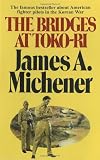
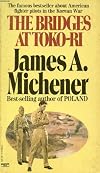
The Bridges at Toko-ri
by James A. Michener
On This Page
Description
Fiction. Literature. Thriller. Historical Fiction. HTML:In one of his beloved early bestsellers, Pulitzer Prize–winning author James A. Michener crafts a tale of the American men who fought the Korean War, detailing their exploits in the air as well as their lives on the ground. Young and innocent, they arrive in a place they have barely ever heard of, on a ship massive enough to carry planes and helicopters. Trained as professionals, they prepare for the rituals of war that countless men show more before them have endured, and face the same fears. They are American fighter pilots. Together they face an enemy they do not understand, knowing their only hope for survival is to win.BONUS: This edition includes an excerpt from James A. Michener's Hawaii.
Praise for The Bridges at Toko-Ri
“A vivid and moving story, as well as an exciting one . . . The humanity of the people is deeply felt.”—Chicago Tribune
“The Banshees screaming over Korea, the perilous landings on an aircraft carrier deck ‘bouncing around like a derelict rowboat,’ a helicopter rescue from the freezing waters . . . all are stirringly rendered.”—The Denver Post
“Michener’s best . . . a story of action, ideas, and civilization’s responsibilities.”—Saturday Review. show less
Tags
Recommendations



















Member Reviews
Despite being over 50 years old, I found this novel aged very well. It is grounded in American culture of the 1950s, but its the real culture of the 50s (fear, doubt, exhaustion) and not the whitewashed, overly optimistic America that contemporary culture often projects onto the period.
The central dilemma of the novel, a pilot's conflict between fear and duty in pursuing a difficult target with dubious strategic effects in a war that America neither knows nor cares much about could easily apply to the modern war on terror.
The central dilemma of the novel, a pilot's conflict between fear and duty in pursuing a difficult target with dubious strategic effects in a war that America neither knows nor cares much about could easily apply to the modern war on terror.
I think what Michener was trying to do in this book was to speak for the US Navy pilots, and more broadly, for all the US servicemen who served in the Korean War, with many nods given to World War II, which had only ended a few years before. I think he wanted to convey what they thought about the military, the war, and one another. He was exploring what made them keep doing their dangerous jobs, even as most people back home seemed indifferent to them. I don't have the knowledge or experiences to know how well he accomplished this, but the picture he paints certainly lines up with what I absorbed from my dad and uncle, both US military veterans.
Speaking of painting a picture, where this novella really shines is in the almost tactile show more vividness of Michener's descriptions of carrier operations. I've never been on an aircraft carrier, but this writer made me feel like I was there. My favorite character was Beer Barrel, the hard drinking Texan farmer who found his true vocation as a master at guiding pilots to safe landings on the pitching deck of a carrier. show less
Speaking of painting a picture, where this novella really shines is in the almost tactile show more vividness of Michener's descriptions of carrier operations. I've never been on an aircraft carrier, but this writer made me feel like I was there. My favorite character was Beer Barrel, the hard drinking Texan farmer who found his true vocation as a master at guiding pilots to safe landings on the pitching deck of a carrier. show less
I don't know how I never read this book before since it has been on our book shelf for years. I didn't realize what a classic wonderful book this is. Although short, it hit the mark on depicting the bravery of our American Boys during the Korean War. Seeing a documentary a few years ago about how the planes take off and land on the carriers, this book gave such visual detail on how dangerous a job it is for each man. I loved this book, it filled me with pride for our volunteer military. How brave they are and quoting Admiral Tarrant "Why is America lucky enough to have such men? They leave this tiny ship and fly against the enemy. Then they must seek the ship, lost somewhere on the sea. And when they find it, they have to land upon its show more pitching deck. Where did we get such men?". This book left me feeling proud of our troops, Heartbroken for the loss of those that gave all and disappointed in the rest of us who go about our day without a thought of what is happening to the men and women who protect our country everyday. show less
The Bridges of Toko-Ri is a novella by America author James A. Michener. The book tells the story of the United States Pilots in the Korean War as they undertake a mission to destroy the protected bridges in the enemy territory.
This is a vivid and moving novella and really does pack a punch. I loved the information about the ship and the aircraft landings; I remember a trip to the Intrepid War Ship in New York and being fascinated at how the pilots landed their aircrafts on these ships in such a tight space. It is a very short read but does enlighten the reader to the exploits in the air as well as the men who served on the ground. Together they face an enemy they do not understand, knowing their only hope for survival is to win.
My show more Uncle fought in this war as a foot solider, so it was nice to read this book and remember him and his war experiences and how lucky he was to return to his family in New York and live a full life although he rarely ever talked about his experiences.
I listened to this one on audible and I really don't recommend listening to it as the narration is very poor and does nothing for the book. show less
This is a vivid and moving novella and really does pack a punch. I loved the information about the ship and the aircraft landings; I remember a trip to the Intrepid War Ship in New York and being fascinated at how the pilots landed their aircrafts on these ships in such a tight space. It is a very short read but does enlighten the reader to the exploits in the air as well as the men who served on the ground. Together they face an enemy they do not understand, knowing their only hope for survival is to win.
My show more Uncle fought in this war as a foot solider, so it was nice to read this book and remember him and his war experiences and how lucky he was to return to his family in New York and live a full life although he rarely ever talked about his experiences.
I listened to this one on audible and I really don't recommend listening to it as the narration is very poor and does nothing for the book. show less
I am a Michener fan but have discovered I like his territorial sagas better than his historical novellas. This book told the story of heroic Naval pilots of Task Force 77 during the Korean War. It was Task Force 77's job to knock out the vital bridges at Toko-Ri from whence Russian and Chinese soldiers, supplies and ammunition were being funneled into North Korea. The characterizations were good for a novella. The storyline seemed a bit blah. 123 pages 3 stars
An early work by Michener. Simpler language than I expected from him, but then the characterizations kicked in and the evocation of time and place. A reflection upon the purpose and necessity of wars that the general public pays little attention to; might speak just as well to today's Afghanistan. A respectful salute to under-appreciated men of war. Fifty years on, this is still a great read.
LT Review: The Bridges at Toko-Ri, James Michener
The Bridges at Toko-Ri is Michener’s classic tale of naval aviation in the Korean War. Not quite a novel and more than a short story, it’s probably fine to describe it as a novella. It’s an engaging and thoughtful read, and does a good job of describing the life of Naval Aviators in the Korean War.
If you're not familiar with the movie, it's a great read, and highly worthwhile.
The biggest problem is if you’re a fan of the movie (and that’s probably how you have heard about it in the first place, since the book isn't terribly famous anymore), you’ll enjoy it...but don’t expect much more than what was in the movie (and maybe less). Biggest difference from what I remember is show more the character of Beer Barrel is discussed more, and I don’t think he needs to be to explained more to appreciate the story.
If you're not familiar with the movie, it's a great read, and highlyt show less
The Bridges at Toko-Ri is Michener’s classic tale of naval aviation in the Korean War. Not quite a novel and more than a short story, it’s probably fine to describe it as a novella. It’s an engaging and thoughtful read, and does a good job of describing the life of Naval Aviators in the Korean War.
If you're not familiar with the movie, it's a great read, and highly worthwhile.
The biggest problem is if you’re a fan of the movie (and that’s probably how you have heard about it in the first place, since the book isn't terribly famous anymore), you’ll enjoy it...but don’t expect much more than what was in the movie (and maybe less). Biggest difference from what I remember is show more the character of Beer Barrel is discussed more, and I don’t think he needs to be to explained more to appreciate the story.
If you're not familiar with the movie, it's a great read, and highlyt show less
Members
- Recently Added By
Author Information

James A. Michener, 1907 - 1997 James Albert Michener was born on February 3, 1907 in Doylestown, Pa. He earned an A.B. from Swarthmore College, an A.M. from Colorado State College of Education, and an M.A. from Harvard University. He taught for many years and was an editor for Macmillan Publishing Company. His first book, "Tales of the South show more Pacific," derived from Michener's service in the Pacific in World War II, won the 1947 Pulitzer Prize for Fiction and was the basis for the Rodgers and Hammerstein Broadway musical South Pacific, which won the 1950 Pulitzer Prize for Drama. Michener completed close to 40 novels. Some other epic works include "Hawaii," "Centennial," "Space," and "Caribbean." He also wrote a significant amount of nonfiction including his autobiography "The World Is My Home." Among his many other honors, James Michener received the Presidential Medal of Freedom in 1977. He was married to Patti Koon in 1935; they divorced in 1948. He married Vange Nord in 1948 (divorced 1955) and Mari Yoriko Sabusawa in 1955 (deceased 1994). He died in 1997 in Austin, Texas. (Bowker Author Biography) show less
Some Editions
Awards and Honors
Distinctions
Series
Belongs to Publisher Series
Heyne Allgemeine Reihe (5367)
Work Relationships
Is contained in
Has the adaptation
Is abridged in
Reader's Digest Condensed Books: Adventures In Two Worlds • The Bridges At Toko-Ri • Old Herbaceous • Operation Cicero • Digby by Reader's Digest
Selezione del libro. Marnie. I ponti di Toko-Ri. I cacciatori di microbi. La landa senza stelle. by Reader's Digest
Adventures in Two Worlds / The Bridges at Toko-ri / Kiss Me Again, Stranger / Rivets / The Silent World / Story of Aviation / The Swimming Pool / 7 Short Stories of De Maupassant by Nelson Doubleday
Det Bästas Bokval (1956) vol 2 : Broarna vid Toko-Ri; Vinden sveper nedåt Ryder Hill; På lösan sand; Elefant-Bill; Spindeln by Reader's Digest
Common Knowledge
- Canonical title
- The Bridges at Toko-ri
- Original title
- The Bridges at Toko-ri
- Original publication date
- 1953
- People/Characters
- Harry Brubaker; George Tarrant; Mike Forney; Nestor Gamidge; Beer Barrel; Wingman 1592 (Joe) (show all 15); Nancy Brubaker; the Brubaker girls; Cag; Kimiko; Japanese man; Japanese woman; Teiko; Takako; Roundelay
- Important places
- Korea; Yokosuka, Japan
- Important events
- Korean War (1950 | 1953)
- Related movies
- The Bridges at Toko-Ri (1954 | IMDb)
- Dedication
- To Marshall U. Beebe, Jet Pilot
- First words
- The sea was bitter cold.
- Quotations
- Why is America lucky enough to have such men?
“All wars are stupid,” the old man grunted. . . . “But we’d better learn to handle the stupidity.” - Last words
- (Click to show. Warning: May contain spoilers.)They did not waste fuel orbiting but screamed to the west, seeking new bridges in Korea.
- Blurbers
- Herman Wouk
- Original language
- English
Classifications
Statistics
- Members
- 781
- Popularity
- 35,530
- Reviews
- 17
- Rating
- (3.66)
- Languages
- 9 — Dutch, English, French, German, Italian, Korean, Norwegian, Polish, Swedish
- Media
- Paper, Audiobook, Ebook
- ISBNs
- 28
- ASINs
- 34