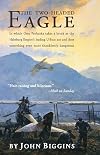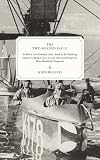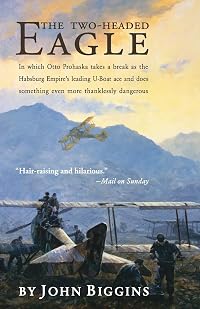
The Two-Headed Eagle: In Which Otto Prohaska Takes a Break as the Habsburg Empire's Leading U-boat Ace and Does Something Even More Thanklessly Dangerous
by John Biggins
Otto Prohaska (3)
On This Page
Description
It is the summer of 1916 and, as luck would have it, Otto is assigned to the nascent, unreliable, and utterly frightening Imperial and Royal Austro-Hungarian Flying Service. Ottto's aerial chauffeur is the self-willed Sergeant-Pilot Toth, with whom he can only communicate in broken Latin--although when all else fails, screaming will suffice! On the ground the rickety Habsburg Empire begins to crumble before the onslaught of WWI, while in the air Otto confronts a series of misadventures and show more the winds of change. show lessTags
Recommendations














Member Reviews
Naval Officer Ottokar Prohaska has been seconded to the Austro-Hungarian Air Force (k.u.k. Fleigertruppe) to avoid embarrassing questions about whether the Italian submarine he received the Knight’s Cross of Maria Teresa for sinking was actually a German U-boat operating in the Adriatic - and one with his brother-in-law on board, at that. He finds himself operating out of a dubious airfield on the dubious Italian front, commanded by a dubious officer who has never actually flown in an airplane.
This novel has a darker feel than the earlier ones in the series. There are still flashes of the humor and humanity that distinguishes the previous books, but the Italian front in WWI was hell, and there is no way to civilize it. Prohaska finds show more himself flying as an observer in a Hansa-Brandenburg C1 biplane, piloted by Hungarian ex-monk Zoltan Toth, with whom he must communicate in Latin because that’s their only common language. Their unit conducts ineffectual bombing raids because the statistics-obsessed commanding officer insists on judging success by number of bombs dropped and therefore loads the missions with the smallest bombs available. The author, John Biggins, once again draws on actual events - Prohaska encounters Italian ace Oreste di Carraciolo, clearly based on the real Gabriele D'Annunzio.
The Austro-Hungarian empire is a fascinating place - how could a state that was so incompetent in technical matters turn out Strauss and Strauss and Strauss and Lehar and Liszt and Rilke and Meitner and Klimt and Frisch and Musil and Bartok and hundreds of other composers and authors and painters and scientists? show less
This novel has a darker feel than the earlier ones in the series. There are still flashes of the humor and humanity that distinguishes the previous books, but the Italian front in WWI was hell, and there is no way to civilize it. Prohaska finds show more himself flying as an observer in a Hansa-Brandenburg C1 biplane, piloted by Hungarian ex-monk Zoltan Toth, with whom he must communicate in Latin because that’s their only common language. Their unit conducts ineffectual bombing raids because the statistics-obsessed commanding officer insists on judging success by number of bombs dropped and therefore loads the missions with the smallest bombs available. The author, John Biggins, once again draws on actual events - Prohaska encounters Italian ace Oreste di Carraciolo, clearly based on the real Gabriele D'Annunzio.
The Austro-Hungarian empire is a fascinating place - how could a state that was so incompetent in technical matters turn out Strauss and Strauss and Strauss and Lehar and Liszt and Rilke and Meitner and Klimt and Frisch and Musil and Bartok and hundreds of other composers and authors and painters and scientists? show less
I just love this book the most out of the 4 book series. I tend to read it once a year.
Ratings
Members
- Recently Added By
Author Information

7 Works 437 Members
Some Editions
Series

Common Knowledge
- Canonical title
- The Two-Headed Eagle: In Which Otto Prohaska Takes a Break as the Habsburg Empire's Leading U-boat Ace and Does Something Even More Thanklessly Dangerous
- Original publication date
- 1993
- People/Characters
- Otto Prohaska
- Important events
- World War I (1914 | 1918)
- First words
- Strange, I always think, how the pettiest and least significant things — some banal tune playing o the wireless, the smell of the floor polish they once used at your old school — can set off a train of recollections; even... (show all) when one has not thought about the matters in question for decades past, and even in someone like myself, who has never been one of nature's chroniclers or — at least until lately — much addicted to reverie, never even kept a diary except when required to do so by service regulations.
- Last words
- (Click to show. Warning: May contain spoilers.)I cannot say, only tell you what I saw and hope that you will know about it when I am no more: know about it, and perhaps understand better than I did.
- Original language
- English
Classifications
Statistics
- Members
- 88
- Popularity
- 363,661
- Reviews
- 2
- Rating
- (4.35)
- Languages
- English
- Media
- Paper, Audiobook, Ebook
- ISBNs
- 8
- ASINs
- 6