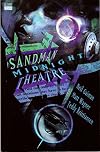
Sandman Midnight Theatre
by Neil Gaiman, Teddy Kristiansen (Illustrator), Matt Wagner
Sandman Mystery Theatre (6.5), The Sandman (Additional — Sandman Midnight Theatre)
On This Page
Description
Set in 1939, this Sandman story follows a trail of blackmail, murder and suicide to London where Wesley Dodds discovers a high society group obsessed by the occult.Tags
Recommendations







Member Reviews
Teddy Kristiansen's artwork is incredible.
That's about the only positive, and it's a really big positive. Most of this crossover between Wagner's Sandman and Gaiman's more modern Sandman is hurt by being so incredibly boring. Nothing is gained, nothing's learned by the characters. They meet, and then go back to their respective worlds.
[N.B. This review includes images, and was formatted for my site, dendrobibliography -- located here.]
A crossover is a tool, and can't immediately account for a result. (Obviously.) Sandman Midnight Theatre, unfortunately, (and like most every crossover ever written,) reads as if they structured the entire 60-page story around the tool. Finding something interesting to do with that tool came second to show more simply getting the means out there. This accounts for a threadbare 1939 mystery used to get Wagner's Sandman to England so he can meet the more popular Sandman--at this point, held prisoner in the Sandman #1. It dissolves by the end, so much so that the conclusion is hidden under the crossover.
Midnight Theatre was plotted by Wagner, and fleshed out by Gaiman. This leads to Midnight Theatre being much more of a Sandman Mystery Theatre story than the Sandman, which, again, weird considering the size of their respective fanbases. Some of Gaiman's trademark philosophizing on the meaning of story is here, but doesn't benefit the mystery much when it's only here for the purpose of crossover.
But good lord, Teddy Kristiansen's art might make it worth it. His style is a bit abstract, reminding me of the abstract cubists or German expressionists that dominated the early 20th century. He adds a lot of nuance to Wesley Dodd's internal conflicts, of his attraction to series regular Diana, of his broken identity.
& that's it. Great art, boring, pointless story. The only excuse to read this is for struggling completists of either authors--and it's a pretty crummy excuse. show less
That's about the only positive, and it's a really big positive. Most of this crossover between Wagner's Sandman and Gaiman's more modern Sandman is hurt by being so incredibly boring. Nothing is gained, nothing's learned by the characters. They meet, and then go back to their respective worlds.
[N.B. This review includes images, and was formatted for my site, dendrobibliography -- located here.]
A crossover is a tool, and can't immediately account for a result. (Obviously.) Sandman Midnight Theatre, unfortunately, (and like most every crossover ever written,) reads as if they structured the entire 60-page story around the tool. Finding something interesting to do with that tool came second to show more simply getting the means out there. This accounts for a threadbare 1939 mystery used to get Wagner's Sandman to England so he can meet the more popular Sandman--at this point, held prisoner in the Sandman #1. It dissolves by the end, so much so that the conclusion is hidden under the crossover.
Midnight Theatre was plotted by Wagner, and fleshed out by Gaiman. This leads to Midnight Theatre being much more of a Sandman Mystery Theatre story than the Sandman, which, again, weird considering the size of their respective fanbases. Some of Gaiman's trademark philosophizing on the meaning of story is here, but doesn't benefit the mystery much when it's only here for the purpose of crossover.
But good lord, Teddy Kristiansen's art might make it worth it. His style is a bit abstract, reminding me of the abstract cubists or German expressionists that dominated the early 20th century. He adds a lot of nuance to Wesley Dodd's internal conflicts, of his attraction to series regular Diana, of his broken identity.
& that's it. Great art, boring, pointless story. The only excuse to read this is for struggling completists of either authors--and it's a pretty crummy excuse. show less
There was a time when Neil Gaiman's The Sandman and Wagner and Seagle's Sandman Mystery Theatre were running alongside one another, so it must have seemed logical to cross the two series over. But despite an appearance by Dream (one of many mainstream DCU appearances in SMT of late), this is definitely a Sandman Mystery Theatre tale, albeit one filtered through a Neil Gaiman style. With Dian gone to England to find herself, Wesley eventually pursues a mystery there, and the two have a number of confrontations while solving a mystery and then reconciling. The mystery is a bit thin, and the reconciliation comes out of nowhere, but I enjoyed the story all the same. It just oozed atmosphere, partially because of Gaiman's dreamlike writing, show more but mostly because of Teddy Kristiansen's amazing artwork. He's the first artist who's not Guy Davis to do successful work on Sandman Mystery Theatre, and I really liked the story as a result. He is the only other person to get Wesley's dashing-but-awkward, young-but-pudgy appearance just right, and the way he does Wesley's glasses was especially great. Sometimes Wesley was as impenetrable as his disguise.
What really bothered me, though, was that Wesley referred to "the Sandman" as a different person throughout the story. Which is a neat idea, but Dian claims it's something he always does-- when he's never done it in Sandman Mystery Theatre ever! Nor does he do it again, to my knowledge. A weird little inconsistency.
Sandman Mystery Theatre: « Previous in sequence | Next in sequence » show less
What really bothered me, though, was that Wesley referred to "the Sandman" as a different person throughout the story. Which is a neat idea, but Dian claims it's something he always does-- when he's never done it in Sandman Mystery Theatre ever! Nor does he do it again, to my knowledge. A weird little inconsistency.
Sandman Mystery Theatre: « Previous in sequence | Next in sequence » show less
Sandman Midnight Theatre features a crossover between the Golden Age Sandman (Wesley Dodds, created by Gardner Fox and Bert Christman) and Neil Gaiman's Sandman (Morpheus, the literal embodiment of Dreams) as written by Gaiman and illustrated by Teddy Kristiansen. The artwork is gorgeous and creates a wonderful brooding, film noir feel as Dodds travels to England to find who had blackmailed his friend, resulting in the friend's suicide. Much of the story serves as a reason for Dodds to meet Morpheus, who at the time of the story is still imprisoned by Roderick Burgess. While Gaiman had previously retconned the Golden Age Sandman to suggest that he devised his superhero alter-ego as part of a psychic side effect from Morpheus' capture, show more the two had not previously met. This one-shot is part of a 70-issue series also published under the Sandman Mystery Theatre banner that updated Wesley Dodds' version of the character for the Modern Age and, as such, it may feel like a forced crossover rather than a fully-developed mystery. Those who enjoy Gaiman's writing and Kristiansen's artwork will find it a fulfilling read. show less
The worlds of the Endless' Sadnman Morpheus and Wesley Dodds (crime fighting Sandman) meet momentarily in 1939 when Dods is lef to Burgess' mansion in search of the murderer of a family friend. This story is largely fluff and is obviously more connected to the Wesley Dodds storyline than to that of Morpheus, but it almost explains how the two characters are connected. Though really it just hints, because what's the fun in a story where everything is completely explained?
Ratings
Members
- Recently Added By
Author Information

843+ Works 449,249 Members
Neil Gaiman was born in Portchester, England on November 10, 1960. He worked as a journalist and freelance writer for a time, before deciding to try his hand at comic books. Some of his work has appeared in publications such as Time Out, The Sunday Times, Punch, and The Observer. His first comic endeavor was the graphic novel series The Sandman. show more The series has won every major industry award including nine Will Eisner Comic Industry Awards, three Harvey Awards, and the 1991 World Fantasy Award for best short story, making it the first comic ever to win a literary award. He writes both children and adult books. His adult books include The Ocean at the End of the Lane, which won a British National Book Awards, and the Locus Award for Best Fantasy Novel for 2014; Stardust, which won the Mythopoeic Award as best novel for adults in 1999; American Gods, which won the Hugo, Nebula, Bram Stoker, SFX, and Locus awards; Anansi Boys; Trigger Warning: Short Fictions and Disturbances; and The View from the Cheap Seats: Selected Nonfiction, which is a New York Times Bestseller. His children's books include The Day I Swapped My Dad for Two Goldfish; Coraline, which won the Elizabeth Burr/Worzalla, the BSFA, the Hugo, the Nebula, and the Bram Stoker awards; The Wolves in the Walls; Odd and the Frost Giants; The Graveyard Book, which won the Newbery Award in 2009 and The Sandman: Overture which won the 2016 Hugo Awards Best Graphic Story. (Bowker Author Biography) show less


474+ Works 6,596 Members
Series


Belongs to Publisher Series
Work Relationships
Is contained in
Common Knowledge
- Canonical title
- Sandman Midnight Theatre
- Original publication date
- 1995-07-25
- People/Characters
- Sandman (Wesley Dodds); Dian Belmont; Lady Annabel Forbes-Whitten; Dream (Morpheus); Lord Roderick Burgess (Morris Burgess Brocklesby); Alexander Burgess (show all 8); Erskine Brown; The Cannon (Reverend Armitage "Bagsy" Hawsley)
- Important places
- Fawney Rig, Wych Cross, East Sussex, England, UK; Hampshire, England, UK; London, England, UK; New York, USA; New York, New York, USA; Scotland Yard, London, England, UK (show all 9); Southampton, England, UK; East Sussex, England, UK; Wych Cross, East Sussex, England, UK
Classifications
- Genres
- Graphic Novels & Comics, Horror
- DDC/MDS
- 741.5973 — Arts & recreation Drawing & decorative arts Drawing Comic books, graphic novels, fotonovelas, cartoons, caricatures, comic strips History, geographic treatment, biography North American United States (General)
- LCC
- PN6728 .S27 .G35 — Language and Literature Literature (General) Literature (General) Collections of general literature Comic books, strips, etc.
Statistics
- Members
- 220
- Popularity
- 147,900
- Reviews
- 4
- Rating
- (3.42)
- Languages
- English, Italian, Spanish
- Media
- Paper, Ebook
- ISBNs
- 4
- ASINs
- 3