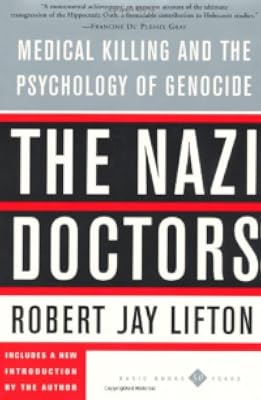
The Nazi Doctors: Medical Killing and the Psychology of Genocide
by Robert Jay Lifton
On This Page
Description
An analysis of the psychological forces behind the transformation of Nazi doctors into mass murderers in Auschwitz and other "death camps."Tags
Recommendations






























Member Reviews
Robert Jay Lifton’s *The Nazi Doctors: Medical Killing and the Psychology of Genocide* is one of the most profound and unsettling examinations of how ordinary professionals became participants in extraordinary evil. Rather than treating Nazi doctors as incomprehensible monsters, Lifton approaches them as human beings shaped by ideology, institutional pressures, and psychological mechanisms. This decision is what gives the book its lasting power: it forces readers to confront the uncomfortable reality that the capacity for such actions is not limited to a few aberrant individuals, but can emerge within structured systems and accepted beliefs.
At the heart of Lifton’s analysis is the concept of “doubling,” a psychological process show more in which individuals create a second self that can carry out actions that would otherwise be morally unacceptable. In the case of Nazi doctors, this meant maintaining one identity as a healer committed to saving lives while simultaneously operating another identity that participated in selection, experimentation, and killing. Lifton argues that this split allowed physicians to reconcile their actions with their professional identity. They were not, in their own minds, abandoning medicine—they were redefining it. Healing was no longer about the individual patient but about the health of the “racial body,” the Volkskörper. Within this framework, killing could be rationalized as a form of treatment.
The book traces how this transformation occurred, beginning with the broader cultural and ideological environment of Nazi Germany. Lifton shows how eugenics, racial hygiene, and nationalist fervor gradually reshaped the ethical foundations of medicine. Physicians were taught to see certain groups—Jews, the disabled, the mentally ill—not as patients but as threats to the health of the nation. This shift was not sudden but incremental, moving from sterilization policies to the so-called “euthanasia” programs and eventually to the mass murder carried out in concentration camps. By presenting this progression, Lifton emphasizes that genocide was not an abrupt rupture but the culmination of a series of morally compromised steps.
One of the most compelling aspects of the book is Lifton’s use of interviews with former Nazi doctors. These firsthand accounts provide insight into how perpetrators understood their own actions. Many did not view themselves as criminals but as professionals fulfilling their duties under difficult circumstances. Some expressed regret, but often in ways that avoided full responsibility, framing their actions as the result of obedience, necessity, or ideological conviction. Lifton does not excuse these individuals, but he seeks to understand them, believing that comprehension is essential to preventing future atrocities.
Lifton also explores the role of bureaucracy and institutional structure in enabling medicalized killing. The Nazi system allowed doctors to operate within a framework that normalized and even rewarded their actions. Decisions about life and death were often reduced to administrative processes, distancing individuals from the consequences of their choices. This bureaucratic environment, combined with ideological indoctrination, created a context in which ethical boundaries were eroded and responsibility was diffused.
Another important theme is the corruption of language. Terms like “euthanasia” and “selection” masked the reality of what was taking place, making it easier for participants to detach from the moral weight of their actions. Lifton shows how language was used not only to deceive others but also to reshape the perceptions of those involved, allowing them to reinterpret killing as a necessary or even benevolent act. This manipulation of language parallels the broader psychological mechanisms that enabled participation in genocide.
What makes *The Nazi Doctors* particularly disturbing is its refusal to offer easy answers or comforting distance. Lifton does not allow readers to dismiss the perpetrators as fundamentally different from themselves. Instead, he highlights the conditions under which ordinary people can become agents of destruction, raising questions about the fragility of ethical norms and the influence of authority and ideology. This approach can be deeply unsettling, as it challenges the reader’s assumptions about human nature and moral stability.
The book is also intellectually demanding. Lifton’s writing is analytical and often dense, blending psychological theory with historical detail. At times, the focus on concepts like doubling can feel repetitive, as he returns to them in multiple contexts. However, this repetition serves to reinforce the central argument and to demonstrate how these mechanisms operated across different individuals and situations. Readers willing to engage with the complexity of the text will find it richly rewarding.
In addition to its historical significance, *The Nazi Doctors* carries important implications for contemporary discussions of ethics, medicine, and authority. Lifton’s work serves as a warning about the dangers of subordinating professional ethics to political or ideological goals. It underscores the importance of maintaining individual moral responsibility, even within hierarchical systems. For medical professionals in particular, the book is a stark reminder that the commitment to do no harm must remain absolute, regardless of external pressures.
Ultimately, *The Nazi Doctors* is not just a study of the past but a meditation on the human capacity for both healing and harm. Lifton’s careful and unflinching analysis forces readers to confront the conditions that make atrocities possible and to consider their own responsibilities within society. It is a challenging and often disturbing work, but one that is essential for understanding how genocide can be carried out not only by fanatics but by professionals who see themselves as simply doing their jobs. show less
At the heart of Lifton’s analysis is the concept of “doubling,” a psychological process show more in which individuals create a second self that can carry out actions that would otherwise be morally unacceptable. In the case of Nazi doctors, this meant maintaining one identity as a healer committed to saving lives while simultaneously operating another identity that participated in selection, experimentation, and killing. Lifton argues that this split allowed physicians to reconcile their actions with their professional identity. They were not, in their own minds, abandoning medicine—they were redefining it. Healing was no longer about the individual patient but about the health of the “racial body,” the Volkskörper. Within this framework, killing could be rationalized as a form of treatment.
The book traces how this transformation occurred, beginning with the broader cultural and ideological environment of Nazi Germany. Lifton shows how eugenics, racial hygiene, and nationalist fervor gradually reshaped the ethical foundations of medicine. Physicians were taught to see certain groups—Jews, the disabled, the mentally ill—not as patients but as threats to the health of the nation. This shift was not sudden but incremental, moving from sterilization policies to the so-called “euthanasia” programs and eventually to the mass murder carried out in concentration camps. By presenting this progression, Lifton emphasizes that genocide was not an abrupt rupture but the culmination of a series of morally compromised steps.
One of the most compelling aspects of the book is Lifton’s use of interviews with former Nazi doctors. These firsthand accounts provide insight into how perpetrators understood their own actions. Many did not view themselves as criminals but as professionals fulfilling their duties under difficult circumstances. Some expressed regret, but often in ways that avoided full responsibility, framing their actions as the result of obedience, necessity, or ideological conviction. Lifton does not excuse these individuals, but he seeks to understand them, believing that comprehension is essential to preventing future atrocities.
Lifton also explores the role of bureaucracy and institutional structure in enabling medicalized killing. The Nazi system allowed doctors to operate within a framework that normalized and even rewarded their actions. Decisions about life and death were often reduced to administrative processes, distancing individuals from the consequences of their choices. This bureaucratic environment, combined with ideological indoctrination, created a context in which ethical boundaries were eroded and responsibility was diffused.
Another important theme is the corruption of language. Terms like “euthanasia” and “selection” masked the reality of what was taking place, making it easier for participants to detach from the moral weight of their actions. Lifton shows how language was used not only to deceive others but also to reshape the perceptions of those involved, allowing them to reinterpret killing as a necessary or even benevolent act. This manipulation of language parallels the broader psychological mechanisms that enabled participation in genocide.
What makes *The Nazi Doctors* particularly disturbing is its refusal to offer easy answers or comforting distance. Lifton does not allow readers to dismiss the perpetrators as fundamentally different from themselves. Instead, he highlights the conditions under which ordinary people can become agents of destruction, raising questions about the fragility of ethical norms and the influence of authority and ideology. This approach can be deeply unsettling, as it challenges the reader’s assumptions about human nature and moral stability.
The book is also intellectually demanding. Lifton’s writing is analytical and often dense, blending psychological theory with historical detail. At times, the focus on concepts like doubling can feel repetitive, as he returns to them in multiple contexts. However, this repetition serves to reinforce the central argument and to demonstrate how these mechanisms operated across different individuals and situations. Readers willing to engage with the complexity of the text will find it richly rewarding.
In addition to its historical significance, *The Nazi Doctors* carries important implications for contemporary discussions of ethics, medicine, and authority. Lifton’s work serves as a warning about the dangers of subordinating professional ethics to political or ideological goals. It underscores the importance of maintaining individual moral responsibility, even within hierarchical systems. For medical professionals in particular, the book is a stark reminder that the commitment to do no harm must remain absolute, regardless of external pressures.
Ultimately, *The Nazi Doctors* is not just a study of the past but a meditation on the human capacity for both healing and harm. Lifton’s careful and unflinching analysis forces readers to confront the conditions that make atrocities possible and to consider their own responsibilities within society. It is a challenging and often disturbing work, but one that is essential for understanding how genocide can be carried out not only by fanatics but by professionals who see themselves as simply doing their jobs. show less
This is a new take on the Holocaust. The thesis is that the policy of the "final solution" was evolutionary, growing out of prior programs, such as euthanasia. A haunting phrase is used to describe Jews (and other subhumans): "Life Unworthy of Life." Lifton's point is that from the very beginning--forced sterilizations--physicians were the point people for every subsequent escalation of death, culminating in Auschwitz. The author provides context and research gathered from multiple sources, including interviews with survivors and SS doctors. The role of Jewish and Polish doctors is examined as well. Nazi doctors believed that the Fuhrer oath supplanted the Hippocratic oath; their patient was deemed to be the German volk, rather than show more individuals. Given that mindset, it made selections at the death campus (conducted almost exclusively by physcians) an acceptable activity. Lifton notes the reversal of reality: from healing people to killing them. His perceptive psychological profiles of people like Mengele are alone worth the price of admission. The medical dimension of the Holocaust seems to be central to the entire Nazi effort to exterminate the Jews. Doctors were the ones, for example, who supervised the delivery of Zyklon B pellets into the showers. Lifton has done history a major service by plumbing this heretofore under-appreciated aspect of Holocaust studies. The last section is devoted to a rather difficult examination of links between psychology and genocide. I couldn't get through that, and it seemed too specialized for someone more interested in history. show less
It is not commonly appreciated that doctors were instrumental in the Shoah; the Nazis were terrorists who perverted the medical professional as they did every apparatus of a modern industrial state. The psychological phenomenon of "splitting" played a key role in the psychology of genocide; it enabled people to commit the horrors they did as a part of their job.
This book is essential in any quest to understand how someone could murder and torture during the day only to return home to their nice families at night.
This is a very frightening book about how ordinary people end up doing horrific things. If you think you could never be involved in an atrocity, I recommend reading this book and finding out just how hard it is to avoid given certain coercive circumstances.
This huge study, taken on by Lifton, must have been very painful in its execution. If you hated Nazis and Aryans before you read this, you will become enraged at their presumptuous impression that THEIR race was the only one that should survive in this world. Ugh. Anyone could be a target for murder: elderly, people with mental illness, homosexuals, Romanians, ...and Jews.
However, when you see Animals as sentient beings, instead of flesh on a plate, you are not as shocked by cruelty to humans as flesh-eaters are.
However, when you see Animals as sentient beings, instead of flesh on a plate, you are not as shocked by cruelty to humans as flesh-eaters are.
Wonderfully written and well informing.
Members
- Recently Added By
Lists

Holocaust
100 works; 13 members

So you want to get into medicine
29 works; 6 members

True Crime
216 works; 16 members

Ten books that most shaped your view of history
91 works; 12 members

Books Set in Germany
74 works; 12 members

Books about World War II
241 works; 22 members

KayStJ's to-read list
1,616 works; 11 members

Five star books
1,767 works; 109 members

Mind Expanding Books by hackerkid
581 works; 8 members
Author Information

37+ Works 2,811 Members
A distinguished professor of psychology & psychiatry at John Jay College & the Graduate Center of the City University of New York, Robert Jay Lifton is the author of many important works, including "The Nazis Doctors," winner of the "Los Angeles Times" Book Prize, & "Death in Life," winner of a National Book Award. (Bowker Author Biography)
Awards and Honors
Awards
Common Knowledge
- Original publication date
- 1986
- Important events
- Holocaust; World War II
Classifications
Statistics
- Members
- 983
- Popularity
- 26,871
- Reviews
- 9
- Rating
- (4.00)
- Languages
- 6 — Dutch, English, French, German, Hungarian, Italian
- Media
- Paper, Ebook
- ISBNs
- 18
- ASINs
- 9