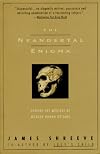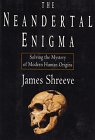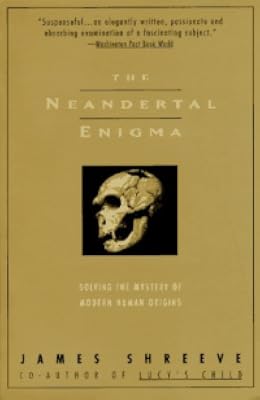
The Neandertal Enigma
by James Shreeve
On This Page
Description
Challenges the belief that the Neandertal was the first true human species, revealing the existence of humans fifty thousand years earlier, and considering why the Neandertal species died out.Tags
Recommendations











Member Reviews
Although necessarily out of date, this book provides a good introduction to what was known about Neandertals at the time; the history is detailed, including details of the many controversies surrounding Neandertal society and human evolution. One thing that stands out loud and clear through the pages of this book is the problem that occurs in science when political correctness, whether the kind that assumes western Europeans must be superior or the kind that assumes all are inherently equal, becomes a guiding factor. The inability to envision a possible hypothesis because it offends your sensitivities is a weakness few scientists can afford, and some of the nonsensical twists and turns that try to fit inconvenient facts into your show more preferred theory are described in gory detail in this book. The author treats his subject, and the scientists, with affection and respect, and that helps him say the things he needs to say. In addition, he adopts an almost poetic prose in many places which serves his subject well. show less
This is three interwoven stories.
The first is the story of the Neandertals: who they were, what they did, where they came from and where they went, who were their predecessors, successors and neighbors, and what kind of world they inhabited. The field is continually refreshed by new archaelogical and genetic studies. The author, not a scientist but a writer, amasses and organizes the facts in an interesting and skillful way and writes rather well about the science. The approach is largely chronological, tracking the history of archaeological discoveries in the field. There is a very occasional clumsiness or loose end, but this story fascinated me, and I recommend it to anyone with a healthy curiosity about our humanness. These show more Neandertals, our cousins, survived and reproduced continually for a quarter million years through ice ages and other catastrophies until somehow disappearing about 35,000 years ago, after the appearance of fully moderm humans in Europe. We have yet a very long way to go to match that record of success.
The second story tells how the archaeological evidence was discovered and about scientists who collected and evaluate it. To anyone not familiar with the usual professional squabbles in any field or with the dialectic that characterizes good science, this second story should be instructive, even if the personalities don't always spring to life.
The third story tells of the author's experiences in meeting and interviewing the scientists. The writing here is unfortunate (in a published book) and seems different in character from the rest, as though the author had farmed out this descriptive task to a middling high schooler. No adjective, comma or figure of speech is safe. Editors may have failed the author in this regard. While you can scan some of it, your eye will catch an important word, and then you must go back and read again. This wears heavily on the patience. As the book proceeds, there is ever less of this writing. Anyway it takes up only the smaller part of the book.
Reduced to schillings and pence, how does it add up? Five stars for Story 1, three stars for Story 2, and one star for Story 3. So three stars. But forewarned is forearmed: if you are reading this, then two stars more, one more for the book and one for you. I could do with one, also, I'm sure.
I am glad I read the book. There is some new science since the book was published, but you can catch up on that: check Wikipedia for "Denisova hominin". The new evidence suggests, among other things, that Neandertals did mate with modern humans, contributing about 4% of their DNA to the modern but non-African human genome and further suggests that adaptive selective pressures may account for its retention. show less
The first is the story of the Neandertals: who they were, what they did, where they came from and where they went, who were their predecessors, successors and neighbors, and what kind of world they inhabited. The field is continually refreshed by new archaelogical and genetic studies. The author, not a scientist but a writer, amasses and organizes the facts in an interesting and skillful way and writes rather well about the science. The approach is largely chronological, tracking the history of archaeological discoveries in the field. There is a very occasional clumsiness or loose end, but this story fascinated me, and I recommend it to anyone with a healthy curiosity about our humanness. These show more Neandertals, our cousins, survived and reproduced continually for a quarter million years through ice ages and other catastrophies until somehow disappearing about 35,000 years ago, after the appearance of fully moderm humans in Europe. We have yet a very long way to go to match that record of success.
The second story tells how the archaeological evidence was discovered and about scientists who collected and evaluate it. To anyone not familiar with the usual professional squabbles in any field or with the dialectic that characterizes good science, this second story should be instructive, even if the personalities don't always spring to life.
The third story tells of the author's experiences in meeting and interviewing the scientists. The writing here is unfortunate (in a published book) and seems different in character from the rest, as though the author had farmed out this descriptive task to a middling high schooler. No adjective, comma or figure of speech is safe. Editors may have failed the author in this regard. While you can scan some of it, your eye will catch an important word, and then you must go back and read again. This wears heavily on the patience. As the book proceeds, there is ever less of this writing. Anyway it takes up only the smaller part of the book.
Reduced to schillings and pence, how does it add up? Five stars for Story 1, three stars for Story 2, and one star for Story 3. So three stars. But forewarned is forearmed: if you are reading this, then two stars more, one more for the book and one for you. I could do with one, also, I'm sure.
I am glad I read the book. There is some new science since the book was published, but you can catch up on that: check Wikipedia for "Denisova hominin". The new evidence suggests, among other things, that Neandertals did mate with modern humans, contributing about 4% of their DNA to the modern but non-African human genome and further suggests that adaptive selective pressures may account for its retention. show less
The journalist surveys the existing literature and experts on what we know about Neandertal man and what happened to this species. It was fascinating that this species came to a dead end 30,000 years ago.
Thinking of becoming an anthropologist? Read something anthropological first...then pick anything else.
Solving the mystery of modern human origins
Archeology
Ratings
Members
- Recently Added By
Author Information

26+ Works 1,052 Members
Some Editions
Common Knowledge
- Canonical title
- The Neandertal Enigma
- Original publication date
- 1995
- People/Characters
- Katel Absolon; Louis Agassiz; Martin Aitken; Richard Alexander; Stanley Ambrose; Peter Andrews (show all 245); Baruch Arensburg; John Avise; Ofer Bar-Yosef; Peter Beaumont; Derek Bickerton; Lewis Binford; James Bischoff; Davidson Black; Francois Bordes; Jacques Boucher de Perthes; Marcellin Boule; Robert Boyle; C. Loring Brace; Robert Brain; Gunter Brauer; Henri Breuil; Paul Broca; Alison Brooks; Richard Byrne; Daniel Cahen; Rebecca Cann; Rachel Caspari; Luigi Cavalli-Sforza; A. J. E. Cave; Napoleon Chagnon; Philip Chase; Desmond Clark; Geoffrey Clark; Pierre Clastres; Captain James Cook, RN, FRS; Carleton Coon; Yves Coppens; Els Cornelissen; Edmund S. Crelin; Georges Cuvier; Raymond Dart; Charles Darwin [Charles Robert: 1809-1882]; Michel Dauvois; Charles Dawson; Hilary Deacon; Terry Deacon; Jean de Heinzelin; Irven DeVore; Jared Diamond; Harold Dibble; Anna Di Rienzo; Theodosius Dobzhansky; Eugène Dubois; Grafton Elliot Smith; Helen Fisher; Robert Foley; Staso Forenbaher; Roger Fouts; Robin Fox; Alan Franklin; David Frayer; Clive Gamble; Rob Gargett; Dorothy Garrod; Jean-Michel Geneste; Mikhail Gerasimov; Nikolay Gogol; Paul Goldberg; William Golding; Jane Goodall; Stephen Jay Gould; Rainier Grun; Petar Gumac; Ernst Haeckel (Ernst Heinrich Philipp August, 1834-1919); Michael Hammond; Ed Hare; Henry Harpending; Otto Hauser; Brian Hayden; Heidelberg Man; Jean-Louis Heim; David Helgren; Trent Holliday; Ralph Holloway; Bill Hornyak; Clark Howell; William Howells; Ales Hrdlicka; Jean-Jacques Hublin; Nicholas Humphrey; Julian Huxley; Thomas Henry Huxley; Ice Man; Glynn Isaac; Java Man; Julian Jaynes; Arthur Jelinek; Michael Jochim; Donald Johanson; Steven Jones; Lawrence Keeley; Arthur Keith; Kenneth Kidd; Hermann Klaatsch; Richard Klein; Bohuslav Klima; Chris Knight; Todd Koetje; Janusz Kozlowski; Steven Khun; Jeffrey Laitman; C. S. Lancaster; Ian Langham; Roy Larick; Henri LaVille; Louis Leakey; Mary Leakey; Richard Leakey; Arlette Leroi-Gourhan; Andre Leroi-Gourhan; Claude Lévi-Strauss; David Lewis-Williams; Richard Lewontin; Dan Lieberman; Philip Lieberman; John Locke (1632-1704); Geoffrey Long; Charles Lyell; Theodore McCown; David Maddison; Lynn Maners; Anthony Marks; Laurence Marshall; Lorna Marshall; Judith Masters; Leo Mastromatteo; A. F. Mayer; Ernst Mayr; Paul Mellars; Gerritt Miller; Gif Miller; Leah Minc; Gabriel de Mortillet; Hallam Movius; Kary Mullis; Joseph Neander; Neanderthals; Cro-Magnons; Masatoshi Nei; Rene Neuville; Vladimir Novotny; Henry Fairfield Osborn; Keith Otterbein; Svante Pääbo; Hugh Patterson; Linus Pauling; Peking Man; Jacques Pelegrin; John Pfeiffer; Geoffrey Pope; Reiner Protsch; Yoel Rak; Michael Rampino; Lego Reznikoff; Jean-Philippe Rigaud; Philip Rightmire; Lars Rodseth; Karen Rosenberg; Shahin Rouhani; Chris Ruff; Marshall Sahlins; Vincent Sarich; Hermann Schaafhausen; Lynne Schepartz; Johann Scheuchzer; Gustav Schwalbe; Henry Schwarcz; Stephen Self; Sergio Sergi; Nicholas Shackleton; John Shea; Vitaly Shevoroshkin; Jan Simek; Tal Simmons; Elwyn Simons; George Gaylord Simpson; O. J. Simpson; Ronald Singer; Olga Soffer; Ralph Solecki; William Sollas; Solo Man; Frank Spencer; John Speth; James Spuhler; Moshe Stekelis; Kathy Stewart; Mary Stiner; Mark Stoneking; William Straus; Christopher Stringer; Randall Susman; Jiri Svoboda; Ian Tattersall; Taung child; Eitan Tchernov; Pierre Teilhard de Chardin; Alan Templeton; Elizabeth Marshall Thompson; Alan Thorne; Ann Marie Tillier; Sarah Tishkoff; Erik Trinkaus; Alan Turner; Francis Turville-Petre; Edward Taylor; Helene Valladas; Henri Vallois; Vernard Vandermeersch; Pamela Vandiver; Linda Vigilant; Rudolf Virchos; John Vogel; G. H. R. von Koenigswald; Elizabeth Vrba; James Wainscoat; Douglas Wallace; Sherwood Washburn; Franz Weidenreich; H. G. Wells; Carl Wernicke; Robert Whallon; Leslie White; Randy White; Tim White; Andrew Whiten; Polly Wiessner; Allan Wilson; Martin Wobst; Milford Wolpoff; John Wymer; John Yellen; Ezra Zubrow; Emile Zuckerkandl
- Important places
- Iraq; Africa; Asia; Australia; Belgium; Brazil (show all 31); China; Czechoslovakia; England, UK; Ethiopia; Europe; France; Germany; Greece; Israel; Italy; Java, Indonesia; Jordan; Kenya; Malaysia; Middle East; New Guinea; Pitcairn Island; South Africa; South Pacific Ocean; Spain; Tanzania; Uganda; Yugoslavia; Zaire; Zambia
- Dedication
- To John Pfeiffer
- Blurbers
- Johanson, Donald; Tattersall, Ian; Weiner, Jonathan
Classifications
- Genres
- Anthropology, Science & Nature, Nonfiction, General Nonfiction
- DDC/MDS
- 573.2 — Natural sciences & mathematics Biology Specific physiological systems in animals, regional histology and physiology in animals Origin of man
- LCC
- GN285 .S57 — Geography, Anthropology and Recreation Anthropology Anthropology Physical anthropology. Somatology Human evolution Fossil man. Human paleontology
- BISAC
Statistics
- Members
- 352
- Popularity
- 89,455
- Reviews
- 6
- Rating
- (3.84)
- Languages
- English
- Media
- Paper
- ISBNs
- 5
- ASINs
- 4