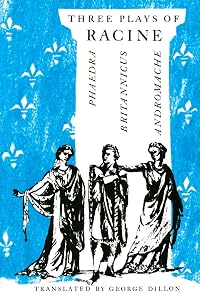
3 Plays: Andromache / Britannicus / Phedre
by Jean Racine
On This Page
Description
"George Dillon has elected for speed and clarity; his speed, of which short quotations can impart no notion, is his equivalent for Racine's impetuous dexterity with the French Alexandrine. . . . Momentum, in such a version, is everything. It stands as a homage to Racine's strength of construction . . . and to the expressive power of his themes, on which Mr. Dillon's prefaces have eloquent and sensible things to say."--Hugh Kenner, National Review "His literal and flexible blank verse show more actually forms the nearest thing in English to the longer-measured rhymed couplets of Racine; even an ordinary reading aloud of so faithful a rendering provides something of the experience that Proust described."--Elliott Coleman, Poetry "A superb introduction . . . flawless translations, infused with poetic fire and charm."--Margaret Carpenter, Norfolk Virginian-Pilot show lessTags
Recommendations



























Member Reviews
Komt wellicht niet helemaal tot zijn recht in vertaling. Maar het is vooral de geloofwaardigheid die problematisch is, de pathetiek is er vér over. Alleen Brittanicus bekoort nog echt, prachtig van opbouw en dialogen; het einde is een anticlimax.
Apr 19, 2010Dutch
Ratings
Members
- Recently Added By
Author Information

324+ Works 7,095 Members
Jean Racine is considered the greatest of French tragic dramatists. If Shakespeare's (see Vol. 1) theater is characterized by exploration and invention, Racine's is defined by restraint and formal perfection. His themes are derived from Greco-Roman, biblical, and oriental sources and are developed in the neoclassic manner: keeping to few show more characters, observing the "three unities" defined by Aristotle (see Vols. 3, 4, and 5) as essential to tragedy (i. e., unity of time, place, and action), and writing in regular 12-syllable verses called "alexandrines." In contrast to Corneille, whose theater is eminently political and concerned with moral choices, Racine locates tragic intrigue in the conflict of inner emotions. He is a master at exploring the power of erotic passion to transform and pervert the human psyche. As a Jansenist who believed that a person deprived of grace was subject to the tyranny of instincts, Racine was interested in portraying human passions---particularly the passion of love---in a state of crisis. Racine is also one of the greatest of all French poets, and his plays are a challenge to any translator. His major tragedies include Andromaque (1667), Britannicus (1669), e Berenice (1670), Iphigenie (1674), and Phedre (1677). (Bowker Author Biography) show less
All Editions
Work Relationships
Is contained in
Contains
Common Knowledge
- Canonical title
- 3 Plays: Andromache / Britannicus / Phedre
- Original publication date
- 1667 (Andromaque) (Andromaque); 1669 (Britannicus) (Britannicus); 1677 (Phèdre) (Phèdre)
- Important places*
- La Ferté-Milon, Hauts-de-France, Frankrijk
*Some information comes from Common Knowledge in other languages. Click "Edit" for more information.
Classifications
- Genre
- Fiction and Literature
- DDC/MDS
- 808 — Literature & rhetoric Literature, rhetoric & criticism Rhetoric and collections of literary texts from more than two literatures
- LCC
- PQ1888 .E5 .D5 — Language and Literature French, Italian, Spanish and Portuguese literatures French literature Modern literature 17th century
- BISAC
Statistics
- Members
- 82
- Popularity
- 389,457
- Reviews
- 1
- Rating
- (3.72)
- Languages
- Dutch, English, French
- Media
- Paper
- ISBNs
- 3
- ASINs
- 3