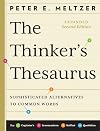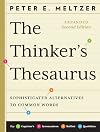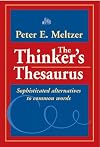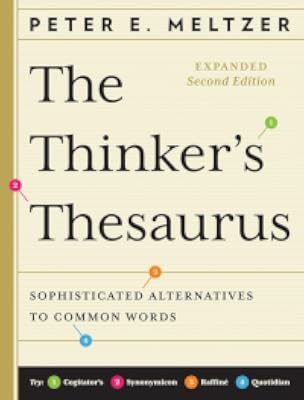
The Thinker's Thesaurus: Sophisticated Alternatives to Common Words (Expanded Second Edition)
by Peter E. Meltzer
On This Page
Description
Writers looking for more than elementary synonyms found in a standard thesaurus will find exceptional and thoughtful alternatives in this advanced thesaurus. Neither weird nor arcane, each listed synonym is carefully chosen, defined by a "clarifier", and used in an example from the popular press that demonstrates its contemporary usage.Tags
Recommendations












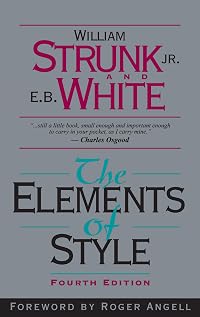
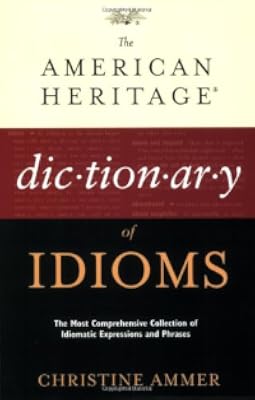
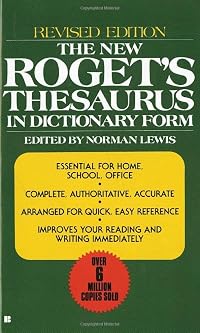
Member Reviews
This is not an ordinary thesaurus. I would characterize it more as a collection for word lovers of entertaining examples of alternate descriptors for ideas, that can be read and sampled as if it were a collection of short essays on words. For example, here is the entry for "essence":
essence (the ... of a matter, as in the bottom line, the main point, the substance, etc.) n.: tachlis (esp. as in "talk tachlis") [Yiddish]. - My current cookbook bible is How to Cook Everything by Mark Bittman. The author writes for the New York Times...and he's written several other good-read cookbooks. Yes he's opinionated, very. But this guy talks tachlis, he gets right to the point and tells you what you need to know in a clear, down to earth manner. show more (Ann Kleinberg, "Books for Cooks," Jerusalem Post, 6/18/2004.)
I chose this example of a Yiddish synonym because the book reminds me in some ways of The Joys of Yiddish by Leo Rosten. That book too is ostensibly a dictionary, but is really more of a collection of anecdotes about usage to be read and savored in little bits.
I wouldn't count on this book for a comprehensive thesaurus, but I think it actually serves a more useful and entertaining function. show less
essence (the ... of a matter, as in the bottom line, the main point, the substance, etc.) n.: tachlis (esp. as in "talk tachlis") [Yiddish]. - My current cookbook bible is How to Cook Everything by Mark Bittman. The author writes for the New York Times...and he's written several other good-read cookbooks. Yes he's opinionated, very. But this guy talks tachlis, he gets right to the point and tells you what you need to know in a clear, down to earth manner. show more (Ann Kleinberg, "Books for Cooks," Jerusalem Post, 6/18/2004.)
I chose this example of a Yiddish synonym because the book reminds me in some ways of The Joys of Yiddish by Leo Rosten. That book too is ostensibly a dictionary, but is really more of a collection of anecdotes about usage to be read and savored in little bits.
I wouldn't count on this book for a comprehensive thesaurus, but I think it actually serves a more useful and entertaining function. show less
Okay. I have a very good vocabulary, which I often have to tone down when speaking to people. I don’t quite understand the point of using the totally obscure words that Meltzer offers as synonyms. Although it might be interesting to page through the book for one’s own amusement and education, the book has little or no practical use. Indeed, as an editor, I might point out that language is generally used to communicate ideas. The use of the words in this book will not serve that purpose and will, in fact, only result in befuddlement.
I examined this thesaurus, and found that it offers some words other thesauruses may not have but also a great number of fairly well-known synonyms that I have already learned. It also demonstrates the word being used--by quoting some lengthy extract from a media source. These quotations often serve to show off the author's sociopolitical views to the reader.
You could do as well with another thesaurus. Not recommended.
You could do as well with another thesaurus. Not recommended.
I was disappointed by this book. To my mind, its not really a thesaurus at all. Metzler appears to have selected a set of his favorite abstruse words, assigned each a simple definition and then arranged them in a reverse dictionary. The result being many of the entries have only one word associated with them.
The book is made somewhat interesting to peruse by usage examples, a la the Oxford English Dictionary, but its not much use as a thesaurus.
The book is made somewhat interesting to peruse by usage examples, a la the Oxford English Dictionary, but its not much use as a thesaurus.
I'm a sucker for titles. The title of this book promises more than it delivers.
The Thinker's Thesaurus: Sophisticated Synonyms for Basic Words, by Peter Meltzer, goes beyond the realm of what we think a "thesaurus" should be by providing us with a level of useful words that exceeds what we've become used to in a normal thesaurus. The thesaurus that most of us are accustomed to suggests words that can be boring and repetitive. Meltzer gives us words contained in recent media, books and hundreds of newspapers and magazines to whet our appetite for more useful and dynamic words.
This unique thesaurus is not only informative, but entertaining - especially to those of us who are died in the wool "word addicts" and love to look up words for the simple enjoyment of it. If you're a writer, you'll use The Thinker's show more Thesaurus to move to a new, higher level of writing by using these incredible words in your poetry or prose.
The Thinker's Thesaurus takes us into modern times - far from the day of Peter Mark Roget in 1852. Roget decided to write a thesaurus himself, since he couldn't find one already published. Roget grouped words by related ideas and as a result earned a place in history as a lexicographical expert.
Others have written their own versions of a thesaurus, but most of the words in them are as common and dated as the original words and so, when writers are stuck and needing help with that one word to complete a thought or sentence, they were out of luck. Now, with Meltzer's "thinker's thesaurus," writers or word addicts can find sparkling words that can make the others almost obsolete.
Peter Meltzer's book, The Thinker's Thesaurus, is unique in three interesting ways:
1. This thesaurus provides sophisticated synonyms for the sophisticated writer, word addict, or those who simply want to sprinkle some glitter into their writing.
2. The Thinker's Thesaurus contains examples (not made up, but actually part of current writing) of almost all of the synonyms presented in the book.
3. You'll find words that you're probably unfamiliar with, but that will intrigue you in an entertaining way. Meltzer thought to insert a "clarifier" feature into the words' explanations so that you'll also have the benefit of choosing the most "target-centered" word rather than using a word that's merely near what you want.
If you're a little skeptical that words can be sophisticated and entertaining, have a look at Peter Meltzer's new book, The Thinker's Thesaurus: Sophisticated Synonyms for Basic Words. Meltzer's thesaurus was the Book Sense Pick of the Month of the American Booksellers Association and earned the award tenfold.
Review by Lauren Smith
This book review covers The Thinker's Thesaurus by Peter E. Meltzer.
Article Source: The Thinker's Thesaurus - Indeed! show less
This unique thesaurus is not only informative, but entertaining - especially to those of us who are died in the wool "word addicts" and love to look up words for the simple enjoyment of it. If you're a writer, you'll use The Thinker's show more Thesaurus to move to a new, higher level of writing by using these incredible words in your poetry or prose.
The Thinker's Thesaurus takes us into modern times - far from the day of Peter Mark Roget in 1852. Roget decided to write a thesaurus himself, since he couldn't find one already published. Roget grouped words by related ideas and as a result earned a place in history as a lexicographical expert.
Others have written their own versions of a thesaurus, but most of the words in them are as common and dated as the original words and so, when writers are stuck and needing help with that one word to complete a thought or sentence, they were out of luck. Now, with Meltzer's "thinker's thesaurus," writers or word addicts can find sparkling words that can make the others almost obsolete.
Peter Meltzer's book, The Thinker's Thesaurus, is unique in three interesting ways:
1. This thesaurus provides sophisticated synonyms for the sophisticated writer, word addict, or those who simply want to sprinkle some glitter into their writing.
2. The Thinker's Thesaurus contains examples (not made up, but actually part of current writing) of almost all of the synonyms presented in the book.
3. You'll find words that you're probably unfamiliar with, but that will intrigue you in an entertaining way. Meltzer thought to insert a "clarifier" feature into the words' explanations so that you'll also have the benefit of choosing the most "target-centered" word rather than using a word that's merely near what you want.
If you're a little skeptical that words can be sophisticated and entertaining, have a look at Peter Meltzer's new book, The Thinker's Thesaurus: Sophisticated Synonyms for Basic Words. Meltzer's thesaurus was the Book Sense Pick of the Month of the American Booksellers Association and earned the award tenfold.
Review by Lauren Smith
This book review covers The Thinker's Thesaurus by Peter E. Meltzer.
Article Source: The Thinker's Thesaurus - Indeed! show less
Ratings
Members
- Recently Added By
Author Information

5 Works 405 Members
Peter E. Meltzer is a practicing attorney in Philadelphia. He is a lifelong fan of rock music (and a frustrated musician) and the author of The Thinker's Thesaurus, So You Think You Know the Presidents? and So You Think You Know Baseball?
Classifications
Statistics
- Members
- 344
- Popularity
- 91,565
- Reviews
- 6
- Rating
- (3.60)
- Languages
- English
- Media
- Paper, Ebook
- ISBNs
- 6
- ASINs
- 3