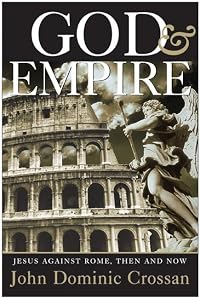
God and Empire: Jesus Against Rome, Then and Now
by John Dominic Crossan
On This Page
Description
In contrast to the oppressive Roman military occupation of the first century, Crossan examines the meaning of the non-violent Kingdom of God prophesized by Jesus and the equality advocated by Paul to the early Christian churches. Crossan contrasts these messages of peace with the misinterpreted apocalyptic vision from the Book of Revelation, which has been misrepresented by modern right-wing theologians and televangelists to justify US military actions in the Middle East. In God and Empire show more Crossan surveys the Bible from Genesis to Apocalypse, or the Book of Revelation, and discovers a hopeful message that cannot be ignored in these turbulent times. The first-century Pax Romana, Crossan points out, was in fact a 'peace' won through violent military action. Jesus preached a different kind of peace-a peace that surpasses all understanding-and a kingdom not of Caesar but of God. The Romans executed Jesus because he preached this Kingdom of God, a kingdom based on peace and justice, over the empire of Rome, which ruled by violence and force. For Jesus and Paul, Crossan explains, peace cannot be won the Roman way, through military victory, but only through justice and fair and equal treatment of all people. show lessTags
Recommendations

Member Recommendations


Member Reviews
This is a complex but fascinating book that I muddled through over the course of Lent this year. The basic thesis of this book is that Jesus Christ taught a radical message contrary to the idea of empire, whether the Roman empire of Christ's time or the American empire today. Pax Romana created peace through the enforcement of Roman military strength but the Kingdom of God is a true peace built on justice and equality. Thus the violence of "civilized" humanity if challenged by Christ's non-violence. This is a book worthy of a contemplative reread.
Favorite Passages:
Favorite Passages:
As the greatest pre-industrial and territorial empire—just as we are the greatest post-industrial and commercial empire—Rome was the expression, no more and no less, ofshow more
the normalcy of civilization’s violence, first-century style. Usually we use the term “civilization” for everything that is good about our humanity—for example, poetry and drama, music and dance, art and architecture, image and narrative. Correspondingly, to call individuals or groups, places or actions, “uncivilized” is normally a calculated insult. So I need to explain very clearly what I mean in this book by the “brutal normalcy of civilization.” The point I wish to emphasize is that imperialism is not just a here-and-there, now-and-then, sporadic event in human history, but that civilization itself, as I am using that term, has always been imperial—that is, empire is the normalcy of civilization’s violence. It is, of course, always possible to oppose this empire in favor of that one, to oppose yours in favor of ours. But if you oppose empire-as-such, you are taking on what has been the normalcy of civilization’s brutality for at least the last six thousand years.show less
As everyone knows, civilization began immediately with fratricide: the murder of one brother by another. But the story is more detailed than that. “Abel was a keeper of sheep, and Cain a tiller of the ground” (4:2), and “when they were in the field, Cain rose up against his brother Abel, and killed him” (4:8). That inaugural fratricide was the murder of a shepherd by a farmer on his own farm. That is the first act in the invention of human civilization—the farmer displacing the shepherd—and God does not punish the farmer but only marks him forever as the future of a lost past. There is no counterviolence from God—not even the appropriate divine vengeance when, as God says, “your brother’s blood is crying out to me from the ground!” (4:10).
I think that Jesus started by accepting John’s theology of God’s imminence but, precisely because of what happened to John, changed from that to a theology of God’s presence. John expected God’s advent, but Antipas’s cavalry came instead. John was executed, and God still did not come as an avenging presence. Maybe, thought Jesus, that was not how God acted because that is not how God is. Jesus’s own proclamation therefore insisted that the Kingdom of God was not imminent but present; it was already here below upon this earth, and however it was to be consummated in the future, it was a present-already and not just an imminent-future reality. Jesus could hardly have made such a spectacular claim without immediately appending another one to it. You can speak forever about the future-imminence of the Kingdom, but unless you are foolish enough to give a precise date, you can hardly be proved right or wrong. We are but waiting for God to act; apart from preparatory faith, hope, and prayer, there is no more we can do. When God acts, it will be, presumably, like a flash of divine lightning beyond all categories of time and place. But to claim an already-present Kingdom demands some evidence, and the only such that Jesus could have offered is this: it is not that we are waiting for God, but that God is waiting for us. The present Kingdom is a collaborative eschaton between the human and divine worlds. The Great Divine Cleanup is an interactive process with a present beginning in time and a future (short or long?) consummation. Would it happen without God? No. Would it happen without believers? No. To see the presence of the Kingdom of God, said Jesus, come, see how we live, and then live likewise.
It is certainly correct, therefore, to call Jesus’s death—or in fact the death of any martyr—a sacrifice, but substitution and suffering are not the point of sacrifice. Substitutionary atonement is bad as theoretical Christian theology just as suicidal terrorism is bad as practical Islamic theology. Jesus died because of our sins, or from our sins, but that should never be misread as for our sins. In Jesus, the radicality of God became incarnate, and the normalcy of civilization’s brutal violence (our sins, or better, Our Sin) executed him. Jesus’s execution asks us to face the truth that, across human evolution, injustice has been created and maintained by violence while justice has been opposed and avoided by violence. That warning, if heeded, can be salvation.
It is the age-old normalcy of civilization’s violent injustice that is weakness and foolishness with God, and it is God’s nonviolent justice that is weakness and foolishness for civilization’s violent normalcy.
To turn the nonviolent resistance of the slaughtered Jesus into the violent warfare of the slaughtering Jesus is, for me as a Christian, to libel the body of Jesus and to blaspheme the soul of Christ.
God and Empire: Jesus Against Rome, Then and Now is a book written to challenge Christians to choose between a God and Christianity of escalatory violence or a Jesus and Christianity of nonviolent resistance to the violent powers of empirical civilization. John Dominic Crossan leverages his scholarship and writing talents to achieve this purpose. The book is very well written, an easy read considering its scholarly content, and the aim is clear. Crossan wanted to draw a sharp line between human violence and divine nonviolence. (pg. 4) He succeeded if one accepts his premises, which this author does not. The entire book is based on one or more faulty premises, with buckets of false conclusions. These conclusions are used throughout the show more book to construct additional faulty arguments. Ironically, there is a copyright page near the end of the book that states, “This book is a work of fiction. The characters, incidents, and dialogue are drawn from the author’s imagination and are not to be construed as real.” (pg. 258) Although it may be a simple publisher’s mistake, it is a good summary of another of the chief problems of the book; so much of the content is simply made up.
Crossan’s arguments are based upon two essential presuppositions that should be understood before moving through the book. First, according to Crossan, humankind is on a devastating path of ever-increasing violence. The ultimate form of that violence can be found in what he called “civilization” or empire. In Crossan’s view, every civilization is founded and built upon the violent subjugation and control of others. (pg. 29) That is key to understanding his view of Rome at the time of Christ and America in the modern day. The second premise required to understand Crossan’s point is his belief that the Christian Bible presents two opposing visions of God. There is the violent God of judgment and retribution best seen in the Old Testament and the nonviolent, gentle, sweet, and lowly God best represented in Jesus of the New Testament. Where the New Testament seems to agree with the Old Testament, Crossan used higher criticism to dismiss and disparage the witness of Scripture. Beneath these two premises are much deeper presuppositions of philosophy and theology, some of which reveal themselves throughout the book's pages and some that remain hidden and unstated. There are other logical problems throughout the book, but they are grounded in these critical premises.
God and Empire is a tough read for anyone who takes Biblical study, Biblical truth, and sound reasoning seriously. Crossan has elevated unbelieving scholarship over foundational truths of the world and faith. Although he called himself a Christian, his understanding of what it means to be a Christian has very little to do with the Bible itself. Crossan does not believe in the deity of Christ or the atonement. He does not believe in the inspiration or inerrancy of Scripture. He rejects the miraculous works of Jesus and selectively excises what he likes from the pages of the Bible. The inference of his writing is a social gospel, with toothless hope for a peaceful and nonviolent future but no answer for the question of man’s sin and broken relationship with the God of heaven. The following quote as an example demonstrates that Crossan does not believe that Jesus was God incarnate. “Other human beings who had greatly benefited their fellows were divinized only after their death, but Caesar Augustus was unique in having achieved divine status while still alive.” (pg. 19) To make that statement, one must dismiss the New Testament claims to Jesus’ deity as mystical or parabolic or assign some other philosophical or arbitrary meaning. Some of the former assertions are not specifically evident in God and Empire, but they are essential parts of Crossan’s body of work, and consultation of even a single debate reveals that. (https://www.youtube.com/watch?v=BIX7eqTllEc&t=7868s) The logical problems discussed later in this review are superficial compared to these presuppositions, so these presuppositions must be held in the back of the reader’s mind to grasp the depth of the error Crossan put forward.
Crossan’s God and Empire was written to challenge Christians to choose between two visions of God. The violent God of the Old Testament and traditional Christianity who hates and punishes sin, or the nonviolent God of love and peace from the world beyond this one. The challenge is faulty, for it is a false dilemma, excluding the possibility of the Biblical God that is perfect in holiness, glory, and majesty. Crossan asks which God the Christian will choose, but the wise Christian must reject the false choice and the false unidimensional gods that Crossan has offered. Too much of this book is faulty. Too much of it is built on shaky ground. Too much is fiction.
Read the full academic review here: https://www.academia.edu/124631069/A_Critical_Review_of_GOD_and_EMPIRE_Jesus_Aga.... show less
Crossan’s arguments are based upon two essential presuppositions that should be understood before moving through the book. First, according to Crossan, humankind is on a devastating path of ever-increasing violence. The ultimate form of that violence can be found in what he called “civilization” or empire. In Crossan’s view, every civilization is founded and built upon the violent subjugation and control of others. (pg. 29) That is key to understanding his view of Rome at the time of Christ and America in the modern day. The second premise required to understand Crossan’s point is his belief that the Christian Bible presents two opposing visions of God. There is the violent God of judgment and retribution best seen in the Old Testament and the nonviolent, gentle, sweet, and lowly God best represented in Jesus of the New Testament. Where the New Testament seems to agree with the Old Testament, Crossan used higher criticism to dismiss and disparage the witness of Scripture. Beneath these two premises are much deeper presuppositions of philosophy and theology, some of which reveal themselves throughout the book's pages and some that remain hidden and unstated. There are other logical problems throughout the book, but they are grounded in these critical premises.
God and Empire is a tough read for anyone who takes Biblical study, Biblical truth, and sound reasoning seriously. Crossan has elevated unbelieving scholarship over foundational truths of the world and faith. Although he called himself a Christian, his understanding of what it means to be a Christian has very little to do with the Bible itself. Crossan does not believe in the deity of Christ or the atonement. He does not believe in the inspiration or inerrancy of Scripture. He rejects the miraculous works of Jesus and selectively excises what he likes from the pages of the Bible. The inference of his writing is a social gospel, with toothless hope for a peaceful and nonviolent future but no answer for the question of man’s sin and broken relationship with the God of heaven. The following quote as an example demonstrates that Crossan does not believe that Jesus was God incarnate. “Other human beings who had greatly benefited their fellows were divinized only after their death, but Caesar Augustus was unique in having achieved divine status while still alive.” (pg. 19) To make that statement, one must dismiss the New Testament claims to Jesus’ deity as mystical or parabolic or assign some other philosophical or arbitrary meaning. Some of the former assertions are not specifically evident in God and Empire, but they are essential parts of Crossan’s body of work, and consultation of even a single debate reveals that. (https://www.youtube.com/watch?v=BIX7eqTllEc&t=7868s) The logical problems discussed later in this review are superficial compared to these presuppositions, so these presuppositions must be held in the back of the reader’s mind to grasp the depth of the error Crossan put forward.
Crossan’s God and Empire was written to challenge Christians to choose between two visions of God. The violent God of the Old Testament and traditional Christianity who hates and punishes sin, or the nonviolent God of love and peace from the world beyond this one. The challenge is faulty, for it is a false dilemma, excluding the possibility of the Biblical God that is perfect in holiness, glory, and majesty. Crossan asks which God the Christian will choose, but the wise Christian must reject the false choice and the false unidimensional gods that Crossan has offered. Too much of this book is faulty. Too much of it is built on shaky ground. Too much is fiction.
Read the full academic review here: https://www.academia.edu/124631069/A_Critical_Review_of_GOD_and_EMPIRE_Jesus_Aga.... show less
In contrast to the oppressive Roman military occupation of the first century, Crossan examines the meaning of the non-violent Kingdom of God prophesized by Jesus and the equality advocated by Paul to the early Christian churches. Crossan contrasts these messages of peace with the misinterpreted apocalyptic vision from the Book of Revelation, which has been misrepresented by modern right-wing theologians and televangelists to justify US military actions in the Middle East. In God and Empire Crossan surveys the Bible from Genesis to Apocalypse, or the Book of Revelation, and discovers a hopeful message that cannot be ignored in these turbulent times.
The first chapter in this book is entitled "God and the Ambiguity of Power" - and the ambiguity of power, or the ethics of power specifically, is exactly the struggle that Christianity has had in determining its relationship to Empire and domination systems. The title alludes to Rome specifically, but really Crossan's "empire" is any powerful and oppressive system.
It might seem obvious that Jesus would have stood against the oppression of Rome, but does that mean that Christians should be "drop-outs" who refuse to go along with these oppressive social evils like capitalism and organized religion? Clearly to revolutionize the system and cure its evils, one must work within the system - thus "violent oppression and nonviolent resistance show more are both modes of social power."
Crossan argues that Christians who seize Revelation especially and make Christianity into a religion of both violence and glory have misinterpreted the message of the historical Jesus - or worse, disregarded it entirely. Jesus was preaching a very present Kingdom of God, and Christians are therefore called to live as though they're living in it. This should be an egalitarian movement, and would be destructive against the empire insofar as its foundation of the social masses would have refused to worship it any longer, but ultimately it would be a revolution that achieves effectiveness through nonviolence. show less
It might seem obvious that Jesus would have stood against the oppression of Rome, but does that mean that Christians should be "drop-outs" who refuse to go along with these oppressive social evils like capitalism and organized religion? Clearly to revolutionize the system and cure its evils, one must work within the system - thus "violent oppression and nonviolent resistance show more are both modes of social power."
Crossan argues that Christians who seize Revelation especially and make Christianity into a religion of both violence and glory have misinterpreted the message of the historical Jesus - or worse, disregarded it entirely. Jesus was preaching a very present Kingdom of God, and Christians are therefore called to live as though they're living in it. This should be an egalitarian movement, and would be destructive against the empire insofar as its foundation of the social masses would have refused to worship it any longer, but ultimately it would be a revolution that achieves effectiveness through nonviolence. show less
John Dominic Crossan's little gem, "God and Empire," is a discussion of the relation of Christianity to worldly political states, particularly empires such as Rome and the current United States. Empires exert power territorially, politically, ideologically, and militarily. Crossan observes that the normal way power is exercised is through force or coercion, but that is not the only way it can be exercised. Nonviolent persuasion is also a way to exert power.
The bible is very ambiguous and ambivalent as to how it portrays God's exercise of power. In the Old Testament, God punishes man by floods and other catastrophes. However, He sometimes is more merciful, such as when He merely marks Cain instead of exerting counter violence to Cain's show more killing his brother.
Crossan distinguishes distributive justice from retributive justice. God exercises both kinds of justice in the Bible. The many rules set forth in Leviticus are [to Crossan] "the Torah's relentless attempt to stay the growth of inequality." Yet, the Bible sometimes portrays God as exacting retributive justice through violent acts. Crossan asks whether there is any scientific evidence that "God ever punishes anyone?" He believes not.
Crossan argues that the fundamental message of Jesus, Paul, and the early Christians is one of opposition to earthly, violent power through nonviolent persuasion. He asserts this despite many passages, particularly in the Apocalypse, that indicate that Jesus may return as a violent avenger, much as he is portrayed in the Left Behind books.
The two final divine solutions for the problem of Gentile empires [Noachic extermination or Abrahamic conversion to justice and peace] is never reconciled in the biblical tradition. Christians must choose between the violent God of human normalcy and the nonviolent God of divine radicality, between peace through violence or peace through justice. Crossan himself opts for the nonviolent approach, and argues that this is the most accurate reading of Jesus and Paul.
Crossan argues that Paul gets a bad rap from today's feminist and gay-tolerant world because several of the epistles attributed to him were clearly written by someone else with a more traditional Jewish view of gender equality and homosexuality. The real Paul recognized several women as important early apostles, the equal of any men.
The final chapter of the book impugns the interpretations of the Apocalypse currently prevalent among evangelicals. He believes in no second coming of Christ as an avenger. Rather, he shows that many of the tribulations described in the Apocalypse were coded allusions to events [the Roman destruction of the Jewish temple and the dispersing of the Jews] that already had taken place when the book was written. A careful reading of the book shows the second coming to take place AFTER those events, not during them. Crosson, a modern sensible man, envisions the second coming not as a physical return of Jesus, but rather as a time when most men will be converted to a more benign, nonviolent way of living. He admits this a radical vision, not the normal [but not inevitable] state of human affairs.
(JAB) show less
The bible is very ambiguous and ambivalent as to how it portrays God's exercise of power. In the Old Testament, God punishes man by floods and other catastrophes. However, He sometimes is more merciful, such as when He merely marks Cain instead of exerting counter violence to Cain's show more killing his brother.
Crossan distinguishes distributive justice from retributive justice. God exercises both kinds of justice in the Bible. The many rules set forth in Leviticus are [to Crossan] "the Torah's relentless attempt to stay the growth of inequality." Yet, the Bible sometimes portrays God as exacting retributive justice through violent acts. Crossan asks whether there is any scientific evidence that "God ever punishes anyone?" He believes not.
Crossan argues that the fundamental message of Jesus, Paul, and the early Christians is one of opposition to earthly, violent power through nonviolent persuasion. He asserts this despite many passages, particularly in the Apocalypse, that indicate that Jesus may return as a violent avenger, much as he is portrayed in the Left Behind books.
The two final divine solutions for the problem of Gentile empires [Noachic extermination or Abrahamic conversion to justice and peace] is never reconciled in the biblical tradition. Christians must choose between the violent God of human normalcy and the nonviolent God of divine radicality, between peace through violence or peace through justice. Crossan himself opts for the nonviolent approach, and argues that this is the most accurate reading of Jesus and Paul.
Crossan argues that Paul gets a bad rap from today's feminist and gay-tolerant world because several of the epistles attributed to him were clearly written by someone else with a more traditional Jewish view of gender equality and homosexuality. The real Paul recognized several women as important early apostles, the equal of any men.
The final chapter of the book impugns the interpretations of the Apocalypse currently prevalent among evangelicals. He believes in no second coming of Christ as an avenger. Rather, he shows that many of the tribulations described in the Apocalypse were coded allusions to events [the Roman destruction of the Jewish temple and the dispersing of the Jews] that already had taken place when the book was written. A careful reading of the book shows the second coming to take place AFTER those events, not during them. Crosson, a modern sensible man, envisions the second coming not as a physical return of Jesus, but rather as a time when most men will be converted to a more benign, nonviolent way of living. He admits this a radical vision, not the normal [but not inevitable] state of human affairs.
(JAB) show less
It’s Jesus vs. Rome. Who will win?
If you’ve read much about the first century, you’re already well aware of the conflict between Christian and Roman claims. Both sides laid claim to the Son of God. Both claimed the inauguration of a new, wonderful age. The Caesars, especially in Asia Minor, were worshipped as God and often went by the title Son of God. Caesar Augustus, in particular, was hailed as the savior of the world, the bringer of peace and prosperity.
The Christians claimed a coming kingdom, or a hidden kingdom; the Romans proved their kingdom by force and heavy presence. The Christian kingdom was not of this world; the Roman kingdom invaded every part of life. Jesus’ kingdom was one of nonviolence; the Roman kingdom was show more just the opposite.
Crossan highlights the conflict between the two, and what, exactly, the Christians were claiming in their “uprising.” Of particular interest, to me, was the discussion of Paul, whom Crossan divides into three categories: The radical Paul, the liberal Paul, and the conservative Paul, representing three stages of Pauline writings.
I give it four stars instead of five, not for the lack of quality, but because little is original from his other writings. It’s just organized and directed differently to emphasize a point. show less
If you’ve read much about the first century, you’re already well aware of the conflict between Christian and Roman claims. Both sides laid claim to the Son of God. Both claimed the inauguration of a new, wonderful age. The Caesars, especially in Asia Minor, were worshipped as God and often went by the title Son of God. Caesar Augustus, in particular, was hailed as the savior of the world, the bringer of peace and prosperity.
The Christians claimed a coming kingdom, or a hidden kingdom; the Romans proved their kingdom by force and heavy presence. The Christian kingdom was not of this world; the Roman kingdom invaded every part of life. Jesus’ kingdom was one of nonviolence; the Roman kingdom was show more just the opposite.
Crossan highlights the conflict between the two, and what, exactly, the Christians were claiming in their “uprising.” Of particular interest, to me, was the discussion of Paul, whom Crossan divides into three categories: The radical Paul, the liberal Paul, and the conservative Paul, representing three stages of Pauline writings.
I give it four stars instead of five, not for the lack of quality, but because little is original from his other writings. It’s just organized and directed differently to emphasize a point. show less
It covers some ground covered in other books. I understand why he did that (otherwise parts of his argument wouldn't make sense to people who hadn't read his other books). I just wish he'd clearly bracketed off the review material. That's the only flaw with what is otherwise an elegant, eloquent, and persuasive book.
Members
- Recently Added By
Author Information

72+ Works 11,297 Members
Considered by many to be the most learned scholar on the topic of Jesus Christ, John Dominic Crossan's adversaries question how he reconciles his Catholic faith with 20th century secular study. A former priest, Crossan is the author of The Essential Jesus: Original Sayings and Earliest Images, The Historical Jesus: The Life of a Mediterranean show more Jewish Peasant, Jesus: A Revolutionary Biography; The Birth of Christianity: Discovering What Happened in the Years Immediately After the Execution of Jesus, and The Cross That Spoke: The Origins of the Passion Narrative, among others. (Bowker Author Biography) show less
Common Knowledge
- People/Characters
- Jesus Christ; Augustus Caesar (Roman empire's first Emperor); Herod Antipas; Herod the Great; Saint Paul
- Important places
- Roman Empire
- Dedication
- for Sarah
on
our twentieth wedding anniversary - First words
- (Prologue) For a very long time I have been pondering the texts and wandering the ruins of the Roman Empire.
(Chapter 1) Between 1945 and 1950, I spent my high school years at St. Eunan’s College in Letterkenny, Ireland. - Last words
- (Click to show. Warning: May contain spoilers.)In the challenge of human evolution, we are called to Post-Civilization, to imagine it, to create it, and to enjoy it on a transfigured earth.
Classifications
- Genres
- Religion & Spirituality, Nonfiction, History, General Nonfiction
- DDC/MDS
- 261.7 — Religion Christian organization, social work & worship Social theology and interreligious relations and attitudes Christianity and political affairs
- LCC
- BR115 .P7 .C755 — Philosophy, Psychology and Religion Christianity Christianity Christianity in relation to special subjects
- BISAC
Statistics
- Members
- 470
- Popularity
- 64,463
- Reviews
- 8
- Rating
- (3.86)
- Languages
- English
- Media
- Paper, Audiobook, Ebook
- ISBNs
- 5
- ASINs
- 5