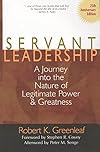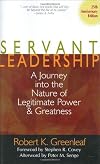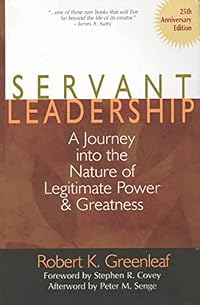
Servant Leadership: A Journey into the Nature of Legitimate Power and Greatness 25th Anniversary Edition
by Robert K. Greenleaf
On This Page
Description
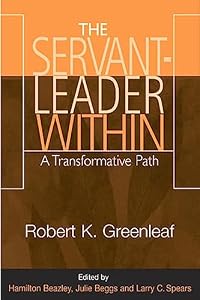
With the publication of Servant Leadership in 1977, a new paradigm of management entered the boardrooms and corporate offices of America. Robert K. Greenleaf, a retired AT & T executive, proposed that service ought to be the distinguishing characteristic of leadership. Not only would it create better, stronger companies, he said, but business leaders themselves "would find greater joy in their lives if they raised the servant aspect of their leadership and built more serving institutions." show more In the quarter century since these ideas were first articulated, the notion of servant leadership has gained ever more disciples in business schools, among executives, in government and in public and private institutions. Greenleaf was among the first to analyze the qualities of leaders and followers--and the necessity for leaders to be attentive to the needs of others. In this respect the leader becomes a follower. Such a leader, said Greenleaf, constantly inquires whether "other people's highest priority needs are being served. Do those served grow as persons? Do they, while being served, become healthier, wiser, freer, more autonomous, more likely themselves to become servants?" The true leader is also a seeker--alert to new possibilities, open, listening and ready for whatever develops. True leadership, then, is an inner quality as much as an exercise of authority. The present volume originated as essays and talks treating servant leadership as a general principle and the way it has been lived by particular people. Sections of the book deal with leadership in education, in foundations, in churches, in bureaucracies, and with the role of the United States as a world leader. It closes with a spiritual reflection on Robert Frost's poem "Directive". The reflection, in Greenland's words, is "partly an acknowledgment of [Frost's] influence on me and partly a sharing with those who are the search for what I have now come to see as servant leadership, and who, sooner or later and in their own way, come to grips with who they are and where they are on the journey." show lessTags
Recommendations









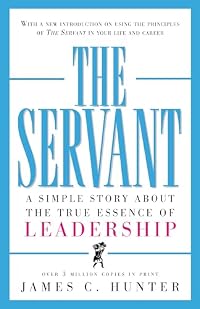
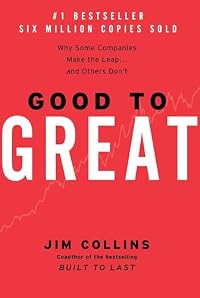
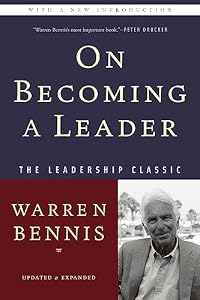
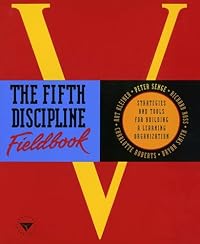


Member Reviews
When observing the world, many see that true leadership does not reflect positions of power; rather, it reflects a quality of personal character. Robert Greenleaf looked at 1970s America and the 1970s world and observed a lack of leadership. We had educated talent out the wazoo, but lacked people able to usher in lasting, good change. He wrote this book to cultivate such leadership qualities in its readers. Leadership, to him, was of a servant's quality; it was not driven by acquiring power but instead by being a true "trustee."
Some of the material is not relevant today because it was so rooted in history. Particularly, his assessment of the universities reflected the historical student uprisings of the 1960s. Thankfully, many of the show more problems have been addressed. Likewise, churches now face a new cadre of problems, not moored to the problems of the 1970s. I suspect the same is true for foundations, another topic of his interest.
However, there is a lasting quality to his philosophy. We are in need of people to serve lasting organizations instead of just hopping on the next new thing. Those people do not necessarily need fancy titles to enact "legitimate power and greatness." The names writing the forward and afterward agree: famous business authors Stephen Covey and Peter Senge. Society needs to continue to read this book because we need better servant leaders.
This book is well-suited for undergraduate and graduate school students seeking to make more of an impact on their world. Young professionals might also give it a good read. Even older people involved in mentoring young adults can benefit from the words in its philosophy. This book is one of those lasting works that deserves to be read for a long time. To be effective, we all need to learn to be better servant leaders. show less
Some of the material is not relevant today because it was so rooted in history. Particularly, his assessment of the universities reflected the historical student uprisings of the 1960s. Thankfully, many of the show more problems have been addressed. Likewise, churches now face a new cadre of problems, not moored to the problems of the 1970s. I suspect the same is true for foundations, another topic of his interest.
However, there is a lasting quality to his philosophy. We are in need of people to serve lasting organizations instead of just hopping on the next new thing. Those people do not necessarily need fancy titles to enact "legitimate power and greatness." The names writing the forward and afterward agree: famous business authors Stephen Covey and Peter Senge. Society needs to continue to read this book because we need better servant leaders.
This book is well-suited for undergraduate and graduate school students seeking to make more of an impact on their world. Young professionals might also give it a good read. Even older people involved in mentoring young adults can benefit from the words in its philosophy. This book is one of those lasting works that deserves to be read for a long time. To be effective, we all need to learn to be better servant leaders. show less
This is a very good book on leaders as servants; doing an excellent job of delineating what that idea truly means. The terminology can be a bit challenging as he writes across institutional lines applying his concepts to business & industry, as well as educational and religious institutions. Greenleaf suggests that foundational to a successful institution is the requirement that it must be more than simply the chief administrator who has a deep commitment. He calls for the board/trustees/synod/executive committee to be comprised of highly committed individuals who are very supportive of the missional goal of the organization. He insists that the chief administrator (CEO/president/minister) should be a first among equals. But he also show more insists that the equals must be equally committed to make the institution successful. The book expands and offers thoughts about the ways to accomplish this. It is not an easy read – much more like a textbook than anything else, but for those who are administrator’s there are tools here that can be utilized to build the organization. show less
Par for the course of self-improvement books. The principles are good, but the style of this genre does not appeal to me.
Ratings
Members
- Recently Added By
Author Information

29 Works 1,305 Members
Robert K. Greenleaf was the creator of the modern trend to empower employees; he also coined the term servant-leadership. He was a top executive in management research, development, and education and AT&T, as well as a visiting lecturer at MIT's Sloan School of Management and Harvard Business School. He also taught at Dartmouth College and the show more University of Virginia. Upon his retirement from AT&T, he founded the Center for Applied Ethics, which eventually became the Robert K. Greenleaf Center for Servant-Leadership, located in Indianapolis. Greenleaf died in 1990 at the age of 86. show less
All Editions
Common Knowledge
- Alternate titles
- 僕人領導學 : 僕人領導的理論與實踐; 僕人領導學 : 領導者與跟隨者互惠雙嬴的領導哲學
Classifications
- Genres
- Business, Nonfiction, Religion & Spirituality, General Nonfiction
- DDC/MDS
- 303.34 — Social sciences Social sciences, sociology & anthropology Social processes Coordination and control Leadership
- LCC
- HM141 .G69 — Social sciences Sociology (General) Sociology These are obsolete numbers no longer used
- BISAC
Statistics
- Members
- 857
- Popularity
- 31,626
- Reviews
- 4
- Rating
- (3.91)
- Languages
- English, Japanese
- Media
- Paper, Audiobook, Ebook
- ISBNs
- 5
- ASINs
- 5