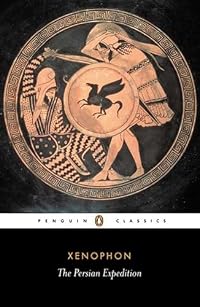
The Anabasis [in translation]
by Xenophon
On This Page
Description
One of the foundational works of military history and political philosophy, and an inspiration for Alexander the Great, the Anabasis of Cyrus recounts the epic story of the Ten Thousand, a band of Greek mercenaries hired by Cyrus the Younger to overthrow his brother, Artaxerxes, king of Persia and the most powerful man on earth. It shows how Cyrus' army was assembled covertly and led from the coast of Asia Minor all the way to Babylon; how the Greeks held the field against a superior Persian show more force; how Cyrus was killed, leaving the Greeks stranded deep within enemy territory; and how many of them overcame countless dangers and found their way back to Greece.Their remarkable success was due especially to the wily and decisive leadership of Xenophon himself, a student of Socrates who had joined the Ten Thousand and, after most of the Greek generals had been murdered, rallied the despondent Greeks, won a position of leadership, and guided them wisely through myriad obstacles.In this new translation of the Anabasis, Wayne Ambler achieves a masterful combination of liveliness and a fidelity to the original uncommon in other versions. Accompanying Ambler's translation is a penetrating interpretive essay by Eric Buzzetti, one that shows Xenophon to be an author who wove a philosophic narrative into his dramatic tale. The translation and interpretive essay encourage renewed study of the Anabasis as a work of political philosophy. They also celebrate its high adventure and its hero's adroit decision-making under the most pressing circumstances. show lessTags
Recommendations















Member Recommendations
WhitmelB This is a modern writer's version of the long trek and is interesting from that angle. This is Michael Curtis Ford's first book. He has since written "Gods and Legions" about ancient Rome which might also interest readers.
31

caflores Dos narraciones de largas y fracasadas expediciones militares, en un estilo sorprendentemente similar.
02

Member Reviews
I've had this book in my home library for several years but never bothered to read it. I was sorely missing an epic account of an army stranded without friends in the heart of the Persian Empire. The author and one of the main characters, ultimately the principal character, presents a vivid account of the trials of an army left without it's chief general. This army of Greek hoplites and peltasts were dejected, suspicious, haughty and yet extremely capable of defeating enemies vastly superior in numbers and usually superior in cavalry. Xenophon's often self-congratulating account presents himself as a unifying presence of dogged persistence, selfless sacrifice for the soldiers and the voice of reason sorting through the constant threat show more of chaos. There was always too many chiefs but Xenophon, as presented, was often willing to let others assume the glory, for the sake of keeping the army united. So often, we find Xenophon left to defend himself against false accusation only to find the army coming to their senses in the nick of time. The best example is toward the end of the account when Xenophon is tirelessly badgering their ally Seuthes for the pay he promised the army while the army is quickly seduced into believing that Xenophon is keeping all the pay for himself. Some of my favorite parts of the book are the character portrayals of Cyrus, Clearchus and some of the other generals and even the Persian governors (i.e Tissaphernes). It is not difficult to discern that the author is more than a historian. He is a classical Athenian and it is no surprise that he is an admirer of philosophical discourse and in particular, Socrates. I shouldn't gloss over the fact that The March of the Ten Thousand is also a very brutal account. The very soldiers the reader is asked to root for are constantly harassing and pillaging villages to provide for their own upkeep. Of course, they prefer that a village would give them food and supplies willingly but if they don't "may the god's help them!" As is the case with many ancient books there is no climactic ending . It just ends with Xenophon departing from the army but with no apparent conclusion. They made it out of the Persian Empire but never back to mainland Greece. It just ends in Pergamon, Xenophon leaves, Thibron takes over and the remaining soldiers resume going to battle against the Persians. show less
This one is account of adventures of Greek mercenaries that were hired by Persian prince Cyrus. After Cyrus fails in his attempted coup [against his brother king], Greeks end up deeply behind enemy lines and without guides to get them back to Greece.
Soon they will start their march to the Black sea and from there to Greece itself. They will suffer great losses during the march (almost half of the forces will succumb whether to wounds or to the ever present diseases) but will hold their ground against every foe they encounter.
Story is full of descriptions of human nature (loss of discipline (and rise of brigandism) after being faced with what seem to be insurmountable odds (and loss of strong leadership), constant squabbling between show more officers for power, treachery of those seeking to use this mighty army for their own purposes (be it other Greeks or other nations) to name the few).
Great story, brilliantly written (short concise sentences – Oxfords’ edition translation is just great) - highly recommended. show less
Soon they will start their march to the Black sea and from there to Greece itself. They will suffer great losses during the march (almost half of the forces will succumb whether to wounds or to the ever present diseases) but will hold their ground against every foe they encounter.
Story is full of descriptions of human nature (loss of discipline (and rise of brigandism) after being faced with what seem to be insurmountable odds (and loss of strong leadership), constant squabbling between show more officers for power, treachery of those seeking to use this mighty army for their own purposes (be it other Greeks or other nations) to name the few).
Great story, brilliantly written (short concise sentences – Oxfords’ edition translation is just great) - highly recommended. show less
The story of how a Greek army, who had gone to Persia to wage war, struggled to return home after things went a bit wrong. It took me a while to get into it--the earlier parts are not so interesting, I think, perhaps because Xenophon himself did not play such a large role in events, though they do contain his very approving portrait of Cyrus. The end, too, can drag on a bit; in the last book, especially, I get the impression of Xenophon trying to settle old scores; interesting in its way, I suppose, but not totally gripping. These outer sections, too, can suffer from a large number of unfamiliar names (people and places) over which my eyes, at least, slip rather easily. The middle, though, after Xenophon has reached a position of power, show more but before the army has reached the coast, is more interesting. Here we get an impression of the day to day life of the army, the fighting, yes, but also the dull marches, the search for supplies, the diplomacy and the petty squabbles. And there is, yet again, evidence that classical writers were not allowed to complete a text without at least one piece of absurdity; here there's an incident where some soldiers eat too much honey, become sick, dizzy, suffer from diarrhoea, "some actually died.... However, they were all alive on the next day..." (p 169).
Rex Warner's translation seems fine. show less
Rex Warner's translation seems fine. show less
The Ancient Greek term anabasis is ambiguous enough that translators often let it stand. Here are some possibilities: march up country, ascent, and literally, expedition up from. In translating Xenophon’s title, Wayne Ambler opts for The Anabasis of Cyrus, which does not clear up the issue.
Xenophon, a military leader, historian, and friend of Socrates, left Athens to join a Spartan mercenary expedition to aid Cyrus the Younger in his effort to overthrow his brother Artaxerxes. Xenophon took command after Cyrus was killed and the Greek leaders were assassinated. With his force of 10,000 hoplites, he fought his way from Babylon to the Black Sea and through Turkey,
Xenophon appears as a character in the narrative. In chronicling his show more journey, he describes the leadership styles of his enemies and allies. He led from the front and used argument and consensus more often than threats of force to keep his troops in line.
After the death of Cyrus, the Greek army often lived off the land; you would not have wanted to be a villager in their path. In the mountains, villagers jumped from cliffs to avoid them. Xenophon reports with equal coolness, acts of courage, nobility, and brutality.
The Anabasis is a landmark work of military history that deserves to be read alongside those of Thucydides, Caesar, and Herodotus. show less
Xenophon, a military leader, historian, and friend of Socrates, left Athens to join a Spartan mercenary expedition to aid Cyrus the Younger in his effort to overthrow his brother Artaxerxes. Xenophon took command after Cyrus was killed and the Greek leaders were assassinated. With his force of 10,000 hoplites, he fought his way from Babylon to the Black Sea and through Turkey,
Xenophon appears as a character in the narrative. In chronicling his show more journey, he describes the leadership styles of his enemies and allies. He led from the front and used argument and consensus more often than threats of force to keep his troops in line.
After the death of Cyrus, the Greek army often lived off the land; you would not have wanted to be a villager in their path. In the mountains, villagers jumped from cliffs to avoid them. Xenophon reports with equal coolness, acts of courage, nobility, and brutality.
The Anabasis is a landmark work of military history that deserves to be read alongside those of Thucydides, Caesar, and Herodotus. show less
Very interesting read. Xenophon provides a fairly detailed account of his time with the Ten Thousand. It's interesting to note that, while written in the 3rd person, it's still obvious in certain instances that Xenophon wrote it, such as places and scenes where he is present tending to be more detailed in conversations, etc. Other aspects are interesting, such as his comparisons of culture, descriptions of places, and mentions of religious practices.
The translation was good, and helped make the book very readable. The footnotes were also helpful, since they helped to provide cultural, historical, and geographical context. They also helped to point out instances where Xenophon may not have been accurate in his accounts, and helped to show more provide alternative explanations and reasons for the errors.
Overall, definately recommend. show less
The translation was good, and helped make the book very readable. The footnotes were also helpful, since they helped to provide cultural, historical, and geographical context. They also helped to point out instances where Xenophon may not have been accurate in his accounts, and helped to show more provide alternative explanations and reasons for the errors.
Overall, definately recommend. show less
The Anabasis is one of the Classics, a personal account of a 3000 mile march through Asia Minor by a Greek mercenary company after the king that they're supporting gets killed in battle. Xenophon was a wealthy Athenian and one of the commanders.
This is inherently a fascinating story of personal bravery, endurance, and diplomacy, full of juicy nuggets about how the ancient Greek fought and lived. The translation, however, is not to my liking. While accurate (as far as I can tell), it tends to blur everything into the same tone. A march of 15 leagues by three stages is described just as a battle over a pass or a conference of captains that might end with Xenophon being stoned to death for treason. I can't tell how much of that is in the show more original and how much is a translator's artifact, but this is not the most accessible book. show less
This is inherently a fascinating story of personal bravery, endurance, and diplomacy, full of juicy nuggets about how the ancient Greek fought and lived. The translation, however, is not to my liking. While accurate (as far as I can tell), it tends to blur everything into the same tone. A march of 15 leagues by three stages is described just as a battle over a pass or a conference of captains that might end with Xenophon being stoned to death for treason. I can't tell how much of that is in the show more original and how much is a translator's artifact, but this is not the most accessible book. show less
Aka The Persian Expedition, Xenophon's account of how Cyrus the Younger led an army partly composed of Greek mercenaries is one of the most important surviving literary works of ancient days (4th century B.C.). It gives us an overview of the civilizations that existed in Asia Minor and their conflicts as the Greeks rose to prominence. Philip of Macedon was supposedly inspired by Xenophon's work to ponder leading expeditions against the Persians-- something Alexander the Great did with great success.
I was inspired to read it after reading this book and C.S.Lewis' autobiography. It (free) has reportedly been used to teach ancient Greek for centuries because of its simple form. I was amazed how straight-forward and non-prosaic (in English) show more the book was; I have to trust the modern English translation (Rex Warner edition), but I found it a very straightforward war story. There are good leadership lessons from the book as Xenophon comes across as the ideal democratically-elected ruler.
One interesting aspect about the structure is that Xenophon will give the narrative, then fill in the background later. He gives a biography and eulogy of the generals after they die, explains how he got caught up in the conflict in Book 3, etc.
Xenophon was a Greek invited by a friend to come meet Cyrus the Younger and fight for him. After consulting Socrates and the Oracle at Delphi, Xenophon signs on. One of my favorite parts was Book 3. The Greeks ("the 10,000") had signed up to be paid mercenaries of Cyrus the Younger, who was marching to seize the Persian throne from his brother Artaxerxes II. Cyrus was much admired by many Greeks in Asia Minor. His army swore oaths to Cyrus and to the gods on how they would conduct themselves--not pillaging but purchasing what they needed with their wages. The Spartan king had also signed up, hoping to gain support for Sparta in its own struggle with Athens. When they reach Babylon, Cyrus is tragically, perhaps mistakenly, killed in battle and now his Greek army is essentially stranded in a foreign land surrounded by Persians who want revenge and natives who want whatever. This harkens back to Homer's The Odyssey.
The Greeks want to get out as safely as they can, and accept promises of Tissaphernes, a Persian satrap. Tissaphernes betrays them and kills several of their generals, including the Spartan king. Despondancy sets in as they are beseiged.
Xenophon can't sleep one night because he recognizes that the army is now in confusion and had better set to reorganizing itself lest it be destroyed at any moment. He calls together remaining officers and implores action. The Greek army then elects new leaders (go Greek democracy!) and Xenophon overcomes objections of others to become one of the leaders.
He rallies the troops with the argument that they, unlike their enemies, have kept their oaths to the gods, and thus can expect the gods' favor in their quest. Better to fight and die nobly, and maybe they can make it home and tell their homeland of the riches to be had in this foreign land. Then, the Hollywood moment:
"The words were scarcely spoken when someone sneezed, and with one impulse the soldiers bowed in worship; and Xenophon proceeded: "I propose, sirs, since, even as we spoke of safety, an omen from Zeus the Saviour has appeared, we vow a vow to sacrifice to the Saviour thank-offerings for safe deliverance, wheresoever first we reach a friendly country; and let us couple with that vow another of individual assent, that we will offer to the rest of the gods 'according to our ability.' Let all those who are in favour of this proposal hold up their hands." They all held up their hands, and there and then they vowed a vow and chanted the battle hymn."
When the next attack comes, Xenophon leads a defensive action that goes badly and is later criticized by the other commanders. Xenophon shows humility and leadership by admitting his mistakes, explaining his action, and suggesting ways to better reorganize the army to better utilize its strengths against its enemies' superiority. I found this remarkable:
"If any one has any better plan, we need not adopt mine; but if not...for the rest, we can but make experiment of this arrangement, and alter it with deliberation, as from time to time any improvement suggests itself. If any one has a better plan to propose, let him do so."
The 10,000 have to march northward through Kurdistan and Armenia (helpful to remember these societies have been there since ancient days) to the Greek-inhabited colonies along the Black Sea, fighting enemies and nature the entire way.After finally reaching refuge at Trapezus (modern day Trabzon), the Greeks enjoy a rest and even hold sporting events. Then, the army has to march West along the coast-- still encountering hostile kingdoms and tribes-- to Byzantium.
Xenophon faces down opposition along the way. Some soldiers demand he be punished for being too harsh, for having beaten them. He gives a defense of his actions, in some cases he kept soldiers moving about to avoid frostbite or freezing to death. In another case, he struck a man for trying to bury a Greek soldier alive because he did not want to carry him--something Xenophon and his army found dishonorable.
Xenophon is offered supreme command of the army, but turns it down after taking time to sacrifice and consult the gods. He shows great humility, and never undertakes a major decision without first sacrificing to Zeus. He has omens that make him want to relinquish command, and the army breaks up for a time. After meeting with some near-disastrous trials, the army votes never again to break up. During a near-riot in Byzantium, the army offers again to make Xenophon a commander and he shrewdly seems to consent in order to get the troops into their formations, after which he brings them back to their senses and shows them the consequences their actions are likely to bring.
After reaching the Bosphorous, Seuthes the Thracian offers to pay Xenophon and his army to fight for him, urging him not to leave the army for home which was his intention. When the pay doesn't materialize, Xenophon is blamed and has to defend himself to the army once again. In the end, Seuthes pays up. In the end, the army joins with the Spartans to continue the fight against Tissaphernes. Xenophon ends up mostly poor, having little to show for having lead a grand army other than their respect and admiration.
Hopefully anyone who as actually authored an account of war has read this book first. Hopefully this is required reading in our military academies. I recommend utilizing the various free online resources to understand the geography and historical context. If you are a guy who wants to read a classic book that isn't hard, pick this one up.
Having vacationed in Amasra in 2012, I have a scene in my mind now of Greek triremes moving past, and an army moving along the cliffs.
One note: There are at least three mentions of pederasty common in Greek culture in this book-- the army men often quarrel for handsome young boys. I was familiar with this disturbing aspect of Greek culture from reading other books on ancient Greece, but it always strikes one as odd in reading it matter-of-factly as in this work. While some argue it's not the same as paedophilia, it's hard not to read it that way.
Five stars. show less
I was inspired to read it after reading this book and C.S.Lewis' autobiography. It (free) has reportedly been used to teach ancient Greek for centuries because of its simple form. I was amazed how straight-forward and non-prosaic (in English) show more the book was; I have to trust the modern English translation (Rex Warner edition), but I found it a very straightforward war story. There are good leadership lessons from the book as Xenophon comes across as the ideal democratically-elected ruler.
One interesting aspect about the structure is that Xenophon will give the narrative, then fill in the background later. He gives a biography and eulogy of the generals after they die, explains how he got caught up in the conflict in Book 3, etc.
Xenophon was a Greek invited by a friend to come meet Cyrus the Younger and fight for him. After consulting Socrates and the Oracle at Delphi, Xenophon signs on. One of my favorite parts was Book 3. The Greeks ("the 10,000") had signed up to be paid mercenaries of Cyrus the Younger, who was marching to seize the Persian throne from his brother Artaxerxes II. Cyrus was much admired by many Greeks in Asia Minor. His army swore oaths to Cyrus and to the gods on how they would conduct themselves--not pillaging but purchasing what they needed with their wages. The Spartan king had also signed up, hoping to gain support for Sparta in its own struggle with Athens. When they reach Babylon, Cyrus is tragically, perhaps mistakenly, killed in battle and now his Greek army is essentially stranded in a foreign land surrounded by Persians who want revenge and natives who want whatever. This harkens back to Homer's The Odyssey.
The Greeks want to get out as safely as they can, and accept promises of Tissaphernes, a Persian satrap. Tissaphernes betrays them and kills several of their generals, including the Spartan king. Despondancy sets in as they are beseiged.
Xenophon can't sleep one night because he recognizes that the army is now in confusion and had better set to reorganizing itself lest it be destroyed at any moment. He calls together remaining officers and implores action. The Greek army then elects new leaders (go Greek democracy!) and Xenophon overcomes objections of others to become one of the leaders.
He rallies the troops with the argument that they, unlike their enemies, have kept their oaths to the gods, and thus can expect the gods' favor in their quest. Better to fight and die nobly, and maybe they can make it home and tell their homeland of the riches to be had in this foreign land. Then, the Hollywood moment:
"The words were scarcely spoken when someone sneezed, and with one impulse the soldiers bowed in worship; and Xenophon proceeded: "I propose, sirs, since, even as we spoke of safety, an omen from Zeus the Saviour has appeared, we vow a vow to sacrifice to the Saviour thank-offerings for safe deliverance, wheresoever first we reach a friendly country; and let us couple with that vow another of individual assent, that we will offer to the rest of the gods 'according to our ability.' Let all those who are in favour of this proposal hold up their hands." They all held up their hands, and there and then they vowed a vow and chanted the battle hymn."
When the next attack comes, Xenophon leads a defensive action that goes badly and is later criticized by the other commanders. Xenophon shows humility and leadership by admitting his mistakes, explaining his action, and suggesting ways to better reorganize the army to better utilize its strengths against its enemies' superiority. I found this remarkable:
"If any one has any better plan, we need not adopt mine; but if not...for the rest, we can but make experiment of this arrangement, and alter it with deliberation, as from time to time any improvement suggests itself. If any one has a better plan to propose, let him do so."
The 10,000 have to march northward through Kurdistan and Armenia (helpful to remember these societies have been there since ancient days) to the Greek-inhabited colonies along the Black Sea, fighting enemies and nature the entire way.After finally reaching refuge at Trapezus (modern day Trabzon), the Greeks enjoy a rest and even hold sporting events. Then, the army has to march West along the coast-- still encountering hostile kingdoms and tribes-- to Byzantium.
Xenophon faces down opposition along the way. Some soldiers demand he be punished for being too harsh, for having beaten them. He gives a defense of his actions, in some cases he kept soldiers moving about to avoid frostbite or freezing to death. In another case, he struck a man for trying to bury a Greek soldier alive because he did not want to carry him--something Xenophon and his army found dishonorable.
Xenophon is offered supreme command of the army, but turns it down after taking time to sacrifice and consult the gods. He shows great humility, and never undertakes a major decision without first sacrificing to Zeus. He has omens that make him want to relinquish command, and the army breaks up for a time. After meeting with some near-disastrous trials, the army votes never again to break up. During a near-riot in Byzantium, the army offers again to make Xenophon a commander and he shrewdly seems to consent in order to get the troops into their formations, after which he brings them back to their senses and shows them the consequences their actions are likely to bring.
After reaching the Bosphorous, Seuthes the Thracian offers to pay Xenophon and his army to fight for him, urging him not to leave the army for home which was his intention. When the pay doesn't materialize, Xenophon is blamed and has to defend himself to the army once again. In the end, Seuthes pays up. In the end, the army joins with the Spartans to continue the fight against Tissaphernes. Xenophon ends up mostly poor, having little to show for having lead a grand army other than their respect and admiration.
Hopefully anyone who as actually authored an account of war has read this book first. Hopefully this is required reading in our military academies. I recommend utilizing the various free online resources to understand the geography and historical context. If you are a guy who wants to read a classic book that isn't hard, pick this one up.
Having vacationed in Amasra in 2012, I have a scene in my mind now of Greek triremes moving past, and an army moving along the cliffs.
One note: There are at least three mentions of pederasty common in Greek culture in this book-- the army men often quarrel for handsome young boys. I was familiar with this disturbing aspect of Greek culture from reading other books on ancient Greece, but it always strikes one as odd in reading it matter-of-factly as in this work. While some argue it's not the same as paedophilia, it's hard not to read it that way.
Five stars. show less
Members
- Recently Added By
Lists

100 Books to Read in a Lifetime (That Are Older Than 200 Years)
415 works; 173 members

1001 Books You Must Read Before You Die
1,448 works; 1,132 members

SomethingAwful TBB BOTM
66 works; 2 members

Books Read in 2021
5,361 works; 114 members

Folio Society
831 works; 53 members

Books Referenced by Izetbegovic's Islam Between East and West
233 works; 2 members

In Our Time books
4,934 works; 2 members
Author Information

Xenophon's life and personality is better known to us, perhaps, than that of any other Greek who lived before Alexander the Great. Much of his considerable output of historical writing and essays is frankly or implicitly autobiographical. He reveals himself as one of those many Athenians and other Greeks who turned to autocratic political models, show more including admiration of Persia, after the excesses of the Athenian democracy led to disaster in the Peloponnesian War. He also reveals himself as much more than a literary man and a critic of his times. A gentleman adventurer and something of a professional soldier, he followed in turn the philosopher Socrates, the Persian prince Cyrus the Younger, and the Spartan king Agesilaus, all of whom he wrote about with an air of close personal knowledge. His works include the autobiographical Anabasis, an account of his service with a mercenary Greek army that marched from Mesopotamia to the Black Sea after the defeat and death of the younger Cyrus. It provides the most detailed single perspective on the military practices and military mentality of Xenophon's age. His Hellenica, by contrast, is an impersonal continuation to the end of the Peloponnesian War of the work of Thucydides and a patchy memoir that concentrates on Sparta's fortunes until the definitive end of its power in 362 b.c. Xenophon's other major works are the Cyropaedia and the rambling Socratic dialogues known as the Memorabilia. The Cyropaedia is a fictional idealization of the career of Cyrus the Great, the only great conqueror known to the Greeks before Alexander. Often regarded merely as a novel, it is a species of a priori historical reconstruction. A retrojection of the military science and political values of the day into a largely unknown Persia of the past, it is intended to explain Cyrus's success on rational principles. The Memorabilia and the Socratic Apology that comes down with them contain nothing of philosophical value but are thought by some scholars to offer a possible corrective to Plato's altogether too Platonic Socrates. Xenophon had a conventional and second-rate mind, but he is a valuable resource because of his mediocrity. He enables us to make contact with an ordinary intellect from a world that often seems dominated by geniuses. (Bowker Author Biography) show less
Some Editions
Awards and Honors
Notable Lists
Series
Belongs to Publisher Series
Work Relationships
Is contained in
Contains
Is retold in
Inspired
Common Knowledge
- Canonical title
- The Anabasis [in translation]
- Original title
- Ἀνάβασις; Anabasis
- Alternate titles
- The Persian Expedition; The March Up Country; The Expedition of Cyrus
- Original publication date
- c. 370 BCE
- People/Characters
- Xenophon; Menon III of Pharsalus; Artaxerxes II (of Persia); Cyrus the Younger; Clearchus of Sparta; Parysatis (show all 12); Tissaphernes; Cheirisophos; Proxenos; Anaxibios; Cleandros; Agenor
- Important places
- Greece; Persia; Abdera, Thrace; Anaphlystus; Athens, Greece
- Important events
- Retreat of the Ten Thousand; Persian War
- First words
- (Introduction by G. L. Cawkwell): Every schoolboy used to know how ten thousand Greeks found themselves in the heart of the Persian empire a thousand miles from Greece, with half their leaders arrested by the Persians, and w... (show all)ith a Persian army at hand, and how Xenophon the Athenian took charge and brought them safely home over rivers and mountains, through terrible winter and equally terrible barbarian foes, and it was a dull schoolboy indeed who did not thril at the sound heard one day by Xenophon from the rear of the column as he labored up yet another mountain against, as he thought, another hostile tribe -- 'The sea, the sea.'
Darius and Parysatis had two sons. - Last words
- (Click to show. Warning: May contain spoilers.)He attached it to the rest of his Greek army and made war against Tissaphernes and Pharnabazus.
- Original language*
- Greco antico
- Disambiguation notice
- This is the complete text of Xenophon's Anabasis in translation (i.e. without a Ancient Greek text). Please do not combine with volumes containing part of the Anabasis or the work in Ancient Greek... (show all).
*Some information comes from Common Knowledge in other languages. Click "Edit" for more information.
Classifications
- Genres
- History, Nonfiction, General Nonfiction, Biography & Memoir
- DDC/MDS
- 935.050924 — History & geography History of ancient world (to ca. 499) Mesopotamia to 637 and Iranian Plateau to 637
- LCC
- PA4495 .A6 .W3 — Language and Literature Greek language and literature. Latin language and literature Greek literature Individual authors Xenophon
- BISAC
Statistics
- Members
- 2,735
- Popularity
- 6,694
- Reviews
- 53
- Rating
- (3.93)
- Languages
- 19 — Catalan, Chinese, Danish, Dutch, English, Finnish, French, German, Greek (Ancient), Greek, Italian, Norwegian (Nynorsk), Norwegian (Bokmål), Polish, Portuguese, Russian, Spanish, Swedish, Turkish
- Media
- Paper, Audiobook, Ebook
- ISBNs
- 125
- UPCs
- 1
- ASINs
- 85