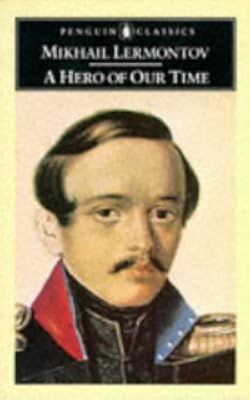
A Hero of Our Time
by Michail Jurjevič Lermontov
There is 1 current discussion about this work.
On This Page
Description
In its adventurous happenings-its abductions, duels, and sexual intrigues-"A Hero of Our Time" looks backward to the tales of Sir Walter Scott and Lord Byron, so beloved by Russian society in the 1820s and '30s. In the character of its protagonist, Pechorin-the archetypal Russian antihero-Lermontov's novel looks forward to the subsequent glories of a Russian literature that it helped, in great measure, to make possible. This edition includes a Translator's Foreword by Vladimir Nabokov, who show more translated the novel in collaboration with his son, Dmitri Nabokov. show lessTags
Recommendations


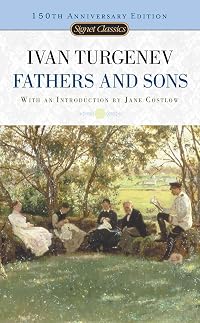
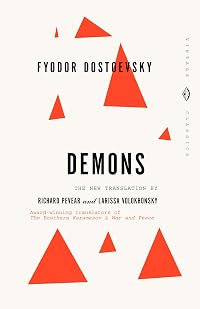
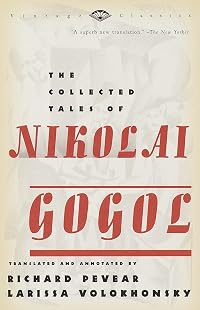

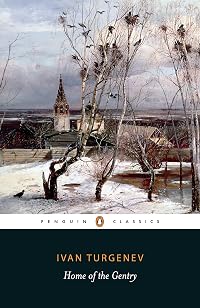

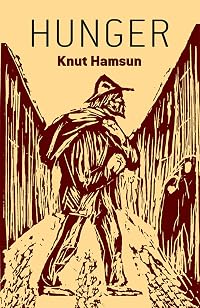
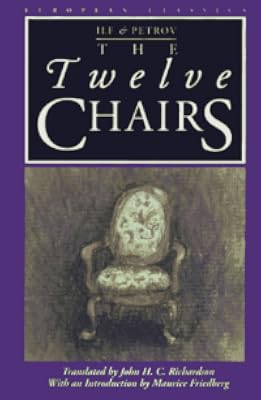
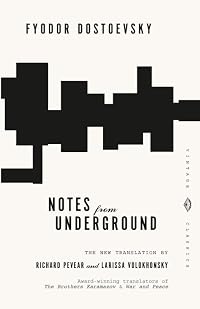
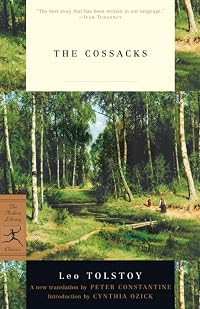

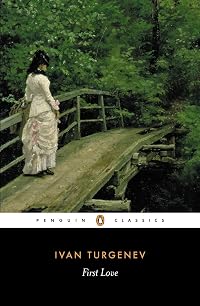





Member Recommendations
Member Reviews
It’s almost painful to read this book. Not because the book is bad but because I want to strangle Grigory Alexandrovich Pechorin, the main character in this book, who is very simply, not a hero – self-centered, arrogant in both an aware and unaware sense, cynical, calculatedly maniacal, and with few cares for the human kind. Pity the many women who have fallen for his fake charms.
This book is written in five major segments, with the first two establishing the then present tense and the last three looking back in time via Pechorin’s journals. The fourth was the longest and most elaborate involving the manipulation of love (Princess Mary), inciting jealousy (ex-lover Vera who is not so-ex), provoking a rival (Grushnitski) that show more results in a duel with obvious consequences. In the first (second longest), Pechorin had Princess Bela kidnapped, enticed to fall in love with him, and promptly loses interest thereafter. In the second, he breaks an old man’s heart, who had believed him to be a friend, not realizing that Pechorin recognizes no friendship. Pechorin lived his life as a game, where his every move is calculated and became bored once his goal is achieved, especially when winning the heart of a pretty lady. In the whole world, only Vera understood him, and even then, he lets her go.
Despite all such negative themes, there is a peculiar magnetic quality to the writing – the scenic Russian lands, the visualization of key characters, and the unavoidable timeless chase between men and women. It’s an odd coincidence that Lermontov himself died from a duel started from a petty disagreement and that months before his death, he composed a prophetic poem about death in dreams. Meanwhile the fifth story in the book speaks of Pechorin’s readiness for death. I somewhat wonder if Pechorin is a version of Lermontov. Write what you know, right?
One last point: Regarding the translators, Vladimir Nabokov and Dmitri Nabokov, I generally love reading the notes, but for the first time, this book’s footnotes are excessive and a distraction. Also, the notes were not always factual but opinionated (107), critical of French literature (“novelistic formula” 57), and they needlessly provided future plot points (100). Despite the abundance of notes, it didn’t provide translation of the French text within the English, which would have been welcomed!
Some quotes:
On the coming of dawn:
“… the dances of stars were interlinked in wondrous patterns above the distant horizon and went out, one by one, while the palish reflection of dawn flooded the dark-violet vault, gradually illuming the steep slopes of the mountains, covered with virgin snow. Right and left, gloomy and mysterious abysses yawned black, and thither glided the mists, whirling and winding, like snakes, down the furrows of nearby cliffs, as if aware and afraid of the approach of day.”
On the sadness of the elderly:
“… It is sad to see a youth lose his fondest hopes and dreams, when the rosy tulle, through which he had looked upon the acts and feelings of men, is torn aside before him, even though there is hope that he will replace his old delusions by new ones, no less fleeting but also no less sweet. But by what can one replace them at Maksim Maksimich’s age? No wonder that the heart hardens and the soul folds up.”
On memory:
“… Every reminder of a past sorrow or joy painfully strikes my soul and extracts from it the same old sounds...”
On the game of love – sickening thought yet artful words:
“… there is boundless delight in the possession of a young, barely unfolded soul! It is like a flower whose best fragrance emanates to meet the first ray of the sun. It should be plucked that very minute and after inhaling one’s fill of it, one should throw it away on the road…”
On death:
“… On the contrary, as far as I am concerned, I always advance with greater courage, when I do not know what awaits me. For nothing worse than death can ever occur; and from death there is no escape!” show less
This book is written in five major segments, with the first two establishing the then present tense and the last three looking back in time via Pechorin’s journals. The fourth was the longest and most elaborate involving the manipulation of love (Princess Mary), inciting jealousy (ex-lover Vera who is not so-ex), provoking a rival (Grushnitski) that show more results in a duel with obvious consequences. In the first (second longest), Pechorin had Princess Bela kidnapped, enticed to fall in love with him, and promptly loses interest thereafter. In the second, he breaks an old man’s heart, who had believed him to be a friend, not realizing that Pechorin recognizes no friendship. Pechorin lived his life as a game, where his every move is calculated and became bored once his goal is achieved, especially when winning the heart of a pretty lady. In the whole world, only Vera understood him, and even then, he lets her go.
Despite all such negative themes, there is a peculiar magnetic quality to the writing – the scenic Russian lands, the visualization of key characters, and the unavoidable timeless chase between men and women. It’s an odd coincidence that Lermontov himself died from a duel started from a petty disagreement and that months before his death, he composed a prophetic poem about death in dreams. Meanwhile the fifth story in the book speaks of Pechorin’s readiness for death. I somewhat wonder if Pechorin is a version of Lermontov. Write what you know, right?
One last point: Regarding the translators, Vladimir Nabokov and Dmitri Nabokov, I generally love reading the notes, but for the first time, this book’s footnotes are excessive and a distraction. Also, the notes were not always factual but opinionated (107), critical of French literature (“novelistic formula” 57), and they needlessly provided future plot points (100). Despite the abundance of notes, it didn’t provide translation of the French text within the English, which would have been welcomed!
Some quotes:
On the coming of dawn:
“… the dances of stars were interlinked in wondrous patterns above the distant horizon and went out, one by one, while the palish reflection of dawn flooded the dark-violet vault, gradually illuming the steep slopes of the mountains, covered with virgin snow. Right and left, gloomy and mysterious abysses yawned black, and thither glided the mists, whirling and winding, like snakes, down the furrows of nearby cliffs, as if aware and afraid of the approach of day.”
On the sadness of the elderly:
“… It is sad to see a youth lose his fondest hopes and dreams, when the rosy tulle, through which he had looked upon the acts and feelings of men, is torn aside before him, even though there is hope that he will replace his old delusions by new ones, no less fleeting but also no less sweet. But by what can one replace them at Maksim Maksimich’s age? No wonder that the heart hardens and the soul folds up.”
On memory:
“… Every reminder of a past sorrow or joy painfully strikes my soul and extracts from it the same old sounds...”
On the game of love – sickening thought yet artful words:
“… there is boundless delight in the possession of a young, barely unfolded soul! It is like a flower whose best fragrance emanates to meet the first ray of the sun. It should be plucked that very minute and after inhaling one’s fill of it, one should throw it away on the road…”
On death:
“… On the contrary, as far as I am concerned, I always advance with greater courage, when I do not know what awaits me. For nothing worse than death can ever occur; and from death there is no escape!” show less
This Russian novel features my favorite Byronic hero ever, the self-aware super jerk Pechorin. Unlike the Byronic heroes of English literature we aren't really told that Pechorin is secretly good underneath. He is a complex man but he never pretends to be anything but selfish and hedonistic. In a series of interconnected short stories that report to be Pechorin's diaries we are introduced to a man who knows his flaws and yet is unconcerned with changing to become a better man. Even as he seems to realize his actions will only hurt him in the end.
A great book for fans of Russian literature or people who love a good anti-hero.
A great book for fans of Russian literature or people who love a good anti-hero.
I know speculation doesn't do anyone any good, but just imagine the kind of work Mikhail Lermontov could have produced had he not been killed at the age of 26. Look at what Russia's greatest 19th century authors were doing when they were 26. Chekhov had just gotten his first newspaper job. Tolstoy had just left the army. Gogol's first draft of Taras Bulba was being ripped to shreds. Dostoevsky hadn't even been exiled to Siberia yet! None of them had come even close to creating a work as brilliant as A Hero of Our Time. It's impossible to say whether or not Lermontov would have reached the heights that the others did, but at least give the guy a chance! Duels are just the worst.
The strength of A Hero of Our Time comes entirely from the show more "hero" himself, Pechorin. While the supporting cast tends to fall into Romantic stereotypes, Pechorin is a brand new character, the first of his kind in Russian literature. He was clearly influential in Russia; I recognized bits and pieces of him in Bazarov from Turgenev's Fathers and Sons as well as Dostoevsky's Underground man.
Nabokov bitched about Lermontov's prose because he was a joyless mope, but I enjoyed it. I much prefer a Romantic narrative to the Romantic characters within that narrative, if that makes any sense, and the novel followed more or less along Romantic lines. It's both a fairly short and fairly quick read, and it's well worth the time.
I don't want to sound like I'm saying the book is just great for a young author, rather than objectively great, but I do think it matters. He might have only lived to be 26, but what he did in those 26 years gave him a social sagacity and insight that escapes most people twice as old. Lermontov's understanding of the importance of perspective, and his subsequent willingness to ignore it through the lens of Pechorin, proves that emotional maturity comes independent of age. Read A Hero of Our Time and recognize this feat for what it is. As Chekhov said, "Still just a boy, and he wrote that!" show less
The strength of A Hero of Our Time comes entirely from the show more "hero" himself, Pechorin. While the supporting cast tends to fall into Romantic stereotypes, Pechorin is a brand new character, the first of his kind in Russian literature. He was clearly influential in Russia; I recognized bits and pieces of him in Bazarov from Turgenev's Fathers and Sons as well as Dostoevsky's Underground man.
Nabokov bitched about Lermontov's prose because he was a joyless mope, but I enjoyed it. I much prefer a Romantic narrative to the Romantic characters within that narrative, if that makes any sense, and the novel followed more or less along Romantic lines. It's both a fairly short and fairly quick read, and it's well worth the time.
I don't want to sound like I'm saying the book is just great for a young author, rather than objectively great, but I do think it matters. He might have only lived to be 26, but what he did in those 26 years gave him a social sagacity and insight that escapes most people twice as old. Lermontov's understanding of the importance of perspective, and his subsequent willingness to ignore it through the lens of Pechorin, proves that emotional maturity comes independent of age. Read A Hero of Our Time and recognize this feat for what it is. As Chekhov said, "Still just a boy, and he wrote that!" show less
Grigory Alexandrovich Pechorin, the main character in this book, is anything but a hero. He is cynical, superficial, and has no lasting attachments to anyone. The boredom he feels with life leads him to manipulate and toy with the passions of those around him, like a cat somewhat distractedly playing with a fatally wounded mouse or bird. The depths to which he does this become particularly apparent in the 4th section of the book, when for kicks he gets a young woman to fall for him, and incites a duel with her rival suitor.
Duels are described in many 19th century books and always fascinate me. In this case, it was of particular interest, knowing that Lermontov himself was killed in a duel at the tender of age of 26 following a trivial show more quarrel with an old schoolfriend. He had survived a duel the year before and apparently the experience wasn’t enough to dissuade him from doing it again. Shades of Pushkin, that giant of Russian literature, who was killed in his 29th(!) duel at age 37 four years earlier, and after having also written of a duel in his masterpiece Eugene Onegin.
Aside from the duel, I also liked the book for its beautiful descriptions of travel in the Caucasus mountains, and for its shocking descriptions of the attitudes towards women at the time, an example of which was a brother binding his beautiful Circassian sister and delivering her to a stranger in exchange for a horse. (yes, wow).
While it’s nice to be transported to a completely foreign way of life, and while the book is essentially providing a negative outlook on the current generation and its “hero” of 1839, it interests me that these sentiments would shortly be echoed by other Russian authors, and are of course echoed by many other authors across all times. And, while I don’t agree with it (I am a believer in the opposite, that the human condition is improving), the following could have been said by a pessimist about today’s generation:
“Whereas we, their miserable descendants, who roam the earth without convictions or pride, without rapture or fear (except for that instinctive dread that compresses our hearts at the thought of the inevitable end), we are no longer capable of great sacrifice, neither for the good of mankind, nor even for our own happiness, because we know its impossibility, and pass with indifference from doubt to doubt, just as our ancestors rushed from one delusion to another. But we, however, do not have either their hopes or even that indefinite, albeit real, rapture that the soul encounters in any struggle with men or with fate.”
The courtship between men and women is shown to be a bit like a game of chess, or perhaps better put, a duel, and I was reminded of the Kerouac line “We turned at a dozen paces, for love is a duel, and looked at each other for the last time” while thinking about that.
In these ways, while the book is a reflection of a completely different time and place, it is also timeless, and that combination always gets me.
The only part I disliked? Nabokov and his son were the translators of this particular edition, and their numbered notes in the back, meant to help the reader along with the text, were seriously annoying. First off, in several places Nabokov gives away parts of what is to come later in the story! Grrr. Secondly, he can’t help but editorialize and criticize. Save it for an appropriate place! He casts his net wide, from various points on Lermontov, e.g. “Throughout the book, he has trouble finding the right words for natural objects” to finding an opportunity to take potshots at Balzac and Tolstoy, e.g. “The allusion is to … a vulgar novelette, ending in a ridiculous melodrama, by the overrated French writer, Balzac”. What was wrong with this guy? He reminds me of an intellectual who is pompous on the outside and insecure on the inside, perhaps because deep down he knew he didn’t have the talent to create the raw, emotional, or spiritual connection with the reader that the giants of the golden age of Russian literature had, that his precise yet sterile prose had risen to fame initially from a book on pedophilia, and is jealous and overly critical of them as a result. Ahem. I digress. I know he is adored by many, including some of my friends, but seriously, those notes bothered me. He and I just don’t seem to mix.
And I’m done now, except for these quotes:
On cruelty:
“…ambition is nothing else than thirst for power, and my main pleasure – which is to subjugate to my will all that surrounds me, and to excite the emotions of love, devotion, and fear in relation to me – is it not the main sign and greatest triumph of power? To be to somebody the cause of sufferings and joys, without having any positive right to it – is this not the sweetest possible nourishment for our pride?”
On difficulty in childhood:
“Everybody read in my face the signs of bad inclinations which were not there, but they were supposed to be there – and so they came into existence. I was modest – they accused me of being crafty; I became secretive. I felt deeply good and evil – nobody caressed me, everybody offended me: I became rancorous. I was gloomy – other children were merry and talkative. I felt myself superior to them – but was considered inferior: I became envious. I was ready to love the whole world – none understood me: and I learned to hate. My colourless youth was spent in a struggle with myself and with the world. Fearing mockery, I buried my best feelings at the bottom of my heart: there they died. I spoke the truth – I was not believed: I began to deceive. … And then in my breast despair was born – not that despair which is cured with the pistol’s muzzle, but cold, helpless despair, concealed under amiability and a good-natured smile.”
On passion:
“She glanced at me intently, shook her head and again became lost in thought: it was evident that she wanted to say something, but she did not know how to begin. Her breast heaved … What would you – a muslin sleeve is little protection, and an electric spark ran from my wrist to hers. Almost all passions start thus! and we often deceive ourselves greatly in thinking that a woman loves us for our physical or moral qualities. Of course, they prepare and incline their hearts for the reception of the sacred fire: nonetheless, it is the first contact that decides the matter.”
On travel, and wanderlust:
“My soul has been impaired by the fashionable world, I have a restless fancy, an insatiable heart; whatever I get is not enough; I become used as easily to sorrow as to delight, and my life becomes more empty day by day; there is only one remedy left for me: to travel. As soon as I can, I shall set out – but, not for Europe, God preserve! I shall go to America, to Arabia, to India – perchance I may die somewhere, on the way!”
Lastly, these descriptions of traveling through the Caucasus:
“We set out; five skinny nags dragged our carriages with difficulty along the road winding up Mount Gud. We followed on foot, chocking the wheels with stones whenever the horses became exhausted; the road seemed to lead up into the sky because, as far as the eye could see, it kept ascending and, finally, it lost itself in the cloud which, since the previous evening, had been resting on the summit of Mount Gud, like a vulture awaiting its prey; the snow crunched underfoot; the air was becoming so rare that it was painful to breathe; the blood kept rushing to our heads every moment, but despite all this, a delighted kind of feeling spread along all my veins, and I felt somehow elated at being so far above the world – a childish feeling, no doubt, but, on getting away from social conventions and coming closer to nature, we cannot help becoming children: all the things that have been acquired are shed by the soul, and it becomes again as it was once, and as it is surely to be again some day.”
“And indeed, the road was dangerous: on the right, there hung, over our heads, masses of snow, ready, it seemed, at the first gust of wind, to come tumbling into the gorge; the narrow road was partly covered by snow which, at some places, gave way underfoot, while in others, it had turned into ice from the action of the sun’s rays and night frosts, so that we had trouble making our way on foot; the horses kept falling: on our left, yawned a deep gulch, where a torrent rolled, now hiding under the icy crust, now leaping family over the black boulders. In two hours we could hardly get around Mt. Cross – a little more than a mile in two hours! Meanwhile, the clouds had settled, it began to hail and to snow heavily; the wind, bursting into the gorges, roared, whistling like Nightingale the Robber, and soon the stone cross disappeared in the mist…” show less
Duels are described in many 19th century books and always fascinate me. In this case, it was of particular interest, knowing that Lermontov himself was killed in a duel at the tender of age of 26 following a trivial show more quarrel with an old schoolfriend. He had survived a duel the year before and apparently the experience wasn’t enough to dissuade him from doing it again. Shades of Pushkin, that giant of Russian literature, who was killed in his 29th(!) duel at age 37 four years earlier, and after having also written of a duel in his masterpiece Eugene Onegin.
Aside from the duel, I also liked the book for its beautiful descriptions of travel in the Caucasus mountains, and for its shocking descriptions of the attitudes towards women at the time, an example of which was a brother binding his beautiful Circassian sister and delivering her to a stranger in exchange for a horse. (yes, wow).
While it’s nice to be transported to a completely foreign way of life, and while the book is essentially providing a negative outlook on the current generation and its “hero” of 1839, it interests me that these sentiments would shortly be echoed by other Russian authors, and are of course echoed by many other authors across all times. And, while I don’t agree with it (I am a believer in the opposite, that the human condition is improving), the following could have been said by a pessimist about today’s generation:
“Whereas we, their miserable descendants, who roam the earth without convictions or pride, without rapture or fear (except for that instinctive dread that compresses our hearts at the thought of the inevitable end), we are no longer capable of great sacrifice, neither for the good of mankind, nor even for our own happiness, because we know its impossibility, and pass with indifference from doubt to doubt, just as our ancestors rushed from one delusion to another. But we, however, do not have either their hopes or even that indefinite, albeit real, rapture that the soul encounters in any struggle with men or with fate.”
The courtship between men and women is shown to be a bit like a game of chess, or perhaps better put, a duel, and I was reminded of the Kerouac line “We turned at a dozen paces, for love is a duel, and looked at each other for the last time” while thinking about that.
In these ways, while the book is a reflection of a completely different time and place, it is also timeless, and that combination always gets me.
The only part I disliked? Nabokov and his son were the translators of this particular edition, and their numbered notes in the back, meant to help the reader along with the text, were seriously annoying. First off, in several places Nabokov gives away parts of what is to come later in the story! Grrr. Secondly, he can’t help but editorialize and criticize. Save it for an appropriate place! He casts his net wide, from various points on Lermontov, e.g. “Throughout the book, he has trouble finding the right words for natural objects” to finding an opportunity to take potshots at Balzac and Tolstoy, e.g. “The allusion is to … a vulgar novelette, ending in a ridiculous melodrama, by the overrated French writer, Balzac”. What was wrong with this guy? He reminds me of an intellectual who is pompous on the outside and insecure on the inside, perhaps because deep down he knew he didn’t have the talent to create the raw, emotional, or spiritual connection with the reader that the giants of the golden age of Russian literature had, that his precise yet sterile prose had risen to fame initially from a book on pedophilia, and is jealous and overly critical of them as a result. Ahem. I digress. I know he is adored by many, including some of my friends, but seriously, those notes bothered me. He and I just don’t seem to mix.
And I’m done now, except for these quotes:
On cruelty:
“…ambition is nothing else than thirst for power, and my main pleasure – which is to subjugate to my will all that surrounds me, and to excite the emotions of love, devotion, and fear in relation to me – is it not the main sign and greatest triumph of power? To be to somebody the cause of sufferings and joys, without having any positive right to it – is this not the sweetest possible nourishment for our pride?”
On difficulty in childhood:
“Everybody read in my face the signs of bad inclinations which were not there, but they were supposed to be there – and so they came into existence. I was modest – they accused me of being crafty; I became secretive. I felt deeply good and evil – nobody caressed me, everybody offended me: I became rancorous. I was gloomy – other children were merry and talkative. I felt myself superior to them – but was considered inferior: I became envious. I was ready to love the whole world – none understood me: and I learned to hate. My colourless youth was spent in a struggle with myself and with the world. Fearing mockery, I buried my best feelings at the bottom of my heart: there they died. I spoke the truth – I was not believed: I began to deceive. … And then in my breast despair was born – not that despair which is cured with the pistol’s muzzle, but cold, helpless despair, concealed under amiability and a good-natured smile.”
On passion:
“She glanced at me intently, shook her head and again became lost in thought: it was evident that she wanted to say something, but she did not know how to begin. Her breast heaved … What would you – a muslin sleeve is little protection, and an electric spark ran from my wrist to hers. Almost all passions start thus! and we often deceive ourselves greatly in thinking that a woman loves us for our physical or moral qualities. Of course, they prepare and incline their hearts for the reception of the sacred fire: nonetheless, it is the first contact that decides the matter.”
On travel, and wanderlust:
“My soul has been impaired by the fashionable world, I have a restless fancy, an insatiable heart; whatever I get is not enough; I become used as easily to sorrow as to delight, and my life becomes more empty day by day; there is only one remedy left for me: to travel. As soon as I can, I shall set out – but, not for Europe, God preserve! I shall go to America, to Arabia, to India – perchance I may die somewhere, on the way!”
Lastly, these descriptions of traveling through the Caucasus:
“We set out; five skinny nags dragged our carriages with difficulty along the road winding up Mount Gud. We followed on foot, chocking the wheels with stones whenever the horses became exhausted; the road seemed to lead up into the sky because, as far as the eye could see, it kept ascending and, finally, it lost itself in the cloud which, since the previous evening, had been resting on the summit of Mount Gud, like a vulture awaiting its prey; the snow crunched underfoot; the air was becoming so rare that it was painful to breathe; the blood kept rushing to our heads every moment, but despite all this, a delighted kind of feeling spread along all my veins, and I felt somehow elated at being so far above the world – a childish feeling, no doubt, but, on getting away from social conventions and coming closer to nature, we cannot help becoming children: all the things that have been acquired are shed by the soul, and it becomes again as it was once, and as it is surely to be again some day.”
“And indeed, the road was dangerous: on the right, there hung, over our heads, masses of snow, ready, it seemed, at the first gust of wind, to come tumbling into the gorge; the narrow road was partly covered by snow which, at some places, gave way underfoot, while in others, it had turned into ice from the action of the sun’s rays and night frosts, so that we had trouble making our way on foot; the horses kept falling: on our left, yawned a deep gulch, where a torrent rolled, now hiding under the icy crust, now leaping family over the black boulders. In two hours we could hardly get around Mt. Cross – a little more than a mile in two hours! Meanwhile, the clouds had settled, it began to hail and to snow heavily; the wind, bursting into the gorges, roared, whistling like Nightingale the Robber, and soon the stone cross disappeared in the mist…” show less
Wow I am astounded! Doesn't matter when written, it feels modern in its literary flow and complex structure that weaves together the voices of the editor and the subject. The five chapters are disparate episodes that cut back and forward in time to build up a sense of the protagonist. Pechorin is the quintessential Russian antihero, a man who is not beholden to society's norms and mores. He is a bastard in many ways, who is easily bored and toys with women, but gives an honest appraisal of his own actions and feelings. "I like to doubt everything - and that cast of mind doesn't prevent one from having a firm character. On the contrary - as far as I'm concerned I always go forward the more boldly when I don't know what awaits me. After show more all, the worst that can happen is death, and that's something you can't avoid!". The environment, conflicts and peoples of the Caucasus are interestingly depicted, and there is also a magical fable like quality to Taman, which on its own is surely one of the best short stories of all time. show less
The shade of Byron, or perhaps more accurately of the Byronic hero (that petulant and brooding vampiric pretty boy that has fascinated us since the days of the famous celebrity-poet), looms large, though in a decidedly ironic fashion, in Lermontov’s _A Hero of Our Time_. The titular ‘hero’ Grigory Alexandrovich Pechorin, seen both from the outside and from within, displays from every angle the nearly perfect vision of the ‘tragic’ Byronic douche bag. From his ability to sway any woman with little more than a glance from his deep, sorrowful, mesmeric eyes and a healthy dose of the cold shoulder, to his barely suppressed glee at the ease with which he can manipulate the feelings and actions of those he sees as his inferiors show more (everyone really) with little more than a bon mot or roll of the eyes, and his long internal monologues bemoaning the tragic fate that has unfairly made him a pariah in the eyes of the world Pechorin is an exemplar of the Byronic template. Presented as several linked stories, starting out with a frame narrative that lets us see Pechorin from the outside which then moves to the personal journal of the man himself, the stories of Pechorin’s life as relayed by Lermontov are dripping with bitterness and irony.
There is a playful, maybe even precious, level of self-awareness in this novel as Lermontov gleefully fills his protagonist with all of the foibles and features of the self-loving (and loathing) Byronic hero. Pechorin is also often used as a mouthpiece for the social and intellectual issues of the day that Lermontov wants to bring front and centre. At times he displays an almost post-modern regret for the lost innocence of mankind and his earlier beliefs:
Ultimately when considering this novel it’s important to realize that, true to its title, it’s all about Pechorin . Whether considering the first part of the novel in which he is viewed with an almost hero-worshipping fascination by the old soldier Maksim Maksimych who relays his reminiscences to our unnamed narrator, or we read the words of the man himself in his private journals, Pechorin truly is (in his own mind at least) a hero of his time. It’s fair to say that Pechorin is a keen observer of the faults and weaknesses of others, however he pairs this with delusions of self-awareness that are monumental in their erroneousness. Indeed Lermontov playfully has his hero allude (sneeringly of course) to the manner in which an adversary acts as though his “aim is to make himself the hero of a novel. He has so often endeavoured to convince others that he is being created not for this world and doomed to certain mysterious sufferings…” This statement, once you get to know Pechorin, displays Lermontov’s liberal use of irony which is nearly dripping from the page. Of course Pechorin is also a model roué whose motto comes out as he reflects on the type of women he has been able to seduce and destroy: “I must confess that, in fact, I do not love women who possess strength of character. What business have they with such a thing?” Everything and everyone is a tool to be used, most especially to divert him and relieve his soul from its monumental ennui and dissatisfaction with daily life. He is a man whose philosophy seems to hearken back to the teaching of Machiavelli and perhaps even looks forward to those to come of Nietszche:
I enjoyed this novel, primarily for its delicious irony, and was shocked to find that upon its release it was apparently taken as an honest tribute to the Byronic rake, so much so in fact that the author felt obliged to spell things out in a preface to the second edition. In it the author described the reading public of Russia as “like a simple-minded person from the country who, chancing to hear a conversation between two diplomatists belonging to hostile courts, comes away with the conviction that each of them has been deceiving his Government in the interest of a most affectionate private friendship”. Meow. I guess irony wasn’t in vogue then, since so far as I was concerned you couldn’t miss it. Sadly it might be said that Pechorin is as much a hero of our time as he was in his own. show less
There is a playful, maybe even precious, level of self-awareness in this novel as Lermontov gleefully fills his protagonist with all of the foibles and features of the self-loving (and loathing) Byronic hero. Pechorin is also often used as a mouthpiece for the social and intellectual issues of the day that Lermontov wants to bring front and centre. At times he displays an almost post-modern regret for the lost innocence of mankind and his earlier beliefs:
…And we, their miserable descendants, roaming over the earth, without faith, without pride, without enjoyment, and without terror – except that involuntary awe which makes the heart shrink at the thought of the inevitable end – we are no longer capable of great sacrifices…because we know the impossibility of such happiness…[and] we pass from doubt to doubt…At others he spouts typically romantic paens to the grandeur of nature, the tininess of mankind and the greatness of his own spirit destined to be crushed by life and fate.
Ultimately when considering this novel it’s important to realize that, true to its title, it’s all about Pechorin . Whether considering the first part of the novel in which he is viewed with an almost hero-worshipping fascination by the old soldier Maksim Maksimych who relays his reminiscences to our unnamed narrator, or we read the words of the man himself in his private journals, Pechorin truly is (in his own mind at least) a hero of his time. It’s fair to say that Pechorin is a keen observer of the faults and weaknesses of others, however he pairs this with delusions of self-awareness that are monumental in their erroneousness. Indeed Lermontov playfully has his hero allude (sneeringly of course) to the manner in which an adversary acts as though his “aim is to make himself the hero of a novel. He has so often endeavoured to convince others that he is being created not for this world and doomed to certain mysterious sufferings…” This statement, once you get to know Pechorin, displays Lermontov’s liberal use of irony which is nearly dripping from the page. Of course Pechorin is also a model roué whose motto comes out as he reflects on the type of women he has been able to seduce and destroy: “I must confess that, in fact, I do not love women who possess strength of character. What business have they with such a thing?” Everything and everyone is a tool to be used, most especially to divert him and relieve his soul from its monumental ennui and dissatisfaction with daily life. He is a man whose philosophy seems to hearken back to the teaching of Machiavelli and perhaps even looks forward to those to come of Nietszche:
…ambition is nothing more nor less than a thirst for power, and my chief pleasure is to make everything that surrounds me subject to my will. To arouse the feeling of love, devotion and awe towards oneself – is not that the first sign, and the greatest triumph, of power?After having lived this philosophy to the full and having destroyed, or nearly destroyed, the lives of numerous ‘friends’ and ‘lovers’ and things finally start to go sour Pechorin even has the audacity to wonder “Why do they all hate me?” There but for the grace of God.
I enjoyed this novel, primarily for its delicious irony, and was shocked to find that upon its release it was apparently taken as an honest tribute to the Byronic rake, so much so in fact that the author felt obliged to spell things out in a preface to the second edition. In it the author described the reading public of Russia as “like a simple-minded person from the country who, chancing to hear a conversation between two diplomatists belonging to hostile courts, comes away with the conviction that each of them has been deceiving his Government in the interest of a most affectionate private friendship”. Meow. I guess irony wasn’t in vogue then, since so far as I was concerned you couldn’t miss it. Sadly it might be said that Pechorin is as much a hero of our time as he was in his own. show less
Pushkin was killed in a duel at 37. Lermontov, a fairly immature (and wealthy) poet himself, responded with an angry poem condemning the society that supposedly pushed Pushkin to his death—a fate Lermontov himself would meet at the age of 26, also in a duel. It’s worth noting parenthetically that Lermontov’s work is notable for its protagonist as well as for Lermontov’s lyrical descriptions of the Caucasus Mountains where the stories are set. The Czar had effectively banished him there for his poem about Pushkin’s death. Lermontov’s anti-hero in this work, Pechorin, is a classic illustration of the “superfluous man,” a type created by Pushkin and later popularized by Turgenev. Pechorin is a cynical, arrogant show more egotist…unattractive at best. A Hero Of Our Time is his story, told in five parts, out of chronological order. The first story introduces Lermontov (the narrator), who is traveling through the Caucasus and meets Maksim Maksimych. This new friend recounts a story about his acquaintance, Pechorin. That narrative tells of Pechorin’s kidnapping and seducing a young local girl and the consequence of these acts. The next story introduces Pechorin in person, making clear just how unattractive most of his traits are. The last three stories consist of excerpts from Pechorin’s journals: “Taman” (Pechorin runs afoul of a band of smugglers); “Princess Mary,” a very long section about Pechorin’s courtship of a woman undertaken at the request of a another woman whom he actually loves, a story that ends tragically for all; and “The Fatalist,” a very short story about destiny and death. It’s hard not to be impressed by these stories which helped cement Lermontov’s place in the Russian pantheon. (Nabokov’s translation, which I read, was the first English version and it contains an interesting foreword; I also have a collection of Lermontov’s other works, including poetry, and the introduction by that translator (Guy Daniels) disagrees vigorously and at length with Nabokov’s interpretations. I suspect both are overstating their case, but the disagreement is enjoyable to behold!) show less
Members
- Recently Added By
Lists

1001 Books You Must Read Before You Die
1,448 works; 1,137 members

Russian Literature
184 works; 35 members

Best of World Literature
437 works; 52 members

Best Gothic Fiction
110 works; 31 members

Favourite 19th century fiction
257 works; 62 members

Favourite Books
1,820 works; 308 members

Books about Russia and the former USSR
67 works; 12 members

Blue Pyramid 1,276 Best Books of All Time
1,248 works; 32 members

Short and Sweet
246 works; 24 members

Best Antiheroes and Antiheroines
119 works; 7 members

Lamont's Hundred Best Novels (1947)
100 works; 4 members
The 150 Greatest Novels of All Time
150 works; 6 members

DigitalDreamDoor top 300
300 works; 4 members
My Favorite Russian Novels
37 works; 2 members
Harold Bloom - The Western Canon: C. The Democratic Age
336 works; 15 members

A Reading List
100 works; 3 members

Further Russian Reading
19 works; 3 members

Edward Gorey Covers
150 works; 8 members

All Things Russia
459 works; 11 members

.
396 works; 1 member
Talk Discussions
Current Discussions
2nd edn Finalist discussion: A Hero of Our Time in Consensus Press (October 2025)
Author Information

One of Russia's greatest nineteenth-century poets, Lermontov was at first an officer in an elite Guards regiment. Because of the views he expressed in a poem written on the death of Pushkin in 1837, he was arrested, tried, and transferred to the Caucasus. The poem, a passionate condemnation of the St. Petersburg elite for inciting Pushkin's show more ill-fated confrontation with D'Anthes, brought Lermontov instant fame. He returned to the capital a year later and began to publish regularly; two volumes of poems and the novel A Hero of Our Time appeared in 1840. Next year, as punishment for a duel, he was sent again to a line regiment in the Caucasus, where he distinguished himself in battle. In July 1841 he was killed in his last duel, the consequence of his own quarrelsome conduct. Lermontov was strongly influenced by Byron and Schiller, writing striking confessional poems that presented him in typically romantic defiance toward society. In his final years, he wrote more reflective and philosophical lyrics, as well as longer narrative poems, also derived from Byronic models. The most important of these is The Demon (1839), on which he worked for a number of years. The story of a fallen angel's love for a woman, it has provided Russian literature and art with a powerful archetype. Besides poetry, Lermontov also wrote plays and fiction, of which A Hero of Our Time is the most important. Made up of several tales by different narrators, the novel centers on Pechorin---a seminal example of the egotistical nineteenth-century "superfluous man," a specifically Russian derivative of the Byronic hero. Both this protagonist and Lermontov's complex narrative technique gave a powerful stimulus to Russian realist fiction. (Bowker Author Biography) show less
Some Editions
Awards and Honors
Distinctions
Notable Lists
Series
Belongs to Publisher Series
Work Relationships
Common Knowledge
- Canonical title
- A Hero of Our Time
- Original title
- Герой нашего времени
- Alternate titles*
- Un eroe dei nostri tempi
- Original publication date
- 1838-1840
- People/Characters
- Pechorin, Grigoriy Aleksandrovich; Lermontov; Bella; Russalka; Princess Mary; Vera
- Important places
- Caucasus Mountains; Russia
- First words
- I was travelling post from Tiflis.
- Quotations
- There's a gang of them formed, armed with lorgnettes, and they look menacing.
My best pleasure is to subject everyone around me to my will, to arouse fellings of love, devotion and fear in me – is this not the first sign and the greatest triumph of power? - Last words
- (Click to show. Warning: May contain spoilers.)I couldn't get any more out of him; he doesn't like metaphysical debates in general
- Original language
- Russian
*Some information comes from Common Knowledge in other languages. Click "Edit" for more information.
Classifications
- Genres
- Fiction and Literature, General Fiction
- DDC/MDS
- 891.733 — Literature & rhetoric Literatures of other languages East Indo-European and Celtic literatures Russian and East Slavic languages Russian fiction 1800–1917
- LCC
- PG3337 .L4 .G4133 — Language and Literature Slavic languages and literatures. Baltic languages. Albanian language Slavic. Baltic. Albanian Russian literature Individual authors and works 1800-1870
- BISAC
Statistics
- Members
- 4,259
- Popularity
- 3,583
- Reviews
- 72
- Rating
- (3.92)
- Languages
- 21 — Catalan, Danish, Dutch, English, Estonian, Finnish, French, German, Galician, Hebrew, Hungarian, Italian, Multiple languages, Norwegian (Bokmål), Polish, Portuguese, Romanian, Russian, Spanish, Swedish, Turkish
- Media
- Paper, Audiobook, Ebook
- ISBNs
- 215
- ASINs
- 76