On This Page
Description
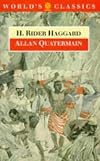
The character Allan Quatermain is the hero of H. Rider Haggard's 1885 novel King Solomon's Mines. In this adventure novel named after him, Quatermain longs for a return to the wilderness after losing his son. He talks a number of companions into joining him and they journey inland from Africa's east coast, where they are attacked by Masai warriors..
Tags
Recommendations
















Member Reviews
I always imagine that the novels of Sir Rider Haggard are a kind of literary precursor of the Indiana Jones films. In fact, with Robert Louis Stevenson, Haggard was part of the literary reaction against domestic realism that has been called a romance revival. While Stevenson listened to the throbbing drums in the South Seas, Haggard painted a romantic picture of valiant Victorian heroes and innocent, blonde maidens threatened by hordes of un-Christian and blood-thirsty Africans.
King Solomon’s Mines (1885), She (1887) and Allan Quatermain (1887) are African adventure stories. It is a bit strange that while King Solomon’s Mines is clearly situated in South Africa, with frequent references to Zulus, the Transvaal and Boers, Allan show more Quatermain is supposedly set in Kenya, but the description is still mostly like South Africa, and the introduction of the Masai is clearly through literary sources. In fact, at the end of the novel Haggard includes a page of "Authorities" to fend of criticism for plagiarism.
Unlike King Solomon’s Mines and She, which presented a fairly unified story, Allan Quatermain consists of two story elements which are only loosely connected as they happen along their journey. As in later Victorian stories, such as Conan Doyle's The lost world the lost civilization is discovered after travelling through a screening setting.
The reason we still read the novels of Sir Rider Haggard is that they were not as offensive about white supremacy and denigrating about the native Africans as some of his contemporaries. One may wonder how long we can bear them in the literary canon before they are scrubbed as products of the colonial mind and white supremacy. However, in the meantime they are highly entertaining, romantics adventure stories. show less
King Solomon’s Mines (1885), She (1887) and Allan Quatermain (1887) are African adventure stories. It is a bit strange that while King Solomon’s Mines is clearly situated in South Africa, with frequent references to Zulus, the Transvaal and Boers, Allan show more Quatermain is supposedly set in Kenya, but the description is still mostly like South Africa, and the introduction of the Masai is clearly through literary sources. In fact, at the end of the novel Haggard includes a page of "Authorities" to fend of criticism for plagiarism.
Unlike King Solomon’s Mines and She, which presented a fairly unified story, Allan Quatermain consists of two story elements which are only loosely connected as they happen along their journey. As in later Victorian stories, such as Conan Doyle's The lost world the lost civilization is discovered after travelling through a screening setting.
The reason we still read the novels of Sir Rider Haggard is that they were not as offensive about white supremacy and denigrating about the native Africans as some of his contemporaries. One may wonder how long we can bear them in the literary canon before they are scrubbed as products of the colonial mind and white supremacy. However, in the meantime they are highly entertaining, romantics adventure stories. show less
The sequel to King Solomon's Mines, this novel offers an adventure of similar quality, and the worst thing I can say about it is that it's perhaps a bit too similar to the first. No, there are no Indiana-Jones-like exploration of an archaeological site with hidden treasure, but there's a similar hidden civilization, a big battle (visits by Quatermain & Co always seem to bring havoc) and it's another adventure with the same main characters: Allan Quatermain, Sir Henry Curtis and Captain Good, accompanied by a different but equally noble and brave indigenous warrior.
I was sorry that the story revealed that Harry, Allan's beloved son, had died, dealing our hero a strong blow.
I quite enjoy Quatermain's narration, his philosophical show more reflections and how his modesty leads him to present his accomplishments as lesser than they really are. Goodbye Allan! show less
I was sorry that the story revealed that Harry, Allan's beloved son, had died, dealing our hero a strong blow.
I quite enjoy Quatermain's narration, his philosophical show more reflections and how his modesty leads him to present his accomplishments as lesser than they really are. Goodbye Allan! show less
A pleasant diversion. I could have done without some of the "Great White Hunter" crap, but otherwise a nice little adventure - sometimes predictable, but still entertaining. The characters were colorful and often had more depth than I expected. But waaaayyyyyy too talky much of the time. The back story was never incorporated into the action; it was presented in tedious detail separately. Not going to read any more of this series.
Having read King solomons mines as a kid i hated Haggard and Quartermain, but i eventually gave She a go and found it surprisingly good. So i decided to give another Quartermain story a try and pick this because i heard he dies in it so thought i'd at least have a happy ending if nothing else. So thoughts.. well it ain't bad at all. Trying hard to remember the details now though, read it some months back. A number of african adventure incidents before they finally reach a lost civilisation then a war breaks out for some reason but i do recall thinking it was quite decent and now i can enjoy my league of extraordinary comics without my old hatred of quartermain spoiling things.
The sequel to the much more famous King Solomon's Mines. Very much in the same vein.
Alan Quatermain - the 'hero' from KSM, is bored. He's been back in civilised and genteel england for a few years. Unfortunetly his son much loved son dies in the intervening period - from smallpox - And he concieves a yearning to return to the wilderness of Africa and the udulation of the natives. Fortunetly his old friends the irrepresible Cook and Curtis also feel similarly inclined. Quartermain remembers an old tale told to him of a tribe of "white" natives who live far out in central africa, and this seems like a suitable target for them to aim for.
Hence various adventures occur and a chance meeting with an old friend the Zulu Umslopogaas provides show more the necessary background to help ensure that the White men and the natives are suitably contrasted - very much a product of the era it was written in. There are the usual diversions with pretty women, scheming priests and just about everything you would expect from an adventure story, including of course graphically bloody massacres, and heoric deeds. Many of the trials they undergo seem to be quite realistic - porters deserting a group was a common hazard for example. The river through the mountain wasn't actually too unbelivable, although the gas jet was just bizarre.
In today's world it is of course horrendously stereotypical and often racist, but at the time it was written, it must have been close to how Africa was percieved, a mysterious continent far away, full of savages and strange possabilities. Only Alan Quatermain himself gets drawn into the story, even his closest aquaintances remain very much 2D shadows to accompany him, but we do get quit a bit of insight into Alan's view of events and the people around him, which is often dryly amusing. The pacing is excellant, and the story rushes along from one place to the next with suitable pauses for the characters and the reader to refresh themselves. There is some trully obvious foreshadowing, but the account is supposed to have been diary entries from AQ written after his travels, so in some respects this is excuseable.
Overal, enjoyable, not as thrilling as KSMs, but another quick fun read highlighting the social differences between the 1880s and today.
.............................................. show less
Alan Quatermain - the 'hero' from KSM, is bored. He's been back in civilised and genteel england for a few years. Unfortunetly his son much loved son dies in the intervening period - from smallpox - And he concieves a yearning to return to the wilderness of Africa and the udulation of the natives. Fortunetly his old friends the irrepresible Cook and Curtis also feel similarly inclined. Quartermain remembers an old tale told to him of a tribe of "white" natives who live far out in central africa, and this seems like a suitable target for them to aim for.
Hence various adventures occur and a chance meeting with an old friend the Zulu Umslopogaas provides show more the necessary background to help ensure that the White men and the natives are suitably contrasted - very much a product of the era it was written in. There are the usual diversions with pretty women, scheming priests and just about everything you would expect from an adventure story, including of course graphically bloody massacres, and heoric deeds. Many of the trials they undergo seem to be quite realistic - porters deserting a group was a common hazard for example. The river through the mountain wasn't actually too unbelivable, although the gas jet was just bizarre.
In today's world it is of course horrendously stereotypical and often racist, but at the time it was written, it must have been close to how Africa was percieved, a mysterious continent far away, full of savages and strange possabilities. Only Alan Quatermain himself gets drawn into the story, even his closest aquaintances remain very much 2D shadows to accompany him, but we do get quit a bit of insight into Alan's view of events and the people around him, which is often dryly amusing. The pacing is excellant, and the story rushes along from one place to the next with suitable pauses for the characters and the reader to refresh themselves. There is some trully obvious foreshadowing, but the account is supposed to have been diary entries from AQ written after his travels, so in some respects this is excuseable.
Overal, enjoyable, not as thrilling as KSMs, but another quick fun read highlighting the social differences between the 1880s and today.
.............................................. show less
Like Turtledove, Haggard is not a stylist, but this is a good sequel to "King Solomon's Mines". If you like books set just off the edge of the map, then this is a ripping yarn.
This is a sequel to King Solomon's Mines. I enjoyed the first half of King Solomon rather much, so downloaded this book before I realized that King Solomon had a number of blemishes. This has some as well. In fact, I found it rather tedious after a while.
This is an adventure story of some British, Victorian adventurers blundering around in Africa. They get swept up in an underground river and end up in an isolated kingdom of white people, deep within the heart of Africa. They get involved in the religious and political intrigues of the whites, have battles and so forth. It's not bad, just got a bit tedious.
To his credit, Haggard has a number of interesting observations on the human condition. So, if I weren't bored with wars, killing, show more and white racism, I might consider reading more of this works. show less
This is an adventure story of some British, Victorian adventurers blundering around in Africa. They get swept up in an underground river and end up in an isolated kingdom of white people, deep within the heart of Africa. They get involved in the religious and political intrigues of the whites, have battles and so forth. It's not bad, just got a bit tedious.
To his credit, Haggard has a number of interesting observations on the human condition. So, if I weren't bored with wars, killing, show more and white racism, I might consider reading more of this works. show less
Members
- Recently Added By
Lists

Folio Society
831 works; 53 members

League of Extraordinary Gentlemen Read-athon
8 works; 1 member

Stories set on African soil
183 works; 2 members
Author Information

284+ Works 18,907 Members
Sir Henry Rider Haggard (1856-1925) is best remembered for his 34 adventure fantasy novels set in exotic locations. As a child, Haggard, whose father was an English barrister, was considered dim-witted and was inclined to daydreaming. His parents ended his formal education when he was seventeen, and he was sent to work in South Africa, where his show more imagination was inspired by the people, animals, and jungle. He became close friends with authors Rudyard Kipling and Andrew Lang. Haggard's most popular books are King Solomon's Mines (1886) and She (1887). He also wrote short stories, as well as nonfiction on topics such as gardening, English farming, and rural life, interests which led to duties on government commissions concerned with land maintenance. For his literary contributions and his government service, Haggard was knighted in 1912. Several of Haggard's novels have been filmed. She was filmed in 1965, starring Ursula Andress. King Solomon's Mines was filmed with Stewart Granger and Deborah Kerr in 1950, and again with Richard Chamberlain and Sharon Stone in 1985. Also, the novel Allan Quatermain was filmed as Allan Quatermain and the Lost City of Gold with Richard Chamberlain and Sharon Stone in 1986. (Bowker Author Biography) show less
Some Editions
Awards and Honors
Series

Belongs to Publisher Series
Work Relationships
Is contained in
H. RIDER HAGGARD Ultimate Collection: 60 Works in One Volume (Allan Quatermain Series, Ayesha Series, Lost World Novels, Short Stories, Essays & Autobiography): ... The People of the Mist, The Ghost Kings… by H. Rider Haggard
Has the adaptation
Common Knowledge
- Canonical title
- Allan Quatermain
- Original title
- Allan Quatermain
- Original publication date
- 1887
- People/Characters
- Allan Quatermain; Nyleptha; Sorais; Umslopogaas; Sir Henry Curtis; Captain John Good
- Important places
- Africa; England, UK; Lamu, Kenya
- Related movies
- Allan Quatermain (1919 | IMDb); King Solomon's Treasure (1977 | IMDb); Allan Quatermain and the Lost City of Gold (1986 | IMDb)
- Dedication
- I inscribe this book of adventure to my son Arthur John Rider Haggard in the hope that in days to come he, and many other boys whom I shall never know, may, in the acts and thoughts of Alan Qatermain and his companions, as he... (show all)rein recorded, find something to help him and them to reach to what, with Sir henry Curtis, I hold to be the highest rank whereto we can attain - the state and dignity of English gentlemen.
- First words
- 'I have just buried my boy, my poor handsome boy of whom I was so proud, and my heart is broken.
- Last words
- (Click to show. Warning: May contain spoilers.)The letters which my brother Henry says he is sending with the packet of manuscript have never arrived, so I presume that they are lost or destroyed.
Classifications
Statistics
- Members
- 904
- Popularity
- 29,700
- Reviews
- 17
- Rating
- (3.63)
- Languages
- 12 — Danish, English, Estonian, Finnish, French, German, Hungarian, Italian, Portuguese, Russian, Spanish, Swedish
- Media
- Paper, Audiobook, Ebook
- ISBNs
- 146
- ASINs
- 48