
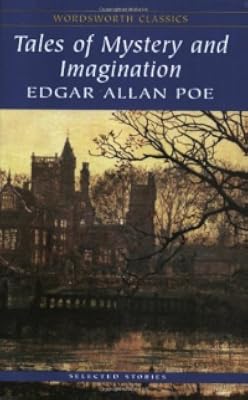
Tales of Mystery and Imagination
by Edgar Allan Poe
On This Page
Description
According to even his most forgiving biographers, Edgar Allan Poe (1809-49) was a difficult man. Arrested whilst touring Europe, and expelled from the United States Military Academy at West Point, he tended to lose both work and friends through drunkenness. Best known for his goriest stories, Poe is often presented to the modern reader as a writer of horror. However, this collection, published in 1852, offers a broader selection of his work. It includes one of his first pieces of detective show more fiction, 'The Gold-Beetle', resulting from his preoccupation with cryptography; 'A Descent into the Maelström', an early example of science fiction; the mesmeric verse of 'The Raven'; and some of his lesser-known love poetry. A pioneer of modern genre fiction, Poe remains important and influential in the American literary canon. This lavishly illustrated collection represents an excellent introduction to his work. show lessTags
Recommendations



















Member Recommendations
Member Reviews
"An artist is usually a damned liar, but his art, if it be art, will tell you the truth of his day." D.H. Lawrence.
Burying people alive, ghosts, macabre deaths of usually delicate and young women, dark magic, effects of inebriation and hallucination, torture, whirlpools sucking people out of their time, fatal plagues, torture, abnormal psychological states, obsessional behaviors... William Blake in prose.
If D.H. Lawrence was any close to right about his predicament I wouldn't have liked to be in Mr.Poe's skin, such horrors!
That Poe lead a tormented and dysfunctional life is no secret. Haunted by the death of her mother when he was barely a toddler and later by the long illness and ultimate death of the love of his life(his cousin show more Virginia)whom she married when she was only thirteen, Poe struggled to keep afloat between the feelings of abandonment and loss and his growing ill-health and addictions which eventually killed him in mysterious circumstances at the age of 40.
Whether this gloomy life served him as inspiration or he released his pain into his work, the extremeness of his imaginative creations managed to capture attention, if not acceptance.
The sickness-the nausea-
The pitiless pain-
Have ceased, with the fever
That maddened my brain-
With the fever called "Living"
That burned in my brain.
Considered the father of the short story, Poe manages to control the soul of the reader, nothing intervenes or distracts once you are engulfed in one of his curious and terrifying tales, you feel pulled down by an inexplicable and exotic sort of nostalgia which catches at your breath and prevents you from stopping to read. But make no mistake, Poe plays with you, giving you hope in a futile attempt to search for the truth and offer a plausible explanation for the unaccountable, even though you know deep inside that the end will be doomed from the start.
His literary quality is irrefutable, he borrows from the European Gothic tradition and adds elements of detective stories, creating a new register which seeks for the horrendous truth, for the paincuts into your soul, although sometimes a rare kind of beauty oozes from the text, whether conscious or unconsciously I can't say:
Then silence, stillness, and night were the universe
But mainly, Poe appears as a ruthless, crude and pessimistic voice who wants to put order amid the chaos, who wants to explain the inexplicable to elevate the name of the artist; offering an alternative to the newly born optimism, complacency and materialism of his age, and asking for nothing in return. He didn't seek for approval and often had to endure rebuke, few of his contemporaries valued his work at the time and being considered an oddball he was banned from society (or he excluded himself willingly).
It is through the anguish and torment expressed in his poems and short stories that it is plausible to imagine his existence rather miserable and that he suffered from a precariously balanced state of mind. But then, once again, I ask myself the same question which always arises when I try to link the real life of a writer with his work, was it his eccentricity that made his works so special? Were they the product of a genius or a deranged mind ? Or both?
The truth is, I am heartily sick of this life, and of the nineteenth century in general. I am convinced that everything is going wrong. Besides, I am anxious to know who will be President in 2045. As soon, therefore, as I shave and swallow a cup of coffee, I shall step over to Ponnonner's and get embalmed for a couple of hundred years.
In any case, although his haunted mind offered no respite, Poe's lucid writing managed to push the scales of reality and redefine the artistic world of beauty and lyricism towards a new daring approach where the probability of terror and darkness prevailed and where the motto could be summed up as to deny what is, and explain what is not .
As it usual happens in real life, neither black nor white, just a blurred smudge of indistinct grey. show less
Burying people alive, ghosts, macabre deaths of usually delicate and young women, dark magic, effects of inebriation and hallucination, torture, whirlpools sucking people out of their time, fatal plagues, torture, abnormal psychological states, obsessional behaviors... William Blake in prose.
If D.H. Lawrence was any close to right about his predicament I wouldn't have liked to be in Mr.Poe's skin, such horrors!
That Poe lead a tormented and dysfunctional life is no secret. Haunted by the death of her mother when he was barely a toddler and later by the long illness and ultimate death of the love of his life(his cousin show more Virginia)whom she married when she was only thirteen, Poe struggled to keep afloat between the feelings of abandonment and loss and his growing ill-health and addictions which eventually killed him in mysterious circumstances at the age of 40.
Whether this gloomy life served him as inspiration or he released his pain into his work, the extremeness of his imaginative creations managed to capture attention, if not acceptance.
The sickness-the nausea-
The pitiless pain-
Have ceased, with the fever
That maddened my brain-
With the fever called "Living"
That burned in my brain.
Considered the father of the short story, Poe manages to control the soul of the reader, nothing intervenes or distracts once you are engulfed in one of his curious and terrifying tales, you feel pulled down by an inexplicable and exotic sort of nostalgia which catches at your breath and prevents you from stopping to read. But make no mistake, Poe plays with you, giving you hope in a futile attempt to search for the truth and offer a plausible explanation for the unaccountable, even though you know deep inside that the end will be doomed from the start.
His literary quality is irrefutable, he borrows from the European Gothic tradition and adds elements of detective stories, creating a new register which seeks for the horrendous truth, for the paincuts into your soul, although sometimes a rare kind of beauty oozes from the text, whether conscious or unconsciously I can't say:
Then silence, stillness, and night were the universe
But mainly, Poe appears as a ruthless, crude and pessimistic voice who wants to put order amid the chaos, who wants to explain the inexplicable to elevate the name of the artist; offering an alternative to the newly born optimism, complacency and materialism of his age, and asking for nothing in return. He didn't seek for approval and often had to endure rebuke, few of his contemporaries valued his work at the time and being considered an oddball he was banned from society (or he excluded himself willingly).
It is through the anguish and torment expressed in his poems and short stories that it is plausible to imagine his existence rather miserable and that he suffered from a precariously balanced state of mind. But then, once again, I ask myself the same question which always arises when I try to link the real life of a writer with his work, was it his eccentricity that made his works so special? Were they the product of a genius or a deranged mind ? Or both?
The truth is, I am heartily sick of this life, and of the nineteenth century in general. I am convinced that everything is going wrong. Besides, I am anxious to know who will be President in 2045. As soon, therefore, as I shave and swallow a cup of coffee, I shall step over to Ponnonner's and get embalmed for a couple of hundred years.
In any case, although his haunted mind offered no respite, Poe's lucid writing managed to push the scales of reality and redefine the artistic world of beauty and lyricism towards a new daring approach where the probability of terror and darkness prevailed and where the motto could be summed up as to deny what is, and explain what is not .
As it usual happens in real life, neither black nor white, just a blurred smudge of indistinct grey. show less
Harry Clarke's vivid and disturbing illustrations, reminiscent of the work of Aubrey Beardsley, bring hideous life to Poe's stories, and I find myself returning to both the stories and the illustrations again and again.
My parents had a copy of the original version of this book, published by Tudor Publishing Co. Calla Editions has done a truly excellent job with this reproduction, and I can't recommend it highly enough.
If you have any interest in either Poe's fiction, or weird art, this book will give you a lifetime of enjoyment--and if you're lucky, a nightmare or two!
My parents had a copy of the original version of this book, published by Tudor Publishing Co. Calla Editions has done a truly excellent job with this reproduction, and I can't recommend it highly enough.
If you have any interest in either Poe's fiction, or weird art, this book will give you a lifetime of enjoyment--and if you're lucky, a nightmare or two!
Edgar Allan Poe is the savior of Gothic literature: not only is he largely responsible for salvaging the Gothic imagination from a deeply stagnant mire of clichéd melodrama, over-rehearsed motifs, and unreservedly bad writing, he is also the father of two genres that, in essence, did not exist before he put pen to paper: the detective story (chiefly) and what we refer to today as the ‘psychological’ horror story. His use of Gothic devices, though, ensured that the mode did not entirely disassemble: rather, it took on new shapes and meanings—new colors: without Poe, there would be no Bierce and no Lovecraft, no Turn of the Screw or Picture of Dorian Gray; it can even be argued that, without Poe, there would be no Melville or show more Conrad—no Heart of Darkness, no Moby-Dick. Our literary debt to this single, sui generis figure is so significant that, a century and a half after his death, he remains one of the most widely-read and influential of all American authors, both here and abroad—particularly in France, where he was the immediate muse of Baudelaire, and, by extension, the Decadent movement. This is no small feat for a man whose common leitmotifs include premature burial, decomposition, disassociation, anomie, mourning, insanity, and a general repudiation of the more common Romantic applications of allegory and moral. Much of his reputation in his own day relied as much upon his poetry, numerous satires, humor pieces, and scathing critical reviews as upon his ‘tales of the grotesque and arabesque,’ but I will limit this review to the latter.
Among the varied output of of a highly variable man,'The Masque of the Red Death' makes an especially compelling case for a unique philosophy in art. A formative influence upon the Symbolist movement, the familiar comeuppance of ‘happy and dauntless and sagacious’ Prince Prospero at the hands of a ghastly plague he has sought to avoid through reclusion can be viewed as a sort of Á Rebours in miniature. Those seeking an allegory or final moral in this profoundly symbolic piece will find none: it is a fable, but it owes very little to Aesop. In common with Poe’s other out-right horror-work (‘The Pit and the Pendulum,’ ‘The Black Cat,’ ‘The Tell-Tale Heart,’ and the remarkably gruesome ‘Facts in the Case of M. Valdemar’), ‘The Masque of the Red Death’ is more an examination of the limits of the psyche: and these limits, in ‘The Masque of the Red Death,’ are examined, chiefly, through a reader’s inability to refrain from attaching any ultimate ‘meaning’ to the story presented. To this end, Poe demonstrates what is, perhaps, the totality of his vision: that ambiguity itself can become a theme in literature, particularly when this ambiguity mirrors its own content (as in ‘The Assignation,’ ‘Silence,’ ‘The Cask of Amontillado,’ ‘The Fall of the House of Usher,’ or the mingled horror/humor of ‘King Pest,’ which Poe claims contains an ‘allegory,’ but which, of course, contains none at all). For Poe, symbolism can exist outside of allegory—this was what Baudelaire and the Decadents responded to most intensely: a scent can have a color, a sound a feeling. Poe invented this system of correspondences, even as he distanced himself from the idea of ‘correspondence.’
At the other end of the spectrum, Poe’s detective stories—he deemed them tales of ‘ratiocination’—remain among his most immediately influential: without Poe, as in so many other cases, there would be no Adventures of Sherlock Holmes or Mystery of the Yellow Room. Poe mapped the modes of this method of storytelling through the introduction of his ingenious C. Auguste Dupin, who unravels the mysteries of the widely-read ‘Murders in the Rue Morgue,’ alongside its sequel, ‘The Mystery of Marie Roget,’ and ‘The Purloined Letter.’ Poe tried his hand at similarly ordered tales of mystery unraveled, as in ‘The Gold Bug,’ but it was to be his construction of a central detective character—now a stock type, near-universally possessed of a justified arrogance, clarity of vision, and uncanny fastidiousness—that would have, arguably, the greatest impact of all Poe’s literary inventions.
Poe was famously haunted by recurring themes of grief, beauty, and decay, and his characters, particularly those mourning dead lovers, can often be viewed as surrogates for Poe himself—whether intentional or unintentional—and this idea of self-insertion would be a further influence upon Decadent literature, from Baudelaire to Mallarmé, Wilde, Huysmans and beyond. There is little predictability to this set of motifs, however, as Poe's characters, so often taken to particularly poisoned states of mourning, behave in dramatically different ways: the only dubiously-bereaved narrator of ‘Morella,’ with his near-hatred for the object of his affections, stands in striking contrast to that of ‘Ligeia,’ whose intensely unhinged state (as much a product of opium as of sorrow) is responsible for an ending that can be viewed as either dream or reality, depending upon a reader’s interpretation. In further contrast is the narrator of the horrifying ‘Berenice,’ whose obsession eventually centers upon one, solely physical, feature of his cataleptic lover, with gruesome results. Catalepsy is a recurring motif in Poe’s work, particularly within this variety of story, but premature burial itself was less a particular obsession of Poe’s than a general, widespread paranoia of Victorian audiences as a whole. Poe helped to crystallize the idea, however, and our notion of premature burial is, today, less informed by actual incident than by the trappings of Poe’s fictions: chiefly, this is due to the fevered detail of ‘The Premature Burial,’ but the motif is also present in ‘Berenice,’ ‘The Fall of the House of Usher,’ and others.
Remarks on Poe’s poetry, essays, and only novel (The Narrative of Arthur Gordon Pym) will demand further entries in this journal. By way of conclusion, some personal reflection: Edgar Allan Poe was the first author I discovered as a child: a collection titled The Poe Reader was both my first exposure to his work and the first adult book I ever owned, purchased at the tender age of nine. My immediate obsessions centered on ‘The Masque of the Red Death’ and his enchanting poem ‘Ulalume,’ leading to further examinations as I grew older, in turn revealing both more famous pieces and some strange odds-and-ends, like his treatise on interior design, ‘The Philosophy of Furniture.’ Further exploration yielded the gorgeous, otherworldly pen-and-ink drawings of Harry Clarke, several of which are scattered throughout this review (note: see the illustrated review at aportraitinflesh.blogspot.com), and from there the astonishing breadth of Poe's influence on disciplines as diverse as literature, painting, cinema, music, and fashion.
Perhaps more than any other influence, Poe has impacted my thought processes, particular obsessions, and even the direction of my life: for without Poe, it seems, I would not write; his work emphasized that by responding to our visions, as opposed to merely describing them, the products of an artist's toils become more palpable—more real and more affectingly beautiful. And it is through this message that Poe, the perfect alchemist of American letters, remains one of the chief ambassadors of our literature—a poet and storyteller for all times and all places, forever. show less
Among the varied output of of a highly variable man,'The Masque of the Red Death' makes an especially compelling case for a unique philosophy in art. A formative influence upon the Symbolist movement, the familiar comeuppance of ‘happy and dauntless and sagacious’ Prince Prospero at the hands of a ghastly plague he has sought to avoid through reclusion can be viewed as a sort of Á Rebours in miniature. Those seeking an allegory or final moral in this profoundly symbolic piece will find none: it is a fable, but it owes very little to Aesop. In common with Poe’s other out-right horror-work (‘The Pit and the Pendulum,’ ‘The Black Cat,’ ‘The Tell-Tale Heart,’ and the remarkably gruesome ‘Facts in the Case of M. Valdemar’), ‘The Masque of the Red Death’ is more an examination of the limits of the psyche: and these limits, in ‘The Masque of the Red Death,’ are examined, chiefly, through a reader’s inability to refrain from attaching any ultimate ‘meaning’ to the story presented. To this end, Poe demonstrates what is, perhaps, the totality of his vision: that ambiguity itself can become a theme in literature, particularly when this ambiguity mirrors its own content (as in ‘The Assignation,’ ‘Silence,’ ‘The Cask of Amontillado,’ ‘The Fall of the House of Usher,’ or the mingled horror/humor of ‘King Pest,’ which Poe claims contains an ‘allegory,’ but which, of course, contains none at all). For Poe, symbolism can exist outside of allegory—this was what Baudelaire and the Decadents responded to most intensely: a scent can have a color, a sound a feeling. Poe invented this system of correspondences, even as he distanced himself from the idea of ‘correspondence.’
At the other end of the spectrum, Poe’s detective stories—he deemed them tales of ‘ratiocination’—remain among his most immediately influential: without Poe, as in so many other cases, there would be no Adventures of Sherlock Holmes or Mystery of the Yellow Room. Poe mapped the modes of this method of storytelling through the introduction of his ingenious C. Auguste Dupin, who unravels the mysteries of the widely-read ‘Murders in the Rue Morgue,’ alongside its sequel, ‘The Mystery of Marie Roget,’ and ‘The Purloined Letter.’ Poe tried his hand at similarly ordered tales of mystery unraveled, as in ‘The Gold Bug,’ but it was to be his construction of a central detective character—now a stock type, near-universally possessed of a justified arrogance, clarity of vision, and uncanny fastidiousness—that would have, arguably, the greatest impact of all Poe’s literary inventions.
Poe was famously haunted by recurring themes of grief, beauty, and decay, and his characters, particularly those mourning dead lovers, can often be viewed as surrogates for Poe himself—whether intentional or unintentional—and this idea of self-insertion would be a further influence upon Decadent literature, from Baudelaire to Mallarmé, Wilde, Huysmans and beyond. There is little predictability to this set of motifs, however, as Poe's characters, so often taken to particularly poisoned states of mourning, behave in dramatically different ways: the only dubiously-bereaved narrator of ‘Morella,’ with his near-hatred for the object of his affections, stands in striking contrast to that of ‘Ligeia,’ whose intensely unhinged state (as much a product of opium as of sorrow) is responsible for an ending that can be viewed as either dream or reality, depending upon a reader’s interpretation. In further contrast is the narrator of the horrifying ‘Berenice,’ whose obsession eventually centers upon one, solely physical, feature of his cataleptic lover, with gruesome results. Catalepsy is a recurring motif in Poe’s work, particularly within this variety of story, but premature burial itself was less a particular obsession of Poe’s than a general, widespread paranoia of Victorian audiences as a whole. Poe helped to crystallize the idea, however, and our notion of premature burial is, today, less informed by actual incident than by the trappings of Poe’s fictions: chiefly, this is due to the fevered detail of ‘The Premature Burial,’ but the motif is also present in ‘Berenice,’ ‘The Fall of the House of Usher,’ and others.
Remarks on Poe’s poetry, essays, and only novel (The Narrative of Arthur Gordon Pym) will demand further entries in this journal. By way of conclusion, some personal reflection: Edgar Allan Poe was the first author I discovered as a child: a collection titled The Poe Reader was both my first exposure to his work and the first adult book I ever owned, purchased at the tender age of nine. My immediate obsessions centered on ‘The Masque of the Red Death’ and his enchanting poem ‘Ulalume,’ leading to further examinations as I grew older, in turn revealing both more famous pieces and some strange odds-and-ends, like his treatise on interior design, ‘The Philosophy of Furniture.’ Further exploration yielded the gorgeous, otherworldly pen-and-ink drawings of Harry Clarke, several of which are scattered throughout this review (note: see the illustrated review at aportraitinflesh.blogspot.com), and from there the astonishing breadth of Poe's influence on disciplines as diverse as literature, painting, cinema, music, and fashion.
Perhaps more than any other influence, Poe has impacted my thought processes, particular obsessions, and even the direction of my life: for without Poe, it seems, I would not write; his work emphasized that by responding to our visions, as opposed to merely describing them, the products of an artist's toils become more palpable—more real and more affectingly beautiful. And it is through this message that Poe, the perfect alchemist of American letters, remains one of the chief ambassadors of our literature—a poet and storyteller for all times and all places, forever. show less
I remember visiting the Edgar Allan Poe museum the last time I was in Richmond, Virginia. At the time I don't think I had read any of his work, except perhaps The Raven. The museum was a creepy place, as you might imagine, with a lot of dark wood and eerie pictures and a strange garden that seemed to be in permanent shadow. It was a strange place and he was a strange man – a hard writer to pin down: distinctly American, but hugely influential in European letters; not technically a very brilliant writer, and yet the founder of half a dozen new literary genres.
Reading him feels, to me, like an act of almost shameful self-indulgence; rich but sickly; you feel you need a brisk walk afterwards. His weird stories mark a bridge between the show more Gothic and the new movements of symbolism and decadence and, later, the genres that would become known as horror and science fiction. He also invented the modern detective story.
I think of him as one of those writers that translates easily. In the same way, Tolstoy is venerated by non-Russians while native speakers find his prose mediocre. French speakers often say something similar about Victor Hugo. And the French were, it must be said, quite obsessed with ‘Edgar Poe’, particularly after his works were translated by Baudelaire.
Quelque chose de monomanique was the shrewd judgement of the Goncourts. Hard to argue with that. The predominant theme is death, but death elevated to a supernatural vividness and importance. The archetypal image of his works, for me, is the image of the young, beautiful, dead woman. This trope features heavily in ‘Morella’, ‘Berenice’, ‘The Fall of the House of Usher’, ‘Ligeia’ – and indeed in Poe's own life, because he married his thirteen-year-old cousin and she went on to die of tuberculosis when she was twenty-four. The death clearly left a lasting imprint on him.
So, yes: thanatophilia. I'm rolling out the long words. But it's true. Have a look at how he chooses to end ‘The Masque of the Red Death’, for instance:
And now was acknowledged the presence of the Red Death. He had come like a thief in the night. And one by one dropped the revellers in the blood-bedewed halls of their revel, and died each in the despairing posture of his fall. And the life of the ebony clock went out with that of the last of the gay. And the flames of the tripods expired. And Darkness and Decay and the Red Death held illimitable dominion over all.
Sleep tight, kids! Another story ends: ‘the grave was still a home, and the corrosive hours, co-mates.’ Another ends: ‘there lay a nearly liquid mass of loathsome—of detestable putridity.’ Another ends – well you get the idea.
Poe's prose is melodramatic and rococo and makes full use of Grand Exclamations! And italicised phrases of dread! Oh the Horror and the Agony! And nothing but the drear grave and the worm for evermore! And so forth. But he is also imaginative and, sometimes, positively economical, setting the scene brilliantly in just a few short sentences and creating an atmosphere all his own (what Allen Ginsberg called his ‘demonic dreaminess’). His vocabulary, steeped as it is in the high-flown tradition of dark romanticism, was a constant delight to me, built of ornate items like sulphureous, pulsation, exergue, faucial, chasmal, cachinnatory, asphyctic and many more goodies besides.
Jorge Luis Borges said that Poe's writings as a whole constitute a work of genius, although each individual piece is flawed. This is a very appealing assessment. He is an important writer, and often a very fascinating and enjoyable one – but that said, I don't really feel the desire to spend all that much time in his company.
However, make sure you get a version with Harry Clarke's angular, Beardsley-esque illustrations. They are superlative. show less
Reading him feels, to me, like an act of almost shameful self-indulgence; rich but sickly; you feel you need a brisk walk afterwards. His weird stories mark a bridge between the show more Gothic and the new movements of symbolism and decadence and, later, the genres that would become known as horror and science fiction. He also invented the modern detective story.
I think of him as one of those writers that translates easily. In the same way, Tolstoy is venerated by non-Russians while native speakers find his prose mediocre. French speakers often say something similar about Victor Hugo. And the French were, it must be said, quite obsessed with ‘Edgar Poe’, particularly after his works were translated by Baudelaire.
Quelque chose de monomanique was the shrewd judgement of the Goncourts. Hard to argue with that. The predominant theme is death, but death elevated to a supernatural vividness and importance. The archetypal image of his works, for me, is the image of the young, beautiful, dead woman. This trope features heavily in ‘Morella’, ‘Berenice’, ‘The Fall of the House of Usher’, ‘Ligeia’ – and indeed in Poe's own life, because he married his thirteen-year-old cousin and she went on to die of tuberculosis when she was twenty-four. The death clearly left a lasting imprint on him.
So, yes: thanatophilia. I'm rolling out the long words. But it's true. Have a look at how he chooses to end ‘The Masque of the Red Death’, for instance:
And now was acknowledged the presence of the Red Death. He had come like a thief in the night. And one by one dropped the revellers in the blood-bedewed halls of their revel, and died each in the despairing posture of his fall. And the life of the ebony clock went out with that of the last of the gay. And the flames of the tripods expired. And Darkness and Decay and the Red Death held illimitable dominion over all.
Sleep tight, kids! Another story ends: ‘the grave was still a home, and the corrosive hours, co-mates.’ Another ends: ‘there lay a nearly liquid mass of loathsome—of detestable putridity.’ Another ends – well you get the idea.
Poe's prose is melodramatic and rococo and makes full use of Grand Exclamations! And italicised phrases of dread! Oh the Horror and the Agony! And nothing but the drear grave and the worm for evermore! And so forth. But he is also imaginative and, sometimes, positively economical, setting the scene brilliantly in just a few short sentences and creating an atmosphere all his own (what Allen Ginsberg called his ‘demonic dreaminess’). His vocabulary, steeped as it is in the high-flown tradition of dark romanticism, was a constant delight to me, built of ornate items like sulphureous, pulsation, exergue, faucial, chasmal, cachinnatory, asphyctic and many more goodies besides.
Jorge Luis Borges said that Poe's writings as a whole constitute a work of genius, although each individual piece is flawed. This is a very appealing assessment. He is an important writer, and often a very fascinating and enjoyable one – but that said, I don't really feel the desire to spend all that much time in his company.
However, make sure you get a version with Harry Clarke's angular, Beardsley-esque illustrations. They are superlative. show less
Tales of Mystery And Imagination by Edgar Allan Poe is a collection of short stories and novellas, some of these such as The Murders in the Rue Morgue, The Purloined Letter and The Fall of the House of Usher were familiar to me, but there were plenty more that were new to me.
Although I didn’t love the story, I was glad to finally read “The Pit and the Pendulum” as it is a story that I heard about for years. Poe is an expert at writing short stories that feature both obsessive and abnormal behaviour as stories like “Ligeia” and “The Oblong Box” illustrate. He also is a master at portraying horror as in “The Black Cat” and “The Tell-Tale Heart”. All of the stories gathered in this book have been published in other show more volumes but this is a comprehensive collection of this work.
This anthology has a total of 22 stories and these lurid tales of the macabre, although written in the 1800’s, are still dark and disturbing today. show less
Although I didn’t love the story, I was glad to finally read “The Pit and the Pendulum” as it is a story that I heard about for years. Poe is an expert at writing short stories that feature both obsessive and abnormal behaviour as stories like “Ligeia” and “The Oblong Box” illustrate. He also is a master at portraying horror as in “The Black Cat” and “The Tell-Tale Heart”. All of the stories gathered in this book have been published in other show more volumes but this is a comprehensive collection of this work.
This anthology has a total of 22 stories and these lurid tales of the macabre, although written in the 1800’s, are still dark and disturbing today. show less
Since I'm not a fan of Poe's writing I shall restrict my review of this book to the illustrations - they are the only reason that I picked up this book in the first place.
Rackham is known for his whimsical fairytale illustrations, but he applies his signature silhouettes and linework well to Poe's tales of horror. His mastery of chiaroscuro is evident in the full-page illustration of "the Assignation," which depicts two men in a boat on a Venetian canal. It is clear that the scene occurs at night, but Rackham is able to illuminate the scene with his characteristic balance of black and white. I found the colour panels to be less satisfying, in fact, because the sedate pastel tones (also a Rackham trademark) dampen the intensity of the show more characters and wash out the compositions. Overall a good showcase of Rackham's work of a more adult subject. show less
Rackham is known for his whimsical fairytale illustrations, but he applies his signature silhouettes and linework well to Poe's tales of horror. His mastery of chiaroscuro is evident in the full-page illustration of "the Assignation," which depicts two men in a boat on a Venetian canal. It is clear that the scene occurs at night, but Rackham is able to illuminate the scene with his characteristic balance of black and white. I found the colour panels to be less satisfying, in fact, because the sedate pastel tones (also a Rackham trademark) dampen the intensity of the show more characters and wash out the compositions. Overall a good showcase of Rackham's work of a more adult subject. show less
Gothic, gloomy and prolix, the Germanic feel enhanced by the excess of sentiment and the fascination with now-dated scientific speculations: crazed phantasms, Mesmerism, galvanising corpses. Some mystery and suspense, as with the proto-Holmesian solving of the Rue Morgue killings, but mainly just the grotesque: torment and torture, feelingly portrayed in ghastly gorgeous detail, not least that bizarrely widespread19th century phobia of being entombed alive. A touch sadistic, but not sordidly so, determinedly secular, good stories.
Members
- Recently Added By
Lists

Scary Stories for the Season
160 works; 94 members

Weird and Weirder Fiction
270 works; 35 members

The Top 100 Crime Novels of All Time
100 works; 15 members

Top 100 Mystery Novels of All Time
98 works; 9 members

Jones and Newman's Horror: The 100 Best Books
100 works; 4 members

H.R.F. Keating's 100 Best Crime & Mystery Books
100 works; 8 members

Haycraft Queen Cornerstones
181 works; 3 members
Folio Society
831 works; 53 members

Edward Gorey Covers
150 works; 8 members

CCE 1000 Good Books List
1,033 works; 12 members

Short Story Collections and Anthologies
261 works; 42 members

Finish Strong 2015
15 works; 1 member

Huxley's reading log 2016
84 works; 3 members
Talk Discussions
Past Discussions
Illustrations in Poe's Tales of Mystery & Imagination in Thing(amabrarian)s That Go Bump in the Night (November 2007)
Author Information

Edgar Allan Poe was born in Boston, Massachusetts on January 19, 1809. In 1827, he enlisted in the United States Army and his first collection of poems, Tamerlane and Other Poems, was published. In 1835, he became the editor of the Southern Literary Messenger. Over the next ten years, Poe would edit a number of literary journals including the show more Burton's Gentleman's Magazine and Graham's Magazine in Philadelphia and the Broadway Journal in New York City. It was during these years that he established himself as a poet, a short story writer, and an editor. His works include The Fall of the House of Usher, The Tell-Tale Heart, The Murders in the Rue Morgue, The Mystery of Marie Roget, A Descent into the Maelstrom, The Masque of the Red Death, and The Raven. He struggle with depression and alcoholism his entire life and died on October 7, 1849 at the age of 40. (Bowker Author Biography) show less
Some Editions
Awards and Honors
Notable Lists
Series
Belongs to Publisher Series
World's Greatest Literature (Volume 8)
Work Relationships
Is contained in
Contains
Has the adaptation
Common Knowledge
- Canonical title
- Tales of Mystery and Imagination
- Original title
- Tales of Mystery and Imagination
- Original publication date
- 1832–1849
- People/Characters
- Allamistakeo; C. Auguste Dupin; Roderick Usher
- Important places
- Paris, France; Rue Morgue, Paris, France
- Related movies*
- Pit and the Pendulum (1961 | IMDb); The Pit and the Pendulum (1991 | IMDb); The Black Cat (1934 | IMDb); La verdad sobre el caso del señor Valdemar (2009 | IMDb); The Masque of the Red Death (1964 | IMDb); Ligeia (IMDb) (show all 8); The Fall of the House of Usher (1979 | IMDb); Murders in the Rue Morgue (1971 | IMDb)
- First words
- Many years ago I contracted an intimacy with a Mr William Legrand.
In the consideration of the faculties and impulses--of the prima mobilia of the human soul, the phrenologists have failed to make room for a propensity which, although obviously existing as a radical, primitive, irredu... (show all)cible sentiment, has been equally overlooked by all the moralists who have preceded them - Last words
- (Click to show. Warning: May contain spoilers.)"...They are to be found in Crébillon's Atrée."
- Original language*
- Inglés
- Canonical DDC/MDS
- Fic
- Canonical LCC
- PZ7.P7515
*Some information comes from Common Knowledge in other languages. Click "Edit" for more information.
Classifications
- Genres
- Fiction and Literature, Horror, Mystery
- DDC/MDS
- 813.3 — Literature & rhetoric American literature in English American fiction in English Middle 19th Century 1830-1861
- LCC
- PZ7 .P7515 — Language and Literature Fiction and juvenile belles lettres Fiction and juvenile belles lettres Juvenile belles lettres
- BISAC
Statistics
- Members
- 4,949
- Popularity
- 2,826
- Reviews
- 42
- Rating
- (4.02)
- Languages
- 8 — Chinese, Dutch, English, French, German, Greek, Portuguese, Spanish
- Media
- Paper, Audiobook, Ebook
- ISBNs
- 121
- UPCs
- 2
- ASINs
- 159