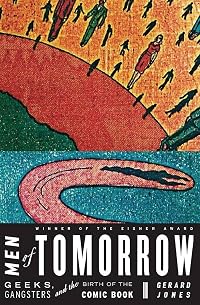
Men of Tomorrow: Geeks, Gangsters, and the Birth of the Comic Book
by Gerard Jones
On This Page
Description
"Gerard Jones, a longtime insider to the comic book business, draws on years of research and interview to reveal how the collision of Yiddish and American culture shaped the modern vision of the hero. He recounts the frightened counterattack against comics that nearly destroyed the industry in the 1950s and traces the underground resurgence that inspired a new generation to transmute those long-ago fantasies into art, literature, and blockbuster movies. Along the way he uncovers show more never-before-told stories about the makers of America's most peculiar art form." "Far more than the story of superheroes, Men of Tomorrow tells of the growth of geek culture from its birth in the science fiction fandom of the 1920s to its conquest of mass media sixty years later and tracks pop culture's transformation from the freewheeling, pickpocket entrepreneurship of the early twentieth century through immigration, technological upheaval, and a pair of world wars to the corporate control of the AOL/Time Warner era."--Jacket. show lessTags
Recommendations






Member Reviews
It is hard to praise enough this detailed (perhaps an edge too much so in the very first chapters), well researched, well sourced, well judged and readable account of the creation of the comic books industry.
Jones balances the human, creative and business stories and makes a convincing case for this being a peculiarly Jewish-American phenomenon grounded initially (though not today) in a particular milieu.
Comic book production in New York in the 1940s was a classic case of an urban centre of excellence feeding off its own pool of talent and networks.
And if you see a non-Jewish name (Kane, Kirby, Lee), don't be fooled, these are just second generation Jewish immigrants coming to terms with assimilation.
The American comic book is a show more Jewish invention to all intents and purposes and Jones has some important insights as to why that should be.
Creatively, comic books might be seen as a Jewish re-translation into fantasy of the dialectic between Protestant America and the attempt to configure a new identity.
The book should be read as much as a history of the creation of American capitalism as anything else, with a three-way struggle between anarcho-socialism, unregulated capitalism and regulated capitalism.
The role of organised crime (aka unregulated capitalism) and the Jewish mobsters as they shift into legitimate business is an essential part of this story and explanatory of much American exceptionalism.
One of the reasons America is in trouble today in the wider world is that the necessity of regulation and moral fervour has become a habit, upsetting peoples that really require neither.
Screwing over Swiss and French bankers is just an extension of WASP determination to tame the new immigrants into good conduct and moral conformity. It's just how they are.
As for the books themselves, they should be studied in and for themselves but the psychological origins of some key characters such as Superman are well argued for.
It is fun to read again the polyamorous sado-masochistic origins of Wonder Woman but the personal hurt behind the creation of Superman and Batman is very real and well argued by Jones.
The characters, with exceptions such as Stan Lee, are not very attractive. There is a disproportionate number of neurotic losers and outright unpleasant bastards but that's American capitalism for you.
Invaluable social history, this book is highly recommended. show less
Jones balances the human, creative and business stories and makes a convincing case for this being a peculiarly Jewish-American phenomenon grounded initially (though not today) in a particular milieu.
Comic book production in New York in the 1940s was a classic case of an urban centre of excellence feeding off its own pool of talent and networks.
And if you see a non-Jewish name (Kane, Kirby, Lee), don't be fooled, these are just second generation Jewish immigrants coming to terms with assimilation.
The American comic book is a show more Jewish invention to all intents and purposes and Jones has some important insights as to why that should be.
Creatively, comic books might be seen as a Jewish re-translation into fantasy of the dialectic between Protestant America and the attempt to configure a new identity.
The book should be read as much as a history of the creation of American capitalism as anything else, with a three-way struggle between anarcho-socialism, unregulated capitalism and regulated capitalism.
The role of organised crime (aka unregulated capitalism) and the Jewish mobsters as they shift into legitimate business is an essential part of this story and explanatory of much American exceptionalism.
One of the reasons America is in trouble today in the wider world is that the necessity of regulation and moral fervour has become a habit, upsetting peoples that really require neither.
Screwing over Swiss and French bankers is just an extension of WASP determination to tame the new immigrants into good conduct and moral conformity. It's just how they are.
As for the books themselves, they should be studied in and for themselves but the psychological origins of some key characters such as Superman are well argued for.
It is fun to read again the polyamorous sado-masochistic origins of Wonder Woman but the personal hurt behind the creation of Superman and Batman is very real and well argued by Jones.
The characters, with exceptions such as Stan Lee, are not very attractive. There is a disproportionate number of neurotic losers and outright unpleasant bastards but that's American capitalism for you.
Invaluable social history, this book is highly recommended. show less
This book is a history of that ubiquitous part of contemporary American adolescent life, the comic book.
In the early part of the 20th Century, there were an entire generation of male geeks and outsiders who enjoyed reading this crazy literature called science fiction. Mainly Jewish, and usually living in the Lower East Side of Manhattan, they combined their fantasies and youthful traumas into the square-jawed heroes who are now a central part of pop culture.
A central part of this book are Jerry Siegel and Joe Shuster, a couple of kids from Cleveland who created the first superhero, Superman. They learned, the hard way, that hard-nosed businessmen of questionable reputations, like pornographer and bootlegger Harry Donnenfeld, now ran the show more business. In the beginning, Siegel and Shuster signed away the rights to their creation (standard procedure). It took until the 1970s, just before the first Superman movie, for the pair to get official recognition, and something like a reasonable amount of money, for Superman.
The 1930s saw an explosion in comic book popularity. Even the shadiest, two-bit publisher could put out the worst schlock ever created, and it would be vacuumed up by the public. A seemingly infinite number of superheroes came before the public, teamed up with every other superhero, fighting any villain that could be put on paper. Some combinations worked, while others failed. Hitler and the Nazis provided a ready-made villain during the 1940s, which saw the public turn away from superheroes. Wartime paper restrictions put most publishers out of business; those that remained put out crime stories, westerns, and horror stories, to name a few. In the 1950s, Congress discovered the comic book. They were accused of corrupting America’s youth, especially the horror stories.
For the artists in the industry, working conditions were little better than a sweatshop. For instance, if 64 pages of material were due at the printer in three days, there was no possibility of leaving the office until those pages were done. With such time constraints, many details were left out of panels and chunks were taken from other stories, even if the two had nothing to do with each other.
This book is excellent. Anyone who has ever read an old superhero comic book, or a newer "independent" comic, should read this book. It’s also recommended for those interested in early 20th Century pop culture. show less
In the early part of the 20th Century, there were an entire generation of male geeks and outsiders who enjoyed reading this crazy literature called science fiction. Mainly Jewish, and usually living in the Lower East Side of Manhattan, they combined their fantasies and youthful traumas into the square-jawed heroes who are now a central part of pop culture.
A central part of this book are Jerry Siegel and Joe Shuster, a couple of kids from Cleveland who created the first superhero, Superman. They learned, the hard way, that hard-nosed businessmen of questionable reputations, like pornographer and bootlegger Harry Donnenfeld, now ran the show more business. In the beginning, Siegel and Shuster signed away the rights to their creation (standard procedure). It took until the 1970s, just before the first Superman movie, for the pair to get official recognition, and something like a reasonable amount of money, for Superman.
The 1930s saw an explosion in comic book popularity. Even the shadiest, two-bit publisher could put out the worst schlock ever created, and it would be vacuumed up by the public. A seemingly infinite number of superheroes came before the public, teamed up with every other superhero, fighting any villain that could be put on paper. Some combinations worked, while others failed. Hitler and the Nazis provided a ready-made villain during the 1940s, which saw the public turn away from superheroes. Wartime paper restrictions put most publishers out of business; those that remained put out crime stories, westerns, and horror stories, to name a few. In the 1950s, Congress discovered the comic book. They were accused of corrupting America’s youth, especially the horror stories.
For the artists in the industry, working conditions were little better than a sweatshop. For instance, if 64 pages of material were due at the printer in three days, there was no possibility of leaving the office until those pages were done. With such time constraints, many details were left out of panels and chunks were taken from other stories, even if the two had nothing to do with each other.
This book is excellent. Anyone who has ever read an old superhero comic book, or a newer "independent" comic, should read this book. It’s also recommended for those interested in early 20th Century pop culture. show less
This book is a great, well-written, readable overview of the comic book industry in the United States. It reads more like a novel than a history, but the reader leaves feeling informed. Huzzah!
This is not so much a history of comics as it is a collection of the biographies of the men who, mostly out of greed, created the comic book genre.
Gerard Jones writes:
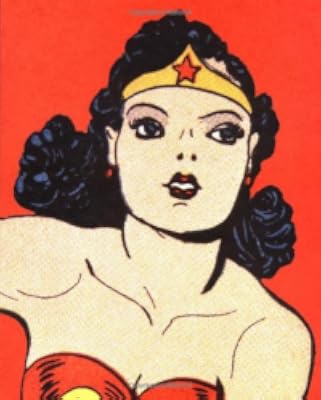
No other fad in entertainment has ever paralleled real-life events as closely as the superheros paralleled World War II. Superman fist drew attention in the summer of 1938, as war fears grew out of the Czechoslovakia crisis, and it was after the war really began late the next summer that the superhero fad took flight. By 1941, as America moved inevitably into the war, the heros grew rapidly in number, popularity, variety, and aggression, and some of the most popular were taking on the Nazis. The last new superhero to find a big audience, Wonder Woman, hit at the end of that year, as the war finally swept across the ocean. For the next three years, sales climbed. Superman and his imitators had captured a national show more emotional upwelling and turned it into a shared fantasy of escape. Their first and essential market was kids, but to enjoy the towering sales they did during the war, they had to be read by innumerable adults who pretended they were just indulging the “child in us all.”
Superheros turned the anxiety into joy. As the world plunged into conflict and disaster almost too huge to comprehend, they grabbed their readers’ darkest feelings and bounded into the sky with them. They made violence and wreckage exciting but at the same time small and containable. So flat, iconic, childlike, unreal, and absurd were those godlings in tights that no reader had to feel he was really engaging with his own angry fantasies. Superman was less a fantasy self than a god out of the machine – a sudden flash-of-color resolution to conflicts too terrible to think about. The superheros were slapstick comedians in a vaudeville of holocaust. Even in Captain America’s angriest assault on the Nazis and Superman’s darkest melodrama in Luthor’s lab, every reader over the age of eight had to laugh at them. Superheros served the purpose of slapstick comedians but on a global scale: They built fear and frustration in a containable fantasy world and then released them with a shock.
Superheros allowed adolescents and adults to slip back to the confidence and inviolability of that last moment of childhood before the anxiety of pubescence. It had been a long, nerve-wearing run for twenty years, through Prohibition and sexual revolution and economic transformation and urbanization and Depression and the rumors of war, when a naïve nation had to pretend to be adult and sophisticated. All through the 1920s and early 1930s, there had been childlike entertainment that had captured adults, but it nearly always had a cruel humor (Our Gang), strenuous melodrama (King Kong), or a melancholy sentimentality (Shirley Temple). Finally, at the end of the 1930s, in the moment of The Wizard of Oz, the American imagination retreated into the laughing, arrogant fun of the ten-year old. Superman was the physical embodiment of that fantasy of wholeness, that wondrous sense of knowing who one is and believing one can do anything, that shatters in adolescence.
Superheros were a latent-phase dream, embodying sex but invulnerable to it. They distilled that moment of swelling, big-kid pride in the new power and agility of the body, that last moment before the body begins to make its own scary demands and the world turns the mechanisms of shame against it. Superman in particular cartooned the cruelty of sex – Superman tricks Lois sadistically, but then as Clark he flings himself masochistically before her high heels – but with his famous wink at the reader, he let us know that he played every minute of it as a game. As the “Man of Tomorrow,” he has supposedly evolved beyond sexual entanglements, but in fact he was the man of the day before yesterday, looking at the agonies of adolescence with the superior sneer of a little brother spying on his sister. After the frenzied sexual questioning of the Twenties and the cynicism of sex and economics in the early Depression, and with the draft now bringing on another huge dislocation, the superhero was a welcome island of prepubescence.
Superheros were also an expression of a rising American thrill. All the queasiness of the Depression was about to be blown away in a great and terrible battle, and as much as most people shook their heads about the horror of the war, there was a hunger for it, too. The war meant not survival and dirty compromise but utter triumph or utter disaster. It meant unity of purpose too, and the superheros embodied that in their polychrome simplicity: Superman, Captain America and Wonder Woman were the most distinct individuals imaginable, but at the same time, each of them was all of us. The rarely spoken hunger for war was especially sharp for the children of immigrants and of the polyglot cities. A nation dominated for a generation by isolationist, prohibitionist, and small-town WASPs was about to plunge into the world, led by its cockiest, most sophisticated progressives. America had won the last war. Since then it had only grown in size, influence, and industrial capacity. It had held itself back from world events as fascism spread, but Roosevelt’s voters knew how powerful the country was. America was playing Clark Kent. It was time to rip off the suit. show less
No other fad in entertainment has ever paralleled real-life events as closely as the superheros paralleled World War II. Superman fist drew attention in the summer of 1938, as war fears grew out of the Czechoslovakia crisis, and it was after the war really began late the next summer that the superhero fad took flight. By 1941, as America moved inevitably into the war, the heros grew rapidly in number, popularity, variety, and aggression, and some of the most popular were taking on the Nazis. The last new superhero to find a big audience, Wonder Woman, hit at the end of that year, as the war finally swept across the ocean. For the next three years, sales climbed. Superman and his imitators had captured a national show more emotional upwelling and turned it into a shared fantasy of escape. Their first and essential market was kids, but to enjoy the towering sales they did during the war, they had to be read by innumerable adults who pretended they were just indulging the “child in us all.”
Superheros turned the anxiety into joy. As the world plunged into conflict and disaster almost too huge to comprehend, they grabbed their readers’ darkest feelings and bounded into the sky with them. They made violence and wreckage exciting but at the same time small and containable. So flat, iconic, childlike, unreal, and absurd were those godlings in tights that no reader had to feel he was really engaging with his own angry fantasies. Superman was less a fantasy self than a god out of the machine – a sudden flash-of-color resolution to conflicts too terrible to think about. The superheros were slapstick comedians in a vaudeville of holocaust. Even in Captain America’s angriest assault on the Nazis and Superman’s darkest melodrama in Luthor’s lab, every reader over the age of eight had to laugh at them. Superheros served the purpose of slapstick comedians but on a global scale: They built fear and frustration in a containable fantasy world and then released them with a shock.
Superheros allowed adolescents and adults to slip back to the confidence and inviolability of that last moment of childhood before the anxiety of pubescence. It had been a long, nerve-wearing run for twenty years, through Prohibition and sexual revolution and economic transformation and urbanization and Depression and the rumors of war, when a naïve nation had to pretend to be adult and sophisticated. All through the 1920s and early 1930s, there had been childlike entertainment that had captured adults, but it nearly always had a cruel humor (Our Gang), strenuous melodrama (King Kong), or a melancholy sentimentality (Shirley Temple). Finally, at the end of the 1930s, in the moment of The Wizard of Oz, the American imagination retreated into the laughing, arrogant fun of the ten-year old. Superman was the physical embodiment of that fantasy of wholeness, that wondrous sense of knowing who one is and believing one can do anything, that shatters in adolescence.
Superheros were a latent-phase dream, embodying sex but invulnerable to it. They distilled that moment of swelling, big-kid pride in the new power and agility of the body, that last moment before the body begins to make its own scary demands and the world turns the mechanisms of shame against it. Superman in particular cartooned the cruelty of sex – Superman tricks Lois sadistically, but then as Clark he flings himself masochistically before her high heels – but with his famous wink at the reader, he let us know that he played every minute of it as a game. As the “Man of Tomorrow,” he has supposedly evolved beyond sexual entanglements, but in fact he was the man of the day before yesterday, looking at the agonies of adolescence with the superior sneer of a little brother spying on his sister. After the frenzied sexual questioning of the Twenties and the cynicism of sex and economics in the early Depression, and with the draft now bringing on another huge dislocation, the superhero was a welcome island of prepubescence.
Superheros were also an expression of a rising American thrill. All the queasiness of the Depression was about to be blown away in a great and terrible battle, and as much as most people shook their heads about the horror of the war, there was a hunger for it, too. The war meant not survival and dirty compromise but utter triumph or utter disaster. It meant unity of purpose too, and the superheros embodied that in their polychrome simplicity: Superman, Captain America and Wonder Woman were the most distinct individuals imaginable, but at the same time, each of them was all of us. The rarely spoken hunger for war was especially sharp for the children of immigrants and of the polyglot cities. A nation dominated for a generation by isolationist, prohibitionist, and small-town WASPs was about to plunge into the world, led by its cockiest, most sophisticated progressives. America had won the last war. Since then it had only grown in size, influence, and industrial capacity. It had held itself back from world events as fascism spread, but Roosevelt’s voters knew how powerful the country was. America was playing Clark Kent. It was time to rip off the suit. show less
Ratings
Members
- Recently Added By
Author Information

243+ Works 1,628 Members
Gerard Jones's work has appeared in Harper's, The New York Times, and other publications. He is also a former comic-book and screen writer whose credits include Batman, Spider-Man, and Pokemon, and whose own creations have been turned into video games and cartoon series. More recently he has developed the Art & Story Workshops for children and show more adolescents. Jones is the founder of Media Power for Children and serves on the advisory board of the Comparative Media Studies Program at M.I.T. He lives in San Francisco with his wife and son show less
Awards and Honors
Awards
Common Knowledge
- Canonical title
- Men of Tomorrow: Geeks, Gangsters, and the Birth of the Comic Book
- Original publication date
- 2004-10-12
- People/Characters
- Jerry Siegel; Joe Schuster; Superman
- Important places
- New York, New York, USA; Cleveland, Ohio, USA
- Dedication
- For my father, RUSSELL JONES Who taught me what a hunk of ink-stained pulp can mean to a young man in the hardest times
- First words
- In the end, Harry was a collection of stories.
- Last words
- (Click to show. Warning: May contain spoilers.)In the strange alchemy of their long pasts and the indefinable present of a mongrel nation, they glimpsed and created a future.
- Blurbers
- Kaz ; Plant, Bud; Spiegelman, Art ; Epstein, Lawrence J. ; Orenstein, Catherine ; Moore, Alan (show all 7); Scott, A. O.
Classifications
Statistics
- Members
- 637
- Popularity
- 45,736
- Reviews
- 5
- Rating
- (4.13)
- Languages
- English, Portuguese (Portugal)
- Media
- Paper, Ebook
- ISBNs
- 7
- ASINs
- 5