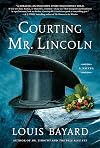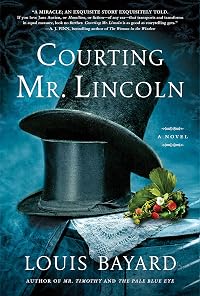
Courting Mr. Lincoln
by Louis Bayard
On This Page
Description
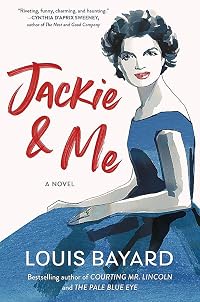
Includes a special preview chapter of Jackie & Me, coming June 14 from Louis Bayard“Riveting . . . Enticing.” —The Washington Post
“Exquisite.” —People
“A triumph of a novel.” —Bookreporter.com
“Rich, fascinating, and romantic.” —Newsday
A Washington Post Bestseller * An Indie Next Pick * An Apple Books Best of the Month for April * A People Magazine Best Book of the Week
When Mary Todd meets Abraham Lincoln in Springfield in the winter of 1840, he is on no show more one’s short list to be president. Mary, a quick, self-possessed debutante with an interest in debates and elections, at first finds this awkward country lawyer an enigma. “I can only hope,” she tells his roommate, the handsome, charming Joshua Speed, “that his waters being so very still, they also run deep.”
It’s not long, though, before she sees the Lincoln that Speed knows: an amiable, profound man with a gentle wit to match his genius, who respects her keen political mind. But as her relationship with Lincoln deepens, she must confront his inseparable friendship with Speed, who has taught his roommate how to dance, dress, and navigate polite society.
Told in the alternating voices of Mary Todd and Joshua Speed, and inspired by historical events, Courting Mr. Lincoln creates a sympathetic and complex portrait of Mary unlike any that has come before; a moving portrayal of the deep and very real connection between the two men; and most of all, an evocation of the unformed man who would grow into one of the nation’s most beloved presidents. show less
Tags
Recommendations







Member Reviews
A love triangle involving Abraham Lincoln? Well, yes, and what's more, Louis Bayard's 2019 novel “Courting Mr. Lincoln” sticks fairly close to the historical record.
Lincoln and Mary Todd show up in Springfield, Ill., at about the same time. Gangly and ignorant of how to dress and behave in polite society, Lincoln comes to town to launch both his legal and his political careers. Mary moves in with her sister to try to find a suitable husband, although her outspokenness has so far turned suitors away.
Unable to afford a room of his own, Lincoln accepts an offer to share a bed with Joshua Speed, a merchant with good prospects and a man seen as Mary's best prospect. Yet Joshua and Mary, it turns out, are each more interested in Lincoln show more than in each other.
An older woman in Springfield who views herself as both a political kingmaker and a matchmaker, sees potential in Lincoln that is still invisible to others, but she knows he needs a wife to get very far in politics. She settles on Mary Todd as the best choice, and she conspires to bring the two of them together in secret in her home.
Wondering where his friend is spending his afternoons, a jealous Speed has Lincoln followed, then he reveals the secret to Mary's sister, believing that will end the affair. And it does, but only temporarily. How Abraham and Mary eventually get back together and what happens in the Lincoln-Speed friendship occupies the rest of this engrossing and very unusual romantic novel.
So did Lincoln have homosexual leanings? Bayard raises the possibility, but leaves the question unanswered. just as history does. show less
Lincoln and Mary Todd show up in Springfield, Ill., at about the same time. Gangly and ignorant of how to dress and behave in polite society, Lincoln comes to town to launch both his legal and his political careers. Mary moves in with her sister to try to find a suitable husband, although her outspokenness has so far turned suitors away.
Unable to afford a room of his own, Lincoln accepts an offer to share a bed with Joshua Speed, a merchant with good prospects and a man seen as Mary's best prospect. Yet Joshua and Mary, it turns out, are each more interested in Lincoln show more than in each other.
An older woman in Springfield who views herself as both a political kingmaker and a matchmaker, sees potential in Lincoln that is still invisible to others, but she knows he needs a wife to get very far in politics. She settles on Mary Todd as the best choice, and she conspires to bring the two of them together in secret in her home.
Wondering where his friend is spending his afternoons, a jealous Speed has Lincoln followed, then he reveals the secret to Mary's sister, believing that will end the affair. And it does, but only temporarily. How Abraham and Mary eventually get back together and what happens in the Lincoln-Speed friendship occupies the rest of this engrossing and very unusual romantic novel.
So did Lincoln have homosexual leanings? Bayard raises the possibility, but leaves the question unanswered. just as history does. show less
Set in Springfield, Illinois in the 1840s, this book fictionalizes the romance between Abraham Lincoln and Mary Todd, his future wife, and the friendship between him and Joshua Speed, a merchant and Lincoln’s landlord and bedmate. Speed finds his purpose in life in educating Lincoln on how to be a gentleman; he teaches him etiquette and how to dress properly. Tensions arise between the two when Lincoln meets Mary and begins courting her. The courtship has a number of problems, some of which are instigated by Speed because he sees Mary as a rival for Lincoln’s affections.
The narrative alternates between Mary and Speed’s points of view. This technique fills in gaps. For instance, Mary is sometimes confused about Lincoln’s show more behaviour; Speed’s perspective then explains what Mary doesn’t know. I found Speed’s sections more compelling. His interactions with Lincoln are natural and relaxed whereas Mary and Lincoln’s relationship lacks that ease, though much of the awkwardness can be attributed to the constraints of acceptable behaviour between the sexes.
What emerges is a complex portrait of Lincoln as seen by two people who love him. Speed describes him as someone “with not a scrap of affectation or unnaturalness in him. He is purely what he is and thinks more deeply, more searchingly than anybody I know.” When Mary first meets Lincoln, she sees “An El Greco frame, stretched beyond sufferance. A mournful well of eye. A face of bones, all badgering to break through.” He is not her romantic ideal, but she becomes interested and then fascinated, though Lincoln is insecure because of his background and feels unworthy of Mary. In his interactions with both people, Lincoln shows himself to be intelligent, determined, and compassionate. In the end, it is a supporter’s description that perhaps best describes the future president: “a great man – large of mind and large of soul.”
Speed and Mary also emerge as fully developed characters. Speed is witty and charming, the life of parties. He recognizes the potential in the awkward, unpolished man he first meets, though he does not always understand himself very well. He takes actions, like informing on Mary to her sister, without fully understanding his motivation. Mary is intelligent and opinionated, especially about politics which are her passion. Because of her spirited nature, she struggles with the restrictions placed on her because of her gender.
I loved the elegant prose. In many ways, it reminded me of that of Jane Austen. The dialogue is also similar; much is left unsaid. There is much humour in the conversational exchanges, especially between Speed and Lincoln. The dance and etiquette lessons are hilarious.
I really enjoyed the book. My only regret is that my knowledge of the American political system is lacking. Not being American, I don’t know much about the Whig party and the various politicians mentioned in the novel; as a result, many of the political discussions meant little to me. Based on what I do know about Lincoln, the novel’s portrayal seems historically accurate. I am inspired to read more about Mary Todd to compare this fictional representation with her historical record.
Note: I received a digital galley from the publisher prior to the book’s paperback release on Feb. 11.
Please check out my reader's blog (https://schatjesshelves.blogspot.com/) and follow me on Twitter (@DCYakabuski). show less
The narrative alternates between Mary and Speed’s points of view. This technique fills in gaps. For instance, Mary is sometimes confused about Lincoln’s show more behaviour; Speed’s perspective then explains what Mary doesn’t know. I found Speed’s sections more compelling. His interactions with Lincoln are natural and relaxed whereas Mary and Lincoln’s relationship lacks that ease, though much of the awkwardness can be attributed to the constraints of acceptable behaviour between the sexes.
What emerges is a complex portrait of Lincoln as seen by two people who love him. Speed describes him as someone “with not a scrap of affectation or unnaturalness in him. He is purely what he is and thinks more deeply, more searchingly than anybody I know.” When Mary first meets Lincoln, she sees “An El Greco frame, stretched beyond sufferance. A mournful well of eye. A face of bones, all badgering to break through.” He is not her romantic ideal, but she becomes interested and then fascinated, though Lincoln is insecure because of his background and feels unworthy of Mary. In his interactions with both people, Lincoln shows himself to be intelligent, determined, and compassionate. In the end, it is a supporter’s description that perhaps best describes the future president: “a great man – large of mind and large of soul.”
Speed and Mary also emerge as fully developed characters. Speed is witty and charming, the life of parties. He recognizes the potential in the awkward, unpolished man he first meets, though he does not always understand himself very well. He takes actions, like informing on Mary to her sister, without fully understanding his motivation. Mary is intelligent and opinionated, especially about politics which are her passion. Because of her spirited nature, she struggles with the restrictions placed on her because of her gender.
I loved the elegant prose. In many ways, it reminded me of that of Jane Austen. The dialogue is also similar; much is left unsaid. There is much humour in the conversational exchanges, especially between Speed and Lincoln. The dance and etiquette lessons are hilarious.
I really enjoyed the book. My only regret is that my knowledge of the American political system is lacking. Not being American, I don’t know much about the Whig party and the various politicians mentioned in the novel; as a result, many of the political discussions meant little to me. Based on what I do know about Lincoln, the novel’s portrayal seems historically accurate. I am inspired to read more about Mary Todd to compare this fictional representation with her historical record.
Note: I received a digital galley from the publisher prior to the book’s paperback release on Feb. 11.
Please check out my reader's blog (https://schatjesshelves.blogspot.com/) and follow me on Twitter (@DCYakabuski). show less
“It is a truth universally acknowledged, that a single man in possession of ambitions in politics must be in want of a wife.”
No, that’s not how this richly imagined novel about Abraham Lincoln and Mary Todd begins, but it could have. For Bayard’s tale recalls Jane Austen in its wit, keenly observed social conventions, and chief object, finding love amid the teacups and calling cards, the glances and tacit declarations of acceptance or rejection.
But this is Austen with broader humor, because Lincoln arrives in Springfield, Illinois, blissfully unaware of said social conventions, and the way he learns, and his reaction to his studies, is often hilarious.
Then, too, the narrative has a sharper, more serious tone, because the show more mud-plagued streets of Springfield have nothing like the gentility that Elizabeth Bennet & Co. would recognize, and some of the mud is metaphorical, flung by politicians at one another.
The two principals here are lonely, tortured people, for whom marriage, as every reader surely knows, will bring many heartrending trials. And the chief obstacle to their betrothal isn’t Mary’s snobby, married sister Elizabeth, with whom she lives, but the psychological pain with which Lincoln lives.
With that inescapable, tragic overlay, Bayard does a remarkable job of evoking the lightness in both lovers; her wit and intelligence, his qualities that other men lack. As his close friend Joshua Speed puts it, Lincoln says what he believes and believes what he says. This characteristic is so startling that other men beg for his opinion on every matter under the sun. Be it known also that when Mary first meets him, he reminds her of a spindly pine tree, so a little moral strength helps.
Joshua and Mary are the two point-of-view characters, not Lincoln. That choice offers three crucial advantages, which Bayard deftly exploits. First, Lincoln’s intense feelings of unworthiness, which often prompt a deep withdrawal into himself, remain suggested but properly enigmatic, so the reader shares Speed’s and Mary’s frustration that he’s unreachable.
Second, Speed has undertaken to school Lincoln in etiquette and social graces; since they both live above Speed’s dry-goods store (with two other men), they’re often together. Though aware that a more refined Lincoln will make him fitter for female company — partly the purpose, for he’ll need a wife if he’s to advance in politics — Speed resents his friend’s success with Mary. Jealous of Lincoln for getting the belle of Springfield, and of the belle for intruding on a perfectly good bachelor friendship, Speed has mixed motives throughout.
That unusual window allows the narrative to explore and comment on the bounds of friendship and courtship in a deep, thought-provoking way. Friendship is much easier to test, define, and judge, whereas marriage is a speculative option, at best. It’s also apparent that Speed is courting Lincoln too, for his own purposes — hence the title. Yet none of that prevents Lincoln’s preparation for social respectability from reaching high comedy, especially when the merchant tries to teach the backwoods lawyer how to waltz.
If Courting Mr. Lincoln has a notable flaw, it’s the repetition, the alternating perspective of Mary and Speed going over the same events. To be sure, they offer very different views. But even though I understood the literary convention, which Bayard invokes without calling attention to it — the characters wouldn’t, would they? — the narrative still surprised me. I wound up thinking, Wait a minute; I read this before.
But that’s no reason to fault a superb love story. And though each of us likely imbues Lincoln with the virtues we wish to see in him, I came away from this portrayal marveling at how our most thoughtful, compassionate president, mortified at hurting anyone or anything, oversaw our country during its deadliest, most divisive conflict. show less
No, that’s not how this richly imagined novel about Abraham Lincoln and Mary Todd begins, but it could have. For Bayard’s tale recalls Jane Austen in its wit, keenly observed social conventions, and chief object, finding love amid the teacups and calling cards, the glances and tacit declarations of acceptance or rejection.
But this is Austen with broader humor, because Lincoln arrives in Springfield, Illinois, blissfully unaware of said social conventions, and the way he learns, and his reaction to his studies, is often hilarious.
Then, too, the narrative has a sharper, more serious tone, because the show more mud-plagued streets of Springfield have nothing like the gentility that Elizabeth Bennet & Co. would recognize, and some of the mud is metaphorical, flung by politicians at one another.
The two principals here are lonely, tortured people, for whom marriage, as every reader surely knows, will bring many heartrending trials. And the chief obstacle to their betrothal isn’t Mary’s snobby, married sister Elizabeth, with whom she lives, but the psychological pain with which Lincoln lives.
With that inescapable, tragic overlay, Bayard does a remarkable job of evoking the lightness in both lovers; her wit and intelligence, his qualities that other men lack. As his close friend Joshua Speed puts it, Lincoln says what he believes and believes what he says. This characteristic is so startling that other men beg for his opinion on every matter under the sun. Be it known also that when Mary first meets him, he reminds her of a spindly pine tree, so a little moral strength helps.
Joshua and Mary are the two point-of-view characters, not Lincoln. That choice offers three crucial advantages, which Bayard deftly exploits. First, Lincoln’s intense feelings of unworthiness, which often prompt a deep withdrawal into himself, remain suggested but properly enigmatic, so the reader shares Speed’s and Mary’s frustration that he’s unreachable.
Second, Speed has undertaken to school Lincoln in etiquette and social graces; since they both live above Speed’s dry-goods store (with two other men), they’re often together. Though aware that a more refined Lincoln will make him fitter for female company — partly the purpose, for he’ll need a wife if he’s to advance in politics — Speed resents his friend’s success with Mary. Jealous of Lincoln for getting the belle of Springfield, and of the belle for intruding on a perfectly good bachelor friendship, Speed has mixed motives throughout.
That unusual window allows the narrative to explore and comment on the bounds of friendship and courtship in a deep, thought-provoking way. Friendship is much easier to test, define, and judge, whereas marriage is a speculative option, at best. It’s also apparent that Speed is courting Lincoln too, for his own purposes — hence the title. Yet none of that prevents Lincoln’s preparation for social respectability from reaching high comedy, especially when the merchant tries to teach the backwoods lawyer how to waltz.
If Courting Mr. Lincoln has a notable flaw, it’s the repetition, the alternating perspective of Mary and Speed going over the same events. To be sure, they offer very different views. But even though I understood the literary convention, which Bayard invokes without calling attention to it — the characters wouldn’t, would they? — the narrative still surprised me. I wound up thinking, Wait a minute; I read this before.
But that’s no reason to fault a superb love story. And though each of us likely imbues Lincoln with the virtues we wish to see in him, I came away from this portrayal marveling at how our most thoughtful, compassionate president, mortified at hurting anyone or anything, oversaw our country during its deadliest, most divisive conflict. show less
For the most part, this is a pretty conventional novel about Lincoln's on-again/off-again courtship of Mary Todd. Here's the twist: Lincoln is also being courted by his roommate, Joshua Speed. I remember reading a few years ago a claim that Lincoln was probably bisexual and involved in a love relationship with Speed, a shop owner who lodged above his store with the young lawyer; of necessity, the two shared a bed. While this novel doesn't full-out into claim that the two had a physical relationship, it does at least give the impression that there was a deep bond between them and perhaps (especially on Speed's part) a desire for more. And Mary Todd becomes the disrupting factor. Lincoln is attracted to her, primarily for her show more outspokenness and interest in politics, and he is aware of the fact that he will need a wife to rise in the political arena. But Speed carries out some rather extreme machinations to ensure that the two will never tie the knot and to make it difficult for Lincoln to put aside his obligations to him. What's interesting here is that Mary never realizes that she has a rival for Lincoln's attention.
The story is told in chapters alternating between Speed's and Mary's point of view. Another reader-reviewer complained that there is too much repetition in this structure, since the two narrators go over the same events. She missed the point. What Bayard wants us to recognize is that as different as they are, Speed and Mary are quite similar in their devotion to Lincoln and in their efforts to snare him as much through guilt and jealousy as through love. In that regard, I found them both annoying. Also annoying after a while: Lincoln's naiveté and a humility that often crosses the line into self-denigration. It had gotten old--very old--by the book's midpoint. He becomes a pawn in his own story, which is not a position that I would have expected to find him in. show less
The story is told in chapters alternating between Speed's and Mary's point of view. Another reader-reviewer complained that there is too much repetition in this structure, since the two narrators go over the same events. She missed the point. What Bayard wants us to recognize is that as different as they are, Speed and Mary are quite similar in their devotion to Lincoln and in their efforts to snare him as much through guilt and jealousy as through love. In that regard, I found them both annoying. Also annoying after a while: Lincoln's naiveté and a humility that often crosses the line into self-denigration. It had gotten old--very old--by the book's midpoint. He becomes a pawn in his own story, which is not a position that I would have expected to find him in. show less
This was one of the first books in which I have read about Mary Todd and Abraham Lincoln dating. This was a different way to write about Mary , Abe and his friend Joshua. This was well written but I am not sure that the writer needed to read into the friendship of Abe and Joshua quite as much as he did but it might have happened that way. I think I would have liked to know a little more about Mary Todd through this but I enjoyed the story. I received a copy of this book from Algonquin books for a fair and honest opinion that I gave of my own free will.
Fictionalized account of the triangular relationship between Mary Todd, Lincoln and Joshua Speed prior to the Lincoln-Todd marriage. Lincoln had lived above the Speed family's grocery shop, and shared a bed with Speed for 4 years (men did that back in those times to save money). The book takes the perspective that Lincoln and Speed shared a much more intimate relationship (not sexual) than has previously been known. In the end, both men married women and lead independent lives, although their love for each other persisted. Quite an interesting perspective. The book gives me an understanding of how people dealt with strong feelings for members of their same sex at a time when homosexual behavior would have been unthinkable. Very well show more written. show less
Although historical romance is not my favorite genre, I do enjoy reading about Abraham Lincoln. This portrait of Mary Todd is much kinder than others, and the romance between two socially awkward people is a sweet story.
Members
- Recently Added By
Lists

Kirkus Starred Fiction Reviews of Books Published in 2019
411 works; 12 members

Fiction: Historical
288 works; 3 members
Author Information

Some Editions
Awards and Honors
Distinctions
Common Knowledge
- Canonical title
- Courting Mr. Lincoln
- Original publication date
- 2019-04-23
- People/Characters
- Mary Todd Lincoln; Joshua Fry Speed; Abraham Lincoln
- Important places
- Springfield, Illinois, USA
- Epigraph
- I hid myself within my flower,
that wearing on your breast,
You, unsuspecting, wear me too --
and angels know the rest.
I hid myself within my flower,
That fading from your vase,
You, unsuspecting feel... (show all) for me,
Almost a loneliness.
-- Emily Dickinson - First words
- Her journey from Alton to Springfield should have taken no longer than two days, but as the stage driver himself said, "That's no more 'n a hope."
- Quotations
- "It's like this," her new friend Mercy told her. "When womenfolk start in to settling a place—clearing their trees, I mean, and fighting their Indians—they're perfectly happy with whores. It's all they're fit for. But onc... (show all)e a town gets up on its feet, as Springfield has, well, then they start aspiring to something more. The kind of girl you can take out on your arm."
"He owns a two-story brick house, and Ninian tells me he is unimpeachably solvent."
"Solvent? Is that now enough to recommend a man? Why not declare him bipedal? Air-breathing?"
Half a league outside Springfield, Uncle John drew the sleigh to a halt and pointed toward a nearby walnut tree, where a strange, gray figure stood shimmering in the dusk. Like a charcoal drawing, she thought, bleeding off th... (show all)e page.
A gentleman's voice, robed in Kentucky vowels.
With a bow, he angled his body away and then left the room, maneuvering around each guest in the manner of a barge navigating sandbars.
"Men don't always know what they need. That's why God made women."
What did it mean, exactly, that a man was not of the marrying sort? And what did that say about the girl who finally landed him? That she had gone at him so relentlessly as to break down his resistance? Or had simply waited h... (show all)im out, like a quail hunter by a copse?
"Why, Mr. Lincoln," she said, "I believe you have had a hand in this."
"No person shall be compelled to be a witness against himself."
"Does he ever speak of me?" she said at last.
Mr. Speed seemed to consider many responses before he settled on one. "I am no lawyer, but in this event, I should probably plead attorney-client privilege."
squinting lightly, he transferred his gaze to the window, where the bare branches of an elm made a map of the morning light.
The springhouse at Farmington was built so snugly into the stream bank that the neighboring moss had, without a second thought, fanned across it and cloaked it in an emerald sward. A single door, opening at the top, gave way ... (show all)to a damp, grotto-like interior, in which the outlines of cider barrels and butter paddles and cream crocks were only half-visible in the shafts of sunlight. On the shelves sat buckets of fresh milk, waiting to be churned, and the walls breathed out scents of mint and cress.
Joshua lifted his face to the sky, watched the moon shake off its cheesecloth of cloud.
The blue of Matilda's eyes was never so warm as when she said, "He smells of money. The future kind."
"Mary Todd," he said, drawing his head back. "I believe you and I are the two brokenest birds I know." - Last words
- (Click to show. Warning: May contain spoilers.)Why, you're Miss Todd.
- Publisher's editor
- Gleick, Betsy
- Blurbers
- Finn, A. J.; Mundy, Liza; Bollen, Christopher; Morris, Mary; Mullen, Thomas
Classifications
Statistics
- Members
- 269
- Popularity
- 120,147
- Reviews
- 13
- Rating
- (3.90)
- Languages
- English
- Media
- Paper, Audiobook, Ebook
- ISBNs
- 7
- ASINs
- 2