
On This Page
Description
Anthony Powell's universally acclaimed epic A Dance to the Music of Time offers a matchless panorama of twentieth-century London. Now, for the first time in decades, readers in the United States can read the books of Dance as they were originally published--as twelve individual novels--but with a twenty-first-century twist: they're available only as e-books.A Question of Upbringing (1951) introduces us to the young Nick Jenkins and his housemates at boarding school in the years just after show more World War I. Boyhood pranks and visits from relatives bring to life the amusements and longueurs of schooldays even as they reveal characters and traits that will follow Jenkins and his friends through adolescence and beyond: Peter Templer, a rich, passionate womanizer; Charles Stringham, aristocratic and louche; and Kenneth Widmerpool, awkward and unhappy, yet strikingly ambitious. By the end of the novel, Jenkins has finished university and is setting out on a life in London; old ties are fraying, new ones are forming, and the first steps of the dance are well underway."Anthony Powell is the best living English novelist by far. His admirers are addicts, let us face it, held in thrall by a magician."--Chicago Tribune"A book which creates a world and explores it in depth, which ponders changing relationships and values, which creates brilliantly living and diverse characters and then watches them grow and change in their milieu. . . . Powell's world is as large and as complex as Proust's."--Elizabeth Janeway, New York Times"One of the most important works of fiction since the Second World War. . . . The novel looked, as it began, something like a comedy of manners; then, for a while, like a tragedy of manners; now like a vastly entertaining, deeply melancholy, yet somehow courageous statement about human experience."--Naomi Bliven, New Yorker"The most brilliant and penetrating novelist we have."--Kingsley Amis"There is no other work in the annals of European fiction that attempts meticulously to recreate half a century of history, decade by decade, with anything like the emotional precision or details of Powell's twelve volumes. Neither Balzac's panorama of the Restoration, nor Zola's chronicles of the Second Empire, nor Proust's reveries in the Belle Epoque can match a comparable span of time, an attention to variations within it, or a compositional intricacy capable of uniting them into a single narrative. . . . The elegance of this artifice was only compatible with comedy."--Perry Anderson show lessTags
Recommendations






















Member Recommendations



Member Reviews
This is the first in the 12 book cycle "A Dance to the Music of Time". Knowing that it feels a lot like a prolonged introduction rather than a piece in its own right. Not a lot happens, but there's clearly a lot of ground work being laid for what is to follow.
We follow Jenkins as he progresses through school to a summer in France to Cambridge. It's a very particular set of people, they are all of the upper classes and it shows at several points. It is also very very male. There are a few women, but they are very much supporting players.
Jenkins is rooming with Stringham and Templer and we meet them each several times as the book progresses. The school is a private school, and is not named explicitly, but being between London & Reading, show more it's being Eton is rather probable. Stringham leaves school early and visits East Africa to be with his father for a while. Jenkins visits Templer at home in London, meeting his sister Jean and falling for her in some way that's not immediately obvious.
Jenkins meets Stringham again at Cambridge, to which he returns after the Africa trip. They react differently to the environment and each other, with Jenkins seeming to be settling down to gain a degree, while Stringham is unsettled from the first and finds a job with a firm in the city.
These three start as the closet of friends. but there is even in the beginning seeds of dispersal. Their relationships change as their circumstances change. They drift apart and when Stringham leaves to go to a party, Jenkins senses the closing of a door in that relationship. It's true of all relationship from youth to young adult hood, they don't all survive the transition.
We meet a number of other characters along the way, that are painted with a deft stroke of the pen. Widmerpool promises to be a feature in the future, based on his prominence. He had a reputation of being "different" all based around an overcoat and a propensity for solitary runs. Uncle Giles, particularly, sticks in the memory as being slight disreputable and thus so much more interesting. Sillery comes across as slightly sinister, in a pulling strings from behind the curtains manner.
Despite not a lot happening, this was not at all boring. There are events, even if they are relatively minor. There are character studies and the boys all grow and evolve in a believable way. If I had a quibble, it is that it is terribly class ridden. The attitude displayed towards Quiggen, who speaks with North Country vowels and has several scholarships to earn his place leaves a bit of a nasty taste in the mouth. show less
We follow Jenkins as he progresses through school to a summer in France to Cambridge. It's a very particular set of people, they are all of the upper classes and it shows at several points. It is also very very male. There are a few women, but they are very much supporting players.
Jenkins is rooming with Stringham and Templer and we meet them each several times as the book progresses. The school is a private school, and is not named explicitly, but being between London & Reading, show more it's being Eton is rather probable. Stringham leaves school early and visits East Africa to be with his father for a while. Jenkins visits Templer at home in London, meeting his sister Jean and falling for her in some way that's not immediately obvious.
Jenkins meets Stringham again at Cambridge, to which he returns after the Africa trip. They react differently to the environment and each other, with Jenkins seeming to be settling down to gain a degree, while Stringham is unsettled from the first and finds a job with a firm in the city.
These three start as the closet of friends. but there is even in the beginning seeds of dispersal. Their relationships change as their circumstances change. They drift apart and when Stringham leaves to go to a party, Jenkins senses the closing of a door in that relationship. It's true of all relationship from youth to young adult hood, they don't all survive the transition.
We meet a number of other characters along the way, that are painted with a deft stroke of the pen. Widmerpool promises to be a feature in the future, based on his prominence. He had a reputation of being "different" all based around an overcoat and a propensity for solitary runs. Uncle Giles, particularly, sticks in the memory as being slight disreputable and thus so much more interesting. Sillery comes across as slightly sinister, in a pulling strings from behind the curtains manner.
Despite not a lot happening, this was not at all boring. There are events, even if they are relatively minor. There are character studies and the boys all grow and evolve in a believable way. If I had a quibble, it is that it is terribly class ridden. The attitude displayed towards Quiggen, who speaks with North Country vowels and has several scholarships to earn his place leaves a bit of a nasty taste in the mouth. show less
2020 update: This review is somewhat superseded by my reading of future volumes in the series, where I have fallen utterly in love with Mr Powell's work.
There are a few ways a work can be dated. Anthony Powell's A Question of Upbringing falls into most of the possible categories. The novel is famously the first in a 12-book series, A Dance to the Music of Time, that not coincidentally recalls the greatest work on memory ever written, Proust's In Search of Lost Time. You can find my detailed reviews of those seven books on Goodreads, and I was excited for Powell because of the connection. Unfortunately, A Question of Upbringing does not sprint out of the gate like Swann's Way does; it might be a much speedier read, but it's also a show more shallower one. Or is it?
The novel is quite simple. Nicholas Jenkins attends his last year of highschool in 1920s England, unsure of his future and whether he can make a living out of his creative tendencies, spends a summer with school friends as their friendships start to fade, takes a "gap" trip to France where he is involved in arbitrating a tense tennis match between two surly Scandinavians, and then attends his first year at university, where not much happens of any note. As he depicts the uncertain connections between his schoolmates: reckless womaniser Peter Templer, aristocratic prankster Charles Stringham, and the uncomfortable but observant Kenneth Widmerpool, Nick ponders his future.
Powell seems to be self-consciously channeling Proust here - a generation after Proust's death - by setting up a dozen or so characters whom we're explicitly told will return later in Nick's life. And indeed, every world Nick enters feels already lived-in, with a deftness of description that is worth commenting upon. I quite enjoyed the novel, don't get me wrong, but I think Proust's shadow looms rather too large at this early stage.
For one thing, there's Nick's narrative voice. What makes Proust so utterly intoxicating is the gulf between the narrator and his younger self; it's also the source of much of the comedy, as young Marcel doesn't have any notion of what's really going on. The distinction here is far more blurry, and Nick already seems to be realising far too much far too early. Of course, the character of Nick seems to be more mature than the precocious young Marcel is intended to be, but the trouble is that it's hard to tell who is narrating this story - Nick as he goes along, or an older version? Nevertheless, every time narrator-Nick tells us of a character's future, or of his own future relationship with them (such as with Widmerpool), it only serves to distract from the task of describing them more adequately in the present. More to the point, despite the blurb's assertion that this is a "comic masterpiece", it is strongly advised to remember this is comic in the classical sense. Aside from an incident with a chamberpot, the humour lies in under-the-surface character notes, a beguiling sense of the world from Jenkins' point of view, and people at odds with one another.
And this is why I started this review by mentioning how things date. As someone who is fairly proficient in mid-century English literature and culture, I can absorb many of the little phrases which made a great deal of sense to people in 1950 who had lived through 1930. But so many of the phrases, as in any naturalistic conversation, don't have meaning to your average reader in 2016. I don't think many people in my generation - at least outside of central England - know that "going up" means to start university, "coming down" means to finish, and being "sent down" means to be released from school ignominiously. And that's just the tip of a rather broad iceberg. Powell was writing for a well-heeled, white, colonial readership, and that means this book just doesn't carry well into the 21st century. "But", I hear you say, "Proust was writing for those people a generation earlier, in French!". Well, yes, but Proust's work invites us to be historians, presenting a narrator who is caught between the different worlds of society; Jenkins mainly stays put. Besides which, the French - at least in Proust - are nothing if not exclamatory; Powell's Britons are bastions of diplomacy, and it's very hard to tell when anyone is showing emotion at all. Simply put, this is a book out of its time. The implications of Sillery and his coterie of students have almost completely receded into the mists, written as they are essentially shadows, sketch drawings designed to represent flesh-and-blood characters to readers already familiar with the type. I like to think of myself as somewhat aware of this period of history, but the apparently "sacerdotal" tendencies of the butler(?) Moffet, and the issue of the boy whose father may or may not have "worked"(?) for the railway line still confuse me. These are figments of an author's imagination drawn in vague snippets of conversation. Which I guess is what James Joyce did too, and more about that below.
Or perhaps it's that Powell uses limited dialogue. Even one of the longest conversations - at the very end of the book - is muted, despite significant plot revelations, and it's sometimes hard to tell which of the participants is speaking. Remarkably, during the entire chapter set in France, a few of the characters never get to speak at all. We are told about the vast party of residents in passing, and then proceed to spend most of the time on whether Widmerpool can speak French. At the end of the day, the book feels like a skim. And where this most has an impact, unfortunately, is in the women, Jean Templer in particular. Jean is evidently going to become a large part of Nick's life, and perhaps Powell is during what Proust did with Albertine - making her a cipher because that's all Nick knows about her right now. But, given Nick basically falls in love with her right away, it's frustrating that we barely hear Jean utter two words. If he's meant to have fallen for her ironically, because that's what 18-year-old boys do when they meet a girl for the first time after years of being at an all-boys school, I'm not picking up any hints of that.
Powell's writing can sometimes, frankly, be lazy. He introduces two characters by saying their names were, "respectively", X and Y. There's no need for that "respectively", as he's not adding any further attributes that need clarifying. At one point, he writes: For some reason, I felt enormously surprised to see [Le Bas] standing there. He had passed so utterly from daily life. For some reason? You just literally explained the reason, Mr. Powell! And, beyond all of that, I'd be remiss if I didn't stress that the final chapter suggests this will be 12 books about privileged straight white able-bodied men learning that life isn't always the pranks and philosophical debates that it was in highschool.
Now, let me backtrack. Because of course, I have no problem with that last fact. I yearn for the days of the early 20th century, when writers could churn out one or two books a year that were meant to be read, not overly critiqued. Agatha Christie is a great case in point: not every novel has to be - or should be - a masterpiece. Tell a story, tell it in your way, tell it to your ideal audience, because they aren't addicted to their iPad so they'll happily buy a book every two weeks. Those were the days, and I miss them greatly. I don't begrudge Powell doing what he's doing. And I have some faith, given how famous the work is. On some level, for instance, Powell seems to deliberately not be interested in describing his characters in great depth; they exist as types, types drawn from history and literature. They say (correctly) that Conan Doyle wrote good short stories and terrible novels, and Christie wrote good novels and terrible short stories. Perhaps Powell is the anti-Proust, and his work will get better with each successive novel. I surely hope so.
I also don't want to besmirch Powell entirely. His technique is, on the whole, very sensible. And at the close of the incident involving the crowded car ride (page 200 in my Chicago edition) there is an absolutely exquisite paragraph, one of the best paragraphs I have read in a long time. It uses all the things I've complained about, including short but weighty clippings of dialogue, to gorgeous effect. Oh, Anthony.
Before I depart, I must say a word about the edition. I lamented this with Proust also, and it's not a coincidence I mentioned Joyce earlier: publishing houses need to devote more money to annotations and amendments. I know we live in a dreary "more with less" economy, and that publishing of fine literature isn't exactly getting the Kardashian fans a-moving. But it's a cost saving now which will ultimately drive literature (and readers) further into the ground. For starters there's Powell's punctuation, which is very dated, particularly his use of colons. Then there are the ceaseless references which go unexplained, and which would already have been confusing, no doubt, to a teenager when the book was written! Beyond that, there are numerous passages in French which go untranslated, and I'm sure it won't be the only language by the time we're done. Sure, the engaged reader can do the work on all of the above (although some of the cultural references are so coded that it's hard to tell they are references), but the vast majority of the public are not engaged readers. Chicago's cover designs are delightful, but the book itself is merely an imprint of one of the earliest publications. So much so that, in this book containing the first three novels in the series, the page numbers start from "1" for each novel, so they can't even include a table of contents to direct you to the second and third ones! I have to say, I also think an introduction wouldn't go astray, given that this is a book in which multiple pages of a fairly short run are devoted to how many tennis balls there are at the manor, and in what quality they be. I recognise this is a vanilla edition; I'm not a ninny. But I'm not sure how much longer the protectors of Western literature can take that chance.
How much can we judge history?
Since we're going to be in the world of Powell for some time, loyal readers, it's a question we should probably ask throughout the review process. Is it fair to judge works of a different era for their values? Their beliefs? Their biases? How about for the limited nature of their audience, or for any ways in which our generation are restricted in terms of access, through no fault of the author's own? Well, probably not a lot. There's much to be said for reading something through an historical lens, and I argue this for many of my favourite authors from Shakespeare to Dickens. At the same time, we have to look critically at the work when it deserves it (i.e. if any racist or sexist biases appear) and, more to the point, we can't deny the limitations history places on a modern audience's ability to understand. Here I was assuming that "R.A." stood for "resident [or religious] advisor", as per my university days, when it fact it denotes a member of the Royal Academy! Anyhow, it's something to keep in mind as we barrel on through future volumes.
Powell and Art
Yes, I'm capitalising it, because Art may as well be a character in this great tapestry. In A Question of Upbringing, we see references to artists from Veronese to Millais, from classic sculpture to the Bayeux Tapestry, not to mention the Poussin work from which the cycle takes its name. Works of art are used to help describe characters, to foreshadow events, and to provide an authentic sense of the milieu in which these characters operate. It is one of the most Proustian elements of the novel, and also serves to appoint the Dance to its rightful place amongst the vast library of classical and modern works from which Powell draws his references. (It is, of course, another way of limiting the audience to the classically educated, but we've had enough of that.)
In closing, I will continue to read the Dance, at least until the end of the first three novels - the "First Movement", as this edition charmingly calls them. There is the suggestion that these four gentlemen will go out into the world and lead us into something rich and strange. Perhaps in retrospect these peculiar, privileged idylls will overflow with foreshadowing and pathos. So far, however, Powell seems to have yielded to the fault of many people trying to create a long-running storyline: building the foundations without putting up some bright scaffolding to hide the construction. show less
There are a few ways a work can be dated. Anthony Powell's A Question of Upbringing falls into most of the possible categories. The novel is famously the first in a 12-book series, A Dance to the Music of Time, that not coincidentally recalls the greatest work on memory ever written, Proust's In Search of Lost Time. You can find my detailed reviews of those seven books on Goodreads, and I was excited for Powell because of the connection. Unfortunately, A Question of Upbringing does not sprint out of the gate like Swann's Way does; it might be a much speedier read, but it's also a show more shallower one. Or is it?
The novel is quite simple. Nicholas Jenkins attends his last year of highschool in 1920s England, unsure of his future and whether he can make a living out of his creative tendencies, spends a summer with school friends as their friendships start to fade, takes a "gap" trip to France where he is involved in arbitrating a tense tennis match between two surly Scandinavians, and then attends his first year at university, where not much happens of any note. As he depicts the uncertain connections between his schoolmates: reckless womaniser Peter Templer, aristocratic prankster Charles Stringham, and the uncomfortable but observant Kenneth Widmerpool, Nick ponders his future.
Powell seems to be self-consciously channeling Proust here - a generation after Proust's death - by setting up a dozen or so characters whom we're explicitly told will return later in Nick's life. And indeed, every world Nick enters feels already lived-in, with a deftness of description that is worth commenting upon. I quite enjoyed the novel, don't get me wrong, but I think Proust's shadow looms rather too large at this early stage.
For one thing, there's Nick's narrative voice. What makes Proust so utterly intoxicating is the gulf between the narrator and his younger self; it's also the source of much of the comedy, as young Marcel doesn't have any notion of what's really going on. The distinction here is far more blurry, and Nick already seems to be realising far too much far too early. Of course, the character of Nick seems to be more mature than the precocious young Marcel is intended to be, but the trouble is that it's hard to tell who is narrating this story - Nick as he goes along, or an older version? Nevertheless, every time narrator-Nick tells us of a character's future, or of his own future relationship with them (such as with Widmerpool), it only serves to distract from the task of describing them more adequately in the present. More to the point, despite the blurb's assertion that this is a "comic masterpiece", it is strongly advised to remember this is comic in the classical sense. Aside from an incident with a chamberpot, the humour lies in under-the-surface character notes, a beguiling sense of the world from Jenkins' point of view, and people at odds with one another.
And this is why I started this review by mentioning how things date. As someone who is fairly proficient in mid-century English literature and culture, I can absorb many of the little phrases which made a great deal of sense to people in 1950 who had lived through 1930. But so many of the phrases, as in any naturalistic conversation, don't have meaning to your average reader in 2016. I don't think many people in my generation - at least outside of central England - know that "going up" means to start university, "coming down" means to finish, and being "sent down" means to be released from school ignominiously. And that's just the tip of a rather broad iceberg. Powell was writing for a well-heeled, white, colonial readership, and that means this book just doesn't carry well into the 21st century. "But", I hear you say, "Proust was writing for those people a generation earlier, in French!". Well, yes, but Proust's work invites us to be historians, presenting a narrator who is caught between the different worlds of society; Jenkins mainly stays put. Besides which, the French - at least in Proust - are nothing if not exclamatory; Powell's Britons are bastions of diplomacy, and it's very hard to tell when anyone is showing emotion at all. Simply put, this is a book out of its time. The implications of Sillery and his coterie of students have almost completely receded into the mists, written as they are essentially shadows, sketch drawings designed to represent flesh-and-blood characters to readers already familiar with the type. I like to think of myself as somewhat aware of this period of history, but the apparently "sacerdotal" tendencies of the butler(?) Moffet, and the issue of the boy whose father may or may not have "worked"(?) for the railway line still confuse me. These are figments of an author's imagination drawn in vague snippets of conversation. Which I guess is what James Joyce did too, and more about that below.
Or perhaps it's that Powell uses limited dialogue. Even one of the longest conversations - at the very end of the book - is muted, despite significant plot revelations, and it's sometimes hard to tell which of the participants is speaking. Remarkably, during the entire chapter set in France, a few of the characters never get to speak at all. We are told about the vast party of residents in passing, and then proceed to spend most of the time on whether Widmerpool can speak French. At the end of the day, the book feels like a skim. And where this most has an impact, unfortunately, is in the women, Jean Templer in particular. Jean is evidently going to become a large part of Nick's life, and perhaps Powell is during what Proust did with Albertine - making her a cipher because that's all Nick knows about her right now. But, given Nick basically falls in love with her right away, it's frustrating that we barely hear Jean utter two words. If he's meant to have fallen for her ironically, because that's what 18-year-old boys do when they meet a girl for the first time after years of being at an all-boys school, I'm not picking up any hints of that.
Powell's writing can sometimes, frankly, be lazy. He introduces two characters by saying their names were, "respectively", X and Y. There's no need for that "respectively", as he's not adding any further attributes that need clarifying. At one point, he writes: For some reason, I felt enormously surprised to see [Le Bas] standing there. He had passed so utterly from daily life. For some reason? You just literally explained the reason, Mr. Powell! And, beyond all of that, I'd be remiss if I didn't stress that the final chapter suggests this will be 12 books about privileged straight white able-bodied men learning that life isn't always the pranks and philosophical debates that it was in highschool.
Now, let me backtrack. Because of course, I have no problem with that last fact. I yearn for the days of the early 20th century, when writers could churn out one or two books a year that were meant to be read, not overly critiqued. Agatha Christie is a great case in point: not every novel has to be - or should be - a masterpiece. Tell a story, tell it in your way, tell it to your ideal audience, because they aren't addicted to their iPad so they'll happily buy a book every two weeks. Those were the days, and I miss them greatly. I don't begrudge Powell doing what he's doing. And I have some faith, given how famous the work is. On some level, for instance, Powell seems to deliberately not be interested in describing his characters in great depth; they exist as types, types drawn from history and literature. They say (correctly) that Conan Doyle wrote good short stories and terrible novels, and Christie wrote good novels and terrible short stories. Perhaps Powell is the anti-Proust, and his work will get better with each successive novel. I surely hope so.
I also don't want to besmirch Powell entirely. His technique is, on the whole, very sensible. And at the close of the incident involving the crowded car ride (page 200 in my Chicago edition) there is an absolutely exquisite paragraph, one of the best paragraphs I have read in a long time. It uses all the things I've complained about, including short but weighty clippings of dialogue, to gorgeous effect. Oh, Anthony.
Before I depart, I must say a word about the edition. I lamented this with Proust also, and it's not a coincidence I mentioned Joyce earlier: publishing houses need to devote more money to annotations and amendments. I know we live in a dreary "more with less" economy, and that publishing of fine literature isn't exactly getting the Kardashian fans a-moving. But it's a cost saving now which will ultimately drive literature (and readers) further into the ground. For starters there's Powell's punctuation, which is very dated, particularly his use of colons. Then there are the ceaseless references which go unexplained, and which would already have been confusing, no doubt, to a teenager when the book was written! Beyond that, there are numerous passages in French which go untranslated, and I'm sure it won't be the only language by the time we're done. Sure, the engaged reader can do the work on all of the above (although some of the cultural references are so coded that it's hard to tell they are references), but the vast majority of the public are not engaged readers. Chicago's cover designs are delightful, but the book itself is merely an imprint of one of the earliest publications. So much so that, in this book containing the first three novels in the series, the page numbers start from "1" for each novel, so they can't even include a table of contents to direct you to the second and third ones! I have to say, I also think an introduction wouldn't go astray, given that this is a book in which multiple pages of a fairly short run are devoted to how many tennis balls there are at the manor, and in what quality they be. I recognise this is a vanilla edition; I'm not a ninny. But I'm not sure how much longer the protectors of Western literature can take that chance.
How much can we judge history?
Since we're going to be in the world of Powell for some time, loyal readers, it's a question we should probably ask throughout the review process. Is it fair to judge works of a different era for their values? Their beliefs? Their biases? How about for the limited nature of their audience, or for any ways in which our generation are restricted in terms of access, through no fault of the author's own? Well, probably not a lot. There's much to be said for reading something through an historical lens, and I argue this for many of my favourite authors from Shakespeare to Dickens. At the same time, we have to look critically at the work when it deserves it (i.e. if any racist or sexist biases appear) and, more to the point, we can't deny the limitations history places on a modern audience's ability to understand. Here I was assuming that "R.A." stood for "resident [or religious] advisor", as per my university days, when it fact it denotes a member of the Royal Academy! Anyhow, it's something to keep in mind as we barrel on through future volumes.
Powell and Art
Yes, I'm capitalising it, because Art may as well be a character in this great tapestry. In A Question of Upbringing, we see references to artists from Veronese to Millais, from classic sculpture to the Bayeux Tapestry, not to mention the Poussin work from which the cycle takes its name. Works of art are used to help describe characters, to foreshadow events, and to provide an authentic sense of the milieu in which these characters operate. It is one of the most Proustian elements of the novel, and also serves to appoint the Dance to its rightful place amongst the vast library of classical and modern works from which Powell draws his references. (It is, of course, another way of limiting the audience to the classically educated, but we've had enough of that.)
In closing, I will continue to read the Dance, at least until the end of the first three novels - the "First Movement", as this edition charmingly calls them. There is the suggestion that these four gentlemen will go out into the world and lead us into something rich and strange. Perhaps in retrospect these peculiar, privileged idylls will overflow with foreshadowing and pathos. So far, however, Powell seems to have yielded to the fault of many people trying to create a long-running storyline: building the foundations without putting up some bright scaffolding to hide the construction. show less
Powell's prose is, of course, a marvel, but what most surprised me on re-reading the first volume to DMT is how much of it I remember. I'm usually not very good at retaining the details of books for much more than a month or two, unless I've been writing about them; with QU, I remember pretty much everything, so adept is Powell at creating memorable and charming characters with just a few sentences. Nothing much 'happens' here, of course, which is hardly surprising, since not much happens in the first 8.25% of most novels, but Powell does lay substantial groundwork aside from the basics of his characters (particularly Widmerpool).
First, the 'musical' structure of the book gets off to a nice start. Although this should technically just show more be the first statement of the theme, QU has a mini-sonata form of its own, beginning with Widmerpool and Jenkins, ending with a second-hand report of Widmerpool and more Jenkins, with some variations in between. The obvious touchstones (positive or negative) are cheekily dealt with, too: the notably Forsytian Jenkins is connected to an actual line of Galsworthy, and there's a blatantly Proustian feel to chapter three (first love and its after-images, French country-house stylings).
I can also suggest that prospective readers of DMT read Carpenter's 'The Brideshead Generation,' which sets you up nicely for the school and university scenes here. show less
First, the 'musical' structure of the book gets off to a nice start. Although this should technically just show more be the first statement of the theme, QU has a mini-sonata form of its own, beginning with Widmerpool and Jenkins, ending with a second-hand report of Widmerpool and more Jenkins, with some variations in between. The obvious touchstones (positive or negative) are cheekily dealt with, too: the notably Forsytian Jenkins is connected to an actual line of Galsworthy, and there's a blatantly Proustian feel to chapter three (first love and its after-images, French country-house stylings).
I can also suggest that prospective readers of DMT read Carpenter's 'The Brideshead Generation,' which sets you up nicely for the school and university scenes here. show less
Written in a very mannered style, but with such assurance and confidence, the opening book of the twelve book series, A Dance to the Music of Time, is a tour de force.
With the book split into four chapters, in the first we meet our English upper class narrator - Nicholas Jenkins - with his friends Peter Templer and Charles Stringham, at his public school (Eton, although it does not say) in the early 1920's. We also the meet strange character of the slightly older Widmerpool looming up out of the mist as he doggedly trains as a long distance runner.
The second chapter is set in London, when Jenkins visits the Templers meeting peter's sister Jean, whom he decides he loves.
In the third chapter, Jenkins stays at boarding house in France, show more rather like a finishing school to improve one's French, meeting Widmerpool again, who starts to show his ability in settling a dispute between other occupants of the house.
In the final chapter we see Jenkins at Oxford University, meeting Professor Sillery, who one is led to believe may have influence in the larger world, and also being visited by Petter Templer (who take him out in a new car with some London friends, but drives into a ditch ) and visiting Charles Stringham (briefly) in London.
I first read this 24 years ago and so with this reading I appreciate that I am at the beginning of a work that seeks to show the development and changing of characters over a long period of time. This novel therefore needs to be read as an introduction, setting out Jenkins education in a series of scenes and vignettes, as a prelude, building up Jenkins and his milieu in an impressionistic fashion.
As I said at the start, the writing is mannered and full of circumlocutions, being a story told as recollections by the narrator at some future time, with comments with the benefit of hindsight. Provided that you fall into the rhythm of the work and do not demand a plot that goes from A to B in a short time, this is a highly enjoyable, exquisitely written and amusing work. I benefited from allowing myself time to read it in reasonable sections at a time. show less
With the book split into four chapters, in the first we meet our English upper class narrator - Nicholas Jenkins - with his friends Peter Templer and Charles Stringham, at his public school (Eton, although it does not say) in the early 1920's. We also the meet strange character of the slightly older Widmerpool looming up out of the mist as he doggedly trains as a long distance runner.
The second chapter is set in London, when Jenkins visits the Templers meeting peter's sister Jean, whom he decides he loves.
In the third chapter, Jenkins stays at boarding house in France, show more rather like a finishing school to improve one's French, meeting Widmerpool again, who starts to show his ability in settling a dispute between other occupants of the house.
In the final chapter we see Jenkins at Oxford University, meeting Professor Sillery, who one is led to believe may have influence in the larger world, and also being visited by Petter Templer (who take him out in a new car with some London friends, but drives into a ditch ) and visiting Charles Stringham (briefly) in London.
I first read this 24 years ago and so with this reading I appreciate that I am at the beginning of a work that seeks to show the development and changing of characters over a long period of time. This novel therefore needs to be read as an introduction, setting out Jenkins education in a series of scenes and vignettes, as a prelude, building up Jenkins and his milieu in an impressionistic fashion.
As I said at the start, the writing is mannered and full of circumlocutions, being a story told as recollections by the narrator at some future time, with comments with the benefit of hindsight. Provided that you fall into the rhythm of the work and do not demand a plot that goes from A to B in a short time, this is a highly enjoyable, exquisitely written and amusing work. I benefited from allowing myself time to read it in reasonable sections at a time. show less
This novella is the first episode in Powell's twelve volume magnus opus [A Dance to the Music of Time] and as such is fairly difficult to review. The way it ended left me knowing that the story would go on from there.
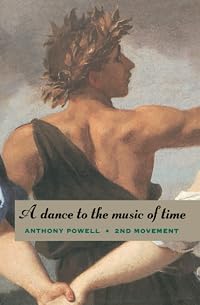
The writing is beautiful, poetic and absolutely flawless and drew me in from the first page. The opening page tells of some men, construction workers huddled around a small fire, trying to warm themselves in the frigid temperatures and it brings to mind the well-known painting that the books’ cover, and the stories inside, convey.
”For some reason, the sight of snow descending on fire always makes me think of the ancient world----legionaries in sheepskin warming themselves at a brazier; mountain altars where offerings show more glow between wintry pillars: centaurs with torches cantering beside a frozen sea---scattered, uncoordinated shapes from a fabulous past, infinitely removed from life; and yet bringing with them memories of things real and imagined. These classical projections, and something in the physical attitudes of the men themselves as they turned from the fire, suddenly suggested Poussin’s scene in which the Seasons, hand in hand and facing outward, tread in rhythm to the notes of the lyre that the winged and naked greybeard plays. The image of Time brought thoughts of mortality: of human beings, facing outward like the Seasons, moving hand in hand in intricate measure: stepping slowly, methodically, sometimes a trifle awkwardly, in evolutions that take recognizable shape: or breaking into meaningless gyrations, while partners disappear only to reappear again, once more giving pattern to the spectacle: unable to control the melody, unable, perhaps, to control the steps of the dance. (Page 2)
But just reading that paragraph explains in great detail exactly what this series will be about. So far, four school chums in Britain, graduate and are ready to face either university or a career and we’re along for the ride as the 1920s fade and the 1930s introduce themselves to the world. I have a feeling it’s going to be quite a ride. show less
The writing is beautiful, poetic and absolutely flawless and drew me in from the first page. The opening page tells of some men, construction workers huddled around a small fire, trying to warm themselves in the frigid temperatures and it brings to mind the well-known painting that the books’ cover, and the stories inside, convey.
”For some reason, the sight of snow descending on fire always makes me think of the ancient world----legionaries in sheepskin warming themselves at a brazier; mountain altars where offerings show more glow between wintry pillars: centaurs with torches cantering beside a frozen sea---scattered, uncoordinated shapes from a fabulous past, infinitely removed from life; and yet bringing with them memories of things real and imagined. These classical projections, and something in the physical attitudes of the men themselves as they turned from the fire, suddenly suggested Poussin’s scene in which the Seasons, hand in hand and facing outward, tread in rhythm to the notes of the lyre that the winged and naked greybeard plays. The image of Time brought thoughts of mortality: of human beings, facing outward like the Seasons, moving hand in hand in intricate measure: stepping slowly, methodically, sometimes a trifle awkwardly, in evolutions that take recognizable shape: or breaking into meaningless gyrations, while partners disappear only to reappear again, once more giving pattern to the spectacle: unable to control the melody, unable, perhaps, to control the steps of the dance. (Page 2)
But just reading that paragraph explains in great detail exactly what this series will be about. So far, four school chums in Britain, graduate and are ready to face either university or a career and we’re along for the ride as the 1920s fade and the 1930s introduce themselves to the world. I have a feeling it’s going to be quite a ride. show less
If you would like to join our GoodReads group BOOKS DO FURNISH A ROOM, then please come on down! As part of this project for 2012, I've written a blog post about re-reading 'A Question of Upbringing' so if you'd like to read this review with the formatting and photo, then here is a link: http://wp.me/p2BcDB-dp )
LIKE BACH, ONLY WITH JOKES.
Having not done any of the background reading about Anthony Powell and A Dance to the Music that I promised myself I would have completed by now, I fear that everything I am about to say is going to turn out to be a hostage to fortune. However, consider if you will, the open sequence, in which a group of men cook kippers on a fire as they wait to start work:
"The men at work at the corner of the street show more had made a kind of camp for themselves, where, marked out by tripods hung with red hurricane-lamps, an abyss in the road [leading] down to a network of subterranean drain-pipes."
From this glimpse of a morning ritual, of spending together, before settling down to spend the time required of wage slaves, to the images of eternity carried by the snow on primeval fire, Powell sets out his stall of time in all her guises. He slides us back and forth in time, in the moment here, looking forward there, and then back again to the classical era. There are references to the time-passing of the seasons, the way evolutions crawls through time, time as it is measured, images of its accumulation in falling snow, and embers devoured, and the signatures it leaves on music, or the wisdom it offers through hindsight, the torment of regret, the notions of Halcyon school days, and the melancholic nostalgia that comes from having lived through enough of the stuff to finally realise you can only really appreciate what has gone on once it is all too late.
And, all of this, in about a thousand words. Not bad. Not bad at all.
If Powell had written this staggering opening at the end of the twelve novels, it might all be a bit easier to fathom. But to have been in possession of this level of overview at the outset of a twenty-four year project seems to me to border on the inhumanly clever.
Re-reading A Question of Upbringing with a gap of some twenty odd years, the thing which really jumped off the page at me was, how on earth did I not remember this as being significantly more brilliant? Why did I let quite so much time pass before picking up the thread and deciding to carry on with the rest of the novels in the Dance?
I suspect, hear again, the answer is time. For while I can clearly remember thinking it was very entertaining in its observations of character, it has taken me this long to develop both the reading skills, and life experience, to delve a little deeper.
Since the second most common word I associate with Dance is plot - and the worrying, alleged lack thereof - I suppose I came to this expecting it to be slightly hard work. Lately it feels I can barely get through a day without hearing someone say that writers must 'grab the reader' in the first page, and then cling to their bloodied throats throughout. So it turned out to be an almost paradoxical delight to be totally immersed in something relatively plot-less for a change.
If anything, it struck me that Powell didn’t even bother to entertain that lofty Flaubertien ideal of having no time for the lazy reader. His indifference is far more complete. Powell’s interest, or so it appears, are the English language, and how it can best be used to document his characters. This is English as a loupe, if you will.
The results are exquisite, leaving the reader feeling a bit indecent at times, the uninvited voyeuse at the party, thrilled to be turning pages. Plot or no plot, I gobbled it up. No shame whatsoever. For the reader-within, it is pure joy. For the writer, it’s like every sentence is a masterclass. I’m struck in particular at the dizzying array of lessons Powell serves up on characterization.
Fittingly, the first person we see through Jenkins’ eyes is Widmerpool, whom, we are told, “was known to go voluntarily for ‘a run’ by himself every afternoon”. How deft that one word, voluntarily. For it manages to be a stone lobbed in two directions at once. The first at Widmerpool’s disconcerting keenness, the second at Jenkins’ unforgiving nature (although what more could one ask for in a narrator). As will be alluded to more than once, Widmerpool is said to have 'made himself memorable' by wearing 'the wrong kind of overcoat'. Again, Powell uses a simple word, made to carry enormous narrative freight.
The second big entrance is reserved for Stringham, who doesn’t so much come onto Jenkins’ stage as, fittingly, the other way around. So that in our first sight of Stringham he is hunched over the grate in his study, cooking sausages for the tea.
"Without looking up, he said: ‘There is a jam crisis."
How perfect is that? Eleven words long, and simply by not looking up from his utter self-absorbed crisis, young Stringham is already giving Sebastian Flyte a run for his money.
Better still, if the spoilers I’ve read are to be trusted, both of these can safely be filed under start-as-we-mean-to-go-on. It’s probably too early for theorizing, but even having just read A Question of Upbringing, it’s hard not to wonder if there are signs of a descriptive thread developing. For someone who seems to have a rich visual memory, and to frequently describe the world in terms of paintings, Jenkins’ tends not to extend this classification to people. If anything, there is relatively little physical description of people, and not least when compared to other novels set in this period. Jenkins is not so much interested in how others appear, so much as in how they conduct themselves. It already feels very much a case of, in the world of A Dance to the Music of Time, character is as character does (or, sometimes, does not).
Or, have I got this completely wrong? Only more reading will tell.
A prediction which seems a safer bet, is that the rest of Dance will prove equally laden with wise, prescient observations on the structural flow of life, and how seemingly uneventful coincidences have a way of stacking up. I was particularly taken with this pearl, from just before Le Bas is about to reappear without warning on stage next to Jenkins.
"There are certain people who seem inextricably linked in life; so that meeting one acquaintance in the street means that a letter, without fail, will arrive in a day or two from an associate involuntarily harnessed to him, or her, in time."
It is impossible to say from this vantage point, but as we have now been told that it is going to be some time before Stringham reappears in Jenkins’ life, I am already very much, albeit somewhat irrationally, hoping his next reappearance will also be signalled by an appearance from Le Bas.
There were also one or two other surprises lying in wait during this re-reading. The first was that, having read warnings about how the prose tended towards the labyrinthine, I was expecting it to be, if not hard work, exactly, then improving, shall we say. While it is definitely this, A Question of Upbringing is also a remarkably easy read. It flew by, read in three short sittings. Yes, Anthony Powell’s sentences are longer than, say, Dan Brown’s. But there is something almost meditative about their rhythm. I can’t read Powell while answering email and watching Borgen, but once I gave myself over to it completely, I decided it was a bit like listening to Bach, but with jokes. Closing the book after a few hours I feel inspired and rested, and looking forward to more. show less
LIKE BACH, ONLY WITH JOKES.
Having not done any of the background reading about Anthony Powell and A Dance to the Music that I promised myself I would have completed by now, I fear that everything I am about to say is going to turn out to be a hostage to fortune. However, consider if you will, the open sequence, in which a group of men cook kippers on a fire as they wait to start work:
"The men at work at the corner of the street show more had made a kind of camp for themselves, where, marked out by tripods hung with red hurricane-lamps, an abyss in the road [leading] down to a network of subterranean drain-pipes."
From this glimpse of a morning ritual, of spending together, before settling down to spend the time required of wage slaves, to the images of eternity carried by the snow on primeval fire, Powell sets out his stall of time in all her guises. He slides us back and forth in time, in the moment here, looking forward there, and then back again to the classical era. There are references to the time-passing of the seasons, the way evolutions crawls through time, time as it is measured, images of its accumulation in falling snow, and embers devoured, and the signatures it leaves on music, or the wisdom it offers through hindsight, the torment of regret, the notions of Halcyon school days, and the melancholic nostalgia that comes from having lived through enough of the stuff to finally realise you can only really appreciate what has gone on once it is all too late.
And, all of this, in about a thousand words. Not bad. Not bad at all.
If Powell had written this staggering opening at the end of the twelve novels, it might all be a bit easier to fathom. But to have been in possession of this level of overview at the outset of a twenty-four year project seems to me to border on the inhumanly clever.
Re-reading A Question of Upbringing with a gap of some twenty odd years, the thing which really jumped off the page at me was, how on earth did I not remember this as being significantly more brilliant? Why did I let quite so much time pass before picking up the thread and deciding to carry on with the rest of the novels in the Dance?
I suspect, hear again, the answer is time. For while I can clearly remember thinking it was very entertaining in its observations of character, it has taken me this long to develop both the reading skills, and life experience, to delve a little deeper.
Since the second most common word I associate with Dance is plot - and the worrying, alleged lack thereof - I suppose I came to this expecting it to be slightly hard work. Lately it feels I can barely get through a day without hearing someone say that writers must 'grab the reader' in the first page, and then cling to their bloodied throats throughout. So it turned out to be an almost paradoxical delight to be totally immersed in something relatively plot-less for a change.
If anything, it struck me that Powell didn’t even bother to entertain that lofty Flaubertien ideal of having no time for the lazy reader. His indifference is far more complete. Powell’s interest, or so it appears, are the English language, and how it can best be used to document his characters. This is English as a loupe, if you will.
The results are exquisite, leaving the reader feeling a bit indecent at times, the uninvited voyeuse at the party, thrilled to be turning pages. Plot or no plot, I gobbled it up. No shame whatsoever. For the reader-within, it is pure joy. For the writer, it’s like every sentence is a masterclass. I’m struck in particular at the dizzying array of lessons Powell serves up on characterization.
Fittingly, the first person we see through Jenkins’ eyes is Widmerpool, whom, we are told, “was known to go voluntarily for ‘a run’ by himself every afternoon”. How deft that one word, voluntarily. For it manages to be a stone lobbed in two directions at once. The first at Widmerpool’s disconcerting keenness, the second at Jenkins’ unforgiving nature (although what more could one ask for in a narrator). As will be alluded to more than once, Widmerpool is said to have 'made himself memorable' by wearing 'the wrong kind of overcoat'. Again, Powell uses a simple word, made to carry enormous narrative freight.
The second big entrance is reserved for Stringham, who doesn’t so much come onto Jenkins’ stage as, fittingly, the other way around. So that in our first sight of Stringham he is hunched over the grate in his study, cooking sausages for the tea.
"Without looking up, he said: ‘There is a jam crisis."
How perfect is that? Eleven words long, and simply by not looking up from his utter self-absorbed crisis, young Stringham is already giving Sebastian Flyte a run for his money.
Better still, if the spoilers I’ve read are to be trusted, both of these can safely be filed under start-as-we-mean-to-go-on. It’s probably too early for theorizing, but even having just read A Question of Upbringing, it’s hard not to wonder if there are signs of a descriptive thread developing. For someone who seems to have a rich visual memory, and to frequently describe the world in terms of paintings, Jenkins’ tends not to extend this classification to people. If anything, there is relatively little physical description of people, and not least when compared to other novels set in this period. Jenkins is not so much interested in how others appear, so much as in how they conduct themselves. It already feels very much a case of, in the world of A Dance to the Music of Time, character is as character does (or, sometimes, does not).
Or, have I got this completely wrong? Only more reading will tell.
A prediction which seems a safer bet, is that the rest of Dance will prove equally laden with wise, prescient observations on the structural flow of life, and how seemingly uneventful coincidences have a way of stacking up. I was particularly taken with this pearl, from just before Le Bas is about to reappear without warning on stage next to Jenkins.
"There are certain people who seem inextricably linked in life; so that meeting one acquaintance in the street means that a letter, without fail, will arrive in a day or two from an associate involuntarily harnessed to him, or her, in time."
It is impossible to say from this vantage point, but as we have now been told that it is going to be some time before Stringham reappears in Jenkins’ life, I am already very much, albeit somewhat irrationally, hoping his next reappearance will also be signalled by an appearance from Le Bas.
There were also one or two other surprises lying in wait during this re-reading. The first was that, having read warnings about how the prose tended towards the labyrinthine, I was expecting it to be, if not hard work, exactly, then improving, shall we say. While it is definitely this, A Question of Upbringing is also a remarkably easy read. It flew by, read in three short sittings. Yes, Anthony Powell’s sentences are longer than, say, Dan Brown’s. But there is something almost meditative about their rhythm. I can’t read Powell while answering email and watching Borgen, but once I gave myself over to it completely, I decided it was a bit like listening to Bach, but with jokes. Closing the book after a few hours I feel inspired and rested, and looking forward to more. show less
The first of Anthony Powell's epic 12 volume saga, this is a nice introduction, but little more. This first book focusses on our narrator, one Nick Jenkins, and his youthful adventures in a series of vignettes serving to introduce us to a host of characters, and their place in post WWI British society.
The writing is, befitting a classic, very good -a dry, sometimes bordering on sardonic style, with some simply gorgeous turns of phrase and even entire paragraphs.
As a standalone novel, it's not very strong. However, knowing there are 11 more novels to come, covering Nick's entire life, there is a very strong sense of all the pieces being set up on a board. I thought perhaps a chessboard, but it's more complex than even that really, more show more like watching a master set up one of those huge and intricate domino falls. It's mesmerising to watch, but it's only a precursor to the real action - and just because you can see the patterns already, doesn't mean that something surprising and wonderful won't happen when the dominoes begin to fall.
So 3 stars, because as much as I liked it, I didn't love it... but I have a feeling I will come to love this series as a whole. I also suspect, there is much richness and foreshadowing that would be found upon a re-read, once I've finished all 12 books. I have a feeling that after this book club read, one novel a month for all of 2016, I may very well be turning around and re-reading them all from the start again. show less
The writing is, befitting a classic, very good -a dry, sometimes bordering on sardonic style, with some simply gorgeous turns of phrase and even entire paragraphs.
As a standalone novel, it's not very strong. However, knowing there are 11 more novels to come, covering Nick's entire life, there is a very strong sense of all the pieces being set up on a board. I thought perhaps a chessboard, but it's more complex than even that really, more show more like watching a master set up one of those huge and intricate domino falls. It's mesmerising to watch, but it's only a precursor to the real action - and just because you can see the patterns already, doesn't mean that something surprising and wonderful won't happen when the dominoes begin to fall.
So 3 stars, because as much as I liked it, I didn't love it... but I have a feeling I will come to love this series as a whole. I also suspect, there is much richness and foreshadowing that would be found upon a re-read, once I've finished all 12 books. I have a feeling that after this book club read, one novel a month for all of 2016, I may very well be turning around and re-reading them all from the start again. show less
Members
- Recently Added By
Lists

Time Magazine's "All-Time 100"
113 works; 15 members

Top Five Books of 2016
795 works; 229 members

1,001 BYMRBYD Concensus
723 works; 27 members

Books Read in 2021
5,361 works; 114 members
Talk Discussions
Past Discussions
Group Read: A Dance to the Music of Time - January: A Question of Upbringing in 1001 Books to read before you die (January 2014)
A Dance to the Music of Time GR 2013 - January: A Question of Upbringing in 75 Books Challenge for 2013 (January 2013)
Author Information

61+ Works 13,440 Members
Anthony Powell was born on December 21, 1905 in Westminster, England and was educated at Eton College and Balliol College, Oxford. In 1926 he became an editor at Duckworth & Co. and later moved on to be a scriptwriter for Warner Brothers. By 1937 he was a regular contributor to The Spectator and the Daily Telegraph. From 1953-1959 Powell was the show more Literary Editor of Punch. His first book, The Barnard Letter, was published in 1928 and his first novel, Afternoon Men, was published in 1931. In 1951 Powell published A Question of Upbringing, which was the first of the 12-novel sequence A Dance to the Music of Time. In 1975 he published Hearing Secret Harmonies, which was the last novel of the sequence. Powell wrote Infants of the Spring, which is part of To Keep the Ball Rolling, his memoirs. He also published The Fisher King in 1986. Anthony Powell died peacefully at his home, The Chantry, aged 94 on March 28, 2000. (Bowker Author Biography) show less
Some Editions
Awards and Honors
Notable Lists
Series

Work Relationships
Is contained in
Has as a reference guide/companion
Common Knowledge
- Canonical title
- A Question of Upbringing
- Original title
- A Question of Upbringing
- Alternate titles*
- Een dans op muziek van de tijd 1 (rug- en omslagtitel) (rug- en omslagtitel)
- Original publication date
- 1951
- People/Characters
- Nicholas Jenkins; Kenneth Widmerpool; Jean Templer; Peter Templer; Charles Stringham; Giles Jenkins (show all 7); Sillery
- Important places
- England, UK; Eton, England, UK; London, England, UK; University of Oxford, Oxford, Oxfordshire, England, UK; Oxford, Oxfordshire, England, UK
- Related movies
- A Dance to the Music of Time (1997 | IMDb)
- Dedication
- FOR T.R.D.P.
- First words
- The men at work at the corner of the street had made a kind of a camp for themselves, where, marked out by tripods hung with red hurricane-lamps, an abyss in the road led down to a network of subterranean drainpipes.
- Last words
- (Click to show. Warning: May contain spoilers.)We discussed the Trust untilit was time to catch my train.
- Original language*
- Engels
- Disambiguation notice
- The "Dance to the Music of Time (Seasons)" are omnibus editions
*Some information comes from Common Knowledge in other languages. Click "Edit" for more information.
Classifications
Statistics
- Members
- 1,115
- Popularity
- 22,805
- Reviews
- 29
- Rating
- (3.64)
- Languages
- 6 — Dutch, English, Finnish, French, German, Swedish
- Media
- Paper, Audiobook, Ebook
- ISBNs
- 25
- ASINs
- 26