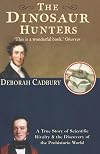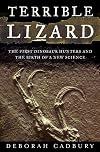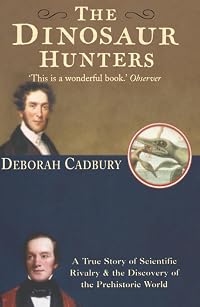
The Dinosaur Hunters: A True Story of Scientific Rivalry and the Discovery of the Prehistoric World
by Deborah Cadbury
On This Page
Description
In "The Dinosaur Hunters" Deborah Cadbury recreates the remarkable story of the bitter rivalry between two men: Gideon Mantell uncovered giant bones in a Sussex quarry, became obsessed with the lost world of the reptiles and was driven to despair. Richard Owen, a brilliant anatomist, gave the extinct creatures their name and secured for himself unrivalled international acclaim.Tags
Recommendations









Member Recommendations
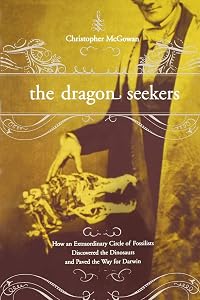
souloftherose Remarkable Creatures is a fictional account of Mary Anning and her fossils. The Dinosaur Hunters is a very readable factual account of the people hunting for fossils in the early 19th century which included Mary Anning.
nessreader Despite the dry title, v & the p is a riveting narrative about the english dawn of geology as a topic, with masses of illustrations and lively descriptions
Member Reviews
This is an account of the early discoveries of fossils of dinosaurs and other early creatures, and the evolution (pardonable pun) of knowledge of and thought about the early history of life on earth, throughout the first half of the 19th century. Two key early discoveries are those of the icthyosaur by Mary Anning in Lyme Regis, and the iguanadon by Gideon Mantell in Lewes in Sussex. These two come across as appealing and very ordinary human individuals, often taken advantage of by others. This is especially so for Anning, discovering fossils very early on as a girl and young woman in the 1810s and 20s; but also in a different way for Mantell, who, lacking the advantages of inherited wealth and free time of other early pioneers in the show more field, had to make his mark as a country doctor, helping and sometimes saving the lives of his poor patients, while trying in his spare time to pursue his passion for geology, a passion that strained his happy marriage to eventual breaking point.
One of the key themes as the book goes on is the bitter rivalry between Mantell and anatomist Richard Owen, coiner of the word "dinosaur" and later the founder and first director of the Natural History Museum in London. Owen, while a brilliant man in his own right, was also unscrupulous in claiming credit for discoveries made by Mantell and others, and diminishing their achievements for the sake of his own self-aggrandisement; this worked for him, and he became tutor to Queen Victoria's children, and played a pivotal role in the organisation of the Great Exhibition in 1851. Even after Mantell's tragic death in 1852, wracked by pain caused by being thrown from a carriage a decade earlier and injuring his back, and only able to function by managing the pain with opiates, Owen rubbished Mantell's work and character in an ostensibly anonymous obituary. In a bizarre and rather unsavoury twist of fate, Mantell's twisted spine ended up as an exhibit in Owen's collection. (as an aside, the spine remained in the Royal College of Surgeons until the mid-20th century; Cadbury says it was bombed in the Blitz, though other sources say it was voluntarily destroyed in 1969 due to lack of space).
Another key theme in the book is the battle between science and religion, but it is not cast in the simple Darwinism vs. creationism paradigm; rather it was a gradual movement of the centre of gravity of mainstream scientific opinion along a spectrum of thought where, for much of the three or four decades before Darwin's Origin of Species was published in 1859, the growing evidence for the development of forms of life and the relations between them was accepted (in the teeth of opposition from creationists), but along with an assumption that God provided the original spark for life in the first place and that he wrote the rules by which life forms developed (in modern parlance, "intelligent design"). Owen was an epitome of this view. Darwin and Huxley of course changed the paradigm in the 1860s and later, such that Owen's reputation was ironically itself trashed somewhat unfairly after his death in 1892, and his life's work dismissed due to his opposition to Darwinism.
This was a fascinating read. Unfortunately this Kindle version lacked the illustrations in the print version (which I used to have, but which has annoyingly disappeared from my shelves!). show less
One of the key themes as the book goes on is the bitter rivalry between Mantell and anatomist Richard Owen, coiner of the word "dinosaur" and later the founder and first director of the Natural History Museum in London. Owen, while a brilliant man in his own right, was also unscrupulous in claiming credit for discoveries made by Mantell and others, and diminishing their achievements for the sake of his own self-aggrandisement; this worked for him, and he became tutor to Queen Victoria's children, and played a pivotal role in the organisation of the Great Exhibition in 1851. Even after Mantell's tragic death in 1852, wracked by pain caused by being thrown from a carriage a decade earlier and injuring his back, and only able to function by managing the pain with opiates, Owen rubbished Mantell's work and character in an ostensibly anonymous obituary. In a bizarre and rather unsavoury twist of fate, Mantell's twisted spine ended up as an exhibit in Owen's collection. (as an aside, the spine remained in the Royal College of Surgeons until the mid-20th century; Cadbury says it was bombed in the Blitz, though other sources say it was voluntarily destroyed in 1969 due to lack of space).
Another key theme in the book is the battle between science and religion, but it is not cast in the simple Darwinism vs. creationism paradigm; rather it was a gradual movement of the centre of gravity of mainstream scientific opinion along a spectrum of thought where, for much of the three or four decades before Darwin's Origin of Species was published in 1859, the growing evidence for the development of forms of life and the relations between them was accepted (in the teeth of opposition from creationists), but along with an assumption that God provided the original spark for life in the first place and that he wrote the rules by which life forms developed (in modern parlance, "intelligent design"). Owen was an epitome of this view. Darwin and Huxley of course changed the paradigm in the 1860s and later, such that Owen's reputation was ironically itself trashed somewhat unfairly after his death in 1892, and his life's work dismissed due to his opposition to Darwinism.
This was a fascinating read. Unfortunately this Kindle version lacked the illustrations in the print version (which I used to have, but which has annoyingly disappeared from my shelves!). show less
This material, despite its inherent interest (Victorian dinosaurs, man!), could easily have been dull in the hands of another writer. Thankfully, Cadbury keeps it very interesting, by turning it into a sort of group biography. This is the birth of paleontology, as told through the life histories of William Buckland, Mary Anning, Gideon Mantell, Richard Owen, Thomas Henry Huxley, and more. I particularly liked the story of Mary Anning, from carpenter's daughter to a key figure in paleontology, but always disadvantaged due to her class and gender. She sketches all these characters in with great deftness, and one enjoys learning little things about them as we go from "undergroundology" to the first instance of dinomania. I am so show more disappointed that I did not know about the Crystal Palace dinosaurs when I went to London! show less
Chock full of dinosaurs! And cool 19th century science, when everything was a curiosity.
So it's England and people have just started to realize that you could put fossils together to get giant skeletons. I was thinking about how insane that must have been -- nowadays, if you found a fossilized dinosaur skeleton in your backyard, it would be amazing but at least you'd start from the point of knowing what a dinosaur WAS. Imagine not knowing what dinosaurs were, and then finding the skeleton and realizing you had a FREAKISHLY GIANT LIZARD on your hands.
This book mostly focused on Gideon Mantell, a mostly self-taught amateur fossil-hunter, and Richard Owen, also brilliant but apparently a bit of a jerk who did not play well with others. show more Overall, the book was interesting and painted a very understandable picture of the context in which this study and research was happening -- they were wrong about a lot of things (we now know), but the incredible thing is how much they got right. show less
So it's England and people have just started to realize that you could put fossils together to get giant skeletons. I was thinking about how insane that must have been -- nowadays, if you found a fossilized dinosaur skeleton in your backyard, it would be amazing but at least you'd start from the point of knowing what a dinosaur WAS. Imagine not knowing what dinosaurs were, and then finding the skeleton and realizing you had a FREAKISHLY GIANT LIZARD on your hands.
This book mostly focused on Gideon Mantell, a mostly self-taught amateur fossil-hunter, and Richard Owen, also brilliant but apparently a bit of a jerk who did not play well with others. show more Overall, the book was interesting and painted a very understandable picture of the context in which this study and research was happening -- they were wrong about a lot of things (we now know), but the incredible thing is how much they got right. show less
Deeply enjoyable book about the early fossil hunters. Buckland, a decent Christian and pioneer geologist always struggling to reconcile his faith with the findings as they come in, Owen the wicked schemer, brilliant but really only interested in building his own empire, Huxley the steelily efficient destroyer of anyone who got in the way of science and her hero, Mantell, who struggled on against heartbreaking difficulties. He could only work in his spare time, and had limited money and no academic backup. He couldn't tear himself away from the hunt despite it destroying his marriage and livelihood, but he at least treated others with consideration.
Poignant incidental information about the death of Mantell's daughter and a sympathetic show more coverage of Mary Anning the unsung working class woman behind some of the finds. show less
Poignant incidental information about the death of Mantell's daughter and a sympathetic show more coverage of Mary Anning the unsung working class woman behind some of the finds. show less
Truly fabulous popular account of the scientific discoveries of dinosaurs, bringing in to great effect the undernoticed Mary Anning and Gideon Mantell instead of just the overbearing Richard Owen (who got his, in the end, but still). Excellently done and highly recommended.
A very interesting book that I enjoyed a lot. While it does not talk too much about dinosaurs, it's very interesting back story as to how dinosaurs were discovered. I worked as a guide at the Swedish Museum of Natural History, and I actually talk about a lot of the things that were brought up in this book, although in a very simplified manner. But now I'll actually know what I'm talking about!
My main concerns are that it's not entirely factually correct, for example it mentions that the biggest dinosaur was 40 meters long, and that's just not true. As far as I know there's not conclusive proof that any dinosaur was bigger than a bluewhale, which clocks in at around 33 meters. Argentionsaurus might be bigger but that was not the dinosaur show more mentioned. On the other hand, people might have believed that in 2001, so I'll give it a pass.
I did know that the church and religion influenced people and science back in the 1800s a lot, but I don't think I had realized just how much until I read this. While I know there are some people who will refuse to accept scientific evidence no matter how obvious it is, having the entire scientific community arguing that god created this and that and therefore it is impossible to accept what we've just found is just baffling.
Oh, and Richard Owens was a dick. I'm glad he's dead. show less
My main concerns are that it's not entirely factually correct, for example it mentions that the biggest dinosaur was 40 meters long, and that's just not true. As far as I know there's not conclusive proof that any dinosaur was bigger than a bluewhale, which clocks in at around 33 meters. Argentionsaurus might be bigger but that was not the dinosaur show more mentioned. On the other hand, people might have believed that in 2001, so I'll give it a pass.
I did know that the church and religion influenced people and science back in the 1800s a lot, but I don't think I had realized just how much until I read this. While I know there are some people who will refuse to accept scientific evidence no matter how obvious it is, having the entire scientific community arguing that god created this and that and therefore it is impossible to accept what we've just found is just baffling.
Oh, and Richard Owens was a dick. I'm glad he's dead. show less
Story of class & competition for glory over early dinosaur fossil finds. Very readable while comprehensively researched. Richard Owens comes out badly.
Read Oct 2005
Read Oct 2005
Members
- Recently Added By
Lists

Best Science Books for Non-Scientists
113 works; 57 members

Non-Fiction Worth Reading
1,015 works; 255 members

Used books to buy next
565 works; 1 member
Author Information

15 Works 2,857 Members
Deborah Cadbury is an award-winning TV science producer for the BBC. She is also the author of "The Feminization of Nature". She lives in London. (Bowker Author Biography)
Some Editions
Awards and Honors
Awards
Distinctions
Common Knowledge
- Original title
- The Dinosaur Hunters: A True Story of Scientific Rivalry and the Discovery of the Prehistoric World
- Alternate titles
- Terrible Lizard: The First Dinosaur Hunters and the Birth of a New Science
- Original publication date
- 2000
- People/Characters
- Richard Owen; Mary Anning; Gideon Mantell; Thomas Henry Huxley (T. H. Huxley); Charles Darwin [Charles Robert: 1809-1882]
- Important places
- Lyme Regis, Dorset, England, UK
- Dedication
- For my mother and Martin,
the first readers,
with love - First words
- On the south coast of England at Lyme Regis in Dorset, the cliffs tower over the surrounding landscape.
- Original language
- English
Classifications
Statistics
- Members
- 584
- Popularity
- 50,300
- Reviews
- 10
- Rating
- (3.98)
- Languages
- 5 — English, German, Italian, Spanish, Swedish
- Media
- Paper, Audiobook, Ebook
- ISBNs
- 15
- ASINs
- 6