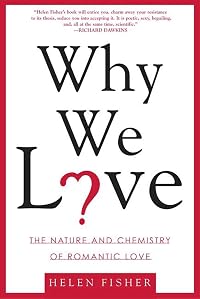
Why We Love: The Nature and Chemistry of Romantic Love
by Helen E. Fisher
On This Page
Description
A study of the origins of love probes the human brain for insights into the origins of the sex drive, romance, and attraction, while offering advice on how to channel these desires into healthy pursuits.Tags
Recommendations




Member Recommendations
Member Reviews
Why do we love?
Love inspired myths, legends, religions, and artworks from paintings to sculptures, and music to literature. Love affects even our most basic biological functions -appetite, sleep. Love can also be the source of sadness, depression, anger, and (paradoxically) hate, divorces, having even extreme consequences in some cases, including for example murders and suicides. In a word: love is but one big mystery! Or... Is it?
Helen Fisher, an anthropologist who seemed to have become the reference on the topic, attempts to answer the question. Surveying thousands of people across the continents, she starts by barging through an open door: no matter our ethnical background, our culture, our age, our education, even our sexual show more orientation, love is shared by us all and affects us all in the same ways. More than being universal, then, love is, first and foremost, something natural, biological, those origins must therefore be searched biologically: within the human brain.
She, therefore, first distinguishes three different phases (not necessarily inter-dependents): desire that is, sexual attraction for someone; romantic love that is, the famous 'love at first sight'; and attachment that is, the bond tying a loving relationship for the long term. She then tackles 'the mystery', working alongside neuroscientists and psychologists.
The result? Love is but a chemical reaction! Dopamine, norepinephrine, serotonin, testosterone, oestrogen, oxytocin, vasopressin... All various components getting activated in different parts of the brain depending on the different phases involved. From then on, of course, more questions arise! Like every chemical reactions, it cannot be eternal. How long does it last? Why these special bonds with that special someone? Why monogamy? Why faithfulness? Why jealousy? Why depression and/ or anger coming with unfulfilled, unrequited, failed love stories? This is where her expertise as an anthropologist is coming in handy! Helped by evolutionary biology, she, here, completes the answers brought about by chemistry... and Darwin meets poetry!
Here's a beautiful read, accessible, and full of literary references. Has the mystery been explained? Or, are here 'just so stories', seductive but reductionist somehow? I suspect, as with everything flirting with evolutionary psychology, that it's a mix of both. Nevertheless, it is, in any case, very engrossing! Love, after all, is about biology. show less
Love inspired myths, legends, religions, and artworks from paintings to sculptures, and music to literature. Love affects even our most basic biological functions -appetite, sleep. Love can also be the source of sadness, depression, anger, and (paradoxically) hate, divorces, having even extreme consequences in some cases, including for example murders and suicides. In a word: love is but one big mystery! Or... Is it?
Helen Fisher, an anthropologist who seemed to have become the reference on the topic, attempts to answer the question. Surveying thousands of people across the continents, she starts by barging through an open door: no matter our ethnical background, our culture, our age, our education, even our sexual show more orientation, love is shared by us all and affects us all in the same ways. More than being universal, then, love is, first and foremost, something natural, biological, those origins must therefore be searched biologically: within the human brain.
She, therefore, first distinguishes three different phases (not necessarily inter-dependents): desire that is, sexual attraction for someone; romantic love that is, the famous 'love at first sight'; and attachment that is, the bond tying a loving relationship for the long term. She then tackles 'the mystery', working alongside neuroscientists and psychologists.
The result? Love is but a chemical reaction! Dopamine, norepinephrine, serotonin, testosterone, oestrogen, oxytocin, vasopressin... All various components getting activated in different parts of the brain depending on the different phases involved. From then on, of course, more questions arise! Like every chemical reactions, it cannot be eternal. How long does it last? Why these special bonds with that special someone? Why monogamy? Why faithfulness? Why jealousy? Why depression and/ or anger coming with unfulfilled, unrequited, failed love stories? This is where her expertise as an anthropologist is coming in handy! Helped by evolutionary biology, she, here, completes the answers brought about by chemistry... and Darwin meets poetry!
Here's a beautiful read, accessible, and full of literary references. Has the mystery been explained? Or, are here 'just so stories', seductive but reductionist somehow? I suspect, as with everything flirting with evolutionary psychology, that it's a mix of both. Nevertheless, it is, in any case, very engrossing! Love, after all, is about biology. show less
I was led to this book after watching Helen Fisher’s 2006 TED talk entitled “Why we love, why we cheat.” Both the talk and the book are largely based on Fisher’s study, begun in 1996, of students at SUNY Stony Brook campus, in which the brain activities of two groups of volunteers were scanned in an MRI. One group reported to be deeply in love, while the other had recently experienced painful breakups. As one would expect, the book contains more details about the study, not provided in the TED talk, as well as additional facts and ideas.
Unfortunately little of the additional material qualifies as ground-breaking or transformative. Even the additional details about the central study do little to strengthen the author’s show more arguments. There is plenty of information about the experiment’s setup, but much of it assumes a rather banal character and, while perhaps mildly entertaining, is not revelatory. More troubling, the 144 brain scans mentioned by the author in her TED talk turn out to be derived from merely 14 individuals – 11 women and 3 men, all college students. Although I cannot authoritatively claim that this sample size is too small or too homogenous – much time has elapsed since my college statistics course – yet I cannot avoid a feeling of suspicion that too much is being made of too small a study.
What’s more, the numbers derived from the study are at times less convincing than the author would have us believe, hinting at a confirmation bias. For example, only 56% of the surveyed women agreed with the statement “My emotional state depends on how _____ feels about me”, yet this is given as further evidence of the author’s hypothesis. This is not a solitary example – on multiple occasions percentages in the low sixties, fifties, and even forties are unreservedly advanced to prove the author’s points, which aim at a generalized understanding. Overall the book seems to lack coherence and reads more like a loose collection of research abstracts, ideas, factoids, and quotes – lots of quotes, which are largely lyrical musings about the nature of love.
Throughout the book, the author also shows a strong proclivity for speculation, seemingly mistaking it for theory. A theory by definition must be falsifiable, yet the author commonly uses the word to refer to what is plainly untestable conjecture, which I think is impermissible in a scientist. Unsurprisingly, the chapter most heavenly laden with such “theorizing” is the one on the evolutionary origins of love. Such speculation may be intelligent, intriguing, and entertaining, but it is not strictly scientific.
Perhaps, my biggest gripe with the book though is the conclusion the author draws from her research. A good percentage of “Why We Love” is devoted to convincing us that romantic live is inherently a neurochemical addiction, not at all dissimilar from alcohol, tobacco or methamphetamine addictions either behaviorally or in its effect on the brain’s neurological pathways. In fact, this is the strongest part of the book, and the reason for my three-star rating. The presented evidence is indeed strongly in favor of the hypothesis. So, after spending so much ink proving to us that romantic love displays all the classic characteristics of a chemical addiction, what does the author propose that we do with this information? She proceeds to give us tips on how to manipulate individuals into developing romantic attachments and make romantic love last longer! Pause to consider the incongruity. This is a rational response only if one believes that the rewards of an addiction are worth the costs, and maybe the author performed the mental comparison, but if she did, she never shares these deliberations with us. As a result, the last part of the book seems oddly disconnected from the first, with the gap bridged by undisclosed value assumptions.
To recap, the book contains enough interesting ideas and data to stimulate thinking but fails to weave them into a coherent theoretical framework or a transformative narrative. Aside from monetary motivations, I am hard pressed to find reasons why this should not have been a TEDBook or a Kindle Single. show less
Unfortunately little of the additional material qualifies as ground-breaking or transformative. Even the additional details about the central study do little to strengthen the author’s show more arguments. There is plenty of information about the experiment’s setup, but much of it assumes a rather banal character and, while perhaps mildly entertaining, is not revelatory. More troubling, the 144 brain scans mentioned by the author in her TED talk turn out to be derived from merely 14 individuals – 11 women and 3 men, all college students. Although I cannot authoritatively claim that this sample size is too small or too homogenous – much time has elapsed since my college statistics course – yet I cannot avoid a feeling of suspicion that too much is being made of too small a study.
What’s more, the numbers derived from the study are at times less convincing than the author would have us believe, hinting at a confirmation bias. For example, only 56% of the surveyed women agreed with the statement “My emotional state depends on how _____ feels about me”, yet this is given as further evidence of the author’s hypothesis. This is not a solitary example – on multiple occasions percentages in the low sixties, fifties, and even forties are unreservedly advanced to prove the author’s points, which aim at a generalized understanding. Overall the book seems to lack coherence and reads more like a loose collection of research abstracts, ideas, factoids, and quotes – lots of quotes, which are largely lyrical musings about the nature of love.
Throughout the book, the author also shows a strong proclivity for speculation, seemingly mistaking it for theory. A theory by definition must be falsifiable, yet the author commonly uses the word to refer to what is plainly untestable conjecture, which I think is impermissible in a scientist. Unsurprisingly, the chapter most heavenly laden with such “theorizing” is the one on the evolutionary origins of love. Such speculation may be intelligent, intriguing, and entertaining, but it is not strictly scientific.
Perhaps, my biggest gripe with the book though is the conclusion the author draws from her research. A good percentage of “Why We Love” is devoted to convincing us that romantic live is inherently a neurochemical addiction, not at all dissimilar from alcohol, tobacco or methamphetamine addictions either behaviorally or in its effect on the brain’s neurological pathways. In fact, this is the strongest part of the book, and the reason for my three-star rating. The presented evidence is indeed strongly in favor of the hypothesis. So, after spending so much ink proving to us that romantic love displays all the classic characteristics of a chemical addiction, what does the author propose that we do with this information? She proceeds to give us tips on how to manipulate individuals into developing romantic attachments and make romantic love last longer! Pause to consider the incongruity. This is a rational response only if one believes that the rewards of an addiction are worth the costs, and maybe the author performed the mental comparison, but if she did, she never shares these deliberations with us. As a result, the last part of the book seems oddly disconnected from the first, with the gap bridged by undisclosed value assumptions.
To recap, the book contains enough interesting ideas and data to stimulate thinking but fails to weave them into a coherent theoretical framework or a transformative narrative. Aside from monetary motivations, I am hard pressed to find reasons why this should not have been a TEDBook or a Kindle Single. show less
This book got off on the wrong foot with me right from the beginning. I found the first two chapters -- on the "symptoms" of romantic love as exemplified by literature and poetry and on behaviors that look like love in animals -- to be shallow, overgeneralized, and far too willing to present anecdotes as if they were evidence. Things got a bit better in chapter three, where Fisher started talking about hormones, brain chemistry, and her own fMRI experiments on people in love. But most of the rest of the book was oversimplified and overly speculative. Particularly problematic were the discussions of gender differences; this is an interesting and valid topic, but more often than not it's impossible to tell whether Fisher's assertions on show more the subject are based on science or stereotype. And to top it all off, she throws in a chapter full of insipid self-help advice at the end.
All in all, a fairly disappointing take on what ought to be a fascinating subject. show less
All in all, a fairly disappointing take on what ought to be a fascinating subject. show less
Intriguing book with a breakdown of multiple surveys, brain chemistry, and anatomy. Loses one star based on the promotion of ignoring others.
The book states you should ignore another to remove them from your thoughts. Yet also states that memories of a lover may never leave you but is reduced in time. As explained in the book, one of the main questions one may ask after a relationship has ended is what they did wrong. By endorsing others to ignore, the rejected may never receive that answer and can not move on.
The reason anger develops is from being ignored. Do not promote this. By talking things through you can identify differences, and reasons for relationship failure to easily move on.
I've had no interest in reigniting past show more relationships but human nature, the selfishness of others, and the common practice of ignoring instead of treating those with respect as people has driven me to reconsider life.
I appreciate the honesty in this book and the poor outlook of long term relationships due to human evolution has further decreased my view on mankind. show less
The book states you should ignore another to remove them from your thoughts. Yet also states that memories of a lover may never leave you but is reduced in time. As explained in the book, one of the main questions one may ask after a relationship has ended is what they did wrong. By endorsing others to ignore, the rejected may never receive that answer and can not move on.
The reason anger develops is from being ignored. Do not promote this. By talking things through you can identify differences, and reasons for relationship failure to easily move on.
I've had no interest in reigniting past show more relationships but human nature, the selfishness of others, and the common practice of ignoring instead of treating those with respect as people has driven me to reconsider life.
I appreciate the honesty in this book and the poor outlook of long term relationships due to human evolution has further decreased my view on mankind. show less
fantastic book - should be read in conjunction with the assorted other sex/love self help book around - even if it is just for the wonderful bibliography of love poems she quotes from the mirriad cultures aroudt he world.
This is woman who has loved and love and then seriously asked "why". It isa an academic research project on the fMRI assisted research into the neurology of loving. Compare it to Burnett's book: Happy Brain
Author talk on TED http://www.ted.com/index.php/talks/view/id/16
Members
- Recently Added By
Lists

How Humans Work
18 works; 1 member
Author Information

9+ Works 1,381 Members
Awards and Honors
Distinctions
Common Knowledge
- Canonical title*
- Miksi rakastumme : Romanttinen rakkaus ja miten säilytämme kipinän
- Original title
- Why We Love: The Nature and Chemistry of Romantic Love
- Alternate titles
- Why We Love
- Original publication date
- 2004
*Some information comes from Common Knowledge in other languages. Click "Edit" for more information.
Classifications
Statistics
- Members
- 452
- Popularity
- 67,499
- Reviews
- 7
- Rating
- (3.63)
- Languages
- 11 — Dutch, English, Estonian, Finnish, French, German, Hungarian, Italian, Polish, Portuguese, Spanish
- Media
- Paper, Audiobook, Ebook
- ISBNs
- 19
- ASINs
- 3