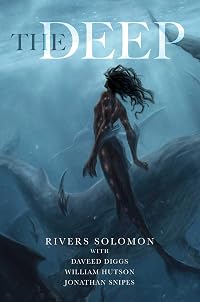
The Deep
by Rivers Solomon, clipping., Daveed Diggs, William Hutson, Jonathan Snipes
On This Page
Description
"The water-breathing descendants of African slave women tossed overboard have built their own underwater society -- and must reclaim the memories of their past to shape their future in this brilliantly imaginative novella inspired by the [...] song "The Deep" from Daveed Diggs's rap group clipping. Yetu holds the memories for her people -- water-dwelling descendants of pregnant African slave women thrown overboard by slave owners -- who live idyllic lives in the deep. Their past, too show more traumatic to be remembered regularly, is forgotten by everyone, save one -- the historian. This demanding role has been bestowed on Yetu. Yetu remembers for everyone, and the memories, painful and wonderful, traumatic and terrible and miraculous, are destroying her. And so, she flees to the surface, escaping the memories, the expectations, and the responsibilities -- and discovers a world her people left behind long ago. Yetu will learn more than she ever expected to about her own past -- and about the future of her people. If they are all to survive, they'll need to reclaim the memories, reclaim their identity -- and own who they really are. Inspired by a song produced by the rap group Clipping for the This American Life episode "We Are In The Future," The Deep is vividly original and uniquely affecting." -- show lessTags
Recommendations





Member Reviews
I haven't read a great adult mermaid novel in.... forever. The story was unique, dark, and captivating; although the plot was quite slow at time. Inspired by the pregnant African slaves who were thrown overboard to die on their way to America for being "disruptive" cargo; the authors wondered what happened to their unborn babies who were already breathing underwater in their mother's womb? Inspired may not be the right word; but that horrible back story helped mold this book into what it is. Yetu, an underwater being tasked with storing the entire history of her people, is barely hanging on. The history of the wajinru is a violent and bloody one and it wants to claw it's way out of Yetu. The wajinru are descended from the pregnant slave show more woman, yet that traumatic history is too much for their people to process so the historian (Yetu) must house all that painful history and bear the burden for all. Yetu must find a way to live with those truths or pass them onto others without breaking tradition. Dark, slow at times, but unique and enchanting! show less
[S]he didn't mind the unknowing because it came with such calm, such a freedom from the pain.
This is a novella based on a Clipping. song; the song was (to quote myself) "about an underwater race made up of the children of pregnant African women thrown off slave ships." I expected the novella to be about the original founding of the underwater species; to my surprise, it was about one of their descendants, an historian who carries her civilization's traumatic memories so everyone else can be spared them. (Some of the founding is filled in in flashback, but it's not the focus.) I expected the novella to be a mediocre Tor.comesque thing; to my surprise, it was a really powerful meditation on the pain of history versus the bliss of show more ignorance, and the need to reach out and embrace the unfamiliar. I will have to look out for more by Rivers Solomon. show less
This is a novella based on a Clipping. song; the song was (to quote myself) "about an underwater race made up of the children of pregnant African women thrown off slave ships." I expected the novella to be about the original founding of the underwater species; to my surprise, it was about one of their descendants, an historian who carries her civilization's traumatic memories so everyone else can be spared them. (Some of the founding is filled in in flashback, but it's not the focus.) I expected the novella to be a mediocre Tor.comesque thing; to my surprise, it was a really powerful meditation on the pain of history versus the bliss of show more ignorance, and the need to reach out and embrace the unfamiliar. I will have to look out for more by Rivers Solomon. show less
What do I even say about this book? It’s magical, heartwrenching, thoughtful, provoking, and reads with just enough adventure that the strong themes don’t become overwhelming and obvious. We are sent deep below the waves, to the kingdom of the wajinru, a race of mer-people who are the offspring of pregnant slave women thrown overboard during transit to the Americas. From this violent and unexpected beginning the wajinru have risen to become a unique society far separated from the human race, and yet they still face similar troubles. Their major difference (besides the fact that they are more communal, having taken on the characteristics of sea creatures) is that their collective memory of their history is kept by only one wajinru - show more the historian. The story we read is led by one of their historians, Yetu, and through Yetu’s rebellion against her role we explore themes of collective suffering, historical remembrance, and individuality. This story is clearly a poignant commentary on the slave trade, and its longstanding emotional and intellectual impact on the Black population, but told through this unexpected lens we are given new perspectives. Throughout the story we see pain, so much pain, through Yetu’s suffering as carrier of the wajinru’s painful and violent history, but we also see hope spring through her pain. Yetu abandons the annual remembrance ceremony in the hope that she will be able to lessen her own suffering and become herself once again, leaving her people to suffer in her stead. And yet, out of her act of selfishness we see the wajinru grow and accept that their method of curbing the pain in short term does nothing towards ultimately healing. We are left not knowing how the wajinru (and Yetu) carry out the rest of their days, but the message of growth leaves us with a feeling of hope towards the future. The novel may be pegged as fantasy by some, but its message is as strong as anything I’ve read and is absolutely poised to become a seminal novel in the years to come. show less
“The Remembrance took more than it gave. It required she remember and relive the wajinru’s entire history all at once. Not just that, she had to put order and meaning to the events, so that the others could understand. She had to help them open their minds so they could relive the past too. It was a painful process.”
Yetu is a historian. She is a part of the wajinru, a race of merfolk who live in the deep. They are descended from pregnant women thrown overboard during the slave trade. As historian, Yetu collects painful memories of her people’s past, which she harbors inside until the annual ceremony called the Remembrance. Historians are charged with stifling their own wants and needs in order to fulfill this important role in show more the community.
This book is a mix of fantasy, literary fiction, and folklore. Yetu is a vessel for storing memories, and she represents both the importance of memory (and by inference, history) as well as the manner in which these become diluted over time. Yetu comes into contact with the “two-legs,” as they call the human surface dwellers, and she realizes that her people’s environment is threatened by their actions.
This story is creatively and beautifully written. Solomon’s prose is elegant and lyrical. Though it is short (166 pages), it works on multiple levels – oral history, folk tale, legacy of slavery, environmental damage, and generational trauma. I particularly enjoyed the exploration of the dichotomy of memory. Do not miss the Afterword, which describes the mixture of original sources that resulted in this poetic and powerful novel.
4.5 show less
Yetu is a historian. She is a part of the wajinru, a race of merfolk who live in the deep. They are descended from pregnant women thrown overboard during the slave trade. As historian, Yetu collects painful memories of her people’s past, which she harbors inside until the annual ceremony called the Remembrance. Historians are charged with stifling their own wants and needs in order to fulfill this important role in show more the community.
This book is a mix of fantasy, literary fiction, and folklore. Yetu is a vessel for storing memories, and she represents both the importance of memory (and by inference, history) as well as the manner in which these become diluted over time. Yetu comes into contact with the “two-legs,” as they call the human surface dwellers, and she realizes that her people’s environment is threatened by their actions.
This story is creatively and beautifully written. Solomon’s prose is elegant and lyrical. Though it is short (166 pages), it works on multiple levels – oral history, folk tale, legacy of slavery, environmental damage, and generational trauma. I particularly enjoyed the exploration of the dichotomy of memory. Do not miss the Afterword, which describes the mixture of original sources that resulted in this poetic and powerful novel.
4.5 show less
Imagine if all of the pregnant slaves thrown overboard during the horrific middle passage went on to have children that survived and built a society underwater. That's the premise of The Deep, a book inspired by a rap song by Daveed Diggs' group Clipping. The story reminds me a bit of The Giver, with one individual in the society carrying the painful memories of their history. I read this after visiting the National Underground Railroad Freedom Center and had all of that history fresh in my mind, which gave the story an even deeper impact.
“What is belonging?” we ask. She says, “Where loneliness ends.”
“The deep will be our sibling, our parent, our relief from endless solitude. Down here, we are wrapped up. Down here, we can show more pretend the dark is the black embrace of another.” show less
“What is belonging?” we ask. She says, “Where loneliness ends.”
“The deep will be our sibling, our parent, our relief from endless solitude. Down here, we are wrapped up. Down here, we can show more pretend the dark is the black embrace of another.” show less
The Deep by Rivers Solomon is a novella that I bought just before the Hugo finalists were announced, with this novella among them. The premise was what particularly grabbed my attention: the horrible and fascinating premise that pregnant slaves thrown overboard birthed a new species of merpeople.
As is explained in the afterword, this novella is a piece of art in conversation with two previous pieces of art. Building on and reinterpreting the same mythology. You don’t really need to know any other background to understand the story, since each retelling (for lack of a better term) is entirely self-contained. That said, I think my understanding of events in The Deep was aided with having remembered the premise from the blurb. (Regular show more readers may remember that I rarely pay much attention to blurbs, but this is one case where I was glad to at least remember the premise.) A key aspect of worldbuilding/history is revealed slowly in the book and I think it helped me to have an idea of the characters’ origins a bit earlier. Your mileage may vary, however.
A key idea explored in The Deep is that if societal memory and specifically memory of trauma. The situation when the story opens is like this: one member of the wajinru people is the historian and only that person holds all the memories of past wajinru and events. Everyone else has a strong tendency not to dwell on or remember anything for very long. Our protagonist, Yetu, is the designated historian and not terribly happy with the role. Apart from anything else, she finds it difficult to be the repository of historical trauma for her entire species. She also finds it hard to interact with others who have such short memories, even about their own lives. As well as exploring how intergenerational trauma should be remembered, and by whom, The Deep questions whether it should be remembered at all, as Yetu grapples with some of these issues.
The Deep was a good read, though I found it was a little slow to start and not the sort of book I could read quickly. I recommend it to people interested in the premise and, perhaps, to fans of merpeople.
4 / 5 stars
You can read more of my reviews on my blog. show less
As is explained in the afterword, this novella is a piece of art in conversation with two previous pieces of art. Building on and reinterpreting the same mythology. You don’t really need to know any other background to understand the story, since each retelling (for lack of a better term) is entirely self-contained. That said, I think my understanding of events in The Deep was aided with having remembered the premise from the blurb. (Regular show more readers may remember that I rarely pay much attention to blurbs, but this is one case where I was glad to at least remember the premise.) A key aspect of worldbuilding/history is revealed slowly in the book and I think it helped me to have an idea of the characters’ origins a bit earlier. Your mileage may vary, however.
A key idea explored in The Deep is that if societal memory and specifically memory of trauma. The situation when the story opens is like this: one member of the wajinru people is the historian and only that person holds all the memories of past wajinru and events. Everyone else has a strong tendency not to dwell on or remember anything for very long. Our protagonist, Yetu, is the designated historian and not terribly happy with the role. Apart from anything else, she finds it difficult to be the repository of historical trauma for her entire species. She also finds it hard to interact with others who have such short memories, even about their own lives. As well as exploring how intergenerational trauma should be remembered, and by whom, The Deep questions whether it should be remembered at all, as Yetu grapples with some of these issues.
The Deep was a good read, though I found it was a little slow to start and not the sort of book I could read quickly. I recommend it to people interested in the premise and, perhaps, to fans of merpeople.
4 / 5 stars
You can read more of my reviews on my blog. show less
I found this book not only incredibly interesting (such an unusual and creative base, and yet also so immediately immersive) but lovely and also painful.
Yetu's pain with her life and her people is telegraphed clearly, and it drew me in to her hopelessness, anger, and eventual grasp at escape - and yet the story also twines the reader into how Yetu is so badly torn evenwhen she does escape the fate that has been killing her .
As I read more and got even further wound up in the story - both Yetu's and of all the wajinru, I truly desperately wanted a happy ending, but also dreaded where the ending would actually take me. I was, in the end, delighted withthe perhaps-not-perfect but incredible resolution that managed to remove the torturous show more worst from Yetu as Historian . . . and to bring Oori with her, never to be left behind again . show less
Yetu's pain with her life and her people is telegraphed clearly, and it drew me in to her hopelessness, anger, and eventual grasp at escape - and yet the story also twines the reader into how Yetu is so badly torn even
As I read more and got even further wound up in the story - both Yetu's and of all the wajinru, I truly desperately wanted a happy ending, but also dreaded where the ending would actually take me. I was, in the end, delighted with
Members
- Recently Added By
Lists

Books Read in 2023
5,547 works; 145 members

LGBTQIA Horror
172 works; 7 members

LGBTQ+ Speculative Fiction
821 works; 51 members

2020 Hugo Eligible Novellas
36 works; 7 members

Books Read in 2020
4,379 works; 124 members

2021
26 works; 1 member

Books With Water Words in the Title
186 works; 12 members

SFF standalone novellas with female protagonists
101 works; 4 members

LGBTQ+ SFF standalone novellas
42 works; 2 members

Trans/Queer Lit
48 works; 5 members

Books Read in 2024
4,623 works; 126 members

Every Lesbian Book I read
13 works; 1 member
Author Information

9+ Works 4,772 Members
8 Works 1,582 Members

4+ Works 1,596 Members
2 Works 1,571 Members
2 Works 1,564 Members
Some Editions
Awards and Honors
Awards
Work Relationships
Common Knowledge
- Canonical title
- The Deep
- Original title
- The Deep
- Original publication date
- 2019-11-05
- People/Characters
- Yetu; Oori
- Dedication
- To the ornery and ill-tempered --R.S.
This book and the song for which it's named would not exist without the work of Gerald Donald and James Stinson. --clipping. - First words
- "It was like dreaming," said Yetu, throat raw.
- Last words
- (Click to show. Warning: May contain spoilers.)This time, the two-legs venturing into the depths had not been abandoned to the sea, but invited into it.
- Publisher's editor
- Wolfe, Navah
- Blurbers
- Due, Tananarive; Machado, Carmen Maria; Anders, Charlie Jane; Leckie, Ann; Das, Indrapramit; El-Mohtar, Amal (show all 8); de Bodard, Aliette; Wells, Martha
- Original language
- English
Classifications
Statistics
- Members
- 1,575
- Popularity
- 14,491
- Reviews
- 100
- Rating
- (3.84)
- Languages
- English, French, Spanish, Turkish
- Media
- Paper, Audiobook, Ebook
- ISBNs
- 16
- ASINs
- 5
