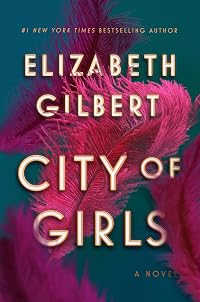
City of Girls
by Elizabeth Gilbert
On This Page
Description
Beloved author Elizabeth Gilbert returns to fiction with a unique love story set in the New York City theater world during the 1940s. Told from the perspective of an older woman as she looks back on her youth with both pleasure and regret (but mostly pleasure), City of Girls explores themes of female sexuality and promiscuity, as well as the idiosyncrasies of true love. In 1940, nineteen-year-old Vivian Morris has just been kicked out of Vassar College, owing to her lackluster freshman-year show more performance. Her affluent parents send her to Manhattan to live with her Aunt Peg, who owns a flamboyant, crumbling midtown theater called the Lily Playhouse. There Vivian is introduced to an entire cosmos of unconventional and charismatic characters, from the fun-chasing showgirls to a sexy male actor, a grand-dame actress, a lady-killer writer, and no-nonsense stage manager. But when Vivian makes a personal mistake that results in professional scandal, it turns her new world upside down in ways that it will take her years to fully understand. Ultimately, though, it leads her to a new understanding of the kind of life she craves - and the kind of freedom it takes to pursue it. It will also lead to the love of her life, a love that stands out from all the rest. Now eighty-nine years old and telling her story at last, Vivian recalls how the events of those years altered the course of her life - and the gusto and autonomy with which she approached it. "At some point in a woman's life, she just gets tired of being ashamed all the time," she muses. "After that, she is free to become whoever she truly is." Written with a powerful wisdom about human desire and connection, City of Girls is a love story like no other. show lessTags
Recommendations




Member Recommendations
Member Reviews
The Signature of All Things by Elizabeth Gilbert was a 5 star read for me in 2013, so I was eager to find out what her next book was going to be about. Released in 2019, City of Girls is set in 1940s New York and is about a young woman who works in a theatre and socialises with glamorous showgirls.
I made the mistake of assuming this was going to be an overtly feminine story in a setting I couldn't relate to and one that didn't interest me. So when I received a copy for review in mid 2019 it languished on my TBR pile.
I decided to give City of Girls a chance in January and figured the writing would at least hold my attention. Woah! I tumbled into Vivian Morris' story immediately and the setting was unexpectedly seductive. The plot had me show more entranced, Vivian's character development was completely unexpected as was the abundance of sex!
The deep personal revelations were incredibly moving and I found myself in the expert hands of Elizabeth Gilbert once again. I should have known better. Besides, Gilbert made the study of mosses riveting so I should have guessed she would wave her writing wand over the theatre scene of 1940s New York and produce a dazzling set of characters. Here are two quotes in particular I enjoyed.
"It's not difficult to compliment people in order to try to win their affections. What is difficult is to do it in the right way. Everyone told Celia she was beautiful, but nobody had ever told her she had the carriage of a trained ballerina. Nobody had ever told her she had a face made for her times." Page 118
And another.
"We'll be fine. She and I respect each other, which makes up for the fact that we dislike each other. Or, rather, I respect her. So that's something we share, at least. We have an excellent relationship based on a deep history of profound one-way respect, and plenty of it." Page 150
City of Girls by Elizabeth Gilbert is highly recommended for historical fiction lovers. This is not chick lit, this is not a romance novel. It's not a war novel either. It's a deep exploration of one woman's life, her sexual desire and the inner and outer expectations of those around her. It's a coming-of-age novel about choosing a different path. The reader will enjoy witnessing Vivian's personal growth and internal realisations and I found it very incredibly moving in parts.
* Copy courtesy of Bloomsbury Publishing * show less
I made the mistake of assuming this was going to be an overtly feminine story in a setting I couldn't relate to and one that didn't interest me. So when I received a copy for review in mid 2019 it languished on my TBR pile.
I decided to give City of Girls a chance in January and figured the writing would at least hold my attention. Woah! I tumbled into Vivian Morris' story immediately and the setting was unexpectedly seductive. The plot had me show more entranced, Vivian's character development was completely unexpected as was the abundance of sex!
The deep personal revelations were incredibly moving and I found myself in the expert hands of Elizabeth Gilbert once again. I should have known better. Besides, Gilbert made the study of mosses riveting so I should have guessed she would wave her writing wand over the theatre scene of 1940s New York and produce a dazzling set of characters. Here are two quotes in particular I enjoyed.
"It's not difficult to compliment people in order to try to win their affections. What is difficult is to do it in the right way. Everyone told Celia she was beautiful, but nobody had ever told her she had the carriage of a trained ballerina. Nobody had ever told her she had a face made for her times." Page 118
And another.
"We'll be fine. She and I respect each other, which makes up for the fact that we dislike each other. Or, rather, I respect her. So that's something we share, at least. We have an excellent relationship based on a deep history of profound one-way respect, and plenty of it." Page 150
City of Girls by Elizabeth Gilbert is highly recommended for historical fiction lovers. This is not chick lit, this is not a romance novel. It's not a war novel either. It's a deep exploration of one woman's life, her sexual desire and the inner and outer expectations of those around her. It's a coming-of-age novel about choosing a different path. The reader will enjoy witnessing Vivian's personal growth and internal realisations and I found it very incredibly moving in parts.
* Copy courtesy of Bloomsbury Publishing * show less
City of Girls – Elizabeth Gilbert
After a somewhat rocky start, Gilbert pulls this one out of the fire with beautifully developed, complex characters.
The book begins as the author/narrator sets out, at the age of 89, to send a “letter” (?) to answer the question of a young woman she barely knows. This reviewer is not fond of “framed” stories and generally gets very impatient with the style, but this one quickly settles down, then ultimately reveals the utterly necessary reason for the framework setup near the end of the book.
It all begins in 1940, when 19-year-old Vivian Morris is invited to leave Vassar and goes to New York City, where she stays with her aunt in a run-down, struggling neighborhood theater. An entirely new show more world opens up for her, and she leaps gleefully into the hard-partying life of a pretty young woman in The Big City.
Yet this is not a coming-of-age tale. It is more a coming-of-character tale, in which Vivian makes some whopper mistakes, ranging from trivial to life-altering, narrowly escapes matrimony, survives World War II, figures out who she wants to be, what she has to cling to, and what she has to give up in order to get there. And it’s all set against the lush, intense background of New York over three decades.
This is a meaty read with intriguing characters and a mystery that isn’t really a mystery until it’s revealed, at which point the reader realizes the point of it all.
Highly recommended. show less
After a somewhat rocky start, Gilbert pulls this one out of the fire with beautifully developed, complex characters.
The book begins as the author/narrator sets out, at the age of 89, to send a “letter” (?) to answer the question of a young woman she barely knows. This reviewer is not fond of “framed” stories and generally gets very impatient with the style, but this one quickly settles down, then ultimately reveals the utterly necessary reason for the framework setup near the end of the book.
It all begins in 1940, when 19-year-old Vivian Morris is invited to leave Vassar and goes to New York City, where she stays with her aunt in a run-down, struggling neighborhood theater. An entirely new show more world opens up for her, and she leaps gleefully into the hard-partying life of a pretty young woman in The Big City.
Yet this is not a coming-of-age tale. It is more a coming-of-character tale, in which Vivian makes some whopper mistakes, ranging from trivial to life-altering, narrowly escapes matrimony, survives World War II, figures out who she wants to be, what she has to cling to, and what she has to give up in order to get there. And it’s all set against the lush, intense background of New York over three decades.
This is a meaty read with intriguing characters and a mystery that isn’t really a mystery until it’s revealed, at which point the reader realizes the point of it all.
Highly recommended. show less
I'd succeeded in avoiding Elizabeth Gilbert until now - I didn't eat, pray, or love with her, or accompany her on her other life journeys either. I thought I could avoid this one as well, but it kept following me - showing up on "best of" lists, "maybe you'd like" etc. When I saw it on the recent releases shelf at my library, I gave in and took it home.
I devoured this novel, and cried through the last 30 pages. I almost quit about 15o pages in because it was a little too graphic, but I'm glad I stuck with it. Gilbert uses a narrative device of framing the book as a letter to the daughter of....someone, and with every new character, you wonder, is this it? Is this the father of the person to whom the narrator is telling her life show more story?
The second half of the novel speeds up, as does life itself for the author I guess, and the last 30 pages left me glued to my reading chair, reading through tears. Not because of the sadnesses of the book so much as because it makes the reader stop and reconsider their own life, and the choices of those we meet.
I'm emotionally exhausted, having finished the novel this afternoon, and wish I could read it again for the first time. Meanwhile, maybe I need to check out eat, pray, love after all. show less
I devoured this novel, and cried through the last 30 pages. I almost quit about 15o pages in because it was a little too graphic, but I'm glad I stuck with it. Gilbert uses a narrative device of framing the book as a letter to the daughter of....someone, and with every new character, you wonder, is this it? Is this the father of the person to whom the narrator is telling her life show more story?
The second half of the novel speeds up, as does life itself for the author I guess, and the last 30 pages left me glued to my reading chair, reading through tears. Not because of the sadnesses of the book so much as because it makes the reader stop and reconsider their own life, and the choices of those we meet.
I'm emotionally exhausted, having finished the novel this afternoon, and wish I could read it again for the first time. Meanwhile, maybe I need to check out eat, pray, love after all. show less
It is such a long time since I have read a book that spoke to me like this one did. It caused me to shrink in shame, puff up with pride, and to cry my eyes out. Vivian Morris could so easily be me, although the characters is about 20 years older than me. I too have suffered like Vivian. Youthful mistakes, irreconcilable differences, and regrets, unimaginable sorrow and great joy populate my past as is the case with most women my age. The book is written as a letter. We have 95-year-old Vivian Morris writing the story of her life to Angela, who we do not know until the end of the book. In it Vivian bares all, and offers a revealing look at her past from early 1940's New York in the theatre world when she is 19, to a time where she is show more banished to her home in shame at 22, and from there back to New York where she forges a life for herself doing what she loves. Vivian is a talented and gifted seamstress, and this work opens up the world of New York to a young woman. Like all of us she makes mistakes, falls down, and picks herself up to carry on. We see her through the war years, the 1950's to the 1960's and beyond. We grow and learn with Vivian. Elizabeth Gilbert's talent in storytelling is second to none to be sure, but her characterizations are absolutely amazing. I felt that Vivian, Celia, Aunt Peg, Olive, Uncle Jimmy and all the wonderful 3-dimensional characters that people this book were my friends and acquaintances. Looking back at a life well-lived is what this book is really about. Coming to terms with the mistakes and foibles that you have made in that long life is also so much a part of this story. The book moved me to tears, I'm not ashamed to say, and although there is a generation between the fictional Vivian and myself, I see myself in her over and over. Don't get me wrong, I never lived in New York although I've often dreamt about it. But the setting is immaterial to the message of this tremendous book. The same thing could happen anywhere - in cosmopolitan Paris, in free and easy California, or in the prairies in the middle of Canada. Vivian spoke to me as no other character has in all my long history of reading. Yes, it is sometimes uncomfortable to hear what happened to Vivian. I did listen to this book on audiobook, and that made it more meaningful for me. Blaire Brown is probably the absolute best narrator I've listened to, and definitely she is the only one that could be believable with this story. This book picked me up and threw me down over and over throughout. I was there with Vivian and her friends all the way. The end is sad, but so right. It brought me to tears. Definitely the best book I've read this year, and one of my most memorable reads ever. show less
I should confess at the start that I have an inconsistent relationship with author Elizabeth Gilbert. I thought EAT, PRAY, LOVE was vastly overrated. But I simply inhaled THE SIGNATURE OF ALL THINGS. And now, I can wholeheartedly recommend CITY OF GIRLS.
This novel begins with a letter. Written by an older Vivian Morris to a somewhat younger woman, Angela. It's an attempt to answer a question posed by the younger woman. Only it turns out that it's not an easy question to answer. And it takes the entire book to explain why.
Vivian first must revisit her life, beginning in the 1940s. From her wealthy but emotionally remote family of origin to a brief but disastrous experience at Vassar College, and, then landing on the doorstep of her show more bohemian aunt living in New York City. There, Aunt Peg and her extremely efficient business partner, Olive, run a rundown theatre that puts on second rate plays to a not-very-discerning neighborhood audience.
But NYC turns out to be revelation to 19 year old Vivian. Cavorting with glamorous showgirls, meetings legendary actors, and sampling the city's wild nightlife is almost too much for the previously sheltered Vivian to handle. She learns a lot about love and makes some big mistakes, all while putting her considerable sewing skills to good use at the theatre.
I won't speak to her adventures or the impact of World War II. Nor how she ultimately answer's Angela's question -- since that would certainly spoil the read for you. But for me, the real value of this book is its exploration of love, in all its forms. Within family, between romantic partners, between siblings, and among good friends.
We're not talking about the fantasy of love. The love Gilbert explores is all too human. The people are flawed. They often blunder and let each other down. But each one is loved anyway, for the whole person they are. Flaws and all. And, as we ultimately see, even those who aren't lucky enough to be born into loving families can create their own loving families -- out of the special people they meet throughout life. So, keep your eyes open. show less
This novel begins with a letter. Written by an older Vivian Morris to a somewhat younger woman, Angela. It's an attempt to answer a question posed by the younger woman. Only it turns out that it's not an easy question to answer. And it takes the entire book to explain why.
Vivian first must revisit her life, beginning in the 1940s. From her wealthy but emotionally remote family of origin to a brief but disastrous experience at Vassar College, and, then landing on the doorstep of her show more bohemian aunt living in New York City. There, Aunt Peg and her extremely efficient business partner, Olive, run a rundown theatre that puts on second rate plays to a not-very-discerning neighborhood audience.
But NYC turns out to be revelation to 19 year old Vivian. Cavorting with glamorous showgirls, meetings legendary actors, and sampling the city's wild nightlife is almost too much for the previously sheltered Vivian to handle. She learns a lot about love and makes some big mistakes, all while putting her considerable sewing skills to good use at the theatre.
I won't speak to her adventures or the impact of World War II. Nor how she ultimately answer's Angela's question -- since that would certainly spoil the read for you. But for me, the real value of this book is its exploration of love, in all its forms. Within family, between romantic partners, between siblings, and among good friends.
We're not talking about the fantasy of love. The love Gilbert explores is all too human. The people are flawed. They often blunder and let each other down. But each one is loved anyway, for the whole person they are. Flaws and all. And, as we ultimately see, even those who aren't lucky enough to be born into loving families can create their own loving families -- out of the special people they meet throughout life. So, keep your eyes open. show less
I should confess at the start that I have an inconsistent relationship with author Elizabeth Gilbert. I thought EAT, PRAY, LOVE was vastly overrated. But I simply inhaled THE SIGNATURE OF ALL THINGS. And now, I can wholeheartedly recommend CITY OF GIRLS.
This novel begins with a letter. Written by an older Vivian Morris to a somewhat younger woman, Angela. It's an attempt to answer a question posed by the younger woman. Only it turns out that it's not an easy question to answer. And it takes the entire book to explain why.
Vivian first must revisit her life, beginning in the 1940s. From her wealthy but emotionally remote family of origin to a brief but disastrous experience at Vassar College, and, then landing on the doorstep of her show more bohemian aunt living in New York City. There, Aunt Peg and her extremely efficient business partner, Olive, run a rundown theatre that puts on second rate plays to a not-very-discerning neighborhood audience.
But NYC turns out to be revelation to 19 year old Vivian. Cavorting with glamorous showgirls, meetings legendary actors, and sampling the city's wild nightlife is almost too much for the previously sheltered Vivian to handle. She learns a lot about love and makes some big mistakes, all while putting her considerable sewing skills to good use at the theatre.
I won't speak to her adventures or the impact of World War II. Nor how she ultimately answer's Angela's question -- since that would certainly spoil the read for you. But for me, the real value of this book is its exploration of love, in all its forms. Within family, between romantic partners, between siblings, and among good friends.
We're not talking about the fantasy of love. The love Gilbert explores is all too human. The people are flawed. They often blunder and let each other down. But each one is loved anyway, for the whole person they are. Flaws and all. And, as we ultimately see, even those who aren't lucky enough to be born into loving families can create their own loving families -- out of the special people they meet throughout life. So, keep your eyes open. show less
This novel begins with a letter. Written by an older Vivian Morris to a somewhat younger woman, Angela. It's an attempt to answer a question posed by the younger woman. Only it turns out that it's not an easy question to answer. And it takes the entire book to explain why.
Vivian first must revisit her life, beginning in the 1940s. From her wealthy but emotionally remote family of origin to a brief but disastrous experience at Vassar College, and, then landing on the doorstep of her show more bohemian aunt living in New York City. There, Aunt Peg and her extremely efficient business partner, Olive, run a rundown theatre that puts on second rate plays to a not-very-discerning neighborhood audience.
But NYC turns out to be revelation to 19 year old Vivian. Cavorting with glamorous showgirls, meetings legendary actors, and sampling the city's wild nightlife is almost too much for the previously sheltered Vivian to handle. She learns a lot about love and makes some big mistakes, all while putting her considerable sewing skills to good use at the theatre.
I won't speak to her adventures or the impact of World War II. Nor how she ultimately answer's Angela's question -- since that would certainly spoil the read for you. But for me, the real value of this book is its exploration of love, in all its forms. Within family, between romantic partners, between siblings, and among good friends.
We're not talking about the fantasy of love. The love Gilbert explores is all too human. The people are flawed. They often blunder and let each other down. But each one is loved anyway, for the whole person they are. Flaws and all. And, as we ultimately see, even those who aren't lucky enough to be born into loving families can create their own loving families -- out of the special people they meet throughout life. So, keep your eyes open. show less
There are some books I regret buying after reading, and then there's City of Girls which I borrowed from the library and now wish that I'd invested in my own copy - and a free pin while the offer was on! This was an absolute delight to read, with a witty narrator and New York as more of a supporting character than a setting. I haven't wanted to visit the city so bad since reading the Nero Wolfe books!
If I had to dumb down this amazing novel for a quick comparison, I would describe City of Girls as a mash-up of How I Met Your Mother and Sex In The City. Told in retrospect, the delightfully vain and vitally independent Vivian Morris relates her younger years in New York to 'Angela', who has written to ask how Vivian knew her father. show more Vivian has a quick wit and a very honest appreciation of her youthful faults that instantly makes her instantly sympathetic to the reader. 'I promise that I will try my best in these pages not to go on and on about how much better everything was back in my day. I always hated old people yammering on like this when I was young. (Nobody cares! Nobody cares about your Golden Age, you blathering goat!)'
Going the long way around in telling Angela how she knew her father, Vivian starts by describing how she was packed off to live with her Aunt Peg in pre-war Manhattan. Not exactly a punishment for being thrown out of Vassar, nineteen year old Vivian is in her element, given free rein by her theatre-owning aunt and falling in with showgirl Celia. She erupts into a new life of good times and sexual freedom, partying all night and sleeping around. When her aunt's estranged husband returns from Hollywood to write a play for exiled English stage actress Edna Parker Watson, Vivian becomes the honorary wardrobe mistress - and falls in love with the leading man. The glamour and romance of New York can't last, however, and Vivian has to learn how to take charge of her life before she find her place in the city.
Stretching from 1940 to the 1970s, I love how Vivian's voice ages with her, even in flashback. Like Scout in Mockingbird, that's a neat narrative trick which draws the reader deeper into the story because we feel like we're growing up alongside the character. She's bright, enthusiastic and completely green when she arrives in New York, shocked and entranced by her aunt's theatrical friends before being drawn into their bohemian lifestyle. Then, drunk on freedom and new experience, Vivian becomes even more selfish and decidedly arrogant, to the point where only her mature self maintains the reader's sympathy. When her flimsy independence and popularity is lost after one careless act, Vivian remains self-involved and immature but then the war gives her another chance at the life she loves.
The play - 'City of Girls' - written by Aunt Peg's husband Billy to be performed in the crumbling grandeur of the Lily Playhouse also seems so real - I could almost hear the musical numbers! And the lost city of 1940s New York City, completely remodelled after the war - I loved reading about the close communities and seedy nightclubs.
Definitely recommended - to buy not borrow! show less
If I had to dumb down this amazing novel for a quick comparison, I would describe City of Girls as a mash-up of How I Met Your Mother and Sex In The City. Told in retrospect, the delightfully vain and vitally independent Vivian Morris relates her younger years in New York to 'Angela', who has written to ask how Vivian knew her father. show more Vivian has a quick wit and a very honest appreciation of her youthful faults that instantly makes her instantly sympathetic to the reader. 'I promise that I will try my best in these pages not to go on and on about how much better everything was back in my day. I always hated old people yammering on like this when I was young. (Nobody cares! Nobody cares about your Golden Age, you blathering goat!)'
Going the long way around in telling Angela how she knew her father, Vivian starts by describing how she was packed off to live with her Aunt Peg in pre-war Manhattan. Not exactly a punishment for being thrown out of Vassar, nineteen year old Vivian is in her element, given free rein by her theatre-owning aunt and falling in with showgirl Celia. She erupts into a new life of good times and sexual freedom, partying all night and sleeping around. When her aunt's estranged husband returns from Hollywood to write a play for exiled English stage actress Edna Parker Watson, Vivian becomes the honorary wardrobe mistress - and falls in love with the leading man. The glamour and romance of New York can't last, however, and Vivian has to learn how to take charge of her life before she find her place in the city.
Stretching from 1940 to the 1970s, I love how Vivian's voice ages with her, even in flashback. Like Scout in Mockingbird, that's a neat narrative trick which draws the reader deeper into the story because we feel like we're growing up alongside the character. She's bright, enthusiastic and completely green when she arrives in New York, shocked and entranced by her aunt's theatrical friends before being drawn into their bohemian lifestyle. Then, drunk on freedom and new experience, Vivian becomes even more selfish and decidedly arrogant, to the point where only her mature self maintains the reader's sympathy. When her flimsy independence and popularity is lost after one careless act, Vivian remains self-involved and immature but then the war gives her another chance at the life she loves.
The play - 'City of Girls' - written by Aunt Peg's husband Billy to be performed in the crumbling grandeur of the Lily Playhouse also seems so real - I could almost hear the musical numbers! And the lost city of 1940s New York City, completely remodelled after the war - I loved reading about the close communities and seedy nightclubs.
Definitely recommended - to buy not borrow! show less
Members
- Recently Added By
Published Reviews
ThingScore 100
The Eat, Pray, Love author’s romp through 1940s Manhattan is a glorious, multilayered celebration of womanhood.
added by gypsysmom
Lists

Kirkus Starred Fiction Reviews of Books Published in 2019
411 works; 12 members

SHOULD Read Books!
354 works; 9 members

Queen Camilla's Reading Room
65 works; 6 members
Author Information

19+ Works 39,160 Members
Elizabeth Gilbert was born in Waterbury, Connecticut on July 18, 1969. She received an undergraduate degree in political science from New York University. After college, she spent several years traveling around the country, working odd jobs and writing short stories. Early in her career, she also worked as a journalist for such publications as show more Spin, GQ and The New York Times Magazine. An article she wrote in GQ about her experiences bartending on the Lower East Side eventually became the basis for the movie Coyote Ugly. She writes both fiction and nonfiction and her books include the short story collection Pilgrims, Stern Men, The Last American Man, Committed, Big Magic: Creative Living Beyond Fear, and The Signature of All Things. Her memoir Eat, Pray, Love, was adapted into a movie starring Julia Roberts. She will be featured at the Sydney Writers Festival in March 2016. (Bowker Author Biography) show less
Some Editions
Awards and Honors
Awards
Distinctions
The Guardian Book of the Day (2019-06-08)
Common Knowledge
- Canonical title
- City of Girls
- Original publication date
- 2019
- People/Characters
- Vivian Louise Morris; Angela Grecco; Peg Morris Buell; William "Billy" Akerman Buell III; Grandmother Morris; Olive Thompson (show all 24); Gladys; Celia Ray (Maria Theresa Beneventi); Roland; Harold Kellogg; Jennie; Edna Parker Watson; Arthur Watson; Donald Herbert; Anthony Rocella; Walter Morris; Walter Winchell; Jim Larson; Louise Morris; Douglas Morris; Marjorie Lowtsky; Nathan Lowtsky; Frank Grecco; Rosella Grecco
- Important places
- New York, New York, USA; Lily Playhouse, New York, New York, USA; The Stork Club, New York, New York, USA; Clinton, New York, USA; L'Atelier Bridal Boutique; USS Franklin
- Epigraph
- You will do foolish things,
but do them with enthusiasm.
---COLETTE - Dedication
- For Margaret Cordi---
my eyes, my ears, my beloved friend - First words
- I received a letter from his daughter the other day.
- Quotations
- The secret to falling in love so fast, of course, is not to know the person at all.
This is what flirtation is in its purest form—a whole conversation held without words. Flirtation is a series of silent questions that one person asks another person with their eyes. And the answer to those questions is alw... (show all)ays the same word:
Maybe.
Asking no further questions is the song of my people.
The dirty little whores had been disposed of; the man was allowed to remain.
Of course, I didn't recognize the hypocrisy back then.
But Lord, I recognize it now.
After a certain age, we are all walking around this world in bodies made of secrets and shame and sorrow and old, unhealed injuries. Our hearts grow sore and misshapen around all this pain—yet somehow, still, we carry on.
(As I once said to Marjorie, "The only two things I've ever been good at in this world are sex and sewing." To which she responded: "Well, honey—at least you chose the right one to monetize.")
The war had invested me with an understanding that life is both dangerous and fleeting, and thus there is no point in denying yourself pleasure or adventure while you are here.
Sex is so often a cheat—a shortcut of intimacy. A way to skip over knowing somebody's heart by knowing, instead, their mere body.
Except theirs was the sort of love that best thrives when a husband and wife are separated by the distance of an entire continent. ("Don't laugh," my grandmother said. "A lot of marriages would work better that way.")
History has a pulse, they say—but mostly I have never been able to hear it, not even when it is drumming right in my goddamn ears.
"So you're not only beautiful, but gifted as well? Imagine that! And they say the Lord never gives with both hands!"
"Honestly, Peg—I don't know why that woman doesn't trust me. I'm very, very, very trustworthy."
"The more 'very's' you, Billy, the less trustworthy you sound. You do know that, right?"
"I've seen him act, if you can call it acting. I saw him in Gates of Noon. He's got the vacant eyes of a milk cow, but he looked like a million bucks in his aviator scarf."
"Pegsy," he said, and that one word—the way he said it—seemed to contain decades of love.
His was a predator's stare. You might have said he was good-looking, if you could release your concerns about when he was going to eviscerate you.
And so I slid toward marriage, like a car sliding off the road on a scree of loose gravel.
"I like you, kiddo, and once I like a person, I can only like them always. That's a rule of my life."
I didn't pursue any men during the war.
For one thing, they were difficult to come by; most everyone was overseas. For another thing, I didn't feel like playing around. In keeping with the new spirit of seriousness and sac... (show all)rifice that blanketed New York, I more or less put my sexual desire away from 1942 until 1945—the way you might cover your good furniture with sheets while you go off on vacation.
Sleep became a golden commodity that everyone longed for but nobody had.
I liked to witness the man's surprise and joy at being propositioned so blatantly by a good-looking woman. They would light up every time. I have always loved that moment. It is as though you have brought Christmas to an orph... (show all)anage.
I liked to leave their beds before they started telling me things about themselves that I didn't want to know.
If you're wondering if any of those men ever fell in love with me—well, sometimes they did. But I always managed to talk them out of it.
Anyway, at some point in a woman's life, she just gets tired of being ashamed all the time.
After that, she is free to become whoever she truly is.
"The field of honor is a painful field," Olive went on at last, as though Peg had not spoken. "That's what my father taught me when I was young. He taught me that the field of honor is not a place where children can play. Chi... (show all)ldren don't have any honor, you see, and they aren't expected to, because it's too difficult for them. It's too painful. But to become an adult, one must step into the field of honor. Everything will be expected of you now. You will need to be vigilant in your principles. You will be judged. If you make mistakes, you must account for them. There will be instances when you must cast aside your impulses and take a higher stance than another person—a person without honor—might take. Such instances may hurt, but that's why honor is a painful field. Do you understand?"
(Lucky is the soul whose only troubles are self-inflicted.)
"She's more church than the Church itself," he said.
"The world ain't straight. You grow up thinking things are a certain way. You think there are rules. You think there's a way that things have to be. You try to live straight. But the world doesn't care about your rules, or wh... (show all)at you believe. The world ain't straight, Vivian. Never will be. Our rules, they don't mean a thing. The world just happens to you sometimes, is what I think. And people just gotta keep moving through it, best they can."
I came to cherish his face precisely because it was his. Even his burn scars became beautiful to my eye. (His skin looked like the weathered binding of some ancient, sacred book.)
"Things happen to people. We are the way we are—there's nothing to be done for it."
That's when he turned to look at me. "I can't live without you, Vivian," he said.
"Good. You'll never have to."
And that, Angela, was the closest your father and I ever came to saying I love you.
We never asked much of Nathan. We thought he was good enough, just the way he was. We were proud of him sometimes just for getting through the day.
There had never been a correct work for what Frank and I were to each other, so the absence I felt after his death was both private and unnamed.
I grew out of my sorrow—the way people usually do, eventually.
This is what I've found about life, as I've gotten older: you start to lose people, Angela.
The world can begin to feel lonely and sparse, teeming though it may be freshly minted young souls. - Last words
- (Click to show. Warning: May contain spoilers.)Thank you for listening,
Vivian Morris - Canonical DDC/MDS
- 813.6
- Canonical LCC
- PS3557.I3415
Classifications
Statistics
- Members
- 3,158
- Popularity
- 5,512
- Reviews
- 123
- Rating
- (3.94)
- Languages
- 15 — Chinese, Czech, Dutch, English, Estonian, Finnish, French, German, Hungarian, Italian, Romanian, Spanish, Swedish, Ukrainian, Portuguese (Portugal)
- Media
- Paper, Audiobook, Ebook
- ISBNs
- 63
- ASINs
- 12