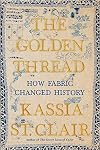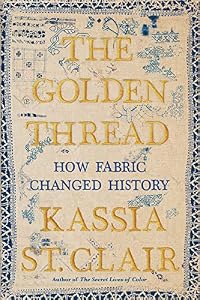
The Golden Thread: How Fabric Changed History
by Kassia St Clair
On This Page
Description
All textiles begin with a twist. From colourful 30,000-year old threads found on the floor of a Georgian cave to what the linen wrappings of Tutankhamun's mummy actually meant; from the Silk Roads to the woollen sails that helped the Vikings reach America 700 years before Columbus; from the lace ruffs that infuriated the puritans to the Indian calicoes and chintzes that powered the Industrial Revolution, our continuing reinvention of cloth tells fascinating stories of human ingenuity. When show more we talk of lives hanging by a thread, being interwoven, or part of the social fabric, we are part of a tradition that stretches back many thousands of years. Fabric has allowed us to achieve extraordinary things and survive in unlikely places, and this book shows you how; and why. With a cast that includes Chinese empresses, Richard the Lionheart and Bing Crosby, Kassia St Clair takes us on the run with escaped slaves, climbing the slopes of Everest and moonwalking with astronauts. Running like a bright line through history, The Golden Thread offers an unforgettable adventure through our past, present and future. show lessTags
Recommendations













Member Recommendations
Member Reviews
St. Clair’s micro-history of fabrics patches a historical record which has often overlooked the role of textiles, perhaps because their contributions arise from predominately female labor. The examination moves from hand-working wild plants to modern man-made synthetics. Johns smoothly handles place names and worlds in multiple languages as St. Clair tours the history of fabric around the globe. With witty humour, Johns gives voice to the metaphors threading fiber arts throughout the English language. Our lives are enfolded with cloth, and textiles even fashion our death rituals. Johns’ lively voice propels this entertaining narrative across historical highlights to weave an accessible and thought-provoking story perfect for causal show more listening. Each chapter visits a different fiber, locale, or time period creating a beautiful, captivating tapestry in which Johns’ elegant tones deftly match St. Clair’s vivid prose. A perfect handsell for any fiber craft hobbyist as well as archaeology and anthropology enthusiasts.
The improved review was published in Booklist April 1, 2020 issue. show less
The improved review was published in Booklist April 1, 2020 issue. show less
Recommended by a fellow embroiderer, I've been reading this and St Clair's "Secret Lives of Colour", both excellent for dipping into, though this one I've been reading through from start to finish. It weaves itself in and out of the history in my head: from Vikings to the Field of Cloth of Gold, up into space via mountain summits and balloons in France, and down into the murky depths of what she calls "Rayon's Dark Past". But it comes at it all from a unique angle of fabric. Reenactment brings textiles and their production - as well as colours for that matter - into the everyday, but otherwise, even working with cloth, it's easy to feel distantly separated from its manufacture and its human, plant and animal stories today, so this book show more is a joy to immerse yourself in.
She sets each scene vividly too, from the lonely Scandinavian church where the woollen sail scrap was found in the rafters to the warring skies of WWII where close-fitting nylon prevented pilot blackout, and into the cotton plantations where expert hands and knowledge created mesmerising and impressive colours and blends.
A new treasure for the reference shelves at home, this one, and a really welcome recommendation. show less
She sets each scene vividly too, from the lonely Scandinavian church where the woollen sail scrap was found in the rafters to the warring skies of WWII where close-fitting nylon prevented pilot blackout, and into the cotton plantations where expert hands and knowledge created mesmerising and impressive colours and blends.
A new treasure for the reference shelves at home, this one, and a really welcome recommendation. show less
[b:The Golden Thread: How Fabric Changed History|43862307|The Golden Thread How Fabric Changed History|Kassia St. Clair|https://i.gr-assets.com/images/S/compressed.photo.goodreads.com/books/1564592440l/43862307._SX50_.jpg|63679455] is an involving history of fabrics, structured thematically around different fibres and their uses. It reads well with books about the clothing industry such as [b:Fashionopolis: The Price of Fast Fashion and the Future of Clothes|43671670|Fashionopolis The Price of Fast Fashion and the Future of Clothes|Dana Thomas|https://i.gr-assets.com/images/S/compressed.photo.goodreads.com/books/1554846636l/43671670._SY75_.jpg|67945585] and [b:Stitched Up: The Anti-Capitalist Book of Fashion|18690352|Stitched Up The show more Anti-Capitalist Book of Fashion|Tansy E. Hoskins|https://i.gr-assets.com/images/S/compressed.photo.goodreads.com/books/1393647667l/18690352._SY75_.jpg|26536148], by providing historical context for the fabrics we use. I found the content fascinating, although the chapter subheadings were a little too obtrusive.
The opening chapter covers archaeological evidence for the earliest use of fibres by humans, and indeed neanderthals. Linen is considered in the context of ancient Egypt, silk in ancient China, wool via the Vikings, cotton in America's slave plantations, and rayon in Nazi factories. This structure works really well and provides a wealth of information about the role of textiles in economies, culture, religion, and society. My favourite anecdote concerns a Chinese poem embroidered in silk in a 29 character by 29 character grid that can be read horizontally, vertically, or diagonally. It contains over three thousand different poems! This incredible work was completed by a woman named Su Hui in the fourth century.
Later chapters focus on the use of fabrics in extreme conditions: in dangerously cold climates, competitive swimming, and space exploration. These are likewise really interesting and serve to explain technological advances during the latter part of the twentieth century. I was particularly struck by the complexities of constructing space suits for the Apollo 11 mission. Although practical considerations would determine whether the astronauts survived, aesthetics played a part too. The suits would have been khaki green had it not been decided that silver and white looked more space-age.
The concluding chapter concerns a fibre that remains elusive: spider silk. Although it has impressive properties, spider silk has thus far proved impossible to produce at scale. Spiders cannot be farmed, it seems, and the efforts of start-ups to duplicate their silk via genetically engineering other species haven't been successful yet. The idea of wearing spider silk is beguiling, although the fabric I came out of the book favouring is linen. It is harder-wearing and less environmentally-damaging to produce than cotton and viscose. Overall, this is an informative, well-written, and enjoyable account of fabrics through the ages. I liked the glossary and end notes, but wish a few illustrations had also been included. show less
The opening chapter covers archaeological evidence for the earliest use of fibres by humans, and indeed neanderthals. Linen is considered in the context of ancient Egypt, silk in ancient China, wool via the Vikings, cotton in America's slave plantations, and rayon in Nazi factories. This structure works really well and provides a wealth of information about the role of textiles in economies, culture, religion, and society. My favourite anecdote concerns a Chinese poem embroidered in silk in a 29 character by 29 character grid that can be read horizontally, vertically, or diagonally. It contains over three thousand different poems! This incredible work was completed by a woman named Su Hui in the fourth century.
Later chapters focus on the use of fabrics in extreme conditions: in dangerously cold climates, competitive swimming, and space exploration. These are likewise really interesting and serve to explain technological advances during the latter part of the twentieth century. I was particularly struck by the complexities of constructing space suits for the Apollo 11 mission. Although practical considerations would determine whether the astronauts survived, aesthetics played a part too. The suits would have been khaki green had it not been decided that silver and white looked more space-age.
The concluding chapter concerns a fibre that remains elusive: spider silk. Although it has impressive properties, spider silk has thus far proved impossible to produce at scale. Spiders cannot be farmed, it seems, and the efforts of start-ups to duplicate their silk via genetically engineering other species haven't been successful yet. The idea of wearing spider silk is beguiling, although the fabric I came out of the book favouring is linen. It is harder-wearing and less environmentally-damaging to produce than cotton and viscose. Overall, this is an informative, well-written, and enjoyable account of fabrics through the ages. I liked the glossary and end notes, but wish a few illustrations had also been included. show less
The Golden Thread How Fabric Changed History
Karisa St. Clair John Murray Pub. 2018
The threads that create fabric have profoundly shaped our history. This book tells engaging tales about them.
Roughly organized around fibers - bast, linen, silk, wool and cotton - with subsequent chapters covering arctic/everest, competitive sport, space, synthetic and spider silk fabrics, I’m amazed at the amount of fascinating information she’s managed to pack into this medium size book. Factual data is footnoted - this isn’t just one woman’s opinion.
An introductory chapter presents women-centered themes with anecdotes. They include: reasons why textile work has been undervalued in recorded history; cotton created and sustained the industrial show more revolution; and incredibly, Sigmund Freud preached that women wove because of (seriously) a “genital deficiency”.
St. Clair then embarks on a fascinating tour of the male-dominated archaeology of early humans. Much textile evidence was discarded as irrelevant to the history of our species. What fragments remain show that the earliest weavers of bast fibers worked between 32,000 and 19,000 years ago. They wove with 8 colors including pink and blue-violet. Weirdly, the genetics of head lice have shown that we first wore cloth between 72,000 and 42,000 years ago. Indian subcontinent finds show that one pound of cotton was spun into thread 200 miles long during that time. And we call these folks “primitive”.
Then on to Egypt, linen and mummies. King Tut was swathed in 16 layers of linen, most of which were discarded by the discoverers. Other mummies had 28 pounds of linen wrappings; one had 50 meters of inscribed bandages. The author demonstrates how linen was essential to preservation of the bodies.
China and silk. I can’t begin to summarize the 5,000 year history she reviews in 40 pages. Some factoids: one thread from a cocoon is 30 microns wide, half the width of a human hair; silk fabric was used as currency for thousands of years; the Silk Road was perhaps the biggest transmitter of culture the world has known; King John of England had 185 silk shirts in 1216, all carried across the Silk Road; in classical Rome, prostitutes were the early adopters of silk fabric and noble women eventually adopted it, whereupon the philosophers condemned it as immoral and indecent, and passed laws forbidding men from wearing it; a silkworm goddess was worshiped through the 19th century in Shanghai textile factories. And that’s just the historical background.
Vikings had wool. Lots and lots of wool. It took around 200 kilos (440 lbs.) of wool and the equivalent of 10 years labor to outfit one Viking ship. One sheep yielded 500 grams of wool suitable for sails, so roughly 400 sheep equaled one ship’s fitting out. Some historians think that a major reason for the Vikings’ raids on England was that England had even more sheep.
Thanks to all those sheep, England became the wool fabric producer of the western world. Their craftspeople became extremely skilled in breeding white and high quality fleece animals, which led to a thriving export business. The fabric was made using warp-weighted and later harness looms in cottages - as we know, a slow process. As cotton became available, imported from the colonies, the flying shuttle and then the spinning jenny were invented and the industrial revolution began.
The chapter on cotton focuses initially on its effect on slavery. St. Clair delves deeply into the uses of fabric in the control and rebellion of slaves over the history of the US south. Using advertisements which searched for escaped slaves in contemporary newspapers, she analyzes the clothing that they wore and took with them. The results are fascinating.
Remaining chapters deal with a kaleidoscope of fabrics. She discusses the fur and skins that polar, antarctic and Everest expeditions wore (and froze in) along with cyclical fashions in underwear fabrics - wool/synthetics/wool. Rayon and its lethal carbon disulphide problem show up along with nylon and the frenzy to get “nylons” (remember those horrible things?). Space suit fabrics, heated controversies about innovative swimsuits, sports bras (duct tape was featured) and spider silk end the book. A really fascinating read.
Reviewed by Pat Zimmerman show less
Karisa St. Clair John Murray Pub. 2018
The threads that create fabric have profoundly shaped our history. This book tells engaging tales about them.
Roughly organized around fibers - bast, linen, silk, wool and cotton - with subsequent chapters covering arctic/everest, competitive sport, space, synthetic and spider silk fabrics, I’m amazed at the amount of fascinating information she’s managed to pack into this medium size book. Factual data is footnoted - this isn’t just one woman’s opinion.
An introductory chapter presents women-centered themes with anecdotes. They include: reasons why textile work has been undervalued in recorded history; cotton created and sustained the industrial show more revolution; and incredibly, Sigmund Freud preached that women wove because of (seriously) a “genital deficiency”.
St. Clair then embarks on a fascinating tour of the male-dominated archaeology of early humans. Much textile evidence was discarded as irrelevant to the history of our species. What fragments remain show that the earliest weavers of bast fibers worked between 32,000 and 19,000 years ago. They wove with 8 colors including pink and blue-violet. Weirdly, the genetics of head lice have shown that we first wore cloth between 72,000 and 42,000 years ago. Indian subcontinent finds show that one pound of cotton was spun into thread 200 miles long during that time. And we call these folks “primitive”.
Then on to Egypt, linen and mummies. King Tut was swathed in 16 layers of linen, most of which were discarded by the discoverers. Other mummies had 28 pounds of linen wrappings; one had 50 meters of inscribed bandages. The author demonstrates how linen was essential to preservation of the bodies.
China and silk. I can’t begin to summarize the 5,000 year history she reviews in 40 pages. Some factoids: one thread from a cocoon is 30 microns wide, half the width of a human hair; silk fabric was used as currency for thousands of years; the Silk Road was perhaps the biggest transmitter of culture the world has known; King John of England had 185 silk shirts in 1216, all carried across the Silk Road; in classical Rome, prostitutes were the early adopters of silk fabric and noble women eventually adopted it, whereupon the philosophers condemned it as immoral and indecent, and passed laws forbidding men from wearing it; a silkworm goddess was worshiped through the 19th century in Shanghai textile factories. And that’s just the historical background.
Vikings had wool. Lots and lots of wool. It took around 200 kilos (440 lbs.) of wool and the equivalent of 10 years labor to outfit one Viking ship. One sheep yielded 500 grams of wool suitable for sails, so roughly 400 sheep equaled one ship’s fitting out. Some historians think that a major reason for the Vikings’ raids on England was that England had even more sheep.
Thanks to all those sheep, England became the wool fabric producer of the western world. Their craftspeople became extremely skilled in breeding white and high quality fleece animals, which led to a thriving export business. The fabric was made using warp-weighted and later harness looms in cottages - as we know, a slow process. As cotton became available, imported from the colonies, the flying shuttle and then the spinning jenny were invented and the industrial revolution began.
The chapter on cotton focuses initially on its effect on slavery. St. Clair delves deeply into the uses of fabric in the control and rebellion of slaves over the history of the US south. Using advertisements which searched for escaped slaves in contemporary newspapers, she analyzes the clothing that they wore and took with them. The results are fascinating.
Remaining chapters deal with a kaleidoscope of fabrics. She discusses the fur and skins that polar, antarctic and Everest expeditions wore (and froze in) along with cyclical fashions in underwear fabrics - wool/synthetics/wool. Rayon and its lethal carbon disulphide problem show up along with nylon and the frenzy to get “nylons” (remember those horrible things?). Space suit fabrics, heated controversies about innovative swimsuits, sports bras (duct tape was featured) and spider silk end the book. A really fascinating read.
Reviewed by Pat Zimmerman show less
For anyone interested in fabric, this book is a joy. Ms. St Clair begins with a brief overview of the role of fabric in society and myth, focussing on "the age old kinship between women and cloth." She then moves from the earliest pre-historic evidence of thread and fabric. From there, she moves forward in history and forward through the basic textile groups -- linen in the context of ancient Egypt, silk of course in China, wool in northern Europe, and cotton, that link between American slavery and the industrial revolution. The last third of the book covers modern topics, and didn't charm me quite as much as the historical sections. But, like the book overall, it is very well written. Given that, and the rarity of interesting material show more about textiles -- and, as Ms. St. Clair shows -- their crucial role in history, the book rates five stars. I hope Ms. St. Clair has more on offer, her earlier "The Secret Lives of Colors" was also terrific. show less
Surprising to me with a potentially dull subject, this layman's treatise on fabric kept my interest all through. The author's breezy style covered the history of fabric from the earliest--threads from Neanderthal man through what types if weaving, linen, wool, silk, cotton, through lace and manmade fabrics used in spacesuits, exploration in extreme cold weather, and sportswear, The author discusses their influence on the development of human culture. There's even a chapter on the possible use of spider silk for clothing of the future. Fascinating study.
Kassia St. Clair’s 'The Golden Thread' is a near-miss overview of how fabrics – as clothing, decoration, and artifacts – have influenced cultures and societies.
Much of the content is fascinating – particularly the chapters on Egypt, on the Silk Roads, and on the development of protective clothing for the astronauts. Others wander off into rant or irrelevance, such as the chapter on damages to the environment and to human health arising from the “fast clothing” industry that depends on man-made fibers and near-slave labor.
The book also cries out for color plates. The curious reader will spend almost as much time on Google Image Search as with the book itself, looking up the items referenced by St. Clair in such glowing terms. show more
And, finally, the entire work feels much like a draft. Coverage of some topics is superficial; of others stultifyingly detailed. St. Clair bounces between American and British idiom, and there are disrupting sentence structures and word use throughout, along with one of the most egregious typos ever put into print. Somebody really should have gone through this thing with a blue pencil before it went to press.
If one is interested in textiles, it’s certainly worth the read, but if one is looking for the ultimate reference book, this isn’t it. show less
Much of the content is fascinating – particularly the chapters on Egypt, on the Silk Roads, and on the development of protective clothing for the astronauts. Others wander off into rant or irrelevance, such as the chapter on damages to the environment and to human health arising from the “fast clothing” industry that depends on man-made fibers and near-slave labor.
The book also cries out for color plates. The curious reader will spend almost as much time on Google Image Search as with the book itself, looking up the items referenced by St. Clair in such glowing terms. show more
And, finally, the entire work feels much like a draft. Coverage of some topics is superficial; of others stultifyingly detailed. St. Clair bounces between American and British idiom, and there are disrupting sentence structures and word use throughout, along with one of the most egregious typos ever put into print. Somebody really should have gone through this thing with a blue pencil before it went to press.
If one is interested in textiles, it’s certainly worth the read, but if one is looking for the ultimate reference book, this isn’t it. show less
Members
- Recently Added By
Published Reviews
ThingScore 100
Most of us don’t expend much mental energy thinking about fabric, beyond appreciating the cool touch of soft cotton when our heads touch the pillow at night, or worrying if our bag of donated clothes is destined for a landfill. But reading journalist Kassia St. Clair’s “The Golden Thread: How Fabric Changed History,” it’s likely you’ll never look at cloth the same way again. “The show more Golden Thread” offers an eclectic take on how humans have developed fabric, from the first known flax fibers found in a cave in Georgia, spun from the insides of plants and dating at around 32,000 years ago, to the spacesuits made from synthetic materials created in the past 100 years.
“Clothing,” St. Clair notes, “would have been one of a suite of skills — including the ability to make shelter and fire — that humans would have needed to thrive in diverse regions.” However, because cloth is harder to preserve, archaeologists have paid less attention to its significance in ancient cultures than to other, less perishable objects such as bronze or iron. Explorers studying Egyptian mummies, for example, hurriedly sliced away the outer wrappings to get to the bodies and treasures inside. “This is unfortunate,” St. Clair writes, because for the ancient Egyptians, “linen was imbued with powerful, even magical, meaning: linen was what made mummies sacred.”
Throughout history, the task of cloth production has frequently fallen to women, who supplemented household incomes or paid taxes through their labor. Women cared for silkworms in China, probably created the Bayeux Tapestry in 11th-century England and today toil by the millions in the garment factories of Bangladesh. St. Clair suggests that because it’s women’s work, the creation of textiles has been devalued, even though cloth is essential to human survival and progress. Sails, for example, whose early development has been traced to sites in Saudi Arabia, Bahrain and Qatar in the sixth millennia BC, allowed the Vikings to travel long distances. “While it has been estimated that it would take two skilled shipwrights a fortnight to make a longboat,” St. Clair writes, “creating a sail would take two equally skilled women a full year or more, depending on the size required.” show less
“Clothing,” St. Clair notes, “would have been one of a suite of skills — including the ability to make shelter and fire — that humans would have needed to thrive in diverse regions.” However, because cloth is harder to preserve, archaeologists have paid less attention to its significance in ancient cultures than to other, less perishable objects such as bronze or iron. Explorers studying Egyptian mummies, for example, hurriedly sliced away the outer wrappings to get to the bodies and treasures inside. “This is unfortunate,” St. Clair writes, because for the ancient Egyptians, “linen was imbued with powerful, even magical, meaning: linen was what made mummies sacred.”
Throughout history, the task of cloth production has frequently fallen to women, who supplemented household incomes or paid taxes through their labor. Women cared for silkworms in China, probably created the Bayeux Tapestry in 11th-century England and today toil by the millions in the garment factories of Bangladesh. St. Clair suggests that because it’s women’s work, the creation of textiles has been devalued, even though cloth is essential to human survival and progress. Sails, for example, whose early development has been traced to sites in Saudi Arabia, Bahrain and Qatar in the sixth millennia BC, allowed the Vikings to travel long distances. “While it has been estimated that it would take two skilled shipwrights a fortnight to make a longboat,” St. Clair writes, “creating a sail would take two equally skilled women a full year or more, depending on the size required.” show less
added by kirstenlund
Author Information

7 Works 2,583 Members
Awards and Honors
Distinctions
Work Relationships
Common Knowledge
- Original publication date
- 2018
- Dedication
- To my father, for tenacity and storytelling
- First words
- If you take your eyes off this page and look down, you will see that your body is encased in cloth. (Preface)
- Last words
- (Click to show. Warning: May contain spoilers.)A little more attention to detail shouldn't be too much to ask.
Classifications
Statistics
- Members
- 745
- Popularity
- 37,522
- Reviews
- 18
- Rating
- (3.92)
- Languages
- 5 — Dutch, English, German, Italian, Spanish
- Media
- Paper, Audiobook, Ebook
- ISBNs
- 15
- ASINs
- 6