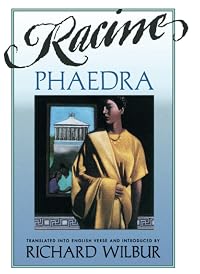
Phaedra
by Jean Racine
On This Page
Description
Based on Euripides' Hippolytus, this play by one of France's greatest playwrights is a magnificent example of character exposition. When the title character, Hippolytus' stepmother, receives false information that her husband, Theseus, is dead, Phèdra reveals a passionate love for her stepson -- an act that eventually spells doom for both characters.Tags
Recommendations























Member Reviews
Let's see: thwarted love, betrayal, implied incest, heinous lies, father-son love triangle with wife/stepmother, and a whole lot of death at the end. Um, yeah, that's the recipe for a pretty awesome story. Phaedra, married to Theseus, has always nurtured a secret love for his son, Hippolytus. When she receives news that Theseus is dead, she finally confesses her love to Hippolytus, who is in love with Aricia and is disgusted by his step-mother's advances. But, hey, guess what? Theseus isn't dead and returns just in time for all Hades to break loose . . .
Soap operas have nothing on ancient Greek drama. Plus, on All My Children, you never get a half bull/half dragon sea beastie sent by Neptune to torch our hero into a crispy critter show more before his horses go mad, crash the chariot, and then drag him to death. show less
Soap operas have nothing on ancient Greek drama. Plus, on All My Children, you never get a half bull/half dragon sea beastie sent by Neptune to torch our hero into a crispy critter show more before his horses go mad, crash the chariot, and then drag him to death. show less
When is one guilty of something, when one commits the reprehensible deed, and only one knows it, or when it is made known to others?
Phèdre thinks that the latter case is a great deal worse, worse even than death:
je meurs pour ne point faire un aveu si funeste
je n’en mourrai plus, j’en mourrai plus coupable
And so probably did Racine, because in his Phèdre, the action is activated by Phèdre’s avowal of her guilt which she makes three times. These three long soliloquies are amongst the most famous parts of the play. She is guilty of loving her stepson and she acknowledges this to her “confidente” (Oenone), to her stepson (Hyppolite), and to her husband (Thésée). These three confessions trigger the drama that unfolds show more irremediably fast, bringing the tragic downfall of both guilty and non guilty.
But the interest of this play is not in the plot, but in the themes that Racine so lyrically develops. Love coupled with jealousy as a fatal damnation. Treachery as the worst ignominy that can be suffered and inflicted. Choices that remain captive and render Destiny unavoidable. And expectedly in Racine, the power of the word as the vehicle for the human soul.
Racine’s tragedies are distilled drama. They are tragedies at their purest in which there is the very minimum of extraneous material. Respecting the three Aristotelian units of one place, one theme and one unit of time (one day), Racine also added the typically 17th century French concept of “bienséance” or “propriety”. He approached the three units by emptying them as much as possible. The place is no place, but just an enclosing undefined lieu that traps the tragic heroes and heroines in their own disarrays. The action takes place elsewhere and the messengers just inform the enclosed heroes about them. The resulting single action we see acted is no action at all, but the soul’s suffering them (in a way similarly to Baroque opera in which the recitatives tell the story and the arias sing the feelings). With so much material stripped out, then everything can happen quickly. We end up not been aware of whether it all happened in one day, or in an accelerated, condensed and immeasurable eternity. On the stage are left the abstract concepts that do not resolve.
For Phèdre has remained guilty.
I have reread this play as a complement to reading Marcel Proust’s La recherche du temps perdu as part of the 2013: The Year of Reading Proust Group. And since it is a play I have sought to watch it acted out. I found this DVD http://www.amazon.co.uk/Phèdre-DVD-Dominique-Blanc/dp/B0002T279G/ref=sr_1_1?ie=..., and therefore my review will comment on this production as well.
I should add that, sadly, this is the only filmed production of a Racine play that I have been able to find. Are they commercially so unattractive? When I lived in Paris I was on a budget but was willing to stand and queue, for sometimes close to two hours, to be able to get the cheapest tickets (FF12.-) for the Comédie Française performances (Corneille, Marivaux, but mostly Molière and Racine). In one year I did not miss one single production.
I am lucky that I have seen some wonderful productions of Racine at the CF then. The stage settings were bare. The accoutrements for emphasizing the Drama were almost only the costumes that the characters wore, with their flowing tunics and floating capes and veils. They were simple but made out of absolutely exquisite materials. Contrasting hues in the clothing paralleled opposite personalities while subtle gradations in color tones marked allegiances. Only tenuously would they distract from the declaimed verses. The acting was selective. Racine’s characters do not move abruptly nor do they gesticulate while they converse. They do not need to touch since they reach each other with their words. Racine’s heroes and heroines are walking and speaking souls.
When in this DVD Phèdre first appears on the stage as a crouching and limping neurotic woman I was shocked that this could be a Racine Queen. I had been expecting a dignified dame whose august and majestic body carried the full weight of suffering in a stately manner. Phèdre is most famous for her remarkable and very long monologues, known to be so difficult to deliver well that they can make or unmake an actress. It seems that theatre critics count their career in France by the number of Phèdres they have attended. The legendary Sarah Bernhardt was unforgettably photographed in this role.
But this unappealing first entrance of a broken and bent Phèdre in my DVD is, furthermore, followed by somewhat hysterical characters who shout at each other their love and longings. Their incensed and broken sentences and undue emphasis at invented syncopations ruins Racine’s verses and rhyme.
For Racine was a master of the Alexandrines, the twelve syllable verses with a clear caesura in its exact middle. His iambic hexameters establish a cadential rhythm which measures an even pace. True, at selected times he breaks and joins the verses with a skillful “enjambement” (the continuation of a thought in the following verse) that has an effect of an accelerated train of thought, but this enjambement ought not to interfere with a mellifluous enunciation of the lines. His verses should have the lulling effect of a hypnotic lullaby.
In the DVD production, with its broken chants and histrionic acting, a worthy exception is Théramène’s account of Hyppolite’s death. Were a film director of Steven Spielberg’s kind get hold of Théramène’s speech, it would be inflated it into a fantastic rendering of monsters, seas opening into abysms, and a hair-raising run of frenzied and desperate horses with a fatal consequence. Instead, true to Racine, a sad man, barely moving, declaims this succession of horrors, without blinking, depicting with only words the dreadful scene that gradually sinks the listening father into an unavoidable sorrow. What a wonderful speech.
It is not surprising that Racine’s selected use of words and exquisite ability with the Alexandrines would fascinate someone as careful and sensitive to the power of language as Marcel Proust. We have Proust’s explicit admiration for the way Racine could twist the very formal structure of his verses and with a broken syntax add ambiguity and richness to his meaning. These examples he gave are from Andromaque:
Pourquoi l’assassiner, Qu’a-t-il fait? A quel titre ?
Qui te l’a dit ?
But it was the poignant portrayal of guilty love in Phèdre that obsessed Proust. And it is this play, which he knew in its entirety by heart, that he has associated to his fictional actress La Berma and which figures in La recherche repeatedly.
--------------------------
After this wonderful reading I will proceed with the rereading of more plays by Racine and with the listening of Rameau’s Opera, Hippolyte et Aricie. show less
God DAMN I absolutely adored this! 4.5 stars and possibly 5 (we'll see if I round up)! Even though I already know the plot I still found it so heart-rending. Phaedra's soliloquies are so beautifully written, Aricia's rebuttal to Theseus is amazing and had me rooting for her and Hippolytus's characterisation is exactly what I was looking for! The writing style was absolutely gorgeous, I was completely eating it up (remind me at a later date to read Richard Wilbur's translation).
I feel like Racine did an expert job of modernising (relatively speaking) the original myth, still maintaining the tragic plot whilst removing some of the most unnecessarily horrific elements and improving the characterisation - I especially liked Phaedra herself show more not making the accusation which made me all the more conflicted in my sympathies (as this helps maintain, as Racine mentioned, the idea that she is 'neither wholly guilty nor wholly innocent'). Introducing Aricia also gave a breath of fresh air that allowed Hippolytus to not be depicted as one-sided as he often can be.
Overall this was soooo good and I'm excited to read more of Racine's plays! show less
I feel like Racine did an expert job of modernising (relatively speaking) the original myth, still maintaining the tragic plot whilst removing some of the most unnecessarily horrific elements and improving the characterisation - I especially liked Phaedra herself show more not making the accusation which made me all the more conflicted in my sympathies (as this helps maintain, as Racine mentioned, the idea that she is 'neither wholly guilty nor wholly innocent'). Introducing Aricia also gave a breath of fresh air that allowed Hippolytus to not be depicted as one-sided as he often can be.
Overall this was soooo good and I'm excited to read more of Racine's plays! show less
I consider Racine the greatest French playwright (sorry, Molière fans), and I consider Phèdre and Britannicus his two greatest plays. My quarrel here, and hence my low rating of 2½**, is with the translation – specifically, Richard Wilbur's use of heroic couplets which, despite some add-on enjambment, still make Racine sound too much like John Dryden.
Nothing against Dryden, mind you, but I think Wilbur would have been better advised to go with blank verse for a playwright who engages in tragic set-pieces. I'm going to get on to Wilbur's Molière translations, though, where heroic couplets (assuming that's what Wilbur used for Molière) might give a sing-song effect more appropriate to comic satire.
Nothing against Dryden, mind you, but I think Wilbur would have been better advised to go with blank verse for a playwright who engages in tragic set-pieces. I'm going to get on to Wilbur's Molière translations, though, where heroic couplets (assuming that's what Wilbur used for Molière) might give a sing-song effect more appropriate to comic satire.
I loved this. Racine makes one big change from Euripides: he blames Phedre's false accusation mostly (though not wholly) on her nurse, instead of on her. Coincidentally, that's the one thing that really stuck out for me in the original: I found Phedre's final accusation jarring, unearned and unexplained. So...nice job, Racine!
He also throws a love interest for Hippolytus in, though, in order to make him a little less...y'know, above it all. This was less successful. I think he'd have achieved the effect more cleanly simply by having Hippolytus acknowledge some attraction to Phedre.
And I have now managed to second guess Euripides and Racine in two paragraphs. You know who else wasn't that great? Shakespeare. Yeah!
*ahem* Translation show more review: not so great. Rawlings delivers with the original French on preceding pages, which is terrific but also serves to make obvious her own shortcomings. Her translation is loose, and it ignores the rhyme of the original. Richard Wilbur manages the same rhyme scheme with ease in his Moliere translation. I'd heard that he failed hard when he attempted Racine, so I didn't read it. With hindsight, I'd give him a shot - or recent dead Laureate Ted Hughes, who also attempted it. Without anything to compare it to, Rawlings' interpretation is functional but not great. show less
He also throws a love interest for Hippolytus in, though, in order to make him a little less...y'know, above it all. This was less successful. I think he'd have achieved the effect more cleanly simply by having Hippolytus acknowledge some attraction to Phedre.
And I have now managed to second guess Euripides and Racine in two paragraphs. You know who else wasn't that great? Shakespeare. Yeah!
*ahem* Translation show more review: not so great. Rawlings delivers with the original French on preceding pages, which is terrific but also serves to make obvious her own shortcomings. Her translation is loose, and it ignores the rhyme of the original. Richard Wilbur manages the same rhyme scheme with ease in his Moliere translation. I'd heard that he failed hard when he attempted Racine, so I didn't read it. With hindsight, I'd give him a shot - or recent dead Laureate Ted Hughes, who also attempted it. Without anything to compare it to, Rawlings' interpretation is functional but not great. show less
It is stated in the introduction to Phèdre that Racine did not intend to challenge any of the conventions to playwriting with this work, but merely write the strongest possible play while adhering to the established structure of five act dramatic tragedies. Because of this, the play Phèdre by Racine and Hippolytus by Euripides are similar, not only in subject matter, but in structure as well, despite being written over 2,000 years apart. Unfortunately for Racine, this allows a direct comparison between the plays, and for me Hippolytus easily comes out on top.
Racine makes Phèdre a longer play, focusing on the passions that are driving the characters, and adds a plotline where Hippolytus and Aricia fall in love and attempt to elope. show more The longer length means that things that happened in the heat of the moment in Euripides’ play (and made sense in that context) are stretched over a longer span of time (and therefore defy common-sense). Euripides’ Theseus believes the accusations against his son only when he finds a note alleging them clutched in the cold hand of his wife, who has just killed herself. In a rage, and with his wife’s suicide putting her accusations almost beyond reproach, he curses his son and seals his fate. Racine’s Theseus believes accusations brought against his son by his wife’s nurse, and holds onto them stubbornly while one character after another tells him the accusations are false. “Can nothing clear your mind of your mistake?” asks Hippolytus. Obviously not, for the sake of the story, but such a refusal does strain credulity. Racine also has characters take other actions that aren’t very believable, and his commitment to making his characters voice their motivations draws attention to just how unbelievable these actions are. Toward the end of the play Hippolytus states “[l]et us trust to Heav'n my vindication, for the gods are just.” No they aren’t, and Hippolytus should know this based on the earlier parts of the play (and nowhere is Hippolytus previously portrayed as stupid or naïve). Euripides would never have written such a nonsense and cliché line.
The Hippolytus-Aricia subplot must have been added as a crowd-pleaser, because it adds little to the story. There are thousands of plays about forbidden romance, death separating young lovers, and everything else this plotline does, and it distracts from the play’s portrayal of a woman’s love spurned and a father harboring such rage for his son that he calls on the gods to kill him. Alicia’s introduction changes Phaedra’s actions to ones of jealousy just as much as uncontrollable passion, and thus waters down an interesting character. In general Phèdre does a disservice to the character Phaedra, giving many of the key actions to her nurse instead of having Phaedra perform them herself. It is the nurse Oenone who makes the accusations against Hippolytus, which absolves Phaedra of blame in his death but also turns her character into one doomed always to react and never to act of her own volition.
Euripides’ take on this tale is the better one, and is one of his strongest plays. Comparatively, Phèdre is less impressive, and despite Racine’s attempt to imbue the characters with uncontrollable passion, in fact he turns them duller than they had been for the 2,000 years before him. It’s not bad, just not as good as the classic version. show less
Racine makes Phèdre a longer play, focusing on the passions that are driving the characters, and adds a plotline where Hippolytus and Aricia fall in love and attempt to elope. show more The longer length means that things that happened in the heat of the moment in Euripides’ play (and made sense in that context) are stretched over a longer span of time (and therefore defy common-sense). Euripides’ Theseus believes the accusations against his son only when he finds a note alleging them clutched in the cold hand of his wife, who has just killed herself. In a rage, and with his wife’s suicide putting her accusations almost beyond reproach, he curses his son and seals his fate. Racine’s Theseus believes accusations brought against his son by his wife’s nurse, and holds onto them stubbornly while one character after another tells him the accusations are false. “Can nothing clear your mind of your mistake?” asks Hippolytus. Obviously not, for the sake of the story, but such a refusal does strain credulity. Racine also has characters take other actions that aren’t very believable, and his commitment to making his characters voice their motivations draws attention to just how unbelievable these actions are. Toward the end of the play Hippolytus states “[l]et us trust to Heav'n my vindication, for the gods are just.” No they aren’t, and Hippolytus should know this based on the earlier parts of the play (and nowhere is Hippolytus previously portrayed as stupid or naïve). Euripides would never have written such a nonsense and cliché line.
The Hippolytus-Aricia subplot must have been added as a crowd-pleaser, because it adds little to the story. There are thousands of plays about forbidden romance, death separating young lovers, and everything else this plotline does, and it distracts from the play’s portrayal of a woman’s love spurned and a father harboring such rage for his son that he calls on the gods to kill him. Alicia’s introduction changes Phaedra’s actions to ones of jealousy just as much as uncontrollable passion, and thus waters down an interesting character. In general Phèdre does a disservice to the character Phaedra, giving many of the key actions to her nurse instead of having Phaedra perform them herself. It is the nurse Oenone who makes the accusations against Hippolytus, which absolves Phaedra of blame in his death but also turns her character into one doomed always to react and never to act of her own volition.
Euripides’ take on this tale is the better one, and is one of his strongest plays. Comparatively, Phèdre is less impressive, and despite Racine’s attempt to imbue the characters with uncontrollable passion, in fact he turns them duller than they had been for the 2,000 years before him. It’s not bad, just not as good as the classic version. show less
I had a hard time with the inevitability of Phaedra's love for Hippolytus - I'm not a believer in love that you can't resist. This play demonstrated to me the importance of integrity. Phaedra knew what she felt was wrong - but she "gave in" to to the bad advice of her confidant and destroyed the lives of all those around her. While the story may seem old and out of touch with the modern world, I find it particularly timely given our modern inclination to just follow our desires without regard to who may get hurt.
Members
- Recently Added By
Lists

Plays I Like
230 works; 29 members

Théâtre
10 works; 1 member

Western World's Greatest Books - Project Gutenberg
295 works; 15 members

Harold Bloom - The Western Canon: B. The Aristocratic Age
231 works; 13 members

Ancient Crete
39 works; 1 member

How to Read a Book's Recommended Reading List
309 works; 10 members

Greatest Books, allegedly
484 works; 9 members

Recommended Reading : 600 Classics Reviewed, Editors of Salem Press, 2015
634 works; 6 members
My Play Collection
769 works; 3 members

Next Plays / 2025
352 works; 1 member
Author Information

Jean Racine is considered the greatest of French tragic dramatists. If Shakespeare's (see Vol. 1) theater is characterized by exploration and invention, Racine's is defined by restraint and formal perfection. His themes are derived from Greco-Roman, biblical, and oriental sources and are developed in the neoclassic manner: keeping to few show more characters, observing the "three unities" defined by Aristotle (see Vols. 3, 4, and 5) as essential to tragedy (i. e., unity of time, place, and action), and writing in regular 12-syllable verses called "alexandrines." In contrast to Corneille, whose theater is eminently political and concerned with moral choices, Racine locates tragic intrigue in the conflict of inner emotions. He is a master at exploring the power of erotic passion to transform and pervert the human psyche. As a Jansenist who believed that a person deprived of grace was subject to the tyranny of instincts, Racine was interested in portraying human passions---particularly the passion of love---in a state of crisis. Racine is also one of the greatest of all French poets, and his plays are a challenge to any translator. His major tragedies include Andromaque (1667), Britannicus (1669), e Berenice (1670), Iphigenie (1674), and Phedre (1677). (Bowker Author Biography) show less
Some Editions
Awards and Honors
Notable Lists
Series
Belongs to Publisher Series
Work Relationships
Is contained in
The Misanthrope and Other French Classics (Eric Bentley's Dramatic Repertoire ; V. 3) by Eric Bentley
A Treasury of the Theatre; an Anthology of Great Plays From Aeschylus to Hebbel by Philo M. Jr. Buck
Schillers sämtliche Werke. 8 Band. Übersetzungen: Turandot - Der Parasit - Der Neffe als Onkel - Phädra by Friedrich Schiller
Was inspired by
Has as a student's study guide
Common Knowledge
- Canonical title
- Phaedra
- Original title
- Phèdre
- Original publication date
- 1677
- People/Characters
- Hippolytus/Hippolyte; Phaedra/Phedre; Theseus/Thesee
- Important places*
- La Ferté-Milon, Hauts-de-France, Frankrijk
- Related movies*
- Phèdre (2009 | IMDb); Phedre (2010 | IMDb)
- First words
- Le dessein en est pris, je pars, cher Théramène,
Et quitte le séjour de l'aimable Trézène. - Last words
- (Click to show. Warning: May contain spoilers.)Rendons-lui les honneurs qu'il a trop mérités ;
Et pour mieux apaiser ses mânes irrités,
Que malgré les complots d'une injuste famille,
Son amante aujourd'hui me tienne lieu de fille. - Original language
- French
*Some information comes from Common Knowledge in other languages. Click "Edit" for more information.
Classifications
Statistics
- Members
- 2,257
- Popularity
- 8,881
- Reviews
- 33
- Rating
- (3.84)
- Languages
- 16 — Catalan, Czech, Dutch, English, Finnish, French, German, Hebrew, Hungarian, Italian, Norwegian (Nynorsk), Polish, Portuguese, Russian, Spanish, Swedish
- Media
- Paper, Audiobook, Ebook
- ISBNs
- 172
- UPCs
- 3
- ASINs
- 66