
Ted Hughes (1930–1998)
Author of Birthday Letters
About the Author
Ted Hughes was born on August 17, 1930 in England and attended Cambridge University, where he became interested in anthropology and folklore. These interests would have a profound effect on his poetry. In 1956, Hughes married famed poet Sylvia Plath. He taught at the University of Massachusetts at show more Amherst from 1957 until 1959, and he stopped writing altogether for several years after Plath's suicide in 1963. Hughes's poetry is highly marked by harsh and savage language and depictions, emphasizing the animal quality of life. He soon developed a creature called Crow who appeared in several volumes of poetry including A Crow Hymn and Crow Wakes. A creature of mythic proportions, Crow symbolizes the victim, the outcast, and a witness to life and destruction. Hughes's other works also created controversy because of their style, manner, and matter, but he has won numerous honors, including the Somerset Maugham Award in 1960, and the Queen's Medal for Poetry in 1974. His greatest honor came in 1984, when he was named Poet Laureate of England. Ted Hughes died in 1998. (Bowker Author Biography) show less
Image credit: Allen and Unwin Media Centre
Series
Works by Ted Hughes
The Martyrdom of Bishop Farrar 16 copies
Five American Poets — Editor — 3 copies
Sacred earth dramas : an anthology of winning plays from the 1990 competition of the Sacred Earth Drama Trust (1994) 3 copies
Prometheus on his crag : 21 poems 2 copies
Der Gigant aus dem All 2 copies
Capriccio 2 copies
The Coming of the Iron Man: The classic children's story as you've never seen it before (2025) 1 copy
Howls and Whispers 1 copy
Prometheus On His Crag 1 copy
Birthday Violence 1 copy
Brev på födelsedagen 1 copy
Fiori e insetti 1 copy
New Poetry 1 copy
Animal poems 1 copy
Eat Crow 1 copy
Parler en Langues 1 copy
Selected poems, 1956-1975 1 copy
Adam and the Sacred Nine 1 copy
The best worker in Europe 1 copy
The Rain Horse 1 copy
Spring Awakening 1 copy
Gedanken-Fuchs; Gedichte. [ËUbersetzt von Egbert Faas in Zusammenarbeit mit Martin Seletzki (1971) 1 copy
SCRIPT: Oedipus 1 copy
Orpheus 1 copy
Howls & Whispers 1 copy
Din cîntecele lui Kra 1 copy
The deadfall 1 copy
BALINA NASIL BALINA OLDU 1 copy
“Jellyfish” 1 copy
“Crab” 1 copy
A Mulher de Ferro 1 copy
Associated Works
The Oresteia: Agamemnon, Women at the Graveside, Orestes in Athens (0458) — Translator, some editions — 11,748 copies, 87 reviews
The Making of a Poem: A Norton Anthology of Poetic Forms (2000) — Contributor — 1,474 copies, 9 reviews
World Poetry: An Anthology of Verse from Antiquity to Our Time (1998) — Contributor — 499 copies, 2 reviews
The Norton Anthology of English Literature, 4th Edition, Volume 2 (1979) — Contributor — 271 copies, 1 review
Poetry Speaks Expanded: Hear Poets Read Their Own Work from Tennyson to Plath (2007) — Contributor — 158 copies, 2 reviews
The Sophisticated Cat: A Gathering of Stories, Poems, and Miscellaneous Writings About Cats (1992) — Contributor — 112 copies, 1 review
Buzz Words: Poems About Insects (Everyman's Library Pocket Poets Series) (2021) — Contributor — 56 copies
Holding your eight hands; an anthology of science fiction verse (1970) — Contributor — 25 copies, 1 review
William Golding: The Man and His Books - A Tribute on His 75th Birthday (1986) — Contributor — 18 copies
Die englische Literatur 10 in Text und Darstellung. 20. Jahrhundert 2. (2001) — Contributor — 6 copies
Edexcel Poetry Anthology for Advanced subsidiary and advanced GCE examinations in English Literature (2000) — Contributor, some editions — 6 copies
Cricket Magazine, Vol. 7, No. 12, August 1980 — Contributor — 3 copies
New Library: the People's Network — some editions — 2 copies
Cricket Magazine, Vol. 8, No. 2, October 1980 — Contributor — 2 copies
Tagged
Common Knowledge
- Legal name
- Hughes, Edward James
- Other names
- Hughes, Ted
- Birthdate
- 1930-08-17
- Date of death
- 1998-10-28
- Gender
- male
- Education
- University of Cambridge (BA archaeology and anthropology, 1954)
- Occupations
- poet
children's writer - Awards and honors
- Order of Merit (1998)
Poet Laureate of England (1984 - 1998) - Relationships
- Plath, Sylvia (wife)
Hughes, Frieda (daughter)
Causley, Charles (friend)
Wevill, Assia (lover)
Hughes, Gerald (brother) - Short biography
- Notably married to Sylvia Plath (1956-1963) with whom he had two children. Also had a daughter Shura (b. 1965), killed by her mother Assia Wevill as part of her suicide in 1969. Hughes was chosen as Poet Laureate after Philip Larkin declined.
- Cause of death
- myocardial infarction
- Nationality
- UK
- Birthplace
- Mytholmroyd, West Yorkshire, England, UK
- Places of residence
- Mytholmroyd, West Yorkshire, England, UK
Mexborough, South Yorkshire, England, UK
Cambridge, Cambridgeshire, England, UK
Boston, Massachusetts, USA
London, Middlesex, England, UK
North Tawton, Devon, England, UK - Place of death
- London, Middlesex, England, UK
- Map Location
- England, UK
Members
Reviews

Considering that every year I tell myself that I’m going to make a dent in my TBR shelf of poetry collections, and every year I also fail this goal spectacularly, I’m a bit shocked that I managed to read this one cover to cover in just over three months. Rather than focusing on the work of a single poet, this collection is a haphazard assortment that does its titular moniker proud. Rounded up by poets Seamus Heaney and Ted Hughes (two of my favourites), they confess that the collection show more has little rhyme or reason and is simply a book of poems that they liked and brought together with the idea of exploring and making the genre possibly more accessible. While they may have far more white male poets than I would prefer, I was pleasantly surprised at the oft-included poems in translation and a fair number of poems by women who deserve places alongside their male colleagues. Arranged simply by alphabetizing the titles (or first lines, for those poems lacking in formal designation), the collection juxtaposes poems that would never have appeared together in normal circumstance - creating what could easily have been a dissonant noise, but which instead I found to be a far more pleasant cacophony of words that must simply be let stand. The noise they create is indeed a rattle bag, but it is one that is full of pleasant surprises, wonderful language, and not a few moments of amusement. Maybe letting poetry simply be its chaotic self, rather than trying to form a driven narrative in a singular tone or set of motifs, is the key to its true enjoyment; it definitely seemed to work to keep me engaged with this collection, so here’s hoping we can replicate the experiment and get back into this fun genre. show less

Honestly, I could write thousands of words of why this is a horrible horrible collection, but I haven't the time to waste on a review that no-one is going to read, so here's the short version. This work presents itself as a commentary on Plath and Hughes' relationship with the implication that the poems were written in real time. I don't believe this. I think this is a reputation washing exercise and therefore a different type of dishonesty than is usual in poetry. We learn nothing show more significant about either person, Plath or Hughes, that we couldn't have already guessed, but the arrogance and cruelty shown by Hughes in this collection regularly took my breath away. He never shows any sign of attempting to understand her mental health issues, or reflect on his own feelings about those issues. She is reduced a madwoman, a raving creature obsessed for reasons unclear with her own father, a compulsive unreflective beast dedicated to being difficult and getting in the way of him writing Important Poetry. Her behaviours are not rational or based on any set of values, they're just childish tantrums that hurt random people around here, like the imagined English countryman setting traps to catch rabbits for his pot that she starves by tearing up the snares - he gaslights her from beyond the grave, her moral values are fake whilst his are unimpeachable. Their chidren are often mentioned, but only once are either of them refered to as 'his' or 'my', otherwise only 'her', but the children's feelings or lives are not touched on, only their existence refered to obliquely to draw attention to her failings are a parent. He shows no interest in the lives of their chilren or their inner worlds, just uses them as a stick to beat her with. There are so many mocking references to Daddy and Ariel, but no engagement with the works. This is a world in which a woman's trauma is treated as a personality flaw, her bpd is treated as difficulties and troublemaking. I have seen so many people like him in my professional life, they are everything we seek to change about the world and their refusal to understand trauma and psychiatry or do any self-reflection is a major problem in the interpersonal lives of so many people. There is oh so much more, my copy has dozens of corners turned over, stickies put in to show things to raise, notes made in anger. I am a fan of Ted Hughes' work, but this is cruelty pretending to be neutrality, insults pretending to be artistic neutrality, and worst of all, there are very few poems in here that are Hughes at his best. Perhaps the best poem in the book is Wuthering Heights, or maybe The Minotaur, but mostly they are cold, like adverts, like PR bumpf, showing only excerpted versions of the human experience. Poems should make you see things in a new way, good poems should reveal the truths of the world in ways you never imagined. Not a single poem in this collection made my blood pump harder, made me exited, made me read the work out loud to my partner excitedly. There were some good poems, certainly. Hughes skill is undeniable, but there were so few moments in this where his descriptions, his rhythm, his vision grabbed me and surprised me, only depressed me with his art, a great painter leaving a portrait to posterity that is a grotesquery, handing on hatred as truth to posterity. I feel so sorry for Sylvia Plath, being handpicked as a trophy wife by a selfish man who didn't understand her and didn't want to, who felt attacked by the existence of an emotional life that was inconvenient to him, and then having her pain and art turned into mocking and dismissive poems. There is nothing in this book that tells you anything about why he loved her, what he liked about her, the good times they had together, the work they created during their relationship, how he felt and why, what she said about her subjects, their courtship, why they got married, why they had children, a whole relationship reduced to 60 or so bitter vignettes of him having the arse with her. It's the poetry equivalent of a man explaining that his ex is a nutter and you shouldn't believe anything she says. Horrible stuff, sometimes very good in a technical kind of way but mostly the only thing I felt was annoyance. show less
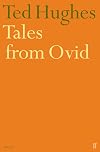
I've not read any other translations of Ovid and I don't know Latin, so I have little choice but to take these selections from the Metamorphoses at face value.
That value is very high: Hughes writes gripping, driving poetry that impatiently whips you along the narrative, with hardly a chance to catch your breathe sometimes. Faster paced than many a novel, there is no chance of being lulled to sleep by endless iambs here. Startling, powerful, often brutal metaphors pay no heed to shouts of show more "Anachronism!" and use whatever image suits Hughes' purpose. There is hardly a dull moment in the entire volume.
Anybody who thought narrative poetry was dead needs to think again: Hughes brought nature observation back to the fore-front of modern poetry with The Hawk in the Rain and subsequent volumes; here he rescues narrative verse from the Romantics and gives it to anybody who loves a good story.
Further - if you had no interest in the Classics before, you will after reading this.
I have to look back to Crow to find the previous volume of Hughes' poetical works that I responded to so uniformly positively. show less
That value is very high: Hughes writes gripping, driving poetry that impatiently whips you along the narrative, with hardly a chance to catch your breathe sometimes. Faster paced than many a novel, there is no chance of being lulled to sleep by endless iambs here. Startling, powerful, often brutal metaphors pay no heed to shouts of show more "Anachronism!" and use whatever image suits Hughes' purpose. There is hardly a dull moment in the entire volume.
Anybody who thought narrative poetry was dead needs to think again: Hughes brought nature observation back to the fore-front of modern poetry with The Hawk in the Rain and subsequent volumes; here he rescues narrative verse from the Romantics and gives it to anybody who loves a good story.
Further - if you had no interest in the Classics before, you will after reading this.
I have to look back to Crow to find the previous volume of Hughes' poetical works that I responded to so uniformly positively. show less

Lupercal is the second collection of poems by Ted Hughes. The poems in it continue the voice Hughes established with The Hawk in the Rain. Poems such as “To Paint a Water Lily” and “Pike” show nature without a sentimental gloss. Others, such as “Everyman’s Odyssey,” “Cleopatra to the Asp,” and “Lupercalia,” evoke the ancient world, but not in an antiquarian way. Instead, the figures in them are not so different from us.
Sometimes I wasn’t sure how a poem’s title show more related to the text. One example is “Wilfred Owen’s Photograph.” Another is “February,” in which the speaker regards a photo of the last wolf killed in England (who makes a surprise reappearance in “The Retired Colonel”). That wolf hovers over the entire collection, given the book’s title and its final poem.
Some poems, such as “Esther’s Tomcat,” are very accessible, whereas others are more obscure. For example, I had to read “Mayday at Holderness” three times before I got a feeling for the juxtaposition of the inexorable work of the North Sea (like a vast digestive tract) and a single death amid the ferocious slaughter at Gallipolli.
“Hawk Roosting” is a masterpiece. Another is “The Bull Moses,” an evocation so powerful I felt as if I were peering through the barn’s half-door and inhaling the odors.
Throughout, Hughes employs short words carefully marshaled for full effect of vowels and consonants, appropriate counterpart to his unflinching view of nature. show less
Sometimes I wasn’t sure how a poem’s title show more related to the text. One example is “Wilfred Owen’s Photograph.” Another is “February,” in which the speaker regards a photo of the last wolf killed in England (who makes a surprise reappearance in “The Retired Colonel”). That wolf hovers over the entire collection, given the book’s title and its final poem.
Some poems, such as “Esther’s Tomcat,” are very accessible, whereas others are more obscure. For example, I had to read “Mayday at Holderness” three times before I got a feeling for the juxtaposition of the inexorable work of the North Sea (like a vast digestive tract) and a single death amid the ferocious slaughter at Gallipolli.
“Hawk Roosting” is a masterpiece. Another is “The Bull Moses,” an evocation so powerful I felt as if I were peering through the barn’s half-door and inhaling the odors.
Throughout, Hughes employs short words carefully marshaled for full effect of vowels and consonants, appropriate counterpart to his unflinching view of nature. show less
Lists
Poetry Corner (4)
Awards


You May Also Like


Associated Authors
Statistics
- Works
- 150
- Also by
- 65
- Members
- 13,888
- Popularity
- #1,662
- Rating
- 4.0
- Reviews
- 177
- ISBNs
- 456
- Languages
- 18
- Favorited
- 32