
Simon Armitage
Author of Walking Home
About the Author
Simon Armitage has published ten volumes of poetry, including his translation of Sir Gawain and the Green Knight. He lives in Yorkshire, England, is a professor of poetry at the University of Sheffield, and in 2010 was awarded the CBE for services to poetry.
Image credit: Simon Armitage Photo: Richard Moran
Works by Simon Armitage
Tract. 2 copies
Sir Gawain and the green knight, with Simon Armitage [Documentary, 2009] — Presenter — 2 copies
Exit the known world 1 copy
Waymarkings 1 copy
Approaches to Learning and Teaching Geography: A Toolkit for International Teachers (Cambridge International Examinations) (2017) 1 copy
The Pendle Witch Child 1 copy
The Bed 1 copy
Associated Works
The Death of King Arthur: A New Verse Translation (1400) — Translator, some editions — 377 copies, 9 reviews
The New Yorker, Dec. 14, 2009 — Poem — 1 copy
Tagged
Common Knowledge
- Birthdate
- 1963-05-26
- Gender
- male
- Education
- Colne Valley High School, Linthwaite, Huddersfield
University of Leeds
University of Iowa - Occupations
- senior lecturer
poet
playwright
novelist
translator - Organizations
- Manchester Metropolitan University
University of Oxford - Awards and honors
- Lannan Literary Award for Poetry (1994)
Sunday Times Young Writer of the Year (1993)
Eric Gregory Award (1988)
Ivor Novello Award for Songwriting (2003)
Royal Society of Literature (Fellow, 2004)
Lannan Literary Award (1994) (show all 8)
Order of the British Empire (Commander, 2010)
Poet Laureate of the United Kingdom (2019- ) - Agent
- David Godwin Associates, Ltd.
Alison Granucci (Blue Flower Arts) - Nationality
- UK
- Birthplace
- Marsden, West Yorkshire, England, UK
- Places of residence
- West Yorkshire, Yorkshire, England, UK
- Map Location
- England, UK
Members
Reviews

An engaging collection of prose pieces exploring different aspects of "the North" (in particular, Lancashire and Yorkshire). Prose literature occasionally has a little fling with Northernness — there was the Winifred Holtby / J.B. Priestley era in the thirties, and the John Braine / Barry Hines thing in the fifties and sixties — but on the whole, it's poets, playwrights and film-makers that regularly venture north of the Watford Gap. Armitage is definitely a poet, with a distinctive show more prose voice that sounds remarkably similar to the voice he uses in his verse: very natural and direct, but always conveying a sense that there's something deeply strange about the ordinariness of life.
The pieces here include memoirs of Armitage's childhood and his time with the probation service, brief comments on things he's seen in the news, the scripts of a couple of radio and TV pieces he's done, an extended outline for a TV play that seems to be a kind of Yorkshire Under Milk Wood, and some slightly baffling (to the uninitiated) notes on local football and cricket. Whilst gently undermining the comforting Last of the summer wine, cloth-caps-and-whippets view of the North, he clearly does believe that there is still something distinctive about the way people in Lancashire and Yorkshire see the world (and indeed, that the border between the two is a line of deep significance), even at the close of the 20th century. show less
The pieces here include memoirs of Armitage's childhood and his time with the probation service, brief comments on things he's seen in the news, the scripts of a couple of radio and TV pieces he's done, an extended outline for a TV play that seems to be a kind of Yorkshire Under Milk Wood, and some slightly baffling (to the uninitiated) notes on local football and cricket. Whilst gently undermining the comforting Last of the summer wine, cloth-caps-and-whippets view of the North, he clearly does believe that there is still something distinctive about the way people in Lancashire and Yorkshire see the world (and indeed, that the border between the two is a line of deep significance), even at the close of the 20th century. show less
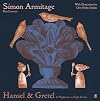
A nightmare in eight scenes, illustrated by Clive-Hicks Jenkins
This is the fairy tale updated for the 21st Century set amidst war with hunger and poverty as its backdrop and the children named Hunger and Cold.
Each voice is in a different colour so there is no need for he said, she said - even in a poem! Set during a war, this stanza reflects the toing and froing of who is in charge and also reminded me of Ukraine or Gaza. The theme is universal.
Where there was once a village there was mainly show more rubble.
And where there was fun there was largely trouble.
And where there were kites there were mostly rags.
And where there was bunting there were chiefly flags.
This flag one week. The next week another.
The children listen in to their parents talking at night and misunderstand or mishear what is being said and what they fear comes true. They are left alone in the forest but not out of spite but to keep them safe from the war. There are several sections in the poem where synonyms are used and this in one place
Left. Discarded. Abandonned. Cut off.
Lost. Rejected. Deserted. Dumped.
And of course, as we all know, a forest that is beautiful by day becomes the stuff of nightmares at night. Until they scent sugar which draws them on until they meet the gingerbread house. But there is 'No such thing as a free lunch'. They are captured and the boy is rested and fattened up and the girl works as a skivvy to slim her down. The girl manages to trap the witch in a vast vat of boiled up sugar and sweets and they return home
A full day's hike.
A two-day trek.
A three-day slog.
A four-day trudge.
A five-day yomp.
When they arrive home by rowing and the land emerged (resolved, declared, appeared, arrived) they find their father alone and so they take him on a journey to where the land is full of trees and food and rain and if all else fails a gingerbread house.
This is not a book for children. I wonder how many refuges start their journey thinking about what they will find when they get to their destination only to realise it isn't like that at all. This version does not make the Grimm's tale any less scary but fits it into a context we can all understand.
The illustrations are wonderful; part woodcutting part folk art looking like they were created with coloured pencils and fit the genre perfectly. show less
This is the fairy tale updated for the 21st Century set amidst war with hunger and poverty as its backdrop and the children named Hunger and Cold.
Each voice is in a different colour so there is no need for he said, she said - even in a poem! Set during a war, this stanza reflects the toing and froing of who is in charge and also reminded me of Ukraine or Gaza. The theme is universal.
Where there was once a village there was mainly show more rubble.
And where there was fun there was largely trouble.
And where there were kites there were mostly rags.
And where there was bunting there were chiefly flags.
This flag one week. The next week another.
The children listen in to their parents talking at night and misunderstand or mishear what is being said and what they fear comes true. They are left alone in the forest but not out of spite but to keep them safe from the war. There are several sections in the poem where synonyms are used and this in one place
Left. Discarded. Abandonned. Cut off.
Lost. Rejected. Deserted. Dumped.
And of course, as we all know, a forest that is beautiful by day becomes the stuff of nightmares at night. Until they scent sugar which draws them on until they meet the gingerbread house. But there is 'No such thing as a free lunch'. They are captured and the boy is rested and fattened up and the girl works as a skivvy to slim her down. The girl manages to trap the witch in a vast vat of boiled up sugar and sweets and they return home
A full day's hike.
A two-day trek.
A three-day slog.
A four-day trudge.
A five-day yomp.
When they arrive home by rowing and the land emerged (resolved, declared, appeared, arrived) they find their father alone and so they take him on a journey to where the land is full of trees and food and rain and if all else fails a gingerbread house.
This is not a book for children. I wonder how many refuges start their journey thinking about what they will find when they get to their destination only to realise it isn't like that at all. This version does not make the Grimm's tale any less scary but fits it into a context we can all understand.
The illustrations are wonderful; part woodcutting part folk art looking like they were created with coloured pencils and fit the genre perfectly. show less
If the acid test of a good book/author is to make the familiar unfamiliar (and interesting) then Armitage and his book both pass the test with flying colours. It could all so easily be a mundane plod through a bit of southern England but it is much more than that because the writer is so alive to language and its possibilities.
I think this is going to take a little time to sink in.
I've read 2 of Simon Armitage's translations of poems from old English, and have adored both of them. This is the first time I've tried his own compositions. The subject matter is dark, it is based on the murder of Sophie Lancaster. in this a couple were set upon and as she tried to shield his beaten body, so they beat her and she subsequently died. This sequence of poems are told in the first person, from her point of view. The show more headlines tend to depersonalise the effect, you see the crime but not the person it happened to, and this aims to give her a voice again, to make it have happened to an individual, with a history, a family and a future ahead of her.
It works.
The poetry has a lot in common with the alliterative style that Armitage has carried over in his translations. It is about more than just rhyme, there's rhythm and structure to the lines and the work as a whole that is not at all dull or repetitive. And the use of everyday language and turn of phrase makes it grab the attention. At only 30 pages it is very short, but it packs a punch and leaves an impression bigger than its size. show less
I've read 2 of Simon Armitage's translations of poems from old English, and have adored both of them. This is the first time I've tried his own compositions. The subject matter is dark, it is based on the murder of Sophie Lancaster. in this a couple were set upon and as she tried to shield his beaten body, so they beat her and she subsequently died. This sequence of poems are told in the first person, from her point of view. The show more headlines tend to depersonalise the effect, you see the crime but not the person it happened to, and this aims to give her a voice again, to make it have happened to an individual, with a history, a family and a future ahead of her.
It works.
The poetry has a lot in common with the alliterative style that Armitage has carried over in his translations. It is about more than just rhyme, there's rhythm and structure to the lines and the work as a whole that is not at all dull or repetitive. And the use of everyday language and turn of phrase makes it grab the attention. At only 30 pages it is very short, but it packs a punch and leaves an impression bigger than its size. show less
Lists
Awards


You May Also Like


Associated Authors
Statistics
- Works
- 80
- Also by
- 16
- Members
- 3,665
- Popularity
- #6,904
- Rating
- 3.8
- Reviews
- 83
- ISBNs
- 192
- Languages
- 5
- Favorited
- 11
