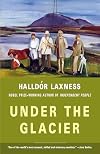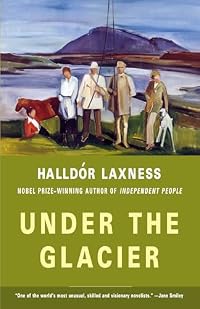
Under the Glacier
by Halldór Laxness
On This Page
Description
Nobel laureate Halldór Laxness’s Under the Glacier is a one-of-a-kind masterpiece, a wryly provocative novel at once earthy and otherworldly. At its outset, the Bishop of Iceland dispatches a young emissary to investigate certain charges against the pastor at Snæfells Glacier, who, among other things, appears to have given up burying the dead.But once he arrives, the emissary finds that this dereliction counts only as a mild eccentricity in a community that regards itself as the center show more of the world and where Creation itself is a work in progress.
What is the emissary to make, for example, of the boarded-up church? What about the mysterious building that has sprung up alongside it? Or the fact that Pastor Primus spends most of his time shoeing horses? Or that his wife, Ua (pronounced “ooh-a,” which is what men invariably sputter upon seeing her), is rumored never to have bathed, eaten, or slept?
Piling improbability on top of improbability, Under the Glacier overflows with comedy both wild and deadpan as it conjures a phantasmagoria as beguiling as it is profound. show less
Tags
Recommendations



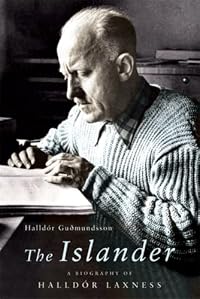





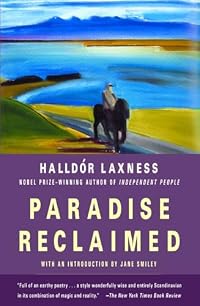





















Member Recommendations
Tinwara Under the glacier is in a way a direct reply to The journey to the centre of the earth; Laxness refers to Verne throughout the book. You would miss a dimension of Under the glacier if you haven't read Jules Verne!
deb80 Similar plot and characters. The bishop is not amused. He sends an emissary to investigate a malfunctioning pastor, church and congregation, with wacky and wonderful results.

jbalthazar Iceland breeds some strange writers. Wonderfully strange.
Member Reviews
I have only one theory.
I have the theory that water is good.
One doesn't even have to go by my theory
unless one is thirsty.
--recalcitrant Pastor Jón Primus
Well, well. Well! How to describe what I just read?
In a nutshell--a nutty nutshell--this short novel takes place in a remote Icelandic village where Christianity hasn't fully taken hold, not even by 1968. The village sits near a glacier and strange things are happening there.
This is the same glacier that Jules Verne's Journey to the Center of the Earth used to reach the mysterious beginnings of life. In this work by Laxness, the glacier's presence and energy is also recognized as something quite special, as an unrelenting pressure on human understanding of Time. And, it's a real show more glacier! Snæfellsjökull.
Here, under the glacier, it is as if Creation is still ongoing. Thus how can any religious or spiritual or intergalactic understanding be "set"? Christianity does, though, see things as set.
The novel begins when alarming rumors have reached the Bishop of Iceland: the village pastor is not performing his high office duties. The church is nailed up, the pastor's wife has been missing, and perhaps most alarming, there has been a mystery burial up on the glacier instead of in the churchyard.
The Bishop dispatches a young emissary to interview the villagers, to record their answers and report back. One gets the impression the self-effacing young man is chosen because he knows how to operate new technology: the tape recorder. (And the "kid" can be had on the cheap.) He is given strict instructions not to believe or disbelieve, not to engage in theological debate, not to try to correct or judge anyone. Just report back what was said.
Embi, as he calls himself, short for "Bishop's Emissary", does exactly that in spite of the many challenges. The instructions were sound because the quirky villagers say things so remarkable and so regularly include comical non sequiturs that I can't imagine anyone else performing so well under those conditions. However, they clearly convey their love for their Pastor Jón and have absolutely no complaints about how he conducts the burden of his office, which he fulfills mostly by being a tireless and talented handyman of old technologies, like horseshoeing and repairing Primus camp stoves. No one is particularly concerned that the church is nailed shut and rotting, of having no services even at Christmas, nor especially worried about the many additional mysteries that come up here and there in their interviews with Embi. Everyone is content. Content with their pastor and with their personal doctrines that each has taken firmly to heart--each being a personalized patchwork of scripture, sagas, and a skewed or maybe not skewed world view.
In this place, Christianity does seem odd and though never disparaged, it just doesn't fit, is not practical, and doesn't help with the hardscrabble struggles of the villagers nor the village's continuation of a near ancient way of life. Christianity is lacking the full power for life under the shadow of all that, plus a glacier.
Multiple times Embi thinks his assigned task is complete--the interviews requested have been duly recorded, if hardly coherent, and ready to submit. He is ready to leave this wackadoodle place. But when a villager unexpectedly dies, he must stay to help oversee the proper arrangements for burial. He does that and again he's ready to finalize his reports and go. But now, suddenly, the time has been deemed right for the coffin buried up at the glacier to be retrieved and an infamous resurrection be conducted. Embi again must stay to protect the church building, which the resurrectors would love to use for the purpose.
What happens next was a doozy.
I most heartily hope to read this again! And definitely more Laxness is in my future. But I would not banter around a recommendation, willy-nilly. I'm not sure I personally know anyone who would like this but me.
Wait. I can think of one person, not living though (how apt). My deceased mother would have enjoyed it. But even if there were such a thing as a current manifestation of Lord Maitreya who could teach how to resurrect a woman (he has also done fish), would a resurrected still be interested in reading? I like to think if any would, it would be my mom.
So, in spite of my not having any knowledge about Iceland except Bjork and loving her music, and in spite of reading this work in translation, and in spite of my head spinning with the many zany philosophies encountered (Theosophy, oh my), in spite of all those obstacles, I absolutely loved this. It was a page-turning, head-scratching, belly-chuckling WTF for me. show less
I have the theory that water is good.
One doesn't even have to go by my theory
unless one is thirsty.
--recalcitrant Pastor Jón Primus
Well, well. Well! How to describe what I just read?
In a nutshell--a nutty nutshell--this short novel takes place in a remote Icelandic village where Christianity hasn't fully taken hold, not even by 1968. The village sits near a glacier and strange things are happening there.
This is the same glacier that Jules Verne's Journey to the Center of the Earth used to reach the mysterious beginnings of life. In this work by Laxness, the glacier's presence and energy is also recognized as something quite special, as an unrelenting pressure on human understanding of Time. And, it's a real show more glacier! Snæfellsjökull.
Here, under the glacier, it is as if Creation is still ongoing. Thus how can any religious or spiritual or intergalactic understanding be "set"? Christianity does, though, see things as set.
The novel begins when alarming rumors have reached the Bishop of Iceland: the village pastor is not performing his high office duties. The church is nailed up, the pastor's wife has been missing, and perhaps most alarming, there has been a mystery burial up on the glacier instead of in the churchyard.
The Bishop dispatches a young emissary to interview the villagers, to record their answers and report back. One gets the impression the self-effacing young man is chosen because he knows how to operate new technology: the tape recorder. (And the "kid" can be had on the cheap.) He is given strict instructions not to believe or disbelieve, not to engage in theological debate, not to try to correct or judge anyone. Just report back what was said.
Embi, as he calls himself, short for "Bishop's Emissary", does exactly that in spite of the many challenges. The instructions were sound because the quirky villagers say things so remarkable and so regularly include comical non sequiturs that I can't imagine anyone else performing so well under those conditions. However, they clearly convey their love for their Pastor Jón and have absolutely no complaints about how he conducts the burden of his office, which he fulfills mostly by being a tireless and talented handyman of old technologies, like horseshoeing and repairing Primus camp stoves. No one is particularly concerned that the church is nailed shut and rotting, of having no services even at Christmas, nor especially worried about the many additional mysteries that come up here and there in their interviews with Embi. Everyone is content. Content with their pastor and with their personal doctrines that each has taken firmly to heart--each being a personalized patchwork of scripture, sagas, and a skewed or maybe not skewed world view.
In this place, Christianity does seem odd and though never disparaged, it just doesn't fit, is not practical, and doesn't help with the hardscrabble struggles of the villagers nor the village's continuation of a near ancient way of life. Christianity is lacking the full power for life under the shadow of all that, plus a glacier.
Multiple times Embi thinks his assigned task is complete--the interviews requested have been duly recorded, if hardly coherent, and ready to submit. He is ready to leave this wackadoodle place. But when a villager unexpectedly dies, he must stay to help oversee the proper arrangements for burial. He does that and again he's ready to finalize his reports and go. But now, suddenly, the time has been deemed right for the coffin buried up at the glacier to be retrieved and an infamous resurrection be conducted. Embi again must stay to protect the church building, which the resurrectors would love to use for the purpose.
What happens next was a doozy.
I most heartily hope to read this again! And definitely more Laxness is in my future. But I would not banter around a recommendation, willy-nilly. I'm not sure I personally know anyone who would like this but me.
Wait. I can think of one person, not living though (how apt). My deceased mother would have enjoyed it. But even if there were such a thing as a current manifestation of Lord Maitreya who could teach how to resurrect a woman (he has also done fish), would a resurrected still be interested in reading? I like to think if any would, it would be my mom.
So, in spite of my not having any knowledge about Iceland except Bjork and loving her music, and in spite of reading this work in translation, and in spite of my head spinning with the many zany philosophies encountered (Theosophy, oh my), in spite of all those obstacles, I absolutely loved this. It was a page-turning, head-scratching, belly-chuckling WTF for me. show less
Under the glacier is a splendidly eccentric novel that doesn't fit into any particular pigeonhole, except perhaps for a generalised sixties feel of "anything goes". A naive young man is sent by his bishop to report on the state of the church community in a remote parish on the slopes of the famous Snæfellsjökull volcano in the far West of Iceland. Not coincidentally, the crater of Snæfellsjökull is where the explorers in Jules Verne's Journey to the centre of the Earth descended below ground. It is clearly a place conducive to all kinds of strangeness.
It turns out that the pastor supports himself mostly by shoeing horses and repairing primus stoves; that his wife - who may or may not be a mythical creature - has been missing for 35 show more years; that no services have been held in living memory and the church is nailed up, its fittings mostly used for firewood; that a mysterious wealthy outsider has had a bungalow built on part of the churchyard; and that there is at least a strong rumour that bodies have been buried in the glacier rather than in the cemetery.
Definitely all very odd, and you won't be much clearer about what is going on at the end than you were at the beginning, but great fun, and plenty to make you think about what we mean by religious belief and the nature of objective observation. In odd ways, it reminded me of Thomas Bernhard's first novel, Frost, published five years earlier - but Laxness is a lot less wordy than Bernhard! show less
It turns out that the pastor supports himself mostly by shoeing horses and repairing primus stoves; that his wife - who may or may not be a mythical creature - has been missing for 35 show more years; that no services have been held in living memory and the church is nailed up, its fittings mostly used for firewood; that a mysterious wealthy outsider has had a bungalow built on part of the churchyard; and that there is at least a strong rumour that bodies have been buried in the glacier rather than in the cemetery.
Definitely all very odd, and you won't be much clearer about what is going on at the end than you were at the beginning, but great fun, and plenty to make you think about what we mean by religious belief and the nature of objective observation. In odd ways, it reminded me of Thomas Bernhard's first novel, Frost, published five years earlier - but Laxness is a lot less wordy than Bernhard! show less
This was such a peculiar book, and I gather that it is quite unlike other books by Laxness. I also gather that he wrote in different styles, so perhaps there is no usual or customary one. Overall, I enjoyed what I read, but there are passages, whole chapters even, that needed a couple of passes through to pull something from them.
The basic premise of the book is that the narrator(variously identified as “the undersigned,” “the emissary of the bishop,” “Umbi,” “EmBi” and “Embi”) is visiting Snæfells Glacier at the behest of the bishop of Iceland. Embi’s mission is to report the facts about reported dereliction of Christian duty, such as neglecting to bury the dead, to baptize children, or to hold services in the show more church, which has been boarded up. And when Embi arrives, he finds things stranger still than they appeared from afar but, just as strangely, also in their own kind of order.
From the outset, Laxness seems to invite an examination of a Christian worldview as an overlay on a world view that is shaped by sagas, mythologies, and local beliefs. On one side there are the expectations of a life explained through Christian theology and its official creation myths, symbology, iconography, hierarchies, and all the norms beliefs and practices it engenders. Contrasted with this is the mythology and the fables of the people at Snæfells Glacier that, to the outsider looking in, are inscrutable and wild. These beliefs and practices seem to represent something more primordial, formless, subject to change, and open to possibility. Whereas Christian theology may describe Creation as something that happened at a point in the past, when all variables were decided and set in motion, moving inexorably toward fulfillment and completion, the mythology found at Snæfells offers a view of creation as something cyclical and going: creation and destruction … renewal.
This is a story about Icelandic people but also about Iceland, which seems presented as a world that is always at the edge of becoming, and that seems to fit the landscape that is shaped by forces of destruction and renewal — by the fire of volcanos and the ice of glaciers. Iceland is, I think, present as symbolic of complexity and renewal through people who live there and their mythologies that speak of death and resurrection, beginnings and ends, alphas and omegas, creation and destruction, religion and non-religion, science and non-science.
I’m reminded of the William James that I read recently and his insight that engaging with primordial is a way of engaging with the divine. And, of course, that experience has to be disorienting in the way that this novel surely was. show less
The basic premise of the book is that the narrator(variously identified as “the undersigned,” “the emissary of the bishop,” “Umbi,” “EmBi” and “Embi”) is visiting Snæfells Glacier at the behest of the bishop of Iceland. Embi’s mission is to report the facts about reported dereliction of Christian duty, such as neglecting to bury the dead, to baptize children, or to hold services in the show more church, which has been boarded up. And when Embi arrives, he finds things stranger still than they appeared from afar but, just as strangely, also in their own kind of order.
From the outset, Laxness seems to invite an examination of a Christian worldview as an overlay on a world view that is shaped by sagas, mythologies, and local beliefs. On one side there are the expectations of a life explained through Christian theology and its official creation myths, symbology, iconography, hierarchies, and all the norms beliefs and practices it engenders. Contrasted with this is the mythology and the fables of the people at Snæfells Glacier that, to the outsider looking in, are inscrutable and wild. These beliefs and practices seem to represent something more primordial, formless, subject to change, and open to possibility. Whereas Christian theology may describe Creation as something that happened at a point in the past, when all variables were decided and set in motion, moving inexorably toward fulfillment and completion, the mythology found at Snæfells offers a view of creation as something cyclical and going: creation and destruction … renewal.
This is a story about Icelandic people but also about Iceland, which seems presented as a world that is always at the edge of becoming, and that seems to fit the landscape that is shaped by forces of destruction and renewal — by the fire of volcanos and the ice of glaciers. Iceland is, I think, present as symbolic of complexity and renewal through people who live there and their mythologies that speak of death and resurrection, beginnings and ends, alphas and omegas, creation and destruction, religion and non-religion, science and non-science.
I’m reminded of the William James that I read recently and his insight that engaging with primordial is a way of engaging with the divine. And, of course, that experience has to be disorienting in the way that this novel surely was. show less
This novel comes with impeccable credentials: Laxness, a Nobel laureate, is one of Iceland's major twentieth-century novelists; the translator is Magnus Magnusson, "Mastermind" television presenter, and authority on the Icelandic sagas; and the book has a late introduction by Susan Sontag (2004). For me, it had the additional attraction that it's set at Snaeffelsjökull, an Icelandic volcano I had just visited, and one of the characters comes from Hafnarfjör∂ur, where I was staying in Iceland.
It is a fantastical story of the parish priest "at the glacier" (under the volcano), and the mysterious things that happen in his parish; but it is also very much of its time and place, the late 1960s. I found it tremendously disappointing, and show more I barely got through it. Sontag's ecstatic introduction links the book to a whole list of sorts of novels:
Science fiction
Tale, fable, allegory
Philosophical novel
Dream novel
Visionary novel
Literature of fantasy
Wisdom lit
Spoof
Sexual turn-on (p. vi)
That's her list, and she links "Under the Glacier" to all but the last one. She also says it is "one of the funniest books ever written." She gives a good account of the elements of comedy in literature, including "defect of affectivity" (the protagonist doesn't feel much, or express it if he does), "repetition," "deficit of understanding," and others. That's a good characterization, but it doesn't mean the novel is funny. Here are two examples of what counts as humor to Laxness. At one point there is a possibility that a corpse will be stolen by a South American man who will take it up onto the glacier and shrink the corpse's head. Laxness mentions this wild possibility in the most offhanded possible way:
"I promise to do everything in my power to prevent the body being taken up onto the glacier, its head removed and shrunk, etc." (p. 155)
The "etc." is supposed to be humorous here: it's part of the deadpan strategy of comedy. On the next page, the narrator considers some damaged paintings:
"I would point out that I have prevented the old paintings... from being scrubbed with caustic soda with the kind of scrubbing brush that Hafnarfjör∂ur people use for scouring the scales off haddock." (p 156)
The strategies of repetition, affectlessness, naiveté, and so on, are exactly as Sontag says: but the effect, for me, is not at all comic: it is tedious.
But the main difficulty I had with this book, and the revision I would like to have made in its reception, is that the book is clearly about a kind of post-Christian mystical communion with nature. It's a meditation on what spirituality might look like after Christianity. The parish priest who is the subject of the narrator's investigation has boarded up his church, and spends his time shoeing horses. (An echo, risky in its obviousness, of Jesus's washing of the disciples' feet.) He can barely bring himself to read anything from the Bible. (In one passage he is called on to read a prayer, and it takes him several minutes to find one he can agree with.) He has an elusive wisdom and happiness, and he is often called "he richest person in the world."
As Sontag says, in a footnote (!), the original Icelandic title can be translated as "Christianity at the Glacier," not "Under the Glacier." One of the models for this post-Christian spirituality is 12th century Franciscan natural revelation. There are, for example, many pages devoted to observations of birds. Birds follow the pastor around, almost in the fashion of St. Francis, and the narrator observes strange and also natural bird behavior. There are also paragraphs devoted to a calf, lambs, the fields, horses, and the weather. Laxness is careful not to include any actual miracles, but the implication throughout is that nature itself is continuously miraculous. It's a kind of low-energy visionary nature poetry, with the revelations omitted and the rhapsodies are refracted through twentieth-century natural history. As a post-theological position, or even a hint of one, it has a pervasive softness and indecision, and it is animated by an unremitting but low-energy hopefulness.
It is true, as Sontag says, that the "deep questions" of life are raised here with "impudent lightness," and it is almost true that it is "a satire on religion," and nearly a "spoof," and it's clearly the case that it carefully avoids the supernatural: but it isn't accurate to mention those things only in passing, on the last page of the introduction. The novel is about naturalistic religion from the very beginning. It hides indecision about the sacred under the lightness of its allegory, and it hides a hapless sincerity under the lightness of its satire. It's not necessary to wish this were either religious or anti-religious to be disappointed by its blurred sense of what is, actually, possible.
The book may very well be unlike any other Laxness wrote (Sontag says that twice in her introduction, making me wonder how sure she was). I hope that's true, because I would like to read more of his books. show less
It is a fantastical story of the parish priest "at the glacier" (under the volcano), and the mysterious things that happen in his parish; but it is also very much of its time and place, the late 1960s. I found it tremendously disappointing, and show more I barely got through it. Sontag's ecstatic introduction links the book to a whole list of sorts of novels:
Science fiction
Tale, fable, allegory
Philosophical novel
Dream novel
Visionary novel
Literature of fantasy
Wisdom lit
Spoof
Sexual turn-on (p. vi)
That's her list, and she links "Under the Glacier" to all but the last one. She also says it is "one of the funniest books ever written." She gives a good account of the elements of comedy in literature, including "defect of affectivity" (the protagonist doesn't feel much, or express it if he does), "repetition," "deficit of understanding," and others. That's a good characterization, but it doesn't mean the novel is funny. Here are two examples of what counts as humor to Laxness. At one point there is a possibility that a corpse will be stolen by a South American man who will take it up onto the glacier and shrink the corpse's head. Laxness mentions this wild possibility in the most offhanded possible way:
"I promise to do everything in my power to prevent the body being taken up onto the glacier, its head removed and shrunk, etc." (p. 155)
The "etc." is supposed to be humorous here: it's part of the deadpan strategy of comedy. On the next page, the narrator considers some damaged paintings:
"I would point out that I have prevented the old paintings... from being scrubbed with caustic soda with the kind of scrubbing brush that Hafnarfjör∂ur people use for scouring the scales off haddock." (p 156)
The strategies of repetition, affectlessness, naiveté, and so on, are exactly as Sontag says: but the effect, for me, is not at all comic: it is tedious.
But the main difficulty I had with this book, and the revision I would like to have made in its reception, is that the book is clearly about a kind of post-Christian mystical communion with nature. It's a meditation on what spirituality might look like after Christianity. The parish priest who is the subject of the narrator's investigation has boarded up his church, and spends his time shoeing horses. (An echo, risky in its obviousness, of Jesus's washing of the disciples' feet.) He can barely bring himself to read anything from the Bible. (In one passage he is called on to read a prayer, and it takes him several minutes to find one he can agree with.) He has an elusive wisdom and happiness, and he is often called "he richest person in the world."
As Sontag says, in a footnote (!), the original Icelandic title can be translated as "Christianity at the Glacier," not "Under the Glacier." One of the models for this post-Christian spirituality is 12th century Franciscan natural revelation. There are, for example, many pages devoted to observations of birds. Birds follow the pastor around, almost in the fashion of St. Francis, and the narrator observes strange and also natural bird behavior. There are also paragraphs devoted to a calf, lambs, the fields, horses, and the weather. Laxness is careful not to include any actual miracles, but the implication throughout is that nature itself is continuously miraculous. It's a kind of low-energy visionary nature poetry, with the revelations omitted and the rhapsodies are refracted through twentieth-century natural history. As a post-theological position, or even a hint of one, it has a pervasive softness and indecision, and it is animated by an unremitting but low-energy hopefulness.
It is true, as Sontag says, that the "deep questions" of life are raised here with "impudent lightness," and it is almost true that it is "a satire on religion," and nearly a "spoof," and it's clearly the case that it carefully avoids the supernatural: but it isn't accurate to mention those things only in passing, on the last page of the introduction. The novel is about naturalistic religion from the very beginning. It hides indecision about the sacred under the lightness of its allegory, and it hides a hapless sincerity under the lightness of its satire. It's not necessary to wish this were either religious or anti-religious to be disappointed by its blurred sense of what is, actually, possible.
The book may very well be unlike any other Laxness wrote (Sontag says that twice in her introduction, making me wonder how sure she was). I hope that's true, because I would like to read more of his books. show less
Laxness's Under the Glacier ( Kristnihald undir Jökli, trans. Magnus Magnusson), is a tale of different kind of marvellousness than Jules Verne's Journey to the Center of the Earth which shares the setting of Snæfellsjökull. The narrator, an unnamed young man, is commissioned by the Bishop of Iceland to go to the village at Snæfellsjökull to examine the inhabitants and determine the state of Christianity in the village (Laxness's title is literally translated as Christianity at Glacier).
As Emissary of the Bishop (quickly shortened to Embi), he is to interview the locals, particularly the pastor Jon Primus, and simply bring back a report to the Bishop -- just the facts, no interpretations. So Embi finds himself in a village where show more the church is boarded up, staying at the pastor's house whose housekeeper only serves cakes, taping philosophical conversations with farmers, scrubwomen, a truck-driving poet, the pastor who sidelines as a locksmith and farrier, and an Australian engineer, originally from Iceland, who stole the pastor's wife Ua and is trying to set up a mystical colony.
And then there is the Glacier: It is often said of people with second sight that their soul leaves the body. That doesn't happen to the glacier. But the next time one looks at it, the body has left the glacier, and nothing remains except the soul clad in air.
It's a wondrous book -- mind-bending, hilarious, and a journey to the center of life. show less
As Emissary of the Bishop (quickly shortened to Embi), he is to interview the locals, particularly the pastor Jon Primus, and simply bring back a report to the Bishop -- just the facts, no interpretations. So Embi finds himself in a village where show more the church is boarded up, staying at the pastor's house whose housekeeper only serves cakes, taping philosophical conversations with farmers, scrubwomen, a truck-driving poet, the pastor who sidelines as a locksmith and farrier, and an Australian engineer, originally from Iceland, who stole the pastor's wife Ua and is trying to set up a mystical colony.
And then there is the Glacier: It is often said of people with second sight that their soul leaves the body. That doesn't happen to the glacier. But the next time one looks at it, the body has left the glacier, and nothing remains except the soul clad in air.
It's a wondrous book -- mind-bending, hilarious, and a journey to the center of life. show less
A flawed diamond of a book. The evocations of Icelandic society, particularly focusing on individuals, is nothing short of masterful, the tone perfect. The pantheism couched in a poetical, mystical vocabulary is engaging. But towards the middle of the book the author gets caught up in “astro-biology” and other new wave, hippy pseudo-science, concepts which had a thankfully brief exposure around the time of the book’s composition. This is by now hugely dated and to this reader embarrassing.
So that some of this book delights me, while some parts of it irritate me beyond endurance. I wish that the author had felt the need to carry out a massive revision – but maybe that wasn’t possible; the book exists “as is”, a child of show more its time. show less
So that some of this book delights me, while some parts of it irritate me beyond endurance. I wish that the author had felt the need to carry out a massive revision – but maybe that wasn’t possible; the book exists “as is”, a child of show more its time. show less
This work does not conform to the traditional literary form of the novel, so it is tempting to call it "experimental". But rather than relying on overly-analytical and often strained forms found in many so-called "experimental" works, Under the Glacier juxtaposes mundane narrative with unbelievable events in the manner of all great fables and fairy tales. And as in any great fable, the seemingly lighthearted adventure often carries a dark shadow. Overall, it is one of the strangest books I've ever read, but also strangely enjoyable.
Members
- Recently Added By
Lists

Books Read in 2022
5,164 works; 113 members

Magic Realism
371 works; 51 members

Allie's Wishlist
217 works; 2 members

Best Sellers / Popular 1968
237 works; 5 members

Top Five Books of 2025
950 works; 302 members
Author Information

123+ Works 8,010 Members
When presenting the 1955 Nobel Prize to Laxness, the Swedish Academy of Letters cited "his vivid writing, which has renewed the Icelandic narrative art." Laxness has been by turns a Catholic convert, a socialist, and a target of the radical press, some of whom accused Laxness of a class ambivalence the Saturday Review summarized this way: "Though show more Laxness came to believe that the novelist's best material is to be found in the proletariat, his rejection of middle-class concerns was never complete, and the ambiguity of his attitude toward the conflict of cultural values accounts for the mixture of humor and pathos that is characteristic of all his novels." Independent People (1934--35) was a bestseller in this country; Paradise Reclaimed Reclaimed (1960), based in part on Laxness's own experiences in the United States, is a novel about a nineteenth-century Icelandic farmer and his travels and experiences, culminating in his conversion to the Mormon church. Laxness owes much to the tradition of the sagas and writes with understated restraint, concentrating almost entirely on external details, from which he extracts the utmost in absurdity. An Atlantic writer found that The Fish Can Sing (1957), the adventures of a young man in 1900 who wants to be a singer, "simmers with an ironic, disrespectful mirth which gives unexpected dimensions to the themes of lost innocence and the nature of art." (Bowker Author Biography) show less
Some Editions
Work Relationships
Has the adaptation
Common Knowledge
- Canonical title
- Under the Glacier
- Original title
- Kristnihald undir Jökli
- Alternate titles
- Under the Glacier
- Original publication date
- 1968
- People/Characters
- Séra Jón Prímus; Umba (Umboðsmaður Biskupsins)
- Important places
- Iceland; Snæfellsnes, Iceland
- Original language
- Icelandic
Classifications
- Genres
- General Fiction, Fiction and Literature
- DDC/MDS
- 839.6935 — Literature & rhetoric German & related literatures Other Germanic literatures Old Norse, Old Icelandic, Icelandic, Faroese literatures Modern West Scandinavian; Modern Icelandic Modern Icelandic fiction 21st Century
- LCC
- PT7511 .L3 .K713 — Language and Literature German, Dutch and Scandinavian literatures Modern Icelandic literature Individual authors or works 19th-20th centuries
- BISAC
Statistics
- Members
- 694
- Popularity
- 40,907
- Reviews
- 28
- Rating
- (3.63)
- Languages
- 11 — Czech, Dutch, English, Finnish, German, Icelandic, Italian, Norwegian (Bokmål), Polish, Romanian, Swedish
- Media
- Paper, Audiobook, Ebook
- ISBNs
- 26
- ASINs
- 6