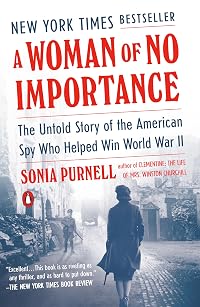
A Woman of No Importance: The Untold Story of Virginia Hall, WWII's Most Dangerous Spy
by Sonia Purnell
On This Page
Description
"The never-before-told story of one woman's heroism that changed the course of the Second World War In 1942, the Gestapo sent out an urgent transmission: "She is the most dangerous of all Allied spies. We must find and destroy her." This spy was Virginia Hall, a young American woman--rejected from the foreign service because of her gender and her prosthetic leg--who talked her way into the spy organization dubbed Churchill's "ministry of ungentlemanly warfare," and, before the United States show more had even entered the war, became the first woman to deploy to occupied France. Virginia Hall was one of the greatest spies in American history, yet her story remains untold. Just as she did in Clementine, Sonia Purnell uncovers the captivating story of a powerful, influential, yet shockingly overlooked heroine of the Second World War. At a time when sending female secret agents into enemy territory was still strictly forbidden, Virginia Hall came to be known as the "Madonna of the Resistance," coordinating a network of spies to blow up bridges, report on German troop movements, arrange equipment drops for Resistance agents, and recruit and train guerilla fighters. Even as her face covered WANTED posters throughout Europe, Virginia refused order after order to evacuate. She finally escaped with her life in a grueling hike over the Pyrenees into Spain, her cover blown, and her associates all imprisoned or executed. But, adamant that she had "more lives to save," she dove back in as soon as she could, organizing forces to sabotage enemy lines and back up Allied forces landing on Normandy beaches. Told with Purnell's signature insight and novelistic panache, A Woman of No Importance is the breathtaking story of how one woman's fierce persistence helped win the war"-- show lessTags
Recommendations







Member Reviews
This woman was extraordinary and should be a household name! The danger she put herself in is unreal- but she was organized, cool-headed and did so much to help the Allies win WWII- while putting up with a lot of incompetent men - some of whom were ostensibly her bosses. After all she accomplished in the war, the way the CIA treated her after the war is abominable and a classic case of discrimination
I would have given this 5 stars but the writing was sometimes dense and encyclopedic
I would have given this 5 stars but the writing was sometimes dense and encyclopedic
This is a fascinating and ultimately heartbreaking story about Virginia Hall, daughter of a prominent Baltimore family, who turned her back on her family's expecations for a most unusual life.
Discouraged, rejected, and outright barred from her first career choice because of her gender and because of a physical disability (she lost one leg in a hunting accident as a young woman), Hall persisted and eventually was sent into France to help organize what became the French Underground, whose efforts played a huge part in the eventual liberation of France.
Unfortunately, the book is dry and slow, packed with names and locations, but we never really begin to "know" Virginia Hall except by a catalogue list of her accomplishments.
If it were show more fiction, no one would believe the incidents related, but by cleaving strictly to records left behind, Purcell is never really able to get inside the mind and soul of her subject. Readers whose interest lie in people rather than in events may find it tough sledding. show less
Discouraged, rejected, and outright barred from her first career choice because of her gender and because of a physical disability (she lost one leg in a hunting accident as a young woman), Hall persisted and eventually was sent into France to help organize what became the French Underground, whose efforts played a huge part in the eventual liberation of France.
Unfortunately, the book is dry and slow, packed with names and locations, but we never really begin to "know" Virginia Hall except by a catalogue list of her accomplishments.
If it were show more fiction, no one would believe the incidents related, but by cleaving strictly to records left behind, Purcell is never really able to get inside the mind and soul of her subject. Readers whose interest lie in people rather than in events may find it tough sledding. show less
Virginia Hall was an amazing person and is a fascinating subject for a biography. She was an incredible agent who worked for the SOE and the OSS during WWII, a key figure in espionage and resistance in occupied France. She deserved better than this book.
A big part of my problem with this book was the writing style; the prose is dull and plodding, and I suspect it would be confusing in places for readers not already familiar with the SOE and its wartime operations. Purnell fails to define key terms or explain the background of major elements in the book.
Purnell also handles names astonishingly badly; she refers to most men mentioned by their last names. She calls women either by their first names (Virginia Hall, Germaine Guerin), their show more full names (Vera Atkins, though honestly I’d be wary of calling her anything else, too), or their titles (many of the Frenchwomen Hall encountered or worked with during the war are called Madame [Lastname]). And she calls most, but not all, SOE agents by their code names, a truly inexplicable choice. (Ben Cowburn remains Ben Cowburn, maybe because of the way he operated, but Brian Stonehouse is referred to as Celestin, Peter Harratt is called Aramis, etc.) I’m not sure how Purnell expects anyone to remember who is who, especially with the vague descriptions and references she provides for most of the people mentioned. I came into this already knowing the names and aliases of most of the major SOE operatives, and I still had to look things up from time to time.
I’m also concerned about accuracy. I am by no means an expert in the SOE, WWII, espionage, or anything else, and I caught several minor factual errors — wrong names, mostly. I have to assume there are other errors that I didn’t catch.
But mostly I’m just sad that this book didn’t make Virginia Hall live, or give any real sense of what her life was like. The most riveting and well-written chapter is the Mauzac prison break, which Hall orchestrated but wasn’t involved in. In other chapters, there’s almost no information on day to day activities, or rich description of Hall’s actions. I realize that’s in part because of the limited information available about Hall; she didn’t write a book about her experiences, or even talk about them, and was notably unwilling to have them commemorated or celebrated. But it’s still sad.
Virginia Hall’s story would make an amazing book, but this book is not the one. (I do hope it inspires someone to make a movie about her, though.) show less
A big part of my problem with this book was the writing style; the prose is dull and plodding, and I suspect it would be confusing in places for readers not already familiar with the SOE and its wartime operations. Purnell fails to define key terms or explain the background of major elements in the book.
Purnell also handles names astonishingly badly; she refers to most men mentioned by their last names. She calls women either by their first names (Virginia Hall, Germaine Guerin), their show more full names (Vera Atkins, though honestly I’d be wary of calling her anything else, too), or their titles (many of the Frenchwomen Hall encountered or worked with during the war are called Madame [Lastname]). And she calls most, but not all, SOE agents by their code names, a truly inexplicable choice. (Ben Cowburn remains Ben Cowburn, maybe because of the way he operated, but Brian Stonehouse is referred to as Celestin, Peter Harratt is called Aramis, etc.) I’m not sure how Purnell expects anyone to remember who is who, especially with the vague descriptions and references she provides for most of the people mentioned. I came into this already knowing the names and aliases of most of the major SOE operatives, and I still had to look things up from time to time.
I’m also concerned about accuracy. I am by no means an expert in the SOE, WWII, espionage, or anything else, and I caught several minor factual errors — wrong names, mostly. I have to assume there are other errors that I didn’t catch.
But mostly I’m just sad that this book didn’t make Virginia Hall live, or give any real sense of what her life was like. The most riveting and well-written chapter is the Mauzac prison break, which Hall orchestrated but wasn’t involved in. In other chapters, there’s almost no information on day to day activities, or rich description of Hall’s actions. I realize that’s in part because of the limited information available about Hall; she didn’t write a book about her experiences, or even talk about them, and was notably unwilling to have them commemorated or celebrated. But it’s still sad.
Virginia Hall’s story would make an amazing book, but this book is not the one. (I do hope it inspires someone to make a movie about her, though.) show less
Sonia Purnell's biography of Virginia Hall is truly compelling non-fiction reading. The majority of the work focuses on Hall's years as an SOE, and later OSS, agent working to coordinate the French Resistance during WWII. Virginia's work was truly amazing, particularly as she was constantly underestimated due to her gender. In addition, she had the added disadvantage of an artificial leg (affectionately known as Cuthbert), which meant that while participating in various Resistance activities, she never had the option of a last minute run if things got dicey. Purnell does an excellent job crafting summaries of Virginia's missions, based on a wide range of field reports, recollections, and other primary sources and also gives the reader a show more good sense of the personality behind the actions. An excellent read of a too often overlooked woman who played a massively important role in the war in France. Highly recommend, particularly for those interested in the period, the French Resistance, or women's history. show less
This is a fascinating exploration of the life of Virginia Hall: a woman who worked undercover for both British and American intelligence in occupied France during the Second World War. Most undercover agents had a very low life expectancy and most were men, but the multilingual Hall not only defied the statistical odds, she led whole groups of Resistance fighters, organised the breakout of a number of prisoners from the Mauzac internment camp, crossed the Pyrenees on foot, and frustrated the hell out of the Nazis—all while being an amputee and having to rely on an ill-fitten wooden leg she called “Cuthbert.”
Reading that paragraph should make you say “damn, what a badass”, and it is absolutely without doubt that Hall had show more nerves of steel and I would never want to go up against her in any kind of fight. Sonia Purnell clearly did her research here, mining archives in France, the UK, and the US, in order to reconstruct as fully as possible the career of a woman who steadfastly refused any public recognition during her lifetime.
However, as much as Purnell (and likely her editor/publishers) are clearly trying to frame Hall’s story as an almost cinematic one of an ass-kicking lone heroine who vanquishes Nazis and misogynists with equal aplomb, what I found the much more fascinating (if depressing) angle was how much Hall’s life and career are an example of what the women’s historian Judith Bennett has termed “patriarchal equilibrium”: the tendency of patriarchy to (re)assert itself over and over, with changes in women’s circumstances not resulting in transformation or in an overall change in their status with respect to that of men. More investigation of that might have deepened this book—but perhaps made it less appealing to a general audience. Equally, I would have been interested to see more of a grounding in a disability studies perspective, but ditto.
These points, coupled with some less than fully polished prose and some minor historical slips, means that this isn’t quite the biography that Virginia Hall deserves—but I am glad to have learned something about her life regardless.
(The audiobook is marred by the narrator’s tendency to lapse into bad accents when reading direct quotes from Americans, French people or Germans.) show less
Reading that paragraph should make you say “damn, what a badass”, and it is absolutely without doubt that Hall had show more nerves of steel and I would never want to go up against her in any kind of fight. Sonia Purnell clearly did her research here, mining archives in France, the UK, and the US, in order to reconstruct as fully as possible the career of a woman who steadfastly refused any public recognition during her lifetime.
However, as much as Purnell (and likely her editor/publishers) are clearly trying to frame Hall’s story as an almost cinematic one of an ass-kicking lone heroine who vanquishes Nazis and misogynists with equal aplomb, what I found the much more fascinating (if depressing) angle was how much Hall’s life and career are an example of what the women’s historian Judith Bennett has termed “patriarchal equilibrium”: the tendency of patriarchy to (re)assert itself over and over, with changes in women’s circumstances not resulting in transformation or in an overall change in their status with respect to that of men. More investigation of that might have deepened this book—but perhaps made it less appealing to a general audience. Equally, I would have been interested to see more of a grounding in a disability studies perspective, but ditto.
These points, coupled with some less than fully polished prose and some minor historical slips, means that this isn’t quite the biography that Virginia Hall deserves—but I am glad to have learned something about her life regardless.
(The audiobook is marred by the narrator’s tendency to lapse into bad accents when reading direct quotes from Americans, French people or Germans.) show less
”If you want something said, ask a man; if you want something done, ask a woman.”
Mrs. Thatcher may have had Virginia Hall in mind when she made this statement. It certainly applies, even if her male supervisors seldom wanted to give her the credit she deserved.
Born into a well-to-do American family she attended Radcliffe and Barnard colleges, then went to study in Paris and fell in love with France. She really wanted to be an ambassador which was nearly unheard of at the time, but accepted clerical positions at the U.S consulate in Turkey. It was in Turkey, while snipe hunting that she actually shot herself in the foot. Gangrene set in and the leg had to be amputated. She was fitted with a prosthesis which she fondly referred to as show more Cuthbert and didn’t let it get in the way of what she really wanted to do which was spy for the British government (SOE) for the benefit of her adored France.
She was an incredible secret agent and the tale of her exploits on behalf of the Resistance offers up an inconceivable story. The high point for me was the segment where she led a group over the Pyrenees in the dead of winter, dragging her prosthetic leg, as they escaped from the Germans who were hot on her trail.
She was an amazing woman, who had no desire for recognition, just wanted to do her job. She eventually went on to work for the CIA but was dissatisfied with a desk job. She was meant for high adventure. She craved it. It’s unfortunate that women, regardless of their accomplishments, have to work so much harder than men to prove themselves. Virginia Hall is to be greatly admired. show less
Mrs. Thatcher may have had Virginia Hall in mind when she made this statement. It certainly applies, even if her male supervisors seldom wanted to give her the credit she deserved.
Born into a well-to-do American family she attended Radcliffe and Barnard colleges, then went to study in Paris and fell in love with France. She really wanted to be an ambassador which was nearly unheard of at the time, but accepted clerical positions at the U.S consulate in Turkey. It was in Turkey, while snipe hunting that she actually shot herself in the foot. Gangrene set in and the leg had to be amputated. She was fitted with a prosthesis which she fondly referred to as show more Cuthbert and didn’t let it get in the way of what she really wanted to do which was spy for the British government (SOE) for the benefit of her adored France.
She was an incredible secret agent and the tale of her exploits on behalf of the Resistance offers up an inconceivable story. The high point for me was the segment where she led a group over the Pyrenees in the dead of winter, dragging her prosthetic leg, as they escaped from the Germans who were hot on her trail.
She was an amazing woman, who had no desire for recognition, just wanted to do her job. She eventually went on to work for the CIA but was dissatisfied with a desk job. She was meant for high adventure. She craved it. It’s unfortunate that women, regardless of their accomplishments, have to work so much harder than men to prove themselves. Virginia Hall is to be greatly admired. show less
A Woman of No Importance tells the story of Virginia Hall, one of the greatest, least known spies in World War II. Hall was sidelined by America because of her gender and a prosthetic leg, but she managed to work her way into the British forces and was a major force behind organizing the French resistance. She was known to the Nazis but managed to evade them, eventually escaping in a grueling hike over the Pyrenees into Spain. The book reminded me of Resistance Women by Jennifer Chiaverini as, like that book, highlights the important work done by women that has been largely forgotten. And, like those women, Hall was often prickly and not the demure debutante most men wanted in that era.
Members
- Recently Added By
Lists

Stories of War and Revolution
143 works; 54 members

Women in War
148 works; 30 members

Female spies
13 works; 2 members

Books Read in 2020
4,379 works; 123 members

Space Force Reading List 2022
9 works; 1 member
THE WAR ROOM
813 works; 24 members

Book Review Roundup
254 works; 2 members
Author Information

6+ Works 3,086 Members
Sonia Purnell is a journalist known for her investigative skills. She began her career at The Economist Intelligence Unit before going on to edit a weekly financial magazine at only 25 years old. She has since worked for a number of newspapers, including the Daily Telegraph, Daily Mail, Independent on Sunday and the London Evening Standard. It was show more during her time working for the Telegraph in Brussels in the early 1990s that Sonia worked with Boris Johnson, who later became the Mayor of London and the subject of Sonia¿s first book, Just Boris. In 2012 Aurum Press released Sonia's new ebook, Pedal Power: How Boris Johnson Failed London's Cyclists. Sonia¿s latest book, First Lady, explores the dynamics of the fascinating union between Clementine and Winston Churchill. From the personal and political upheavals of the Great War, through the Churchills¿ `wilderness years¿ in the 1930s, to Clementine¿s efforts to preserve her husband¿s health during the struggle against Hitler. (Bowker Author Biography) show less
Some Editions
Awards and Honors
Awards
Work Relationships
Common Knowledge
- Canonical title
- A Woman of No Importance: The Untold Story of Virginia Hall, WWII's Most Dangerous Spy
- Original title
- A Woman of No Importance: The Untold Story of the American Spy Who Helped Win World War II
- Alternate titles
- A Woman of No Importance: The Untold Story of the American Spy Who Helped Win World War II
- Original publication date
- 2019-03-28
- People/Characters
- Virginia Hall
- Important places
- France
- Important events
- World War II
- Epigraph
- The Resistance was a way of life. ... We see ourselves there utterly free ... as unknown and unknowable version of ourselves, the kind of people no one can ever find again, who existed only in relation to unique and terrible ... (show all)conditions ... to ghosts, or to the dead ... [Yet] I would call that moment of my life "Happiness."
—Jean Cassou, Toulouse Resistance leader and poet
The ideal subject of totalitarian rule is not the convicted Nazi or the convinced Communist, but people for whom the distinction between fact and fiction (i.e., the reality of experience) and the distinction between true and false (i.e., the standards of thought) no longer exist.
—Hannah Arendt, The Origins of Totalitarianism
It is from numberless diverse acts of courage and belief that human history is shaped. Each time a man stands up for an ideal, or acts to improve the lot of others, or strikes out against injustice, he sends forth a tiny ripple of hope, and crossing each other from a million different centers of energy and daring, those ripples build a current that can sweep down the mightiest walls.
—Robert F. Kennedy - Dedication
- For Sue 1951-2017. Courage comes in many forms.
- First words
- [Prologue] France was falling.
Mrs. Barbara Hall had it all worked out.
[Epilogue] Virginia did not receive the recognition she deserved during her CIA career, but toward the end of her life there were signs that her legacy was becoming better understood. - Last words
- (Click to show. Warning: May contain spoilers.)[Prologue] Even that, though, was not enough for her.
(Click to show. Warning: May contain spoilers.)When they talked with awe and affection of her incredible exploits, they smiled and looked up at the wide, open skies with "les etoiles dans les yeux."
(Click to show. Warning: May contain spoilers.)[Epilogue] Virginia Hall is a legend on the Haute-Loire plateau to this day. - Publisher's editor
- Savitt, Sarah; Schulz, Andrea; Wunderlich, Emily
- Blurbers
- Mulley, Clare; Helm, Sarah; Waller, Douglas
- Original language
- English
- Canonical DDC/MDS
- 940.548673092
Classifications
- Genres
- General Nonfiction, History, Biography & Memoir, Nonfiction
- DDC/MDS
- 940.548673092 — History & geography History of Europe History of Europe 1918- Military history of World War II Other Topics Unconventional warfare of Allies
- LCC
- D810 .S8 .G597 — History of Europe, Asia, Africa and Oceania History (General) World War II (1939-1945)
- BISAC
Statistics
- Members
- 2,177
- Popularity
- 9,326
- Reviews
- 86
- Rating
- (4.03)
- Languages
- 6 — Czech, English, French, Polish, Spanish, Portuguese (Portugal)
- Media
- Paper, Audiobook, Ebook
- ISBNs
- 29
- ASINs
- 9