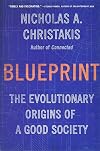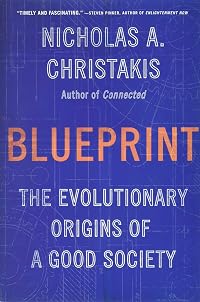
Blueprint: The Evolutionary Origins of a Good Society
by Nicholas A. Christakis MD PhD
On This Page
Description
"For too long, scientists have focused on the dark side of our biological heritage: our capacity for aggression, cruelty, prejudice, and self-interest. But natural selection has given us a suite of beneficial social features, including our capacity for love, friendship, cooperation, and learning. Beneath all our inventions--our tools, farms, machines, cities, nations--we carry with us innate proclivities to make a good society. In Blueprint, Nicholas A. Christakis introduces the compelling show more idea that our genes affect not only our bodies and behaviors, but also the ways in which we make societies, ones that are surprisingly similar worldwide. With many vivid examples--including diverse historical and contemporary cultures, communities formed in the wake of shipwrecks, commune dwellers seeking utopia, online groups thrown together by design or involving artificially intelligent bots, and even the tender and complex social arrangements of elephants and dolphins that so resemble our own--Christakis shows that, despite a human history replete with violence, we cannot escape our social blueprint for goodness. In a world of increasing political and economic polarization, it's tempting to ignore the positive role of our evolutionary past. Drawing on advances in social science, evolutionary biology, genetics, neuroscience, and network science, Blueprint shows how and why evolution has placed us on a humane path--and how we are united by our common humanity."--Dust jacket. show lessTags
Recommendations
































Member Reviews
Social scientists can approach the study of human culture, broadly, by either focusing on differences or similarities. All too often, they choose to accentuate the differences, elaborating on what divides us and on our more aggressive and sinister behaviors. Since cultural differences are so obvious, the countless cross-cultural variations in human behavior would seem to dispel the possibility of cultural universals.
In Blueprint, Nicholas Christakis makes the opposite case: that our genes code for universal traits—the social suite—that underlie all superficial variation in human behavior and provide the foundation by which we form social networks. Christakis uses the metaphor of viewing two mountains from a 10,000 foot plateau, show more noting that one mountain appears three times the size of the other, until you descend from the plateau. Then, you realize the two mountains are 10,300 and 10,900 feet tall, and are not so dissimilar from this enlarged perspective.
This enlarged perspective is the focus of the book. It extends the concept of genetic influence beyond its physical manifestations (without the strict determinism, as we’ll see). To begin with, it is a noncontroversial fact that genes code for proteins, which aggregate into cells. The cells, in turn, form bodies, brains, and ultimately the emergence of mind and behavior. But it is not clear where this genetic influence should stop, and Christakis is suggesting that genes also have an influence on the formation of societies, just as they have an influence on bodies.
The concept of the extended phenotype—popularized by Richard Dawkins—describes the effects of genes on the environment outside of the body. Whereas a phenotype is a physical manifestation of genetic information, as in the genes that code for blue eyes, an extended phenotype is an expression of the genotype that impacts the environment, such as a spider’s web, a bird’s nest, or a beaver’s dam. Experiments have been conducted that show, for example, that birds can build nests without the benefit of social learning, demonstrating that the behavior is innate.
Considering that we know that genes code for physical manifestations and environmental behaviors, there is no logical reason to terminate the point of influence at arbitrary levels; genes, in addition to coding for body shape and size and the instinct to build nests, can also encode for social network formation as an extended phenotype for social animals, including humans.
For a host of historical, philosophical, and religious reasons, we tend to view humans as somehow separate from and superior to nature and other animals, but the distinction breaks down after careful analysis. For example, years of research in animal behavior shows that chimpanzees, elephants, and whales form friendships, engage in pair-bonding, practice altruism, participate in social learning, mourn for the dead, develop a sense of self identity (dolphins, apes, and elephants can pass the mirror test), and develop culture. Since these animals share an evolutionary history with humans, it’s more than likely that these animal behaviors correlate with similar internal states and emotions found in humans, all coded by genetics. And, as Christakis explains, recognizing our similarities with animals makes it harder to deny our common humanity. If we share traits with other species, we must share certain universals among ourselves. As Christakis points out:
Our genes cannot account for differences; cultural variation accounts for that. What our genes can account for are all the similarities that are present underneath all of the cultural variation. Those similarities represent the social suite and the foundation for our societies. The social suite includes eight elements:
1. The capacity to have and recognize individual identity
2. Love for partners and offspring
3. Friendship
4. Social networks
5. Cooperation
6. In-group bias
7. Mild hierarchy (relative egalitarianism)
8. Social learning and teaching
These elements are found across cultures (including to some degree in apes, elephants, and whales), and within unintentional communities (shipwrecked communities), intentional communities (communes), and artificial communities (online communities). Further, successful communities embrace the elements of the social suite whereas failed communities try to repress certain elements (think communist suppression of individuality or totalitarian suppression of the importance of love and family).
It’s important to note that Christakis is not a hard determinist, in the sense that genes determine all behavior or that everything is predetermined and cannot be otherwise. Our genes greatly influence our thoughts and emotions, and therefore influence our beliefs and behaviors. But they are not rigidly determined as in the beaver’s encoded behavior to build specific types of dams. Our genes code for minds that are adaptable, that create societies and solve problems in response to environmental variation, but that the specific products of that activity are variable. But again, at the foundation of that variation is the social suite that is found in all cultures.
Despite cultural variation, you won’t find a culture of isolated humans fending for themselves, a culture devoid of love and friendship, a culture devoid of social learning and cooperation, or a culture composed of humans without individual identity. These are the universals upon which all else is built, and upon which we can continue to build.
And this is good news, because the social suite mostly enhances cooperation—the only real advantage humans have over other animals. We form bonds, friendships, and networks for the purpose of cooperation and social learning that gives us an advantage over our environment—whatever that environment happens to be. Cultural variation is an adaptation to environmental variation that humans have been exposed to throughout our evolutionary history.
A key point to remember is that these evolved traits of cooperation predate written history—and any religious texts—by hundreds of thousands of years. That means, if we didn’t have the innate capacity for cooperation and morality, we would have never survived for the hundreds of thousands of years before the invention of religion and moral philosophy. Our morality is a product of natural selection and is expressed in our best religious and philosophical texts, it is not caused by them. We weren't all killing and stealing from each other indiscriminately for 197,000 years before the Bible was written. The world’s religions and philosophies were written and embraced, and have ultimately survived in one form or another precisely because they harmonize with the social suite.
So if the deepest aspects of our humanity are mostly positive, why is history replete with violence and oppression? The answer is that humans also have parallel aggressive and violent tendencies, which were also necessary for survival (a species too cooperative sets itself up for exploitation). Additionally, cultural variation can be significant and at times at odds with our well-being, and in-group bias can accentuate small differences and obstruct the recognition of our common humanity. But our best chance of transcending these differences and building a better society is not by surrendering to any single belief system, but by recognizing and promoting the cultural universals—the social suite—that optimize human cooperation, expanding the circle of who we consider to be part of the human in-group. show less
In Blueprint, Nicholas Christakis makes the opposite case: that our genes code for universal traits—the social suite—that underlie all superficial variation in human behavior and provide the foundation by which we form social networks. Christakis uses the metaphor of viewing two mountains from a 10,000 foot plateau, show more noting that one mountain appears three times the size of the other, until you descend from the plateau. Then, you realize the two mountains are 10,300 and 10,900 feet tall, and are not so dissimilar from this enlarged perspective.
This enlarged perspective is the focus of the book. It extends the concept of genetic influence beyond its physical manifestations (without the strict determinism, as we’ll see). To begin with, it is a noncontroversial fact that genes code for proteins, which aggregate into cells. The cells, in turn, form bodies, brains, and ultimately the emergence of mind and behavior. But it is not clear where this genetic influence should stop, and Christakis is suggesting that genes also have an influence on the formation of societies, just as they have an influence on bodies.
The concept of the extended phenotype—popularized by Richard Dawkins—describes the effects of genes on the environment outside of the body. Whereas a phenotype is a physical manifestation of genetic information, as in the genes that code for blue eyes, an extended phenotype is an expression of the genotype that impacts the environment, such as a spider’s web, a bird’s nest, or a beaver’s dam. Experiments have been conducted that show, for example, that birds can build nests without the benefit of social learning, demonstrating that the behavior is innate.
Considering that we know that genes code for physical manifestations and environmental behaviors, there is no logical reason to terminate the point of influence at arbitrary levels; genes, in addition to coding for body shape and size and the instinct to build nests, can also encode for social network formation as an extended phenotype for social animals, including humans.
For a host of historical, philosophical, and religious reasons, we tend to view humans as somehow separate from and superior to nature and other animals, but the distinction breaks down after careful analysis. For example, years of research in animal behavior shows that chimpanzees, elephants, and whales form friendships, engage in pair-bonding, practice altruism, participate in social learning, mourn for the dead, develop a sense of self identity (dolphins, apes, and elephants can pass the mirror test), and develop culture. Since these animals share an evolutionary history with humans, it’s more than likely that these animal behaviors correlate with similar internal states and emotions found in humans, all coded by genetics. And, as Christakis explains, recognizing our similarities with animals makes it harder to deny our common humanity. If we share traits with other species, we must share certain universals among ourselves. As Christakis points out:
“The thing about genes is this: we all have them. And at least 99 percent of the DNA in all humans is exactly the same. A scientific understanding of human beings actually fosters the cause of justice by identifying the deep sources of our common humanity. The underpinnings of society that we have come to understand—the social suite that is our blueprint—have to do with our genetic similarities, not our differences.”
Our genes cannot account for differences; cultural variation accounts for that. What our genes can account for are all the similarities that are present underneath all of the cultural variation. Those similarities represent the social suite and the foundation for our societies. The social suite includes eight elements:
1. The capacity to have and recognize individual identity
2. Love for partners and offspring
3. Friendship
4. Social networks
5. Cooperation
6. In-group bias
7. Mild hierarchy (relative egalitarianism)
8. Social learning and teaching
These elements are found across cultures (including to some degree in apes, elephants, and whales), and within unintentional communities (shipwrecked communities), intentional communities (communes), and artificial communities (online communities). Further, successful communities embrace the elements of the social suite whereas failed communities try to repress certain elements (think communist suppression of individuality or totalitarian suppression of the importance of love and family).
It’s important to note that Christakis is not a hard determinist, in the sense that genes determine all behavior or that everything is predetermined and cannot be otherwise. Our genes greatly influence our thoughts and emotions, and therefore influence our beliefs and behaviors. But they are not rigidly determined as in the beaver’s encoded behavior to build specific types of dams. Our genes code for minds that are adaptable, that create societies and solve problems in response to environmental variation, but that the specific products of that activity are variable. But again, at the foundation of that variation is the social suite that is found in all cultures.
Despite cultural variation, you won’t find a culture of isolated humans fending for themselves, a culture devoid of love and friendship, a culture devoid of social learning and cooperation, or a culture composed of humans without individual identity. These are the universals upon which all else is built, and upon which we can continue to build.
And this is good news, because the social suite mostly enhances cooperation—the only real advantage humans have over other animals. We form bonds, friendships, and networks for the purpose of cooperation and social learning that gives us an advantage over our environment—whatever that environment happens to be. Cultural variation is an adaptation to environmental variation that humans have been exposed to throughout our evolutionary history.
A key point to remember is that these evolved traits of cooperation predate written history—and any religious texts—by hundreds of thousands of years. That means, if we didn’t have the innate capacity for cooperation and morality, we would have never survived for the hundreds of thousands of years before the invention of religion and moral philosophy. Our morality is a product of natural selection and is expressed in our best religious and philosophical texts, it is not caused by them. We weren't all killing and stealing from each other indiscriminately for 197,000 years before the Bible was written. The world’s religions and philosophies were written and embraced, and have ultimately survived in one form or another precisely because they harmonize with the social suite.
So if the deepest aspects of our humanity are mostly positive, why is history replete with violence and oppression? The answer is that humans also have parallel aggressive and violent tendencies, which were also necessary for survival (a species too cooperative sets itself up for exploitation). Additionally, cultural variation can be significant and at times at odds with our well-being, and in-group bias can accentuate small differences and obstruct the recognition of our common humanity. But our best chance of transcending these differences and building a better society is not by surrendering to any single belief system, but by recognizing and promoting the cultural universals—the social suite—that optimize human cooperation, expanding the circle of who we consider to be part of the human in-group. show less
I've had a lot of love and interest in the social sciences over the years. I thought I was really into psychology until I fell in love with sociology. This led me to be a huge lover of SF in general, but concurrently, I read all about utopias, planned communities, shipwrecked sailors building their own natural communities, and all the kinds of political, social, and even biological foundations that any of these could arise from.
And then I read this book.
Christakis, a man with titles galore, has done a very thorough and interesting job in breaking down the fundamental similarities between all societies, starting from the same place that I began my research and taking it further... like communities in online gaming. But he doesn't stop show more there. He goes into the inherently social nature of animals, focusing on the features that are similar across the board.
Anyone who has ever had a cat or a dog will recognize the intelligence, altruism, cooperative natures of other social creatures. The same is true for dolphins and whales, elephants and the whole simian hoard. Just watch Animal Planet!
It's easy to see we're all more alike than different. And that's the main point. We're all biologically, genetically set-up, to want certain things. Some of those things conflict with each other. Culture and social structures put a modifier on the worst aspects of those conflicts and reinforce cooperation... but cooperative structures can be gamed. Members within it can cheat and steal and reap the benefits of the cooperation without giving anything back. And then the reaction comes. Punishment, more self-modifiers, and a flip-flop between aggression and cooperation. Richard Dawkins explains this very well in the Selfish Gene, and in a lot more convincing detail, but Christakis is quite good for all that.
We create societies based on our biological "social suite". These are features that cross all boundaries of culture because they're hard-wired in us. I'll steal the list from Bill Gate's review on this book:
1. Individual identity
2. Love for partners and children
3. Friendship
4. Social networks
5. Cooperation
6. Preference for your own group
7. Some form of hierarchy
8. Social learning and teaching
The final takeaway from this book DOES give us hope, oddly enough. These are all positive features of not just humanity but of a lot of the animal kingdom.
But here's the trick: Any time a culture or a social structure tries to break this social suite by denying even a single aspect to it, things tend to fall apart. Social learning rather implies that. And some, like preference for your own group, can be conflated into a major us vs them that can lead to aggressive war parties our world wars.
BUT... when social divisions are crossed, or given aspect in an umbrella from that captures commonalities across the divides, cooperation CAN be reestablished. People have seen this countless times. Giving aid to enemy soldiers on the battlefield, or the Red Cross. Charitable organizations. Doctors Without Borders. Or perhaps we ought to remember that countless unrelated people flocked to the twin towers to help those in need. We DO have a lot of evidence of altruism in our social lives, but this is mitigated against our perception that there are thieves among us.
I personally see a failure of cooperation going on all around us. It seems more glaringly obvious to me every day. And for good reason. The rich are getting richer and the poor are getting poorer. The grand majority in the middle are getting pushed down to the poorer side. Mistrust is everywhere because of the thieves.
I suppose the big question is this: can we learn to cooperate once more to root out the real thieves and reestablish the fundamental social suite that we need to thrive? show less
And then I read this book.
Christakis, a man with titles galore, has done a very thorough and interesting job in breaking down the fundamental similarities between all societies, starting from the same place that I began my research and taking it further... like communities in online gaming. But he doesn't stop show more there. He goes into the inherently social nature of animals, focusing on the features that are similar across the board.
Anyone who has ever had a cat or a dog will recognize the intelligence, altruism, cooperative natures of other social creatures. The same is true for dolphins and whales, elephants and the whole simian hoard. Just watch Animal Planet!
It's easy to see we're all more alike than different. And that's the main point. We're all biologically, genetically set-up, to want certain things. Some of those things conflict with each other. Culture and social structures put a modifier on the worst aspects of those conflicts and reinforce cooperation... but cooperative structures can be gamed. Members within it can cheat and steal and reap the benefits of the cooperation without giving anything back. And then the reaction comes. Punishment, more self-modifiers, and a flip-flop between aggression and cooperation. Richard Dawkins explains this very well in the Selfish Gene, and in a lot more convincing detail, but Christakis is quite good for all that.
We create societies based on our biological "social suite". These are features that cross all boundaries of culture because they're hard-wired in us. I'll steal the list from Bill Gate's review on this book:
1. Individual identity
2. Love for partners and children
3. Friendship
4. Social networks
5. Cooperation
6. Preference for your own group
7. Some form of hierarchy
8. Social learning and teaching
The final takeaway from this book DOES give us hope, oddly enough. These are all positive features of not just humanity but of a lot of the animal kingdom.
But here's the trick: Any time a culture or a social structure tries to break this social suite by denying even a single aspect to it, things tend to fall apart. Social learning rather implies that. And some, like preference for your own group, can be conflated into a major us vs them that can lead to aggressive war parties our world wars.
BUT... when social divisions are crossed, or given aspect in an umbrella from that captures commonalities across the divides, cooperation CAN be reestablished. People have seen this countless times. Giving aid to enemy soldiers on the battlefield, or the Red Cross. Charitable organizations. Doctors Without Borders. Or perhaps we ought to remember that countless unrelated people flocked to the twin towers to help those in need. We DO have a lot of evidence of altruism in our social lives, but this is mitigated against our perception that there are thieves among us.
I personally see a failure of cooperation going on all around us. It seems more glaringly obvious to me every day. And for good reason. The rich are getting richer and the poor are getting poorer. The grand majority in the middle are getting pushed down to the poorer side. Mistrust is everywhere because of the thieves.
I suppose the big question is this: can we learn to cooperate once more to root out the real thieves and reestablish the fundamental social suite that we need to thrive? show less
Well written, well documented description and analysis of what the author calls the social suite consisting of 8 elements: individual identity, love, friendship, social networks, cooperation, in- group bias, mild hierarchy, social learning and teaching. The contention is these are universal in human society and, therefore, genetic. Assuming these traits are universal, it seems inevitable that they are genetic unless you believe in the supernatural or some massive cultural convergence. However, I feel an additional trait is required: creative imagination which explains the wide range of diversity iand flexibility in the various cultures and the ability to form ideas that contrast what is with what might be or ought to be, and to show more actualize a subset of these ideas. Also, I think the analysis is overly optimistic in downplaying in- group bias and qualifying hierarchy with 'mild.' show less
I have mixed feelings about this to be honest. Certainly it is packed with interesting information and examples of surprising behaviours driven by evolutionary selections. So its a compelling book. But I waited in vain for a blueprint to be revealed, and it doesn't come. The argument is broadly that genes, and evolutionary selection, is driven by cultural and environmental factors and that in turn our genes impact culture and the environment. And thus that the social suite is genetically driven
I have no particular issue with this as an argument. But I do question the idea that we are genetically blueprinted to bend towards the good in the way we form societies and interact. Good is relative; we don't know which more utopian paths we show more might have taken, but that we have selected against.
The book is full of interesting fragments, and well worth reading for those. But if you are expecting a universal theory of social behaviour, as some of the blurb seems to suggest, then you might be a little disappointed show less
I have no particular issue with this as an argument. But I do question the idea that we are genetically blueprinted to bend towards the good in the way we form societies and interact. Good is relative; we don't know which more utopian paths we show more might have taken, but that we have selected against.
The book is full of interesting fragments, and well worth reading for those. But if you are expecting a universal theory of social behaviour, as some of the blurb seems to suggest, then you might be a little disappointed show less
There's a lot to unpack from this book. The main thesis being how intertwined society is with our biological evolution. How there is no clear cut distinction of which shaped the other, but a strong feedback loop between them. Humans self-domesticating themselves into cultures and cultures shaping the genetic evolution of humans. This being of course an ongoing process that will always be happening in the background of humanity's future.
Keeping this in mind can help us better understand what goes right or wrong in society. I'm a bit doubtful about how it can be applied to an extent that could help us better organize and tackle challenges, but nevertheless it's good to be reminded of this feedback loop. The book could've been a bit more show more targeted around the main thesis though, with the reasoning that if the reader doesn't accept the premise behind it, piling examples on top of examples won't do much to change that. That would've trimmed around 25% of it and presented a clearer idea. Recommending it to fans of Harari or even Dawkins (should they be prepared for more speculation and less rigor). show less
Keeping this in mind can help us better understand what goes right or wrong in society. I'm a bit doubtful about how it can be applied to an extent that could help us better organize and tackle challenges, but nevertheless it's good to be reminded of this feedback loop. The book could've been a bit more show more targeted around the main thesis though, with the reasoning that if the reader doesn't accept the premise behind it, piling examples on top of examples won't do much to change that. That would've trimmed around 25% of it and presented a clearer idea. Recommending it to fans of Harari or even Dawkins (should they be prepared for more speculation and less rigor). show less
The book is interesting but extremely condensed. I know most of the experiments from other books where they are described in detail but I can't see how you could understand the outcome just based on the brief mentions here. Otherwise well written but the arguments put forward just don't follow from the facts presented. It's like using the Chernobyl meltdown as evidence that Atomic power is safe. I just kept thinking: "wait, what?" over and over.
A universalist and cross-cultural account of friendship, love and social connections. One of the best books to be published in 2019 for its towering ambition and reach.
Members
- Recently Added By
Lists

How it can be.
14 works; 2 members

Foundations of Morality
10 works; 1 member

Books Cited in Blueprint by Nicholas Christakis
261 works; 1 member
Author Information
5+ Works 1,557 Members
Nicholas A. Christakis is a physician and sociologist who explores the ancient origins and modern implications of human nature. He directs the Human Nature Lab at Yale University, where he is the Sterling Professor of Social and Natural Science in the departments of Sociology, Medicine, Ecology and Evolutionary Biology, Statistics and Data show more Science, and Biomedical Engineering. He is the co-director of the Yale Institute for Network Science and the coauthor of Connected. show less
Common Knowledge
- Blurbers
- Applebaum, Anne; Solomon, Andrew; Jahren, Hope; Grant, Adam; Haidt, Jonathan; Duckworth, Angela (show all 29); Schmidt, Eric; Lieberman, Daniel E.; Ferguson, Niall; Stanton, Brandon; Shubin, Neil; Andreessen, Marc; Sunstein, Cass R.; Gilbert, Daniel; Pinker, Steven; Bloom, Paul; Wrangham, Richard; Lukianoff, Greg; Ito, Joi; Chua, Amy; Barabasi, Albert-Laszlo; Apicella, Coren; Banaji, Mahzarin R.; King, Greg; Patterson, Orlando; Fox, Renee C.; Fehr, Ernest; Simon, David; Wagner, Gunter
Classifications
Statistics
- Members
- 427
- Popularity
- 72,385
- Reviews
- 13
- Rating
- (3.94)
- Languages
- English, German, Portuguese (Portugal)
- Media
- Paper, Audiobook, Ebook
- ISBNs
- 11
- ASINs
- 4