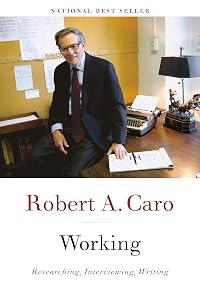
Working
by Robert A. Caro
On This Page
Description
Two-time Pulitzer Prize winner Robert Caro gives us a glimpse into his own life and work. He describes what it was like to interview the mighty Robert Moses; what it felt like to begin discovering the extent of the political power Moses wielded; the combination of discouragement and exhilaration he felt confronting the vast holdings of the Lyndon B. Johnson Library in Austin, Texas; his encounters with witnesses, including longtime residents wrenchingly displaced by the construction of show more Moses' Cross-Bronx Expressway and Lady Bird Johnson acknowledging the beauty and influence of one of LBJ's mistresses. He gratefully remembers how, after years of working in solitude, he found a writers' community at the New York Public Library, and details the ways he goes about planning and composing his books. Caro recalls the moments at which he came to understand that he wanted to write not just about the men who wielded power but about the people and the politics that were shaped by that power. And he talks about the importance to him of the writing itself, of how he tries to infuse it with a sense of place and mood to bring characters and situations to life on the page. show lessTags
Recommendations


Member Recommendations
Member Reviews
“While I am aware that there is no Truth, no objective truth, no single truth, no truth simple or unsimple, either; no verity, eternal or otherwise; no Truth about anything, there are Facts, objective facts, discernible and verifiable. And the more facts you accumulate, the closer you come to whatever truth there is.”
Robert A. Caro has written a memoir that documents his method of work. It is split into the component parts referenced in the subtitle. He accomplishes this goal by using examples from his own writing – primarily his biographies of Robert Moses and Lyndon Johnson. His books explore the sources of power – urban power in the case of Moses, and national political power in the case of Johnson.
Caro is an intentional show more writer – he decides the crux of what he wants to say, boils it down to its essence, then makes sure his written product fits this summary. Nothing superfluous is included. His research is meticulous. He does his own research, assisted only by his wife, Ina. He makes sure he can support his narrative with written documentation and facts. He conducts a vast array of interviews, searching for anyone who knew these people. He interviews key players many times, asking detailed questions to ensure he can convey the emotional context as well as what happened and why. In short, the depth and breadth of his research is astounding.
One of his main points is that writing non-fiction should be similar to writing fiction in terms of creating a sense of place, employing high quality prose, and instilling the narrative with a sense of rhythm and mood. He emphasizes that the non-fiction writer is telling a story, albeit one that has been researched and fact-checked rather than imagined. He believes the time it takes to follow the process, and pursue the truth, is well spent. This book is filled with great advice for writers, and I found it a pleasure to read.
Especially recommended to those interested in writing non-fiction. show less
Robert A. Caro has written a memoir that documents his method of work. It is split into the component parts referenced in the subtitle. He accomplishes this goal by using examples from his own writing – primarily his biographies of Robert Moses and Lyndon Johnson. His books explore the sources of power – urban power in the case of Moses, and national political power in the case of Johnson.
Caro is an intentional show more writer – he decides the crux of what he wants to say, boils it down to its essence, then makes sure his written product fits this summary. Nothing superfluous is included. His research is meticulous. He does his own research, assisted only by his wife, Ina. He makes sure he can support his narrative with written documentation and facts. He conducts a vast array of interviews, searching for anyone who knew these people. He interviews key players many times, asking detailed questions to ensure he can convey the emotional context as well as what happened and why. In short, the depth and breadth of his research is astounding.
One of his main points is that writing non-fiction should be similar to writing fiction in terms of creating a sense of place, employing high quality prose, and instilling the narrative with a sense of rhythm and mood. He emphasizes that the non-fiction writer is telling a story, albeit one that has been researched and fact-checked rather than imagined. He believes the time it takes to follow the process, and pursue the truth, is well spent. This book is filled with great advice for writers, and I found it a pleasure to read.
Especially recommended to those interested in writing non-fiction. show less
“While I am aware that there is no Truth, no objective truth, no single truth, no truth simple or unsimple, either; no verity, eternal or otherwise; no Truth about anything, there are Facts, objective facts, discernible and verifiable. And the more facts you accumulate, the closer you come to whatever truth there is.”
Robert A. Caro has written a memoir that documents his method of work. It is split into the component parts referenced in the subtitle. He accomplishes this goal by using examples from his own writing – primarily his biographies of Robert Moses and Lyndon Johnson. His books explore the sources of power – urban power in the case of Moses, and national political power in the case of Johnson.
Caro is an intentional show more writer – he decides the crux of what he wants to say, boils it down to its essence, then makes sure his written product fits this summary. Nothing superfluous is included. His research is meticulous. He does his own research, assisted only by his wife, Ina. He makes sure he can support his narrative with written documentation and facts. He conducts a vast array of interviews, searching for anyone who knew these people. He interviews key players many times, asking detailed questions to ensure he can convey the emotional context as well as what happened and why. In short, the depth and breadth of his research is astounding.
One of his main points is that writing non-fiction should be similar to writing fiction in terms of creating a sense of place, employing high quality prose, and instilling the narrative with a sense of rhythm and mood. He emphasizes that the non-fiction writer is telling a story, albeit one that has been researched and fact-checked rather than imagined. He believes the time it takes to follow the process, and pursue the truth, is well spent. This book is filled with great advice for writers, and I found it a pleasure to read.
Especially recommended to those interested in writing non-fiction. show less
Robert A. Caro has written a memoir that documents his method of work. It is split into the component parts referenced in the subtitle. He accomplishes this goal by using examples from his own writing – primarily his biographies of Robert Moses and Lyndon Johnson. His books explore the sources of power – urban power in the case of Moses, and national political power in the case of Johnson.
Caro is an intentional show more writer – he decides the crux of what he wants to say, boils it down to its essence, then makes sure his written product fits this summary. Nothing superfluous is included. His research is meticulous. He does his own research, assisted only by his wife, Ina. He makes sure he can support his narrative with written documentation and facts. He conducts a vast array of interviews, searching for anyone who knew these people. He interviews key players many times, asking detailed questions to ensure he can convey the emotional context as well as what happened and why. In short, the depth and breadth of his research is astounding.
One of his main points is that writing non-fiction should be similar to writing fiction in terms of creating a sense of place, employing high quality prose, and instilling the narrative with a sense of rhythm and mood. He emphasizes that the non-fiction writer is telling a story, albeit one that has been researched and fact-checked rather than imagined. He believes the time it takes to follow the process, and pursue the truth, is well spent. This book is filled with great advice for writers, and I found it a pleasure to read.
Especially recommended to those interested in writing non-fiction. show less
Review of: Working: Researching, Interviewing, Writing, by Robert A. Caro
by Stan Prager (10-2-19)
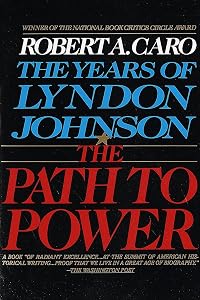
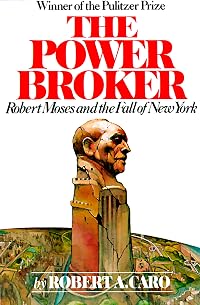
While browsing a bookstore sometime in 1982, I picked up a thick hardcover entitled The Years of Lyndon Johnson: The Path to Power, by Robert A. Caro. I had never heard of Caro, but the jacket flap told of his winning the 1975 Pulitzer Prize for biography for his very first book, The Power Broker: Robert Moses and the Fall of New York. I had never heard of Moses either, but in the days before smartphones and Google might let me dig a little deeper, that accolade spoke directly to the author’s reputation. I did—and still do—like to browse bookstores and to read books about American presidents. The twenty bucks I shelled out to buy that show more book was probably most of the cash I had in my wallet that afternoon, something else that was and remains characteristic of me to this day: given a choice between buying lunch or a new book, I will almost always choose the latter. I mean, I can wait until dinner …
That volume of The Path to Power is 768 pages of small print, not including notes and back matter, of mostly dense material, but Caro’s voice is so commanding that I found myself both absorbed and obsessed. For those who have not read him, it is difficult to describe Caro’s style, which exists somewhere at the confluence of incisive reporting and towering epic, a kind of literary salad that blends the best of Edward R. Murrow and Robert Penn Warren—seasoned with a dash or two of Thucydides—that the reader is driven to devour.
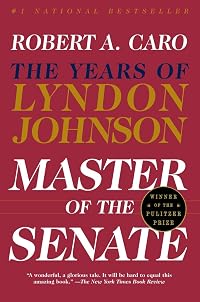
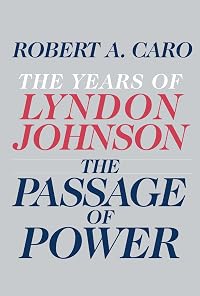
There are great presidential biographers out there—think Robert Remini, David McCullough, Joseph Ellis, Jon Meacham—yet Caro is in a league all his own. And unlike the others, he has not been prolific, devoting the decades since the publication of The Path to Power to just three books, all part of his The Years of Lyndon Johnson saga, one of which—Master of the Senate—is a landmark synthesis of history and biography and politics that won him a second Pulitzer Prize in 2003. Another ten years passed before the release of The Passage of Power, which only just follows LBJ into his first months in the White House. Now an octogenarian still doggedly at work on what is to be the final book in the series, Caro has broken precedent by releasing a slim volume that is a study of the author rather than his subjects.
This latest book, Working: Researching, Interviewing, Writing, is less a memoir than a profile of what Caro has set out to do and how he has approached the process, as neatly summarized by the subtitle. Surprisingly, Caro is not a historian, but instead started off as a journalist who won the respect of an old-fashioned hardboiled editor when his diligence in the field turned up info vital to a storyline. The editor, who had barely acknowledged him before, advised: “Turn every page. Never assume anything. Turn every goddamned page.” That has been his mantra ever since.
Caro is fascinated by power and those who wield it, and especially by the ways power can be obtained and exercised outside of ordinary channels. For instance, his first subject— “master builder” Robert Moses—was never elected to any office, yet at one point simultaneously held twelve official titles and used his accumulated authority to preside over the utter and lasting reshaping of New York City and its suburbs. In his research on LBJ, by turning “every page,” Caro encountered an obscure reference that led him to learn that Lyndon Johnson’s political rise and own personal wealth was closely linked to a long-secret relationship with the principals of Brown & Root, a construction company that built roads and dams and was later enriched by government contracts sent their way by Johnson; in turn, their largesse was to overflow LBJ’s campaign coffers. The rest is—quite literally—history.
A silent partner in Caro’s award-winning achievements has long been his wife Ina, who has quietly devoted her life to aiding his research and managing the household so that he could concentrate entirely on his book projects. In Working, Caro reveals that Ina once sold their home—without telling him—in order to ensure their financial solvency. Another time, when he announced they were moving to the Texas Hill Country for three years to continue his research on LBJ, Ina cracked: “Why can’t you do a biography of Napoleon?” But she went along, without complaint. And Caro makes it clear that Ina was no mere admin or assistant: she often sat across from him at long library tables and turned over half of those “goddamned pages” herself.
By my own calculation, I have read nearly three thousand pages of Robert Caro in his four volumes on Lyndon Johnson. I eagerly and impatiently await the final book. I did not know what to expect from Working, which is closer to memoir than autobiography but truly defies categorization. Most great writers are incapable of talking about themselves without something like bitterness or bravado. Hemingway certainly couldn’t do it. Steinbeck—think Travels with Charley—was better at it, but he tended to conflate fiction and nonfiction along the way. Caro would have none of that. His work has always had a singular focus that has been about the unvarnished facts, about the warts and all, about the inconvenient truths that swirl about the lives of his subjects, and he delivers no more and certainly nothing less when he turns the lens on himself.
Working would be a party favor if written by anyone but Robert Caro. But because he is a magnificent writer gifted with extraordinary insight, it is a kind of a minor masterpiece packaged in an undersized edition that is an easy read of less than two hundred pages. If there is a fault, it is the odd inclusion of an interview with The Paris Review from 2016 that is not only superfluous but distracting; I would urge skipping it. But that’s a quibble. Even if you have never heard of Robert Caro yet are fascinated with history and how solid research serves as the foundation to analysis, interpretation and an ever-evolving historiography, you should read this. If you have read Caro’s other books, of course, then you must read this one!
Review of: Working: Researching, Interviewing, Writing, by Robert A. Caro https://regarp.com/2019/10/02/review-of-working-researching-interviewing-writing... show less
by Stan Prager (10-2-19)
While browsing a bookstore sometime in 1982, I picked up a thick hardcover entitled The Years of Lyndon Johnson: The Path to Power, by Robert A. Caro. I had never heard of Caro, but the jacket flap told of his winning the 1975 Pulitzer Prize for biography for his very first book, The Power Broker: Robert Moses and the Fall of New York. I had never heard of Moses either, but in the days before smartphones and Google might let me dig a little deeper, that accolade spoke directly to the author’s reputation. I did—and still do—like to browse bookstores and to read books about American presidents. The twenty bucks I shelled out to buy that show more book was probably most of the cash I had in my wallet that afternoon, something else that was and remains characteristic of me to this day: given a choice between buying lunch or a new book, I will almost always choose the latter. I mean, I can wait until dinner …
That volume of The Path to Power is 768 pages of small print, not including notes and back matter, of mostly dense material, but Caro’s voice is so commanding that I found myself both absorbed and obsessed. For those who have not read him, it is difficult to describe Caro’s style, which exists somewhere at the confluence of incisive reporting and towering epic, a kind of literary salad that blends the best of Edward R. Murrow and Robert Penn Warren—seasoned with a dash or two of Thucydides—that the reader is driven to devour.
There are great presidential biographers out there—think Robert Remini, David McCullough, Joseph Ellis, Jon Meacham—yet Caro is in a league all his own. And unlike the others, he has not been prolific, devoting the decades since the publication of The Path to Power to just three books, all part of his The Years of Lyndon Johnson saga, one of which—Master of the Senate—is a landmark synthesis of history and biography and politics that won him a second Pulitzer Prize in 2003. Another ten years passed before the release of The Passage of Power, which only just follows LBJ into his first months in the White House. Now an octogenarian still doggedly at work on what is to be the final book in the series, Caro has broken precedent by releasing a slim volume that is a study of the author rather than his subjects.
This latest book, Working: Researching, Interviewing, Writing, is less a memoir than a profile of what Caro has set out to do and how he has approached the process, as neatly summarized by the subtitle. Surprisingly, Caro is not a historian, but instead started off as a journalist who won the respect of an old-fashioned hardboiled editor when his diligence in the field turned up info vital to a storyline. The editor, who had barely acknowledged him before, advised: “Turn every page. Never assume anything. Turn every goddamned page.” That has been his mantra ever since.
Caro is fascinated by power and those who wield it, and especially by the ways power can be obtained and exercised outside of ordinary channels. For instance, his first subject— “master builder” Robert Moses—was never elected to any office, yet at one point simultaneously held twelve official titles and used his accumulated authority to preside over the utter and lasting reshaping of New York City and its suburbs. In his research on LBJ, by turning “every page,” Caro encountered an obscure reference that led him to learn that Lyndon Johnson’s political rise and own personal wealth was closely linked to a long-secret relationship with the principals of Brown & Root, a construction company that built roads and dams and was later enriched by government contracts sent their way by Johnson; in turn, their largesse was to overflow LBJ’s campaign coffers. The rest is—quite literally—history.
A silent partner in Caro’s award-winning achievements has long been his wife Ina, who has quietly devoted her life to aiding his research and managing the household so that he could concentrate entirely on his book projects. In Working, Caro reveals that Ina once sold their home—without telling him—in order to ensure their financial solvency. Another time, when he announced they were moving to the Texas Hill Country for three years to continue his research on LBJ, Ina cracked: “Why can’t you do a biography of Napoleon?” But she went along, without complaint. And Caro makes it clear that Ina was no mere admin or assistant: she often sat across from him at long library tables and turned over half of those “goddamned pages” herself.
By my own calculation, I have read nearly three thousand pages of Robert Caro in his four volumes on Lyndon Johnson. I eagerly and impatiently await the final book. I did not know what to expect from Working, which is closer to memoir than autobiography but truly defies categorization. Most great writers are incapable of talking about themselves without something like bitterness or bravado. Hemingway certainly couldn’t do it. Steinbeck—think Travels with Charley—was better at it, but he tended to conflate fiction and nonfiction along the way. Caro would have none of that. His work has always had a singular focus that has been about the unvarnished facts, about the warts and all, about the inconvenient truths that swirl about the lives of his subjects, and he delivers no more and certainly nothing less when he turns the lens on himself.
Working would be a party favor if written by anyone but Robert Caro. But because he is a magnificent writer gifted with extraordinary insight, it is a kind of a minor masterpiece packaged in an undersized edition that is an easy read of less than two hundred pages. If there is a fault, it is the odd inclusion of an interview with The Paris Review from 2016 that is not only superfluous but distracting; I would urge skipping it. But that’s a quibble. Even if you have never heard of Robert Caro yet are fascinated with history and how solid research serves as the foundation to analysis, interpretation and an ever-evolving historiography, you should read this. If you have read Caro’s other books, of course, then you must read this one!
Review of: Working: Researching, Interviewing, Writing, by Robert A. Caro https://regarp.com/2019/10/02/review-of-working-researching-interviewing-writing... show less
Caro is reputed to be the best living biographer, one whose work not only fully illuminates an individual, but his entire society and times, in prose worthy of an exciting novel. He has won the Pulitzer Prize twice, the National Book Critics Circle award three times, and was given the National Humanities Medal by President Obama. In another decade, when I'm retired, I hope to read his 3,500-page biography of Lyndon Johnson in its entirety. (I hope that by that time, it's been expanded by a further 1,200 pages or so.)
Meanwhile, here are 200 pages of stories and reflections that had no place in the biographies themselves: stories of the people he's met, of the interviews they gave, of how Caro works and how he thinks; it's all show more interesting, sometimes more than just interesting, and it makes me eager to read the rest of his work sooner instead of later. Reading his work is like sitting in his office and listening to him talk about the larger-than-life characters he encountered, and how he got them to open up. In no sense is reading this fascinating book "study" or work. It's as easy as reading a magazine, and a hundred times more rewarding. show less
Meanwhile, here are 200 pages of stories and reflections that had no place in the biographies themselves: stories of the people he's met, of the interviews they gave, of how Caro works and how he thinks; it's all show more interesting, sometimes more than just interesting, and it makes me eager to read the rest of his work sooner instead of later. Reading his work is like sitting in his office and listening to him talk about the larger-than-life characters he encountered, and how he got them to open up. In no sense is reading this fascinating book "study" or work. It's as easy as reading a magazine, and a hundred times more rewarding. show less
Musings and interviews about Caro’s life as a writer and chronicler of what it means to have power. He worked very hard to show people both the human costs and benefits of the exercise of power—Robert Moses’s destruction of thriving neighborhoods and thus of many of the people who lived there; LBJ’s transformation of the lives of rural Texas women who used to have to pull hundreds of gallons of water up from wells by hand, then transport those hundreds of pounds to their houses, every single day, through rural electrification. He tells a wonderful story about figuring out how LBJ went from random junior Congressman to a person that senior elected officials wrote to deferentially—in October 1940, he transformed and organized show more political donations from Texas businesses, putting more money into congressional campaigns around the country than had ever been available, but kept them firmly under his own control. LBJ had tried to keep most of this off the record, but just enough survived (sometimes mysteriously filed) for Caro to piece together the story. In the end, Caro says, power doesn’t necessarily corrupt, but “what power always does is reveal.” show less
Caro’s book is ostensibly about two book subjects: city planner Robert Moses and politician Lyndon Johnson. The Johnson book is four volumes with the fifth supposedly on its way (although Caro is 84 years old, so whether or not it will actually come out is in doubt). Caro’s book is as much about the research and writing process as it is about the two men who are the subjects of his books. Caro goes into detail about how important it is to get his reader to “see” the settings he’s writing about, not merely know the place. He asks his interviewees to reconstruct their dealings with the people Caro is actually writing about. Often its a difficult process to get these people to put themselves back in the situations they’re show more talking about, but the tactic is effective and results in anecdotes that Caro uses to bring these scenes and people to life for his reader.
Caro’s book probably isn’t for everyone. I think it should be required reading in every journalism school and nonfiction writing program in the country. It would be as instructive to students as any textbook. I really enjoyed it. show less
Caro’s book probably isn’t for everyone. I think it should be required reading in every journalism school and nonfiction writing program in the country. It would be as instructive to students as any textbook. I really enjoyed it. show less
This is a collection of writings about Caro's research and writing process, some of it previously published. It's not very long, but it's got some fascinating material on his process and what it was like to interview some of the people involved in his books, including Robert Moses. The quality of Caro's writing is as good as ever--his books are so good not just because of the amount of work he puts into them, but because he's able to turn what could be dry facts into a compelling narrative. Even a small anecdote about what it was like to interview Hill Country women about life before electrification is memorable.
Caro says in his introduction that he plans to write a memoir after he completes the final volume in The Years of Lyndon show more Johnson, but knows that time may be against him. I hope he gets to complete his memoir, but I have another request: for his wife Ina (also a writer) to write about her experiences. Caro has always credited Ina for the work she does on his books, and rightfully so, but I would love to hear her stories, too. show less
Caro says in his introduction that he plans to write a memoir after he completes the final volume in The Years of Lyndon show more Johnson, but knows that time may be against him. I hope he gets to complete his memoir, but I have another request: for his wife Ina (also a writer) to write about her experiences. Caro has always credited Ina for the work she does on his books, and rightfully so, but I would love to hear her stories, too. show less
Members
- Recently Added By
Lists

Books Read in 2019
4,052 works; 110 members
Author Information

20+ Works 14,904 Members
Robert Allan Caro was born October 30, 1935 in New York. He went to Princeton University, where he majored in English and became managing editor of The Daily Princetonian. Caro began his professional career as a reporter with the New Brunswick Daily Home News. He took a brief leave to work for the Middlesex County Democratic Party as a publicist. show more He went on to six years as an investigative reporter with the Long Island newspaper Newsday. Robert Caro then went on to write about influential people in New York. His work The Power Broker was a biography on New York urban planner Robert Moses, that highlighted the fight for a proposed bridge across Long Island Sound from Rye to Oyster Bay. He then went on to write about Lyndon Johnson's life in a 5 volume set. Caro's books portray Johnson as a complex character who he also saw as a visionary progressive. He enjoyed writing about politicians and their use of power. For his biographies, he has won two Pulitzer Prizes in Biography, the National Book Award, the Francis Parkman Prize which is awarded by the Society of American Historians to the book that "best exemplifies the union of the historian and the artist" two National Book Critics Circle Awards, the H.L. Mencken Award, the Carr P. Collins Award from the Texas Institute of Letters, and a Gold Medal in Biography from the American Academy of Art and Letters. In October 2007, Caro was named a "Holtzbrinck Distinguished Visitor" at the American Academy in Berlin. In 2010, he received the National Humanities Medal from President Obama, the highest award in the humanities given in this country and in 2012 his title Passage of Power: The Years of Lyndon Johnson made the New York Times Best Seller List. (Bowker Author Biography) show less
Awards and Honors
Distinctions
Classifications
- Genres
- Biography & Memoir, Nonfiction
- DDC/MDS
- 818.5409 — Literature & rhetoric American literature in English American miscellaneous writings in English 20th Century 1945-1999
- LCC
- PN4874 .C2528 .A3 — Language and Literature Literature (General) Literature (General) Journalism. The periodical press, etc. By region or country
- BISAC
Statistics
- Members
- 768
- Popularity
- 36,484
- Reviews
- 28
- Rating
- (4.34)
- Languages
- English
- Media
- Paper, Audiobook, Ebook
- ISBNs
- 10
- ASINs
- 6