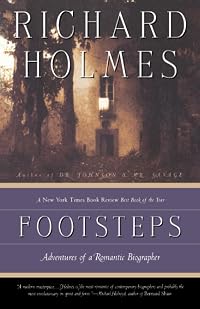
Footsteps: adventures of a romantic biographer
by Richard Holmes
On This Page
Description
Richard Holmes's great work of biographical exploration, rejacketed and republished alongside its sister volume 'Sidetracks'. In 1985, Richard Holmes published a small book of essays called 'Footsteps' and the writing of biography was changed forever. A daring mix of travel, biographical sleuthing and personal memoir, it broke all the conventions of the genre and remains ons of the most intoxicating, magical works of modern literary exploration ever published. Sleeping rough, he retraces show more Robert Louis Stevenson's famous journey through the Cevennes. Caught up in the Parisian riots of the 1960s, he dives back in time to the terrors of Wordsworth and of Mary Wollstonecraft marooned in Revolutionary Paris and then into the strange tortured worlds of G#65533;rard de Nerval. Wandering through Italy, he stalks Shelley and his band of Romantic idealists to Casa Magni on the Gulf of Spezia. show lessTags
Recommendations














Member Recommendations

Member Reviews
This is a kind of "behind-the-scenes" of literary biography, four extended essays in which Richard Holmes describes the process of getting to know the subject of a biography and the way that process is influenced by the subjective circumstances in which it takes place — the external events of the times and the particular situation of the biographer's life. He follows Robert Louis Stevenson and Modestine through the Cevennes, Mary Wollstonecraft and her fellow English radical exiles through the revolutionary Paris of May 1968, and Shelley and his elective family through the Italy of the hippie generation, and pursues Gérard de Nerval through a cloud of seventies esoterica and tries to locate him in the new thinking on mental illness show more due to R D Laing and Michel Foucault. And, repeatedly, shows us that contrary to what the plots of dozens of historical novels pretend, human lives are not detective stories where clues fall into place to create a single, definitive solution. Even if you're called Holmes and the book is set in Baskerville.
There are plenty of modest little jokes of this kind against himself: we see him hiding behind a silly hat on the Stevenson trail, falling into a river or dropping through a Paris skylight whilst reflecting on the starry night, and constantly being put back on the right track by farmers, monks and little old ladies. But in between times he manages to sneak in brief but very convincing biographical sketches of his four main subjects and a considerable number of bystanders, and he gives us some superbly beautiful descriptive travel writing. A very lovely, human book, a real joy to read. show less
There are plenty of modest little jokes of this kind against himself: we see him hiding behind a silly hat on the Stevenson trail, falling into a river or dropping through a Paris skylight whilst reflecting on the starry night, and constantly being put back on the right track by farmers, monks and little old ladies. But in between times he manages to sneak in brief but very convincing biographical sketches of his four main subjects and a considerable number of bystanders, and he gives us some superbly beautiful descriptive travel writing. A very lovely, human book, a real joy to read. show less
I read the first quarter of this four-part book during my MA degree. I attempted to continue with the second instalment but soon gave up.
The author’s style fails to engage me. That said, the opening 20-30 pages are enjoyable, especially the story about a trio of man-eating wolves.
My interest dissolved when the author’s account of his travels in France shift from interesting comparisons to Robert Louis Stevenson undertaking the same journey to stuffy essay-like biography.
My biggest criticism is the amount of untranslated French. The use of foreign words in English texts is my ultimate pet hate in English literature. How am I, the reader, supposed to respond when the language confronting me is indecipherable?
This is plain author show more arrogance. It’s like saying, “Look at me, I know a second tongue. If you don’t understand, then you’re not as clever as me.”
This leaves the reader two choices: skip the foreign passages or break off from the book to find out the translations – which in this volume’s case would be many times.
One thing an author should never do is lose contact with the reader. It’s good to be challenged, but never to be left in the dark, especially if the untranslated phrases are of significance to the narrative. show less
The author’s style fails to engage me. That said, the opening 20-30 pages are enjoyable, especially the story about a trio of man-eating wolves.
My interest dissolved when the author’s account of his travels in France shift from interesting comparisons to Robert Louis Stevenson undertaking the same journey to stuffy essay-like biography.
My biggest criticism is the amount of untranslated French. The use of foreign words in English texts is my ultimate pet hate in English literature. How am I, the reader, supposed to respond when the language confronting me is indecipherable?
This is plain author show more arrogance. It’s like saying, “Look at me, I know a second tongue. If you don’t understand, then you’re not as clever as me.”
This leaves the reader two choices: skip the foreign passages or break off from the book to find out the translations – which in this volume’s case would be many times.
One thing an author should never do is lose contact with the reader. It’s good to be challenged, but never to be left in the dark, especially if the untranslated phrases are of significance to the narrative. show less
When I loved this book, I absolutely adored it. The sections on Robert Louis Stevenson and Mary Wollstonecraft are tremendous. Unfortunately, I found the Shelley section far less interesting, and the section on Nerval went on a bit long, although it was mostly engaging and rewarding. By writing about biography and art and career and creativity, Holmes is essentially talking about life. Apart from in the Shelley section, I found I could relate to the author or his subject.
Holmes writes beautifully, with very clear prose that invites the reader to empathise.
Holmes writes beautifully, with very clear prose that invites the reader to empathise.
Excellent, like all his books. Both intimate, about him and his subjects, and sweeping, about the whole romantic phenomenon. Introduced me to a new character (the pioneering photographer Nadar) and filled out a familiar one ( Nerval, of whom i only new El Desdichado). Nerval turns out to be an acute observer of himself and others, an accomplished travel writer and a fine stylist, at least in Holmes' translations.
Travel writing, biography and autobiography, personal memoir - this is a good read. I love the way he writes of a biographer's links with his subject - the past retaining a physical presence - and particularly this, "Gautier wrote in a story that the most powerful images of past life in the whole of Pompeii were the brown, circular prints left by drinkers' glasses on the marble slabs of the second-century taverna." (page 67).
Literary biographer Richard Holmes provides an inside look at the biographer's craft in Footsteps: Adventures of a Romantic Biographer (1985). Combining sketch-biographies of Robert Louis Stevenson, Mary Wollstonecraft, the Shelleys, and Gerard Nerval with autobiographical accounts of his travels (some physical, some mental) in pursuit of those subjects, Holmes has written an engaging and perceptive account of the process by which he went about his research and work.
Holmes follows RLS and his donkey (Modestine) through the small towns of rural France, experiences Paris during the riots of 1968 to try and relate to Mary Wollstonecraft's residency there during the post-Revolutionary Terror, and tracks the Shelleys and their various show more comrades during their peregrinations around Italy. I think in some senses it's difficult for anyone not so fully immersed in these lives to understand some of the revelations Holmes experienced, but that is certainly no reason for him not to share them or for us not to read them.
http://philobiblos.blogspot.com/2007/10/book-review-footsteps.html show less
Holmes follows RLS and his donkey (Modestine) through the small towns of rural France, experiences Paris during the riots of 1968 to try and relate to Mary Wollstonecraft's residency there during the post-Revolutionary Terror, and tracks the Shelleys and their various show more comrades during their peregrinations around Italy. I think in some senses it's difficult for anyone not so fully immersed in these lives to understand some of the revelations Holmes experienced, but that is certainly no reason for him not to share them or for us not to read them.
http://philobiblos.blogspot.com/2007/10/book-review-footsteps.html show less
This is very quickly becoming one of my favorite books of all danged time.
Members
- Recently Added By
Lists

Mustich's 1000 Books to Read Before You Die: A Life Changing List
1,001 works; 20 members

Take Four Books
130 works; 1 member
Author Information

22+ Works 5,882 Members
Richard Holmes is the author of Footsteps: Adventures of a Romantic Biographer; Dr. Johnson & Mr. Savage; Shelley: The Pursuit; Coleridge: Early Visions, 1772-1804; and Coleridge: Darker Reflections, 1804-1834, which was a 1999 New York Times Book Review Editor's Choice and a National Book Critics Circle Awards finalist. He lives in England. show more (Bowker Author Biography) show less
Awards and Honors
Series
Belongs to Publisher Series
Common Knowledge
- Canonical title
- Footsteps: adventures of a romantic biographer
- Original publication date
- 1985
- People/Characters
- Mary Wollstonecraft; Robert Louis Stevenson; Percy Bysshe Shelley; Mary Wollstonecraft Shelley; Gerard de Nerval; Fanny Stevenson (nee Osbourne)
- Important places
- Cévennes, France
- First words
- All that night I heard footsteps.
Classifications
- Genres
- Biography & Memoir, Travel, Literature Studies and Criticism, Nonfiction
- DDC/MDS
- 820.9008 — Literature & rhetoric English & Old English literatures English and Old English (Anglo-Saxon) literatures History, description, critical appraisal of works in more than one form
- LCC
- PR110 .F7 .H64 — Language and Literature English English Literature
- BISAC
Statistics
- Members
- 452
- Popularity
- 67,472
- Reviews
- 7
- Rating
- (3.99)
- Languages
- Dutch, English, French, Spanish
- Media
- Paper, Ebook
- ISBNs
- 17
- ASINs
- 4