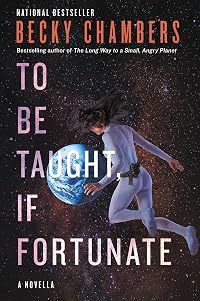
To Be Taught, If Fortunate: A Novella
by Becky Chambers
On This Page
Description
At the turn of the twenty-second century, scientists make a breakthrough in human spaceflight. Through a revolutionary method known as somaforming, astronauts can survive in hostile environments off Earth using synthetic biological supplementations. They can produce antifreeze in subzero temperatures, absorb radiation and convert it for food, and conveniently adjust to the pull of different gravitational forces. With the fragility of the body no longer a limiting factor, human beings are at show more last able to journey to neighboring exoplanets long known to harbor life. A team of these explorers, Ariadne O'Neill and her three crewmates, are hard at work in a planetary system fifteen light-years from Sol, on a mission to ecologically survey four habitable worlds. But as Ariadne shifts through both form and time, the culture back on Earth has also been transformed. Faced with the possibility of returning to a planet that has forgotten those who have left, Ariadne begins to chronicle the story of the wonders and dangers of her mission, in the hope that someone back home might still be listening. show lessTags
Recommendations

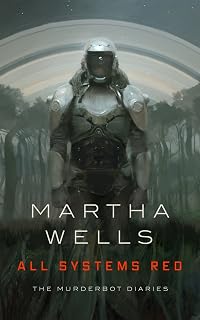
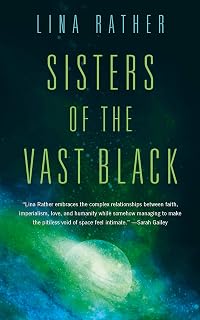
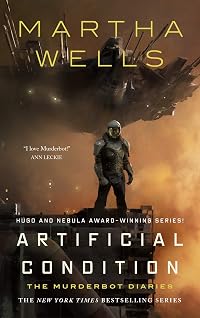
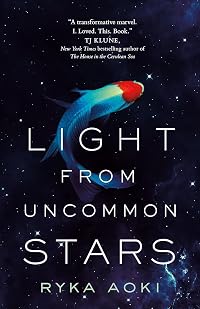












Member Recommendations
by rocks009
Member Reviews
I have been meaning to read this novella for ages as I really enjoy Becky Chambers writing. I enjoyed this as well - it's a consideration of how vast space could be covered and what that would mean. And the ethics of going to other planets - this is the ultimate version of Star Trek - do not mess with other cultures because we have no right to do so and it should be of everything on another planet, from a microbe upwards.
Also I thought the end was as it should be based on that - the astronauts were representative of humanity - the mission & ethics were not to be abandoned simply because of a possible disaster. A novella to make you think.
Also I thought the end was as it should be based on that - the astronauts were representative of humanity - the mission & ethics were not to be abandoned simply because of a possible disaster. A novella to make you think.
We exist where we begin, yet to remain there is death.'
First of all, I loved how the author tackles the issue of space exploration. Hers isn't about relying on machines and technology per se, but adapting the human body to space and the various environments offered by the exoplanets her crew is here exploring. As someone being personally fascinated by the organic, genetics, genetic engineering, transhumanism and the ethical issues coming with it (e.g. eugenics etc.) over tech and machinery, I found her reliance on what she calls 'somaforming' (inspired by the promises of synthetic biology) deeply thought provoking. Imagine, for instance, your blood being able to produce antifreeze -even if temporarily only- so as to adapt to extreme show more temperatures!
Then, I was struck by her ethical concerns embracing, also, ecology. It's made very clear indeed that this is a voyage of discovery to learn, not to colonise. These, here, are therefore more than about human safety (e.g. the risks posed to health by alien bacteria and viruses). At a time when environmental issues are a serious threat on Earth, such referring to the danger potentially lying behind carelessly disturbing otherwise well established ecosystems was a nice add on, leaving, here too, food for thought as to what we have been doing to our own environment.
Saying more would be taking the risk to spoil it. Suffice to say that, this short novella is far more than about exploring space (with all the practical problems that come with it!) and foreign planets to understand alien life (and, by the way, if you love biology/astrobiology then you will be truly engrossed by how she engages with alien taxonomy!). As the ending will reveal, this is, first and foremost, a reflection about knowledge, what we value as being knowledge, and the human drive that feeds such want and/or need to know... If at all! The ending, then, might seem abrupt (I see some readers having been disappointed by it), yet the question it throws at us, in an era when space exploration clearly is no priority, has never been so relevant.
This is a truly engrossing read, with many very clever layers to it. show less
First of all, I loved how the author tackles the issue of space exploration. Hers isn't about relying on machines and technology per se, but adapting the human body to space and the various environments offered by the exoplanets her crew is here exploring. As someone being personally fascinated by the organic, genetics, genetic engineering, transhumanism and the ethical issues coming with it (e.g. eugenics etc.) over tech and machinery, I found her reliance on what she calls 'somaforming' (inspired by the promises of synthetic biology) deeply thought provoking. Imagine, for instance, your blood being able to produce antifreeze -even if temporarily only- so as to adapt to extreme show more temperatures!
Then, I was struck by her ethical concerns embracing, also, ecology. It's made very clear indeed that this is a voyage of discovery to learn, not to colonise. These, here, are therefore more than about human safety (e.g. the risks posed to health by alien bacteria and viruses). At a time when environmental issues are a serious threat on Earth, such referring to the danger potentially lying behind carelessly disturbing otherwise well established ecosystems was a nice add on, leaving, here too, food for thought as to what we have been doing to our own environment.
Saying more would be taking the risk to spoil it. Suffice to say that, this short novella is far more than about exploring space (with all the practical problems that come with it!) and foreign planets to understand alien life (and, by the way, if you love biology/astrobiology then you will be truly engrossed by how she engages with alien taxonomy!). As the ending will reveal, this is, first and foremost, a reflection about knowledge, what we value as being knowledge, and the human drive that feeds such want and/or need to know... If at all! The ending, then, might seem abrupt (I see some readers having been disappointed by it), yet the question it throws at us, in an era when space exploration clearly is no priority, has never been so relevant.
This is a truly engrossing read, with many very clever layers to it. show less
The theme of this book is right there in the title, which in turn comes from Kurt Waldheim’s (then Secretary General of the United Nations) contribution to the playable record fixed to the two Voyager space probes launched back in the 1970s: “We step out of our solar system into the universe seeking only peace and friendship—to teach, if we are called upon; to be taught, if we are fortunate. We know full well that our planet and all its inhabitants are but a small part of this immense universe that surrounds us, and it is with humility and hope that we take this step.”
Ariadne O’Neill is flight engineer aboard the Merian, en route from Earth to the red dwarf star Zhenyi fifteen lightyears away. Their mission, to study show more its four habitable planets, is just part of a whole new phase of space exploration—funded though this time, not by governments or private companies, but the general public; it is apolitical, international and strictly non-profit, pure science and exploration for exploration’s sake. In order to explore these alien moons and planets the crew engage in “somaforming”, physically altering their own bodies to match the alien environments they encounter. But they’re transformed by their experiences in less tangible ways too.
This is beautifully written—the prose has a wonderfully natural feel and flow to it: “…I was happy. Content like I could never remember being. I was surrounded by people I loved, safe in a place free of noise and performance and the empty trappings of civilisation. Here, nobody cared about status or money, who was in power, who was kissing or killing whom. There was only water, and the wonders living within it. The right things mattered on Aecor. I’m a secular woman, but that moon felt to me like a sacred place. A monastic world that repaid hard work and dogged patience with the finest of rewards: Quiet. Beauty. Understanding.”
Do we sit here forever on this one tiny Earth, or venture out into the wider world? This book is about curiosity versus the lack of it, about finally growing up as a species. The message coming in from space here is that what we’ll discover out there in the cosmos is ourselves. But are any of us listening? show less
Ariadne O’Neill is flight engineer aboard the Merian, en route from Earth to the red dwarf star Zhenyi fifteen lightyears away. Their mission, to study show more its four habitable planets, is just part of a whole new phase of space exploration—funded though this time, not by governments or private companies, but the general public; it is apolitical, international and strictly non-profit, pure science and exploration for exploration’s sake. In order to explore these alien moons and planets the crew engage in “somaforming”, physically altering their own bodies to match the alien environments they encounter. But they’re transformed by their experiences in less tangible ways too.
This is beautifully written—the prose has a wonderfully natural feel and flow to it: “…I was happy. Content like I could never remember being. I was surrounded by people I loved, safe in a place free of noise and performance and the empty trappings of civilisation. Here, nobody cared about status or money, who was in power, who was kissing or killing whom. There was only water, and the wonders living within it. The right things mattered on Aecor. I’m a secular woman, but that moon felt to me like a sacred place. A monastic world that repaid hard work and dogged patience with the finest of rewards: Quiet. Beauty. Understanding.”
Do we sit here forever on this one tiny Earth, or venture out into the wider world? This book is about curiosity versus the lack of it, about finally growing up as a species. The message coming in from space here is that what we’ll discover out there in the cosmos is ourselves. But are any of us listening? show less
Reading Becky Chambers is like being warmly embraced by a supportive friend. This book is comforting in its depiction of astronauts studying other planets, and gentle in its plot reveal. There is plenty of tension and high stakes, but she accomplishes it all while not painting any villains, similar to The Galaxy, and the Ground Within. There's less moralizing than in the Monk and Robot duology, which I appreciate. Instead, there's more emphasis on what really motivates scientists and engineers and explorers. It's inspiring - particularly the concept of somaforming! - and hopeful, showing an optimistic vision of humanity that feels close enough to be real.
Well this is a little gem of a book -- not the usual interstellar hijinks I've come to associate with Chambers, but a thoughtful and detailed imagining of exoplanet exploration, based on now and near-now tech. The idea of body adaptation in order to solve gravity challenges (not her idea, but a genius one which she talks about more in the back matter) is mind blowing. The ethics of the current generation of scientists is a beautiful thing (and a heartbreaking one). The quiet imaginings of what life in the universe might be is a constant and riveting wonder. Not a loud book, not a high action book, but deeply satisfying.
Advanced readers copy provided by Edelweiss.
Advanced readers copy provided by Edelweiss.
Man I love me some Becky Chambers. Her optimistic sci-fi always really gets me. There's something so refreshing about science fiction featuring regular, good people doing their best. They care about science and knowledge, and they care about each other, and they still make mistakes, but they try to learn from them and support each other and mission while doing so. Her books remind me why I love Star Trek so much.
I also love the idea of adapting our bodies to space instead of adapting our technologies. Very cool concept, if not really that fleshed out here.
This was a really short and easy and lovely read.
I also love the idea of adapting our bodies to space instead of adapting our technologies. Very cool concept, if not really that fleshed out here.
This was a really short and easy and lovely read.
“Our mission is to catalogue, not to colonise.”
Beautiful and often startling musings on ethics, philosophy, and psychology, as a crew of four search for life on four worlds, light-years from home, over many decades. You feel the awe, the dislocation and discombobulation, the excitement, the struggle to describe the utterly unfamiliar, the camaraderie, and, sometimes, the fear.
It's built on a simple plot that nevertheless has dramatic moments. It could be horribly self-righteous or boring, but I found it profound, provocative, and moving. There’s enough science for sci-fi buffs, but it is primarily about ideas and relationships, and should be appreciated beyond the realm of genre.
Leave no trace?
As 2021 passes into history and 2022 show more begins, it’s natural to think of new year resolutions: what mark we want to leave on the world in our personal and professional lives, perhaps on GoodReads too? But there is another way.
Image: "Leave nothing but footprints. Take nothing but pictures. Kill nothing but time." Variously attributed to John Muir, Aliyyah Eniath, and others. (Source)
“I have no interest in changing other worlds to suit me. I choose the lighter touch: changing myself to suit them.”
The crew use enzyme patches (somaforming) to temporarily change their bodies to suit each planet: glittery skin when there’s almost no light, and extra muscle bulk where gravity is high, for example.
Like all the best sci-fi, the underlying message is also a metaphor to our circumstances. It’s one we can all strive to apply in daily life here on Earth.
“We have found nothing you can sell. We have found nothing you can put to practical use. We have found no worlds that could be easily or ethically settled, were that desired. We have satisfied nothing but curiosity, gained nothing but knowledge.”
Truly, the noblest goals.
Field trip diary
Ariadne, born on Earth in 2081, recounts the four, very different, worlds she and her crewmates, Chikondi, Elena, and Jack, visit. Four years of study are planned on each, with years in “torpor” while travelling, and waking from it differs from waking from sleep in practical and psychological ways. It requires mental adjustment as much as physical, so “the kindest object placement” of the cabin mirror is crucial: out of sight on waking, but visible as soon as the astronaut chooses to float forward.
The relationships between the crew are subtly drawn: they know each other so well, much is unsaid, but understood.
Chambers is also good at gently educating the reader where necessary. For example, the wings of a bat, a bird, and a bee serve the same purpose, but they’re structurally very different because they evolved separately.
Image: Bat, bird, and insect wings, compared (Source)
On Earth, spines evolved only once, but on Mirabilis, there are at least three different types, so Earth-based taxonomy can’t be used.
“The artist’s palette was robbed of green and blue, and every assumption of vertebrate evolution had been thrown out the window.”
Instead, the crew categorise by analogy, “mammal approximate”, for example. Just because something looks like a duck, walks like a duck, and quacks like a duck doesn’t necessarily mean it is a duck.
Quotes
• “A forest is an interdependent community. Resources are shared, and life in isolation is a death sentence.”
• “When the world you know is out of reach, nothing is more welcome than a measurable reminder that it still exists.”
• “I was surrounded by people I loved, safe in a place free of noise and performance and the empty trappings of civilization.”
• “A home can only exist in a moment. Something both found and made. Always temporary.”
• “A face like the ghost of a greyhound, breathtaking in its oddness and shocking in its beauty.”
See also
This was my first Becky Chambers. I loved her lyricism, profundity, and poetic descriptions which reminded me of Ray Bradbury, especially some of The Martian Chronicles (see my review HERE) and also Fahrenheit 451 (see my review HERE).
Image: The cover and inside of the Voyager Golden Record (Source)
The book’s title comes from the Voyager Golden Record, launched in 1977, and quoted at the end of the book:
“I send greetings on behalf of the people of our planet. We step out of our solar system into the universe seeking only peace and friendship, to teach if we are called upon, to be taught if we are fortunate. We know full well that our planet and all its inhabitants are but a small part of the immense universe that surrounds us and it is with humility and hope that we take this step.” show less
Beautiful and often startling musings on ethics, philosophy, and psychology, as a crew of four search for life on four worlds, light-years from home, over many decades. You feel the awe, the dislocation and discombobulation, the excitement, the struggle to describe the utterly unfamiliar, the camaraderie, and, sometimes, the fear.
It's built on a simple plot that nevertheless has dramatic moments. It could be horribly self-righteous or boring, but I found it profound, provocative, and moving. There’s enough science for sci-fi buffs, but it is primarily about ideas and relationships, and should be appreciated beyond the realm of genre.
Leave no trace?
As 2021 passes into history and 2022 show more begins, it’s natural to think of new year resolutions: what mark we want to leave on the world in our personal and professional lives, perhaps on GoodReads too? But there is another way.
Image: "Leave nothing but footprints. Take nothing but pictures. Kill nothing but time." Variously attributed to John Muir, Aliyyah Eniath, and others. (Source)
“I have no interest in changing other worlds to suit me. I choose the lighter touch: changing myself to suit them.”
The crew use enzyme patches (somaforming) to temporarily change their bodies to suit each planet: glittery skin when there’s almost no light, and extra muscle bulk where gravity is high, for example.
Like all the best sci-fi, the underlying message is also a metaphor to our circumstances. It’s one we can all strive to apply in daily life here on Earth.
“We have found nothing you can sell. We have found nothing you can put to practical use. We have found no worlds that could be easily or ethically settled, were that desired. We have satisfied nothing but curiosity, gained nothing but knowledge.”
Truly, the noblest goals.
Field trip diary
Ariadne, born on Earth in 2081, recounts the four, very different, worlds she and her crewmates, Chikondi, Elena, and Jack, visit. Four years of study are planned on each, with years in “torpor” while travelling, and waking from it differs from waking from sleep in practical and psychological ways. It requires mental adjustment as much as physical, so “the kindest object placement” of the cabin mirror is crucial: out of sight on waking, but visible as soon as the astronaut chooses to float forward.
The relationships between the crew are subtly drawn: they know each other so well, much is unsaid, but understood.
Chambers is also good at gently educating the reader where necessary. For example, the wings of a bat, a bird, and a bee serve the same purpose, but they’re structurally very different because they evolved separately.
Image: Bat, bird, and insect wings, compared (Source)
On Earth, spines evolved only once, but on Mirabilis, there are at least three different types, so Earth-based taxonomy can’t be used.
“The artist’s palette was robbed of green and blue, and every assumption of vertebrate evolution had been thrown out the window.”
Instead, the crew categorise by analogy, “mammal approximate”, for example. Just because something looks like a duck, walks like a duck, and quacks like a duck doesn’t necessarily mean it is a duck.
Quotes
• “A forest is an interdependent community. Resources are shared, and life in isolation is a death sentence.”
• “When the world you know is out of reach, nothing is more welcome than a measurable reminder that it still exists.”
• “I was surrounded by people I loved, safe in a place free of noise and performance and the empty trappings of civilization.”
• “A home can only exist in a moment. Something both found and made. Always temporary.”
• “A face like the ghost of a greyhound, breathtaking in its oddness and shocking in its beauty.”
See also
This was my first Becky Chambers. I loved her lyricism, profundity, and poetic descriptions which reminded me of Ray Bradbury, especially some of The Martian Chronicles (see my review HERE) and also Fahrenheit 451 (see my review HERE).
Image: The cover and inside of the Voyager Golden Record (Source)
The book’s title comes from the Voyager Golden Record, launched in 1977, and quoted at the end of the book:
“I send greetings on behalf of the people of our planet. We step out of our solar system into the universe seeking only peace and friendship, to teach if we are called upon, to be taught if we are fortunate. We know full well that our planet and all its inhabitants are but a small part of the immense universe that surrounds us and it is with humility and hope that we take this step.” show less
Members
- Recently Added By
Published Reviews
ThingScore 100
There’s a quiet beauty to Chambers’ writing that envelops you in her story and holds you tight until the very end. Proof that a novel doesn’t have to have hundreds of pages to be impressive.
added by g33kgrrl
With technical prowess and outstanding visceral imagery, Chambers (the Wayfarer Series) packs an immense amount of story into a novella worthy of full-length praise.
added by g33kgrrl
Lists

Favorite Science Fiction by Women Authors
737 works; 196 members

Best Science Fiction Novels
816 works; 430 members

2020 Hugo Eligible Novellas
36 works; 7 members

Top Five Books of 2020
982 works; 350 members

Top Five Books of 2019
387 works; 111 members
LGBTQ+ Speculative Fiction
821 works; 51 members

Short and Sweet
246 works; 24 members

Schisms in transhumanity - SF
34 works; 1 member

Books Read in 2019
4,052 works; 108 members

ALA The Reading List
490 works; 28 members

Books Read in 2020
4,379 works; 124 members

SFF standalone novellas with female protagonists
101 works; 4 members

LGBTQ+ SFF standalone novellas
42 works; 2 members

Books Read in 2025
4,091 works; 97 members

Books We Discovered On LibraryThing
530 works; 130 members
Favorite Science Fiction
456 works; 218 members
Author Information

19+ Works 25,217 Members
Some Editions
Awards and Honors
Awards
Distinctions
Series
Belongs to Publisher Series
Work Relationships
Common Knowledge
- Canonical title
- To Be Taught, If Fortunate: A Novella
- Original publication date
- 2019-09-03
- People/Characters
- Ariadne O'Neill; Elena Quesada-Cruz; Jack Vo; Chikondi Daka; Amado Guinto; Sophie Thomas (show all 8); Lei Jian; Nikki Chambers
- Important places
- Aecor; Mirabilis; Opera; Votum; Cascadia, Earth; Vancouver, Cascadia, Earth
- Dedication
- To Emily, who doesn't have to read this, but did make me think the right thing.
- First words
- Please Read This
If you read nothing else we've sent home, please at least read this. - Quotations
- I know how much a world can change within the bookends of a lifetime.
The awesome, fragile humility of knowing you're the only human around for miles. (p. 30)
I didn't see a waste ... [in] that vast, echoing flatland, I saw exactly what my soul had longed for. A quiet place. A blank slate. A reality in which everything held still for however long I needed it to. It was not exciting... (show all), but neither was it frightening. It was not compelling, but neither was it overwhelming. It was, pure and simple. (p. 116)
As the Secretary General of the United Nations, an organisation of one hundred and forty seven member states who represent almost all of the human inhabitants of the planet Earth, I send greeting on behalf of the people of ou... (show all)r planet. We step out of our solar system into the universe seeking only peace and friendship - to teach, if we are called upon; "to be taught, if" we are "fortunate." We know full well that our planet and all its inhabitants are but a small part of this immense universe that surrounds us, and it is with humility and hope that we take this step.
- Former UN Secretary General Kurt Waldheim, 1977, as recorded on the Voyager Golden Record - Last words
- (Click to show. Warning: May contain spoilers.)We leave that question to you.
- Publisher's editor
- Bradbury, Sam
- Original language
- English
- Canonical DDC/MDS
- 813.6
- Canonical LCC
- PS3603.H347
Classifications
Statistics
- Members
- 2,295
- Popularity
- 8,667
- Reviews
- 154
- Rating
- (4.09)
- Languages
- 5 — Catalan, English, French, German, Spanish
- Media
- Paper, Audiobook, Ebook
- ISBNs
- 18
- ASINs
- 9